A Powerful Past, A Shared Future
Welcome to this digital exploration of "The United States and Mexico: A Powerful Past, A Shared Future" exhibit, on display at the US Ambassador's residence in Mexico City. Discover the deep connections between the United States and Mexico through an array of exceptional artworks. Enjoy exclusive insights from Ambassador Ken Salazar and interact with the gifted artists who crafted these masterpieces. This online experience sheds light on the hopes, dreams, and rich cultural diversity that unite the United States and Mexico. Join us as we dive into the past, evaluate the present, and envision the shared future of our nations.
Stop 1. Introduction
This exhibit brought together a diverse cohort of artists whose works shed light on the complex history of the United States and Mexico. In this space, you'll be able to hear directly from some of the artists whose works are featured in this virtual gallery.
Ken Salazar
[Ambassador Salazar speaking Spanish]I am Ambassador Ken Salazar, the ambassador of the United States to Mexico. I welcome you to your home, a house filled with art, where one can see the history of the United States and Mexico. The birth of the people and of the two nations. The issues that now unite us: the economy, migration, the power to include everyone, the celebration and support of women from the United States and Mexico, because the future lies in this. One can see the work also in the art of the farmers, those who work every day so that we all can eat. But working sometimes under a blazing sun, in difficult places. We also see in the art the dreamers, who dream big dreams; showing us all that if one dreams it, it can be done. To the young people, to all of us, we have no limitations except from ourselves, so we have to dream big. And it is evident through Mexican art, Mexican-American art, the art of the United States in this house, the relationship between our two peoples, which is a relationship for eternity. So there are many forces trying to divide us, but we are working at this embassy to ensure that in these times, and with the leadership of President Biden, and with your servant, we will bring closer and closer the people of the United States and Mexico. Two great nations deserve this, with a culture that is celebrated all over the world, with the greatness of its people, with the greatness of its diversity. So, to all of you, come, come to the house, let's see this art, and then you help us take this story throughout the United States and also through all of Mexico. I am deeply grateful, from my heart.
Angel Cabrales
My name is Angel Cabrales I am from El Paso Texas I grew up along the Borderlands here, and I am a multimedia artist.
Carlos Jackson
My name is Carlos Jackson; I am a professor and currently serve as dean of the Penny W. Stamps School of Art Design here at the University of Michigan. Prior to starting in this role at the University of Michigan, I was on the faculty at the University of California at Davis in the Department of Chicana, Chicano, Chicanx studies I was there for 17 years. While there, I most meaningfully established a community-based Arts Center that's located 10 miles north of UC Davis in a town called Woodland. The community-based Arts Center is a program of the Chicana Chicano Chicanx studies apartment called Taller Arte del Nuevo Amanecer (TANA). Co-founded that with a professor emerita named Malaquías Montoya. I'm a screen printer trained in community-based practices of uh social-political printmaking, some of the forms that emerged out of the Chicano movement, particularly the print poster and the mural. I also paint to draw and I also write I've written a number of Articles and essays for exhibitions and exhibition catalogs, a few books, and just general on general topics of Chicano art, political practice, um & community-based printmaking. Within educational spaces, I've also curated several shows both at that community-based Arts Center I helped establish called TANA and at other galleries and museums.
Santa Barraza
Okay, my name is uh Santa Barraza, and I was born and raised in Kingsville, Texas and I consider myself a contemporary Chicana Tejana visual artist, and I'm the recent founder of Barraza Fine Art LLC, which is where we are right now.
Tony Ortega
Yes, I'm Tony Ortega, I'm a Chicano artist and professor at Regis University in Denver Colorado where I teach painting and design. I work in a variety of media which include acrylic, pastel, and printmaking.
Arely Morales
My name is Arely Morales, and I'm a visual artist working with large-scale portraits. I am very passionate about exploring issues related to identity, humanity and the vulnerability of the Latino immigrant community in the United States. I am from Jalisco, Mexico and I'm currently based in Texas.
Stop 2. History
This room is dedicated to exploring history. Serving as a bridge between past and present, history sets the stage for a shared future. It unveils collective journeys, provides lessons from past challenges, and celebrates shared victories. The artworks showcased here emphasize the profound role history plays in molding the dynamic relationship between the United States and Mexico. Ranging from intricate precolonial Mexican stone carvings to the bold works of contemporary Chicano artists, these pieces underscore the ongoing evolution of this bilateral bond.
Ken Salazar
We are two nations, with an intertwined history, that goes beyond 200 years of diplomatic relations and centuries upon centuries of history. In this section, you will find works from some of the most renowned Mexican muralists, who had influence in Mexico but also in the United States. Here we also recognize the greatness of the indigenous communities and their contributions, not only in our history, but in our day to day.
Angel Cabrales
History in itself, I think, is vitally important to learn from um, but it's also really important to learn the histories that are untaught. A lot of alot of the histories that we learn um are a little slanted from one side to the other, and I think it's really important that we learn our history not just from what we're taught in school on the American side but also on the Mexican side so we can see different perspectives and really in that way learn from each other and expand and grow together. History, it doesn't change because it's already passed, but the beautiful thing about learning from history is that we ourselves can learn from it and grow from it and well, not make those mistakes again.
Stop 3. Family and Dignity
A diverse collection of artworks, ranging from a mythical alebrije sculpture to tapestries, paintings, silkscreens, and photographs, powerfully underscores the significance of family and the shared journey toward human dignity in Mexico and the United States. These pieces aren't just aesthetically pleasing; they carry the weight of cultural traditions and techniques that have been passed down through generations, offering a snapshot of daily life for Mexican-American families in the United States. This gallery is a testament to the enduring influence of Latina and Latino artists in the U.S. art scene. Each work is a symbolic reminder of their courage, resilience, and ongoing determination to thrive.
Ken Salazar
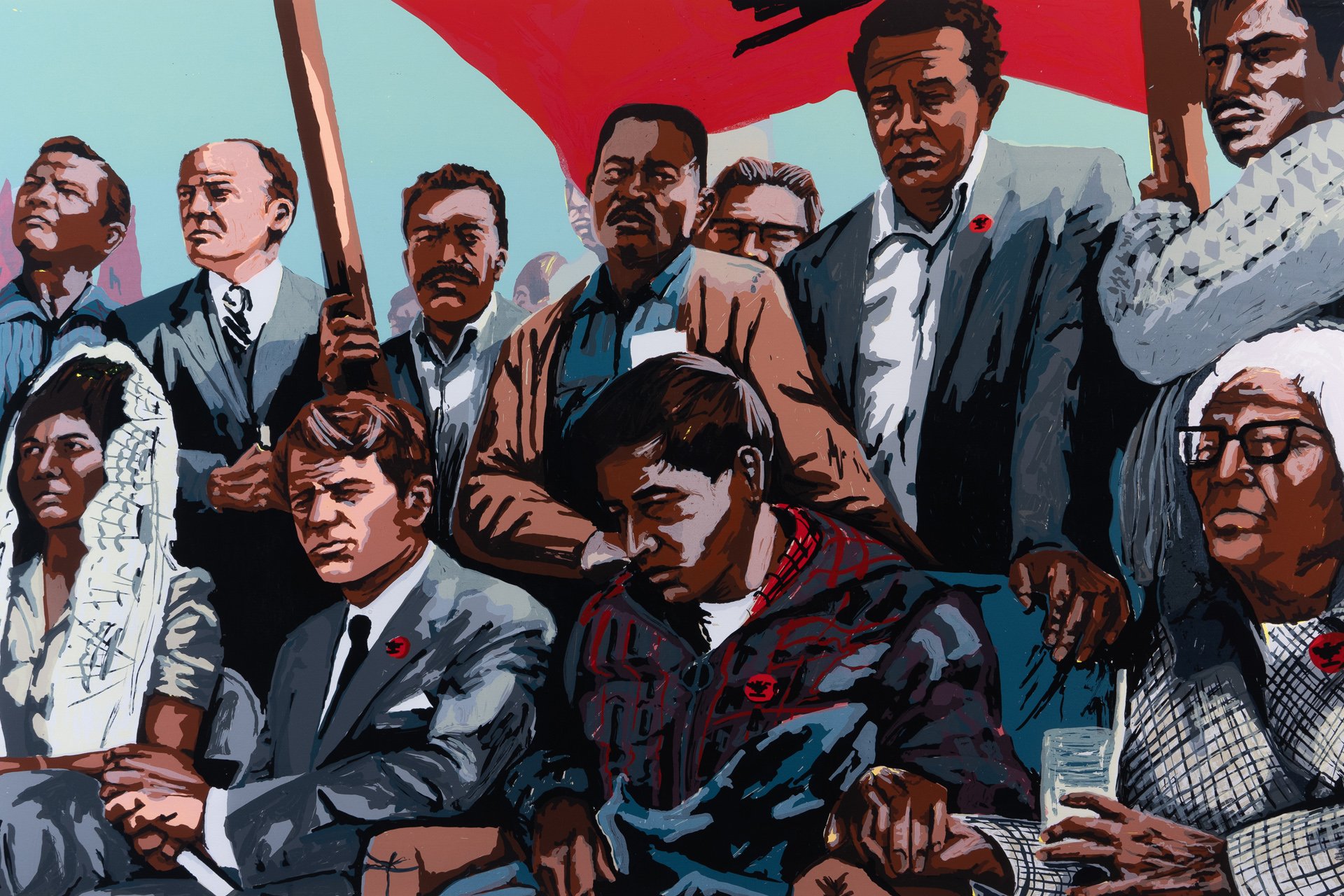
Family ties make us stronger and are our drive to dream big. In this part of the exhibition, you can see one of my favorite pieces, a painting of social leader César Chávez with Senator Bobby Kennedy. This painting is about the strike after many days, a hunger strike. For the field workers, he met there with Bobby Kennedy in 1968. It's a testament to the solidarity of our two nations and how much we can achieve when we work together. This image is very personal because my own family and I worked with César Chávez's movement, with him and his family to promote the rights of farm workers. Family interactions can be seen in various contexts that show us how important it is for our two nations.
Carlos Jackson
So my father was one of eight brothers and sisters. He was born in Laredo and my family lived for generations in Laredo or in Nuevo Laredo, so they were border people, and the family lived on both sides and passed back and forth all the time. And my father was from a family of migrant farm workers, laborers, and craftspeople And they would work the fields up north in the summers. So they would travel to Minnesota and Wisconsin, Illinois, and Michigan back and forth to work the seasonal crops up North. So much of my story has to do with honoring all those different legacies and how much sacrifice the generation before offered and worked through in order to make my life possible. And those sacrifices and those struggles were significant. Without it I wouldn't be here today and so part of me works to understand those histories and to honor them, not take them for granted, and to ensure that I'm keeping the memory alive of those efforts. Which history hasn't fully told.
Stop 4. Power of Women
The artwork in this room is a tribute to women's tenacity, underscoring their role in energizing economies and fortifying democracies. This collection presents a vivid tapestry of female bravery, achievement, and resilience. In the work “Codex de la Trinidad”, the artist, Santa Barraza shows how Mexican traditions and beliefs can sustain cultural identities in the United States. Transcending borders, these works celebrate powerful women figures in Mexico and the United States and seek to inspire the next generation of women creators in both nations.
Ken Salazar
Our two nations could not be understood without the strength, leadership, and power of women. Without a doubt, the future belongs to women, and we want to acknowledge and celebrate each one of them, and because of them, we are where we are. And we have so much hope for the future and for humanity. In both countries, we continue working to have more inclusive societies and with an even playing field for everyone. So, in this section, we recognize all the contributions of women in our societies. We do it in this house every day. We acknowledge their contributions to the prosperity, development, and growth of our two countries and all of North America. They transform our communities daily and improve our communities. They are the foundation of our society, our history, and our future.
Santa Barraza
You know in the 1970s, feminism emerged and as a result of that we were engaged with feminism but then the Chicanas got together and they formed their own organizations and so I, along with Nora Gonzalez Dawson, founded MAS (Mujeres Artistas del Suroeste) and that was in Austin in 1975 to 1985 so we were active for a decade. So I became very um enthused in the role of women in society and the role of women in the visual arts and so that started my whole role of beginning to incorporate women in my art and and became very interested in the empowerment of women. But also when I was in graduate school when they told me that I could not that I could not go into art history because I really didn't exist, I began to go back to my family and do research on my family. I started with my family because there were no books available on Chicano art or Mexican-American art, and very little on Mexican art. And so I would go to my family and we started and I began to learn about the history of my family and the history of curanderismo which is which is based on Shamanism and I began to learn about all these things that made me feel that I was that I did belong in this society and that I was a valid human being and so um so I and I learned from my mother because my mother was loved history so she had all these stories about the family.
Stop 5. The Migrant Experience
This collection vividly brings to life the often untold stories of migrants, shedding light on the hopes and indomitable spirit that move people to leave their homes and follow their dreams. Crafted by artists deeply connected to the migrant experience, the works weave a compelling narrative of courage and adaptation. Take, for example, the piece "Campbells Crossing" by Tony Ortega. In this work, the well-known image of a Campbell's soup can is combined with Menudo, a traditional Mexican dish, and a depiction of two figures crossing a river. These creations not only serve as an homage to the resilience of migrants but also illustrate the concept that migration is a powerful catalyst for societal enrichment and cultural diversity.
Ken Salazar
Migration has touched our two nations at every step of our shared history. In this section, we seek to showcase the different faces of migration, of those who leave their homes to seek better opportunities for their families. It also aims to recognize the role of field workers, temporary workers, those who focus on working in the fields so we can have food on our tables. We acknowledge their contributions to the food security of our two countries. We collaborate with Mexico to achieve a migration system that is much more orderly, safer, and humane because what we have now is broken. We need to prevent migrants from taking the painful path of irregular migration, as victims of cartels and human traffickers, who threaten and exploit them without mercy or conscience. And we celebrate all the support from field workers. From the fields of the United States and the fields of Mexico.
Tony Ortega
My work on hybridity probably touches on the migrant experience, whether it's an experience that's physical coming from Mexico or is it also coming from for me it's coming from New Mexico North to Denver and sort of the differences between that rural Spanish-speaking Catholic Community in New Mexico to a more uh more diverse communities in Denver, where English was dominant, where not everyone was Catholic, not everybody ate Mexican food or lived in a bilingual home. So I think through my work, I try to show that mixing of cultures where American and Mexican cultures combine or divide or are juxtaposed because then I like to think that my work reflects both the Mexican culture the American culture and and what it means to be Chicano and what it means to pay homage to our identity and our traditions and how they tie into both cultures.
Stop 6. The Dreamers
The artwork in this gallery pays homage to both the concept of literal dreaming and the "DREAMers." This term refers to young individuals who were brought to the United States by their parents, who did not have legal immigration status. The art piece "Rosa," a self-portrait by Arely Morales, is a prime example of an immigrant who came to the United States. This piece shows a day of hard work that is about to end and invites viewers to acknowledge the often unseen Latino immigrant community within the United States. The goal of this collection is to make DREAMers feel visible, appreciating their unique presence in the communities where they live and work.
Ken Salazar
It's impossible to discuss migration without addressing both male and female dreamers, that is, the dreamers. One of the most representative works in this section is "Rosa". She is a powerful artist, Arely Morales from Texas, showcasing a hard day's work that is about to end. She is tired. It demonstrates her effort and dedication. She is a dreamer, born in Mexico but raised in the United States. The dreamers, as their name suggests, Rosa and many other Rosas have dreams and aspirations, so they build their future every day. In very difficult jobs. Many of them don't know the land of their birth, like Arely herself, who knew Mexico as a child, but not until she came to this house; to present her work, she hadn't been to Mexico for many years. She came here to celebrate the bicentennial. And to underline that we, from the United States and Mexico, will always be united.
Arely Morales
Dreaming is expressed through my art by the people I paint, each one of them represents someone real, someone who exists, who is working, who is here in the United States. Each of them, at some point in their lives, whether it's them or their parents or generations before, at some point decided to leave everything in their country and follow this dream of seeking a better future, to provide better opportunities for their families, even my parents. They pursued that dream, and it's the reason I am here today. Each person has their own unique story, their own journey, but in my community, where I live in the US, that dream is present within every single one of us and it connects us, has united us over the years, that profound dream of desiring a better future. And in my work, I spend a lot of time talking to individuals in my community, keen to learn their stories, how they arrived here and what motivates them to press on. I deeply admire and value their stories, their love, and the dedication they show in not giving up, continuing to work even when circumstances might not be the best. This ignites a desire within me to portray them, to share their tales, their dreams, their strength because I believe they can benefit us as a community, as a nation, in understanding these topics that we might not be familiar with or hear about. Thus, I believe there's great power in these stories and dreams, and I feel truly fortunate to be able to share them with others.
Stop 7. Conclusion
The United States and Mexico are two nations with a shared future. This exhibition invites the public to suggest ways to collaborate on celebrating the shared history between the United States and Mexico. By learning from our history, we can, together, construct a stronger and more prosperous future. As we mark the bicentennial of diplomatic relations, we hope this exhibition serves as a driver for reflection, commemoration, and celebration for our two nations. We invite you to participate in celebrating our shared past, present, and future through a deeper exploration of these artworks.
Ken Salazar
I hope you enjoyed this virtual tour as much as we did. In it, we connect the role played by social activists like César Chávez, and many other struggles and contributions of the farmers, migrants, and the power of women. Art unites us and allows us to know each other better. It helps us tell the story from another perspective, share the history of our countries. Here our shared past and the bright and prosperous future we are building together converge. Mexican art, Chicano art, the art of the United States is art that we see continuing to work to always strengthen the bond between the United States and Mexico. I invite you to share this virtual tour so more people can get to know it. It has never been done before, so help us, help us from both sides of our border. Art exalts the fact that we recognize Mexico as a brother country, partners, a country of neighbors, a country of family, a friendly country. Thank you very much for being here in your home, at the US embassy in Mexico!
Angel Cabrales
Growing up we used to go to Juarez, Mexico, all the time it was it was just a normal thing. I grew up never really thinking of it as another country, as another city. I just thought it was part of El Paso. But what I really learned as I was growing up was like what a great way it allowed our cultures to mesh together. I love the borderlands I mean not just El Paso but when I've gone to San Diego when I've gone to um you know to Brownsville to Laredo you know. All of that meshing of culture it's it's like a natural thing so that shared culture within each other, Mexico and the US constantly working together along these borders, you know, I think it's vitally important I honestly think if more people actually came to our border to actually see how we live you know as a brother and sisterhood more than anything else I think it would it would greatly benefit a lot of the people.
Santa Barraza
So visual art is very important and um and I think that uh it communicates a unique intrinsic language that is not possible to do with words. It only is Visual, and it and it touches your soul it does touch your soul, and it expresses something it's it touches your spirit, and it affects it, and it transforms it, and I think that that's why visual art is very important um, and the contribution of the these women uh if you talk about women you can inspire other women
Arely Morales
I believe that art has the power to influence people, to perhaps show us different perspectives that maybe we haven't considered in the past. And in that way, I think it can have a positive impact on the world. For instance, "Rosa no rosa" (Rose not a rose) is a painting that represents a woman from a marginalized community in the United States. Throughout the world's history, she hasn't had much presence in places like museums or galleries. We simply haven't been there; we haven't been deemed worthy of those places. And the fact that she can be in such a place nowadays not only do we see ourselves in her and feel seen and valued. But it can also open up space for conversations with other viewers who perhaps aren't from this community and maybe haven't ever thought about these issues. And in that way, I don't think maybe that I can completely change the world, but I hope at the very least to leave a positive impression on other people and plant a little seed in their hearts that perhaps in the future can open their hearts and minds regarding communities like the one I belong to.