César E. Chávez National Monument
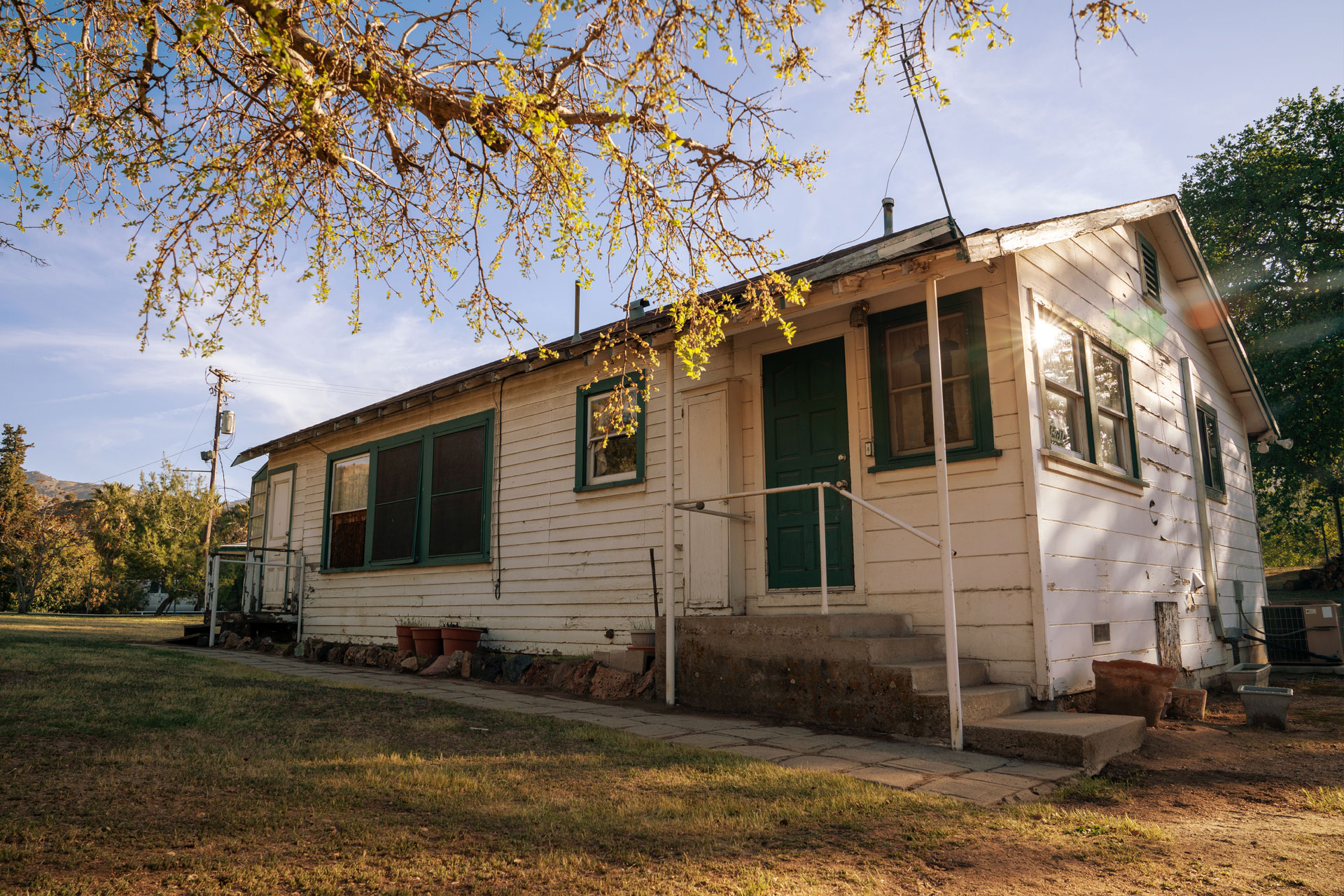
Welcome to the virtual tour of the César E. Chávez National Monument in Keene, California. In the 1970s, César Chávez and his wife Helen made this place not only a family home but also the pulsating heart of the farmworker movement. The simple white two-bedroom home served as a peaceful sanctuary and central hub for the Chávez family nestled in the heart of the community which came to be known as La Paz. Today, several members of Chávez’s family continue to live at La Paz, carrying on the legacy of their parents in partnership with the National Park Service. Join Park Ranger Miranda Hernandez and three of César and Helen’s descendants as they share memories of this historic home and some of the quieter moments central to the farmworker movement.
Stop 1. The Heart of La Paz
The humble home before you is just how Helen Chávez left it when she passed away in 2016. Enclosed by a chain link fence, the surrounding yard dotted with oak trees and a shady garden space all highlight different roles that the home and broader landscape played in family and the movements community life. While the home served as a peaceful respite from the front lines of advocacy work, the chain link fence built after learning of a plot to assassinate César, reveals the dangers posed in the fight against injustice. The dirt roads surrounding the home lead to buildings that were once a former TB sanitaire home, where Helen Chávez was forced to live as a child when the Chávez family moved to Keene in 1971. They transformed the area into a home where they cultivated family and community values. Today, the gravesite of César and Helen Chávez is a two minute walk from the home next to the former United Farmworkers headquarters building where César had his office.
Paul Chávez
PAUL CHAVEZ: My mother had always gone with him when he was in the CSO before he began his work with the union. He organized 22 chapters of the CSO, many times moving the family every year. And so, you know, we lived in places like San Jose and they did work up in Dakota up in the east bay. They were down in Riverside, in Oxnard. And my mother was always there moving the family, keeping up with the newest campaign. When my father told her that he found a new home, a new place, she was excited and she asked, “Where is it?” And he said, “In Keene, a little town Keene.” And then he says, “You know, at the old Stonybrook TB Sanitarium.” And my mother looked and she says, “I'm not going.” And he says, “Come on Mama, you know, I need you to come.” And she goes, “I'm not going to go to that place,I have bad memories.” Well, as it turns out as a young girl, my mother was interned here in this hospital for about a year and it was a horrible experience for her. She remembers nurses being mean, and she talked about hearing coyotes yelping at night and sleeping under the beds, and it was just a terrible time for her. And so she was hesitant. She said she wasn't going to come. Well, you know, after about three months or so, she relented and she gradually moved up, but it was interesting though, that, you know, after she moved up and she began to live here, and this became home, this place that had once had these terrible memories for her was transformed into this place that was full of life and provided a lot of good memories and happy times for her. Later on in her life, you know, we would try to get her to go places, to visit family or to take a ride, and she'd always say, “No, no, no, I'm good. You know, I don't want to go any place. I'm fine.” And, and so it got to a point that, you know, we had an inside joke amongst brothers and sisters, we would laugh and say what a stubborn woman, you know; our father couldn't get her to come and we can't get her to leave. But you know, this place really did change in my mother's eyes.
Anthony Chávez
ANTHONY CHAVEZ: My father would get up very early in the morning, very early in the morning, and do different things. He would do yoga. He would host a radio show from his kitchen table. We hooked up a machine with headphones and he would do an early morning show. But when he would walk in the morning to his office or, he would walk up to the hill to meditate, it was always the same route. He would come this way with his dogs, Boycott and Huelga, his German shepherds, walk to work down the hill and up to his office. And a lot of times he would use his back door. There were stairs that went up and they're not there no more and they were kind of like, strategically placed. You had to know where to step or else the thing would fall apart. He would walk up it and you would see the boards.. But most of the time he would go to the front office, but it was always this route he would take. Even when he went to the top of the mountain to meditate it was always this route. And that route would take him pretty close to where he lays today, him and my mother lie today, on his way up to the hill to meditate.
Miranda Hernandez
I think that sometimes in history we get caught up in the dates and the locations of different things, but I think the intentions and the resolve that it took to keep going with all of these with all of these different strikes and picketing lines and everything like that, I think that's what shines through to me about this site. Because if if I if I just concentrate on the dates, it's kind of like reading. You know, I can get it can get a little bit dry, but the fact that they go through so many of these trials and tribulations and then pick up and do it all over again before the last one is even over. I think that that just leaves me in awe to be honest to to think where they got where they... I mean, this in in the kindest way, but where did they find the audacity to do this? Because I'm looking for some too because that was such bravery for them to do that over and over, and I admire them immensely.
Stop 2. Helen's Park
You are now in the garden known as Helen’s Park, just inside the entrance to the yard. Here, tall oaks provide shade while plants and flowers that Helen Chávez meticulously cared for grow around a neatly trimmed lawn. Helen, much like César, found solace in nature. Helen’s Park is also a testament to the sense of community of La Paz. This park often hosted gatherings for the community which at its peak was home to more than 200 people who volunteered with the farm workers movement.
Paul Chávez
You know, growing up here in La Paz was was a different thing. There was people from all walks of life. And there was there was there were farmworkers who were who were working for justice. And there was religious folks. There was Protestant ministers and Catholic priests and there was nuns and there was activists and Chicano nationalists. And there was just a whole different group of people. And then there was always interesting visitors coming in. So what we grew up in was it was a community that experienced us to a lot of different types of folks and a lot of different ideas. And so as as a as growing up, you know, as a teenager growing up, it was it was a pretty stimulating environment. And I think that it was that it was that setting that that gave my father a lot of nurturing and supported him in the work that he had to do.
Eloise Carrillo
ELOISE CARRILLO: This place meant the world to my mother. She had her roses out here, she'd come out and she'd do her watering, she would take care of them. And she always made sure this place was kept up because when we had first holy communions, baptisms, baby showers, the house was so small, so this is where we would congregate. But one of the biggest, biggest things that would happen here would be our Easter gathering. Of course Easter always started with Mass, and then they’d have a softball game, and there were a lot of children, so my dad always made it a point to include the kids. So he said, “Well, we're going to have a kids' softball game and we'll have an adult softball game.” He always included everyone. So after they did that for a couple of hours, my dad played on both, he pitched for both teams, and he always wanted to be the winner of whatever he was doing. And after that, we'd come here, they'd have a big Easter egg hunt for the kids, and then we'd have a big barbecue. And my parents always invited people that lived here, that didn't, that couldn't go home to families, who didn't have families. We would used to open the place up to others than just the family. My mother loved a T-bone steak, and of course my dad was a vegetarian, right. So you know, after they’d prepare the meal, we'd all sit down to eat. We always said grace before a meal. So my dad knew that my mother loved meat, especially steak. So when she first would cut her steak, he'd go, “Oh, that poor little cow.” She’d look at him and he would not let her eat her steak and peace. He wouldn't. I said, “Dad!” he says, “I'm just teasing with her.” She’d look at him like, “Don't even go there César.” But yeah, he would always tease her about eating meat because she was not a vegetarian and she was not going to be a vegetarian.
Miranda Hernandez
So up here there was a huge community, like I mentioned, it was over 200 people. So people needed a place to stay if they're volunteers, right? They needed something to eat if they're volunteers. So this was perfect for that. But also it was in the middle of everything that was going on. These were the days before cell phones and the Internet. So it really was advantageous to have them actually be on the campus to know where they were going to go out for, whether it be boycotts or for distributing information, things like that. And that community also gave them a sense of family. This was these people sacrificed a lot. They sacrificed their jobs, their livelihoods, including César and Helen. So to have that kind of base and that support, I think, around you to have that larger family, I think that was really important as well. And honestly, if people come in a hundred years and you may see the César and Helen gravestone, you may know that they lived here, may even see the house if we do a great job of preserving it, but I also want them to know that there was an active, lively community here. And I think César's contributions to this cause will live on for a long time and they'll be well known. But like he often said, he didn't do it alone. Nobody can do these huge things alone. They need people to, you know, hold their hand and raise up with them. And that's what these people did. And César was really good. He was a people person. He loved to talk to people. He didn't talk down to them. He talked to them like they were like they could have been his brother or sister, his neighbor. He talked to them like they were real people. And that's why they trusted him and trusted his intentions, that he wasn't out for power or for money, but really for the betterment of the people around him.
Stop 3. The Chávez Home
You are now standing in front of César and Helen’s single-story home with white siding and green trim. This is where César and Helen raised their younger children. This house and the car in the front yard demonstrate sacrifices that César and Helen made in order to address the indignities that farm workers faced and that they had both experienced growing up. With Helen’s support, César and fellow organizers established the country’s first permanent agricultural union securing better working conditions for farm workers as well as higher wages. Creating the home at La Paz reflects one of many ways that the Chávez family chose a humble life to advocate for those who had less than them.
Paul Chávez
PAUL CHAVEZ: When he decided to give up the most secure life he ever lived, he was living in east Los Angeles. He was the staff director for a Latino community rights organization, the CSO, and he was living a middle-class life. You see pictures of him, he looked like Clark Gable. He had his Brooks Brothers suits and ties, and little pencil mustache, and his hair was slicked back. And even back then he used to smoke and he had his cigarette cases with the monograms. He was driving a Volvo. How many Chicanos are driving Volvos in the late fifties? Well, that was my dad. He was on a course to a comfortable middle-class life. But this idea that farmworkers continued to labor under difficult conditions and for terrible wages, he was never able to reconcile himself with the idea that he would be doing that while people continued to live the life that he'd lived. And so him and my mom made the decision that something had to be done about it. My mom would talk about the times if he would come home from trips with the CSO and he would tell her “I drove through the Central Valley and I saw people working the fields, bent over all day in the hot sun, in terrible conditions. Somebody should do something about it.” And she would listen because she agreed, because she lived the same life. But she said that it got old after a while. And it got to the point that one day when he came home and he said that she looked him in the eye and she said, “Well, why don't you do something about it?” And then he says, well, you know what that means?” She goes, “I know what it means.” It meant that they would give up the most comfortable life they had. They had eight children, right? The oldest was 13, I believe, the youngest was still in diapers. They would give up the most comfortable and secure life they'd ever lived. They would return to the fields. My mother would have to go back and work in the fields, not only to put food on the table for her kids, but to get my dad gas money so he could drive up and down the state talking to farm workers about this idea that they could organize a union for farm workers and make a difference. So he understood the enormity of it. But I think that when she challenged him, really, she was telling him is that “I'm with you if you want to do this,” because she grew up in the same conditions with my father. She had to drop out of school in the eighth grade because she had to help her mother feed her brothers and sisters. She lived in a converted horse barn and she understood the dignities that people faced. And so when my father said he wanted to do something about it, she was game because she was cut from the same thread.
Anthony Chávez
ANTHONY CHAVEZ: So this car has been, it's been sitting here since my father passed in 1993. He had several cars and a Crown Victoria, a nice car. He had some St. Regis vehicles that were more powerful cars, elegant cars, relaxing cars. My uncle, his brother, always talked about diesel vehicles. He drove these two vehicles. And he made a bet with my father, and my father didn't believe in him. So he made a bet with my father saying that he could drive from Mexicali, Mexico to El Paso, Texas for less than $10 a diesel, that my dad would have to get one. So it happened. But my uncle traveled on the south of the border where diesel was like 5 cents a gallon, and so he beat my father's bet. But anyways, my father ended up liking that bet. My father got a, it was the late seventies, early eighties, Delta 88. It was diesel. Not only did it have the manufactured tank, he had tanks in the trunk that would carry an extra 20 to 30 gallons of diesel. Extra. So, you know, I would drive my father around sometimes and he asked me to drive into Phoenix one day so that. Okay. So we're driving to Phoenix and we get to Phoenix, and we turned around and we start coming home and I'm noticing the gas gauge is not moving. I said, Dad, I don't know if this is working.” “Oh, it's working. I told you this car is great. The mileage is fantastic.” I said, “Okay”. So I said “You know what dad, just to make sure, I'm going to stop and I'm going to put some diesel on it just to make sure.” So we pull over to the gas station and we're now three quarters of the way through the trip. We've gone to Arizona, to Phoenix, and we're back around the Palm Springs, Coachella area. So I get out and I put gas in it, and it keeps clicking off, clicking off. I look at the pump, I was like, “$7?” I open up the tanks in the trunk and they're still full. He goes, “Didn’t I tell you?” I said, “You're right. You're telling me.” So, I mean, after that point, I remember the organization went out and bought - all the vehicles were diesel. You know, Paul drove a diesel. I drove a diesel. And for the organizers, they bought maybe 30 or 40 diesel Rabbits. And plus we're getting like 60 miles to a gallon. So that's when he fell in love with diesel, and he was a big believer of his doubt to 88.
Miranda Hernandez
When I talk to the kids, I am so happy. I hammer on the point that César was a regular guy. He was a regular guy that tried his hardest for his entire life. And he gave his whole heart to something. And he did amazing things. But he was a hero. Yeah, but he sometimes gets put, like in this elevated status where he was perfect or something. He wasn't perfect. He was a human. That was really giving. But yeah, he was just a person that tried his hardest. And that means that all of these kids that are growing up or these humans, these adults that we talk to every day, they can do big things as well. You can see that from his house. It's nothing fancy. It's a two bedroom home, not too different than a lot of people live in today. When people would come up the hill, they would think that he would live in this giant, beautiful building that actually functioned as the education center. But no, he like to stay in his humble home.
Stop 4. Cooking & Community
This is the heart of César and Helen Chávez's family home: the kitchen. This space is steeped in tradition and warmth. From the beige cabinets to the colorful collection of ceramic teapots on the shelf. It's here that Helen upheld the cherished family tradition of tamales making on Christmas Eve, with everyone lending a hand. Helen's culinary skills extended beyond family dinners; She was renowned for her cooking prowess, preparing meals for countless union events, weddings and special occasions. Whether it was the elaborate holiday feasts in the community kitchen or a simple meal at this table, Helen’s spirit of generosity and community was evident in every dish.
Eloise Carrillo
ELOISE CARRILLO: There were times that she'd be here, she'd be sitting down. My dad would call her and say, “Helen, I just finished a meeting and there's about 10 people were coming over for dinner.” She would look like, “Okay”. And I kid you not, she could put something together every time. And my dad was always so generous about inviting people over to eat, or even she she'd say “César, I don't have anything. I can refry some beans and I can fry some potatoes.” “It doesn't matter. Whatever you have is what we're going to eat.” And so that's what it was.
Stop 5. Family Life
Stepping into the living room of César and Helen Chávez, you are embraced by the warmth of family mementos. Dominating the space are two plush brown couches with patterned cushions and framed photos on display. Portraits of family members cover the surface of a wooden sideboard and framed photographs cover the walls creating a gallery of family history and personal moments. While César was often away from home, he cherished the time he spent with his family in this living room. During holidays, the small room would be filled with the large family of eight children, grandchildren, and extended family.
Eloise Carrillo
ELOISE CARRILLO: My sister and I used to take care of my mom. When her health declined she couldn't really do much. So when I would come to relieve my sister, first thing I do is look at the picture and I'd say, “Oh, okay. Julia was here.” My mom would say, “How do you know?” I says, “Because she's moved her picture right in the front.” So you could always tell who was here last. It's like, “No, Nana, you have to have - you know I’m your favorite - you have to have my picture here.” And my mom would say, “I don't have a favorite. You're all my favorite.” “No, Nana, tell the truth.” “I'm telling the truth!” Anyway, so that's the thing with the pictures.
Anthony Chávez
ANTHONY CHAVEZ: This is where everything happened. My father wasn't here very much. He was always traveling. But when he came, this is where we would be. We gathered around, he tell us about his trip and ask us how things are going. You know, just, family talk, family talk about my mom and us. A typical Christmas and this in the house was my father - we would open this up and they would put the presents in there, and it'd be wall to wal, curtain to curtain, ceiling to ceiling. The kitchen would be packed and we would have tamales cooking, and there'd be a Mexican chocolate going, and drinks, and there'd be kids everywhere. We'd be hanging over the hallway door, looking in, and my father would pick a couple of, uh, grandkids, his grandkids, to help him, be his elves. So my father would sit on the chair and they would handle the presents. And he would read off every single present “To so-and-so”, “To Mom”, “To so-and-so,” “To Dad”, and “Ana to Birdy”. And we would sit there and wait until everybody opened their presents. And we’re talking maybe, forty people in here. Forty people. Maybe more because of nieces and nephews, boyfriends and girlfriends would come over and it would be packed. You could not, once you sat down, you didn't get up. That's what it was. So, I mean, that was a great time for my father because his kids were here and especially his grandkids. All right. That was a special, special time for him to sit down and play Santa Claus. And he wasn't around as much. It was amazing to see how the kids would react to my father. And it was just like glue. They didn’t get to see him much, so they saw them, they really took advantage of it.
Miranda Hernandez
A reason why I like people to see the inside of the house is because, I mean, there's a TV and there is a sofa and there are these really basic things that a lot of us do have and that the Chavez family was just a normal family that really, really fulfilled their potential, I think, at least in that regard.
Stop 6. Faith and Spirituality
While the living room was a communal space, it also served as a place of solace for César and Helen. Crosses on the wall highlight the importance of religion and spirituality. For them, Catholicism was deeply intertwined with their dedication to the farmworker movement. Their faith was not just personal, but communal acting as a cornerstone that galvanized and unified many involved in the cause. César’s spirituality was consistent with his form of pacifist and nonviolent activism, shaping his love for all living things. During his lifetime, César found solace in nature, yoga practice and vegetarianism.
Eloise Carrillo
ELOISE CARRILLO: My dad, I remember also, I stayed here one time, and I'm an early riser. And so I got up, I thought, “I'm going to make my coffee” because everything was quiet, I thought they were asleep. So I get up, I get up and I walk and this wasn’t here yet. And I look, and my dad’s standing on his head. He startled me. And then he comes down and he's laughing. I said, “Dad, what are you doing?” He was doing yoga. He used to get up and do yoga before he'd go to the office. He says, “I saw that look on your face. I couldn't help it I had to just come down.” And I said, “You startled me. I thought you were sleeping.” He says, “You're not the only early riser.” I didn't even hear him get up.
Anthony Chávez
ANTHONY CHAVEZ: One of my brothers or sisters bought the first cross over to my mom. At my father's death they gave it to my mother to show their faith and my mother and father's faith in the religion as a tribute to my father. Well, when we were in Galena we were close to the church. And when we moved up here it was far and we had a priest live onsite for a number of years who would give Sunday services here. And for my father, when my father was on the road, that's one thing when he had security guards or his lead team would find, is a church. So if he was on the road on his Sunday he would make it a point, schedule permitting, to be at church. When we were home with my mom, they would have services here in one of the buildings. Actually in the audio/video room of the center was a conference room where there was an administration building before, and there's where they used to have Sunday services, and we would attend our Sunday services. Our children were taught the catechism from a retired nun, ex-nun who lived on site. And so our kids made their first communions here onsite.
Stop 7. A Place of Solace and Strength
Thank you for joining us on this tour of the Chávez family home at the César E. Chávez National Monument. This humble abode was not just a house, but a sanctuary for César Chávez and other activists in the movement. Amidst the tumult of advocating for the rights of the marginalized through boycotts and pickets, this mountain community offered solace, rejuvenation and the strength to persevere in their mission. César's leadership was a testament to the power of humility and modesty, reminding us that even in the face of adversity, it's the quiet strength and unwavering conviction that can bring about change.