China Camp Village
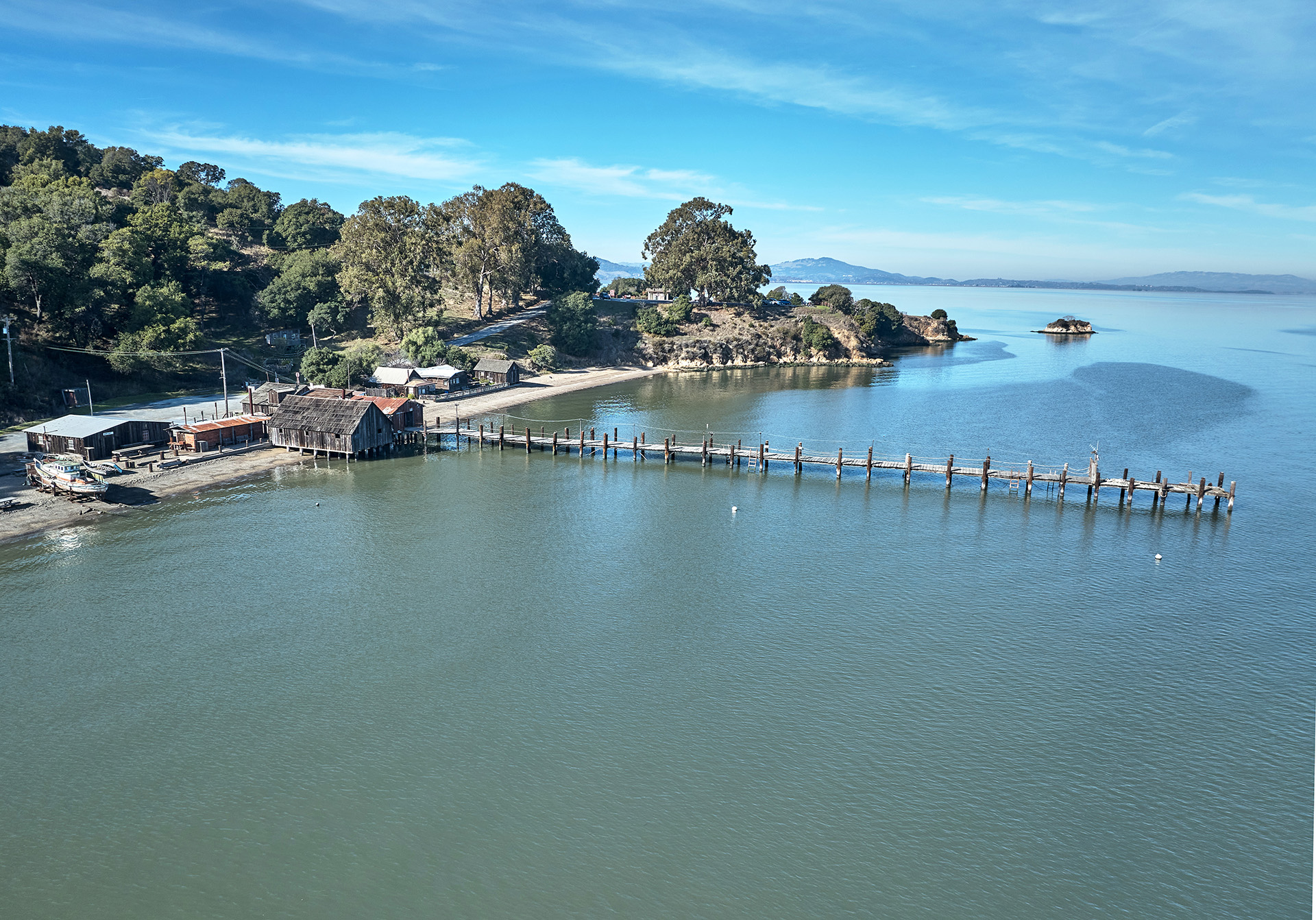
[music playing] China Camp Village, part of China Camp State Park, is tucked away along the southern shoreline of San Pablo Bay. As we enter the village from above, take a look around. While the landscape here has transformed throughout the last century, it remains one of the last historic tidal salt marshes and Chinese fishing villages in the San Francisco Bay area, providing a unique window into the past. In this experience, we will follow the Quan family and their relationship to this wetland ecosystem that people have relied on for centuries. Along the way, you will be guided by experts and community members who will share their expertise and first-hand experiences at China Camp Village.
Stop 1. An Abundant Landscape
[music playing] As we move across the sandy shoreline of China Camp village, imagine what this place would have been like before industrial development in the area. Prior to the 1800s, this place would have been abundant with wildlife and native vegetation that relied on brackish water and mud flats of the tidal wetlands. For thousands of years, Indigenous communities managed and utilized this landscape. By the late 1800s, 85% of the tidal wetlands in the San Francisco Bay Estuary had been lost to industrial and agricultural development. In the 1860s, Chinese immigrants who worked for the ranching family who owned the land established a fishing village here. They were likely drawn to the wetland because of its similarities to shrimping grounds in China.
Matt Ferner
Before the gold rush and European colonization really kicked in, I think this place was characterized by a vibrant and highly productive connected landscape where the uplands, grasslands, and forested hills blended with tidal wetlands all around the margins of San Francisco estuary. I think the tidal wetlands exceeded the area of open water, almost double the amount of open water, and those environments, those habitats hosted a wide diversity of native fish and wildlife that were thriving and connected through their interactions all around the Bay Area. The biggest change in the environment here occurred during the gold rush in the mid-1800s. That phenomenon brought large amounts of people to San Francisco Bay that settled around the bay and the estuary, and those people needed a lot of food, and so a lot of the low-lying tidal wetlands were diked off and drained of water and filled and converted to farmland, and that caused widespread ecological change in the bay. The other main impact of the gold rush was the mining practices used in the mountains to release the gold and look for the gold. Hydraulic mining in particular was really devastating for the bay and basically started with deforestation of sections of the hillsides, and then they blasted those hillsides with water cannons to free up all of the mud and dirt and rock and passed that through troughs that they used mercury to help pull out the gold flakes and particles from, and all that mud and sand and mercury washed down into San Francisco Bay and started accumulating in the bay and is still a problem for the bay in many instances now.
John Muir
There was, well obviously, there was an early presence of Chinese in San Francisco and in California, largely trying to take advantage of their early mining booms of the gold rush and the Comstock load and all those amazing 19th century mining events. And some of the companies that sort of formed out of San Francisco were really making their mark in the economy largely by bringing over Chinese from the Toishan, southern China region, to take part in their endeavors. And shrimp fishing in this area at this time was very much a similar thing. The Chinese companies out of San Francisco, the big six companies, would establish companies and establish fishing, industrial fishing complexes throughout the bay. They're called fishing camps. They were mostly male in the early days. Before immigration was curtailed, there were women as well. And even here at China Camp, there was an effort to establish a larger community. But really what's happening is it was almost an extractive industry here in the shrimp fishing industry. A lot of the Chinese companies were looking for ways to make money, and they were paid to set up the shrimp catching and drying and processing and then the shipping across overseas to the Pacific, throughout Asia. And the California fish shrimp were actually, in fact, the dried shrimp from China Camp in the San Francisco Bay Area were highly prized for being very sweet, full of delicious meat. And they really did very well for themselves running that extractive business.
Stop 2. A Booming Village
[music playing] When Quan Hung Quock first came to China Camp village from San Francisco in the late 1880s, he would have seen an estimated 30 buildings along the shoreline where up to 500 people, mostly men, lived and worked. Perhaps he would have felt a sense of relief at the sound of Chinese dialects at a time when economic insecurity influenced heightened anti-Chinese sentiment and immigration policy. Infrastructure that supported the shrimping enterprise would have extended beyond the shoreline with shrimp drying fields cleared along the hillside and wharfs built above the water to transport shrimp from boats to the shore for processing. One of a network of at least 26 Chinese fishing villages in the Bay Area, the location of China Camp between the San Francisco Bay and the southern end of San Pablo Bay amplified currents, increasing the shrimp flow into staked-out nets. Here, Quan Hung Quock established a livelihood and home with his family that would be carried on at China Camp for generations.
Matt Ferner
Even after the gold rush began, the shoreline region along China Camp was ideal for the California bay shrimp. The main reasons for that are the shallow waters throughout the bay and along the edges and also the large amount of tidal wetlands habitat. Those two areas, those two factors combine together to provide a lot of food for the shrimp, a lot of primary productivity, microscopic algae would grow on the mud and plants in the marsh and those fed small invertebrate animals which were then eaten by the shrimp and allowed the shrimp population to grow and be very large and made for a good shrimp fishing industry here.
John Muir
And it was a busy place. I think one thing is you'd see boats out here on the mud flats and as you when you you'll notice immediately when you're at China Camp the tides are substantial. In fact when it's low tide it's mud, there's no water at all. So a lot of the timing of their coming and going of the fishing boats would be based on tide, so there would be a real tidal cycle there. There's definitely going to be a strong odor of fish and shrimp. They were spreading out, they're cooking the shrimp and they're spreading it out in the sun all over the hillsides and in later years on decks. So there's a lot of busyness there, primarily processing the shrimp and then bagging it up with winnowing machines and then obviously the sounds of the hustle and bustle of just life and that many people living and working. But centered around the rhythm of the tides and you know the rhythm and the drying of the shrimp and bagging up of the shrimp. That was the reality for many decades that was the lifeblood of the place.
Milton Quan
Granddad, for racial reasons, was kicked out of San Francisco. He had a store there. He came here and started a store. And at the time, there were several hundred people living in the area, fishing, etc. So he started a store, and the fishing kind of, there was a big drought in fishing, so most of the people left. He stayed here with his family. And then they learned how to catch shrimp. And he flourished in his business. He did very, very well. He turned out to be a very interesting man. I did not meet him. My mom met him, and she talked about him being a very shrewd businessman. She told me all this stuff, and it made me a little embellished about, he took this thing over like his business. And he ran his little business, but he allegedly had a doctor that treated people who are acupuncturists. And he had a little restaurant here. And of course, he sold hardware to the people who lived here. And I understand he even had a security force. It wasn't a racial issue way back when, so he had to protect the area. So anyway, I heard he was a very shrewd man. I wish I had to meet the guy.
Stop 3. Adapting to Change
[music playing] The wooden structures you see along the shoreline today reflect the ephemeral nature of Chinese fishing villages, places constantly changing and being repurposed with the influx of labor. Following the Chinese Exclusion Act of 1882, the California state government enacted another series of discriminatory policies including a shrimp export ban in 1905 and the prohibition of Chinese-style fishing nets in 1911. With life more difficult at the village, most residents of China Camp left, and Quan Hung Quock’s sons, Henry and George, were forced to adapt to continue to make a living. They utilized trawl nets, and eventually mechanized parts of the shrimping process. With changing environmental conditions reducing shrimp populations, the Quan brothers, along with their wives Alice and Grace, diversified the business at China Camp, establishing a cafe and a boat rental business.
John Muir
Henry Quan, Frank's father, and George, his brother, Henry and George Quan, were the ones to start the Quan Brothers, and they went out fishing regularly with their Montereys, processed the shrimp, and also started the fish cafe, where they'd sell fresh shrimp, and that era started. But the Kwan Brothers were George. George unfortunately passed away early, so it was really Henry Quan, and the Quan Brothers are the ones that marry Alice and Grace. The Cameron House, which is a very famous orphanage for girls in Chinatown, would come up here regularly for their picnics in the summer, and it was during one of these that Alice and Grace met Henry and George, and the romance was begun, and eventually they got married in the 20s and moved up and lived here, which Grace, of course, was Caucasian, and a rare Caucasian in Chinatown orphanage, and had learned how to speak Chinese, so that was also extremely revolutionary for the time, where a Caucasian woman, to get married, they had to leave California and do it in Nevada, I believe. Milton might be able to tell you that, but so that was quite a chapter to the story.
Milton Quan
Family business started as shrimping. The shrimp were so plentiful, and the market was good for them. They could sell shrimp to, I know we used to travel in an old truck he had, and we'd take shrimp to San Francisco, and the people there would pick the shrimp, and they'd eventually all end up at Fishman's Wharf. And then the big platform that's out here, they used to dry shrimp, and those shrimp would go to China. So between those two things was a good living. And then people were starting to catch fish off the pier. And so he thought, gee, it'd be kind of nice to have rowboats. So when I was really, really young, they bought maybe three or four rowboats to rent. And it was so that the people were just clamoring to get those three or four rowboats. So he kept growing and kept growing. And so eventually we had 60 rowboats that we would rent out every Saturday and Sunday. My brother and my sisters, we'd get up at 4.30 in the morning, we had all the fishmen, and we'd get the boats ready and do the shrimp. So my dad, he was a very interesting businessman. He was doing very well in the shrimp, decided to do this. And of course, this parlayed here because people who went fishing, all these men who told their wives that they got stuck in the bay or whatever, end up here drinking beer. And so I remember when I was really young, my mom, who was five foot two, 200 pounds, part of her hair down the middle, and she wanted to give everyone their precious, she was just a fisher girl. And she literally would throw these guys out of this bar here when they got rowdy. So yeah, it was very cute.
Stop 4. Quan Family Life
China Camp today is a window into the mid-20th century as the Quan children grew up alongside the seasonal and daily shifts of the tide. Grace and Alice Quan were the matriarchs of China Camp. In these two homes, they raised 6 children between their two families and ran the family businesses. During the middle of the 20th century, roads made China Camp more accessible, and regional development water diversion began to significantly impact shrimp and fish populations. Adapting to these changes, the Quan family began to rely more on recreation and entertainment to support their way of life here. In 1955, China Camp transformed into a movie set for the film Blood Alley igniting new opportunities for Grace’s son, Milton, in the film industry. As much of the family grew and moved away, Frank Quan remained here, continuing to run the cafe and fishing business, and eventually serving as a caretaker of the State Park.
Matt Ferner
First few decades of the 1900s there was a recognition that fresh water was a limited and valuable resource in California and that's when it started to be a popular idea to divert water from the Sacramento River to the San Joaquin Valley and from San Joaquin River as well down to Southern California. When that started it limited the amount of fresh water from rain and snow melt in the Sierra Nevada Mountains that could make it into San Francisco Bay and that caused the bay waters to become saltier and changed the distributions and stressed animals and plants that relied on that brackish water, the mix of salt and fresh water. So a lot of plant distributions shifted, fish like salmon and delta smelt had to move further up estuary and limited their habitat and it also impacted the California bay shrimp which rely on that fresh water for their life cycle as well.
John Muir
Yeah, I mean, Alice and Grace really, for all intents and purposes, were the matriarchs of China Camp. Grace in particular was quite an outgoing character, and Henry, Frank's father, and Grace's husband would go fishing, but also had a lot of business connecting the product to the city, was involved in bands, so became a little less present in the industry. So really, it was Grace and Alice that were running China Camp as we move into the 30s and 40s and 50s. They were critical to the cafe, running the cafe and selling the shrimp. They also started the boat rental in the 40s, maybe late 30s, where you could come down and rent a skiff and rent a motor and head out for this incredible sport fishing here off China Camp. So they managed that, as well as I think it was five different, five children, and lots of rough and tumble fishermen coming through early. There's some great stories of Grace, fishermen come in at 4am and honk their horn, and Grace would come out and serve them some whiskey, get them their boat, and get them sent out for the day's fishing. So she was really a powerful character, well -known, well-loved, definitely sounds like she could be pretty ornery. I never had the pleasure of meeting her, but just crusty on the outside, but a real sweetheart, and it's evident in all her family and all their kids that they raise, they're just lovely people and very warm and open.
Milton Quan
This talk, between 10 and 14 years old, I'd get up in the morning and we had chores. And the chores in the morning were, if there were any boats that had to be taken from the shore and anchored out there, that was my job. That was early in the morning. And from there, I would help the shrimp get into, we had a little shrimp store that was part of my job. And then I would go to school, either grammar school. I'd come back home and there were always boats that we'd have to row out and anchor out there. And it was always the shrimp that was on the deck had to return to be dried properly. So we'd take brooms and we would do that every day. And then it was always chores. Mom had all the stuff going on. And then plus the times I would go out fishing, actually go out by myself and fish. And I think now I would never, ever let an eight-year-old or a nine -year-old go by himself. It'd be so dangerous. Go out there, no self-service, go out there and no one can communicate with you and catch fish. And so that was kind of my day. I was really a busy guy. It was great. Maybe that's why I never got any trouble.
Stop 5. A State Park
[music playing] Frank Quan’s craftsmanship is visible in the wooden structures you see at China Camp including the Quan homes, the apartment on the hillside, and the shop where Frank spent much of his time before he passed away here in 2016 at the age of 90. Frank saw first-hand how factors such as pollution, water diversion, and development had impacted the ecosystem at China Camp. By the 1950s, the shrimp that Frank and Milton’s grandfather harvested and the fish that relied on them had greatly diminished. Faced with development, this place became part of the CA State Park system in 1977. In 2012, the Friends of China Camp assumed responsibility for park operations after severe state budget cuts. The spirit of community passed down through the Quan family for over a century lives on at the park today as one of the last standing historic tidal wetlands and the only remaining historic Chinese fishing village in the region.
Matt Ferner
The environmental degradation of the Bay and all of those pressures around humans' impact on the Bay really over time increased the consciousness of environmental protection and the need for those kinds of conservation and activism in the public. This was helped a lot at the national level through a bunch of environmental legislation in the early 1970s. There was the Clean Water Act that got passed that helped to protect water quality and create some standards for what can be discharged into the Bay. There was the Endangered Species Act that helped to protect limited resource habitats and sensitive species such as those that are found in the tidal salt marshes at China Camp. There also was the Coastal Zone Management Act which gave the Bay Conservation and Development Commission regulatory power over development along the edges of the Bay and dredging and sediment disposal in the Bay. And as all those things were happening the local communities next to China Camp, like in Peacock Gap right up the hill here, became much more aware of the need for environmental protection. They were seeing these impacts locally at China Camp, especially at the village which was a very popular site for people to come and fish and recreate and hang out. And mostly through their grassroots effort they lobbied the state and got the property protected as a state park in 1976. I think part of the incentive for that was the plans for an oil company and development to take over this part of the shoreline in Marin County. They saw that coming and they didn't want that to happen and that's what led to the state park being designated and that's what now gives protection to this area, both cultural resource protection and environmental natural resource protection.
John Muir
Frank, he really was somebody that we were fortunate to have when they made this a park, the place had sort of come to be a little bit run down, Grace had passed away, there was a possibility that China Camp could be turned into a solo for private interests and development, but state parks and the community here really rallied together to save the area and the whole park as it is today, including the village. And the first superintendent, Jack Hirshmeier, for state parks had the good insight to sort of install Frank and to safeguard Frank, to literally grandfather him into the park from the get -go, recognizing that here he had a fellow still practicing the living history and the traditional ways of China Camp. And he was also someone who's very handy and scrappy, loved to fix things and very outgoing, so could really interrelate to both the state parks folks and people in the village, and really took it on himself, luckily, to become sort of the unofficial caretaker for China Camp, really cooperating with state parks in their efforts, really having an understanding while still keeping his life going, having an understanding of the need for it to be a park and to help the park thrive. And his touches throughout the village as having maintained and kept the place and a lot of the kind of traditional feel of the place alive for so many years.
Milton Quan
They have heritage days that the park puts on, or the Foundation puts on, yes. And I've been able to partake in that the last five years. And that's where I'm able to come down and people can see a person who actually lived here. And my granddad was the guy. So I get some really interesting questions. And I've been able to do some walking tours and explain what the buildings were and what they did and what it looked like in the 40s and 50s. Yeah, and they do that every year and it's great. There are dancers, the park service contributes. It's a really nice event.
Stop 6. Impacts of a Changing Climate
[music playing] The landscape and ecosystem at China Camp have transformed over the years, but its location along the shoreline is particularly precarious as human-induced climate change increasingly impacts coastal communities. Changes in air temperature, acidification of water, and frequency and intensity of storms have increased in recent years. Most impactful, is the projected sea level rise, which has the potential to completely cover the village and convert the historic tidal marsh into mud flats by the end of the century. Research conducted as part of the San Francisco Bay National Estuarine Research Reserve continues to provide insight into these changes. Efforts to protect this ecosystem and historic site will require the careful collaboration and involvement of community partners.
Matt Ferner
We've noticed over the last 10 or 20 years an increase in extreme events possibly related to climate change and those include big flood years or wet years and also very long hot drought years and those kind of extreme conditions when they happen more frequently cause a lot of stress to the plants and animals that live in the environments at China Camp. For example when there's big atmospheric river events that bring massive amounts of rainfall and sometimes snow pack to the mountains and the local watersheds, all that freshwater floods the bay, rises the water levels even above their average high tide levels and those lower salinities can kill creatures in the bay like the oysters that don't survive well under freshwater conditions and they can also flood infrastructure like roads and the structures here at the China Camp Village. We've seen an increase in that since I've been paying attention to China Camp and we expect that to just increase even more in the future. Sea level has been rising here over the last 125 years since we've been monitoring sea level in San Francisco Bay. It rises at about a couple millimeters a year, so not super fast, but we are expecting an acceleration in that rising of sea level as the ocean expands due to gradual warming and that rise in sea level is probably going to be on the order of two or three feet by the time we finish this century and if that occurs as we expect we will see a lot more devastating coastal flooding in China Camp. Both of the historic structures and the low -lying roads through the park.
John Muir
But in recent years, in the last two or three years, I've continued to help maintain the village itself as a volunteer, and we've been shocked by some of the level of storm surge. When the wind and tide come up, we've had water just erasing parts of the fences around Frank's houses, scouring out the sand and the dirt from under the picnic tables. We had the old buildings under the museum and under the shrimp processing place, the shrimp cooking, just got hammered by the tides and by the waves. And so it was completely undercut, scouring out the foundation, in fact. So the old brick shrimp cooker, a lot of the very historic parts of the camp were really at danger. And at one point, I really thought they were done. But luckily, state parks answered the bell and came in and were able to stabilize a lot of that structure for now. But you do really get the sense of the water being more of an issue now and the tide surge and the tide heights. The wind and storms as well. The roofs here are under constant barrage of northerly winds when the north comes. A lot of the fire winds, too, are just incredible waves and winds coming through here and lifting off shingles and weathering the place. It feels very fragile, very on edge, and we're going to be up against it trying to preserve it into the future.
Stop 7. The Future of China Camp
[music playing] On any given morning at China Camp State Park, you can see swimmers doing laps in the shallow water and local community members taking a stroll along the shoreline. The Quan family's relationship with this historic tidal wetland is part of a long history of communities cultivating a home here. We encourage you to continue your exploration of this place and support and learn more about the communities and organizations that work to carry on its legacy.
Milton Quan
Once again, the feeling is that I hope this place stays the way it is. As I say, for a person that lived here and experienced all these wonderful things, to be able to come back every couple of weeks and see it, I mean, how great is that? Just amazing. So that would be kind of my last thought. It's so wonderful to see this place.