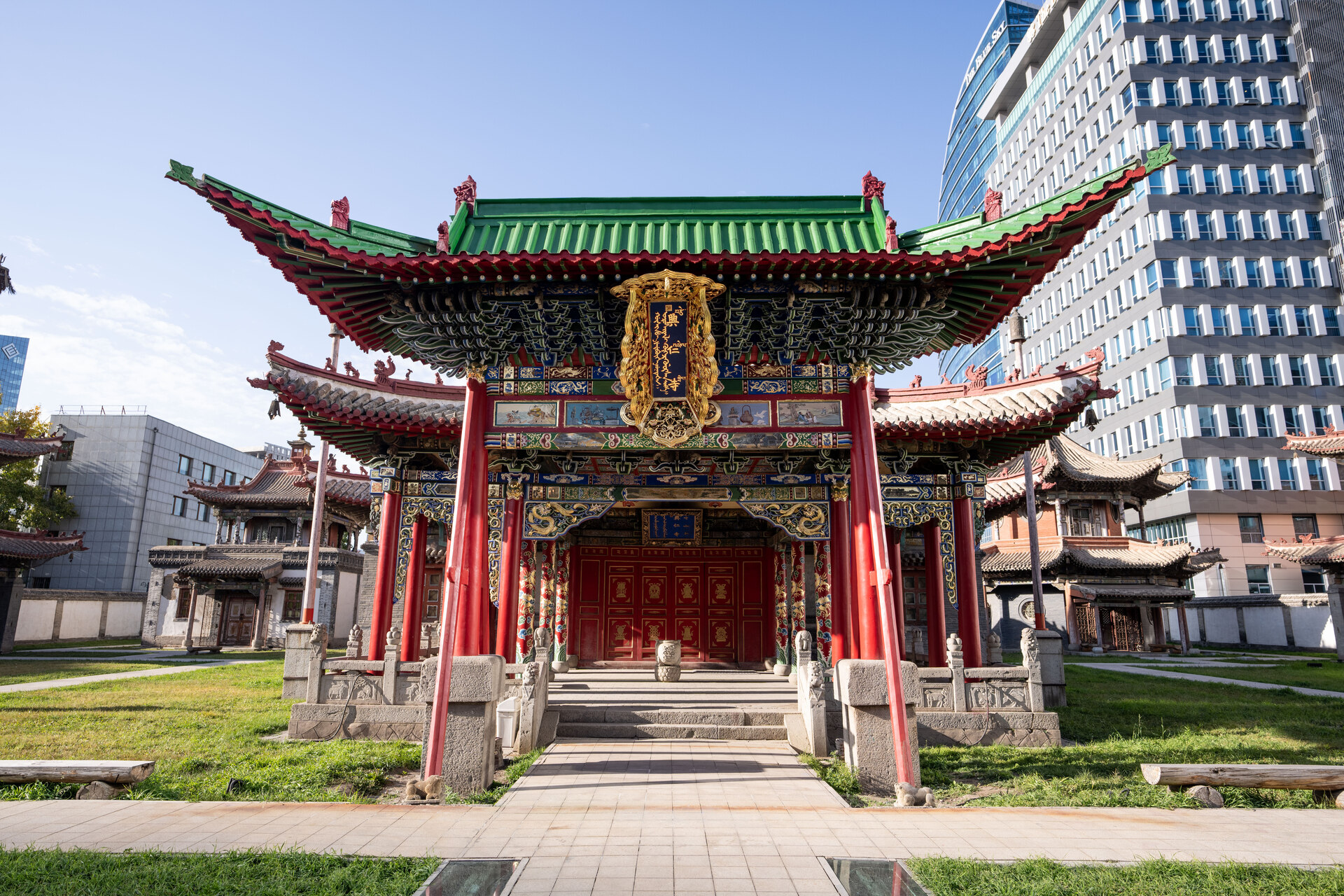
Welcome to Choijin Lama Temple Museum
Welcome to Choijin Lama Temple Museum. One of Mongolia's most cherished landmarks. Built between 1904 and 1908. This sacred complex blends Mongolian and Tibetan architectural traditions. On this journey, you will uncover the temple's profound role in Mongolia's history. From its influence during critical moments of national struggle to its survival through periods of political repression. As Ulaanbaatar grows and transforms around it. Choijin Lama Temple Museum stands as a testament to Mongolia's enduring heritage. Along the way, you will meet a monk, a cultural expert, an architect and an artist, each sharing personal insights into this remarkable site.
Stop 1. An Auspicious Location
Once known as Khuriye or Khuree, Mongolia's capital began as a nomadic monastic center before settling into its current location. Choijin Lama Temple Museum is located in the heart of the modern city, and this site was originally chosen in 1903 for its auspicious qualities by geomancy experts, who study the spiritual and spatial harmony of a site. As we approach the site, we are greeted by protective elements designed to ward off evil spirits. The sculpted stone reliefs of the shield wall mark the transition from the mundane world to the holy realms. Beyond this threshold lies the Temple of Maharajas, which houses statues of the four guardian kings, powerful deities who watch over the cardinal directions of the universe. In this scene, the director of ChoiJin Lama Temple Museum explains its history, construction, and the geomagnetic factors behind its location.
Otgonsuren Dugarsuren
The first temple was built in 1899-1901 in the north side of Zuun Khuree. However, it was burned down due to sudden fire in the winter of 1903. Second temple built on this very ground. Land-inspecting lamas chose the most frosted land with wrathful deities. For the State Oracle Luvsankhaidav's religious endeavours, the temple complex was built by 300 top craftsmen, led by Ombo. Since its establish in 1908 until the end of 1930s, the temple had 50 monks and 2 clerks.
Amgalan Norovtseden
In Buddhism, there are Buddha, Dharma, and Sangha. What did Buddha say? What did Buddha teach? What does his teaching Dharma say about? How does the Dharma affect people's perceptions? There are people who exemplify the ideology and enlightenment. Who are called Sangha. These three things have great importance in Buddhism. They're called Three Jewels. Then there are many guardians who took the oath to protect and promote these three jewels and protect them. Many of them. In particular, the guardians are incarnated in many forms, some of them are calm, some of them are very fierce, some of them are half-evil, and they appear to us in many different forms. They rectify the evil mind of a person and cleanse their defilement. All of them belong to the Buddha whether they have a fierce or a calm form they belong to the nature of Buddha. Some people choose the use of force as a solution. Some people choose pacifying methods to solve things. If we say, "My son, please stop". They do stop. When we force them to stop, some people get scared and stop. So guardians are in different forms. Calm and fierce. Among the many such incarnations, guardians that protect temples, prevent the spread of non-virtue, and keep society in peace are called guardians that protect dharma. They are called Choijin guardians or the dharma-promoting guardians.
Dr. Oyunbileg Zundui
When we construct a temple or monastery, choosing the right land is the first task. Where it should be located? Special land inspector does this task. Considering the proximity to nature, In rural areas, for example, the leeward side of a mountain is preferable. When the Choijin Lama Temple Museum was built, it was a empty steppe. Bogd Mountain was in the south. There was another temple next to it. In terms of architecture planning, it's located at the central axis of symmetry. The main temple is the center. All other facilities were built following the centripetal principle and located two sides of the main temple. Main buildings were built at the center.
Stop 2. Heart of the Complex
Passing through the Temple of Maharajas and the Ceremonial Gate. A central pathway leads us toward the main temple and courtyard, the heart of the complex. In its prime. This space was a hub for vibrant ceremonies led by the Choijin Lama, the state oracle who performed Oracle trances to guide Mongolia's political leaders throughout major historical events, including the fight for independence from the Qing dynasty in 1911. During the political repressions of the 1930s, a violent period when many monasteries and religious sites were raised, ChoiJin Lama Temple was reclassified as a museum to protect it from destruction. Today, the museum is home to over 6000 artifacts, including rare scriptures, ceremonial garments, ritual instruments, paintings and sculptures. It not only acts as a repository for collective memory, but also actively hosts educational programs that foster appreciation for the spiritual and artistic traditions of the Mongols. The Temple of Undur Gegeen flanked the main temple on the eastern end of the courtyard, while the Temple of Zuu is located on the western end and the Yadam Temple on its northern end, each dedicated to different deities and functions.
Otgonsuren Dugarsuren
End of the 1930s was a critical time for the future of the temple and its existence Scientists and researchers of the Mongolian Academy of Sciences, and Russian architect Vasilav submitted their request to the state officials to leave the temple intact and the suggested that precious religious relics should be studied. In 1938, the Prime Minister Amar and Marshal Choibalsan decided and transferred the ownership to the Mongolian Academy of Sciences for research and exhibition purposes. That's how it became a museum.
Amgalan Norovtseden
During the late spread period of Buddhism in Mongolia, considering its 2000 years of development culture and education system, the prosperity created by the nation, an unfortunate and major event occurred. That we all wish it would never happen again. This is the repression period that lasted from 1937 to 1939. Back then Mongolia was a great nation. Great country with great culture. With well-developed Buddhism religion. Unfortunately, that religious belief was destroyed to its full extent. In total, more than 21,000 monks had been persecuted. Over a thousand temples in Mongolia were destroyed. Very unfortunate event. I sincerely hope that such a sad thing will not happen again. Calling it repression is an understatement. Western and foreign researchers say it's not a repression. They conclude that it's organized genocide. It's an accurate conclusion.
Stop 3. Retreat Sanctuary for the Oracle
Passing the Temple of Zuu on the west, we head to the northern end of the complex and the Yadam temple. This temple served as Oracle Lama's retreat hall for sacred tantric meditations. Choijin Lama Luvsankhaidav’s activities were instrumental to the spread of Buddhist practices, intertwining spiritual teachings with the cultural identity of the nation. The title “Choijin Lama” symbolizes the deep connections between the oracle lama and protector deities of Buddhism, especially the Vajrayana branch of Tantric Buddhism. Here, he practiced the highest class of secret tantric meditations and retreats. Inside, Yadam temple houses various thangka paintings, brass and copper statues, and ritual objects which are considered masterpieces of Buddhist art.
Otgonsuren Dugarsuren
Choijin Lama Temple museum was established for the religious endeavours of Choijin Lama Luvsankhaidav. Luvsankhaidav was born in 1872 in Lhasa city in Tibet. He was the fifth son of Konchok Tsering, a clerk of His Holiness the Dalai Lama His brother was recognized as the Eight Bogd Jibzundampa Khutugtu of Mongolia In 1874. Then his family was invited to Mongolia. He was exposed the Mongolian culture in early his childhood He learned Mongolian language and culture very well and grew up as an intellectual. Around 1883-1884, to protect the Buddhim in Khalkha the Eighth Bogd Jibzundampa khutugtu and Dharma King Palten Choephel decided and recognized him as ‘the State Oracle Lama of Mongolia’ and invited Gurtem Lama from Tibet to teach Luvsankhaidav to execute wrathful deities and perform oracle trance. Luvsankhaidav became the State Oracle. In his temple, he performed oracle trance to protect the public and the religion. Recognizing his efforts to protect the state and the religion, Eight Bogd Jibzundampa Khutugtu and the title of Gujir Khamba, State Oracle, and the title of ‘One with Precious Wisdom and Clear Devotion’. He was awarded with the title and the seal of Khutugtu. And the seal of temple chief. The State Oracle passed away in February 16, 1918 at Dragon hour due to fainting.
Amgalan Norovtseden
In general, if a person wants enlightenment and free himself from 84 thousand evils, they must meditate to the highest level. In order to meditate to the highest level, a person needs to adapt the pride of Yadam deity learn from him and practice his meditation in order. So that the person can reach enlightenment in his lifetime. In Buddhism, it's important to guide the path to reach Yadam quickly and bring people to their highest level of development. That's why Yadam deity's temple, praying for Yadam and practicing his meditation is the most important in Buddhism. That's why the Yadam temple is located right behind the main temple in the Choijin Lama Temple Museum. Our Bogd khutugtus worship Demchig deity a lot. They practice the Demchig's meditation. They also practice the Yamandag deity's meditation. Sandui deity's meditation as well. Uniting all these efforts, we worship and pray in the Yadam temple. That's how the masters and religious leaders are born.
Ukhaanzaya Dorjnamjin
In the Choijin Lama Temple Museum, many extraordinary art pieces are present. In terms of moulding, there are deities created with moulding technique, Creation of body forms. Also, there are thangka paintings. Silk paintings or applique creations. Engraved wooden mandalas. Paper mache arts. Deities can be created using these methods. Moulding, applique, or silk paintings and embroidery methods can be used to create the three forms of art. Body form, sutras and ritual items. In the Choijin Lama Temple Museum, we have precious art forms created with the applique. There are also many deities created with the moulding technique. With the paper mache method, the paradise and Yamandag mandalas were created. Many engraved Buddhist arts. Highly ornate structure of the temple created with wooden engravings. So, we have many superior forms of art in the Choijin Lama Temple Museum
Stop 4. Crowning Glory
Looking up at the tiered roof of the temple complex, you will see golden spires, detailed ridge pull, effigies of animals and colorful paintings that symbolize the creative aspirations of its builders. The temple's vivid decorations demonstrate the artisan's extraordinary skill, while its layout reflects thoughtful spiritual design. Recent restoration efforts have safeguarded its painted columns, gold leafing, intricate woodwork, carved details, and sacred objects central to Buddhism. As one of the few surviving examples of historic Buddhist architecture in Mongolia. Choijin Lama Temple Museum was included on the 2020 World Monuments Watch for its role in the country's ongoing revival of Buddhism. Its preservation has been guided by a Conservation Master Plan and supported by the World Monuments Fund, Arts Council of Mongolia and Choijin Lama Temple Museum. These restoration efforts have strengthened local expertise in conservation through training programs for heritage professionals, ensuring that Choijin Lama Temple Museum continues to welcome visitors for generations to come.
Otgonsuren Dugarsuren
In efforts to ensure customers' comfort, to improve the preservation and protection of exhibits and relics, to promote the preservation of cultural and historical heritage individuals and organizations have been supporting us greatly. As a result, our museum operation has expanded. The Choijin Lama Temple museum team renewed our long-term plan. In collaboration with an expert from the World Monuments Fund, we developed a management plan for the restoration of the monumental buildings. Our museum was selected as one of the top 25 landmarks of 22 countries. We plan to have world-class facilities for exhibitions and the plan is already reflected in the government's action program. Our team is confident that the activities of the museum will continue to expand. It will become a world-class museum with buildings that meet museum standards, creating a comfortable environment for our customers. I would like to express my gratitude to the people and organizations who have supported the museum until today.
Ukhaanzaya Dorjnamjin
Applique or silk painting is popular in Mahayana Buddhism countries. They're known by the name of silk art or applique. In Mongolia especially, applique has developed to its peak. From 19-20th century, 8th Bogd Javzandamba khutagt, the brother of Choijin Lama thangka art was developed to its peak. Researchers say that. Applique is commonly used for sutra creation. There are three types of creation: Body forms, sutras, and ritual items. All of them were created by applique methods. I mentioned there are many different forms of arts. Painting... Body forms, sutras, and ritual items. Another one is casting. Engraving, paper mache, and sculpting. The main one is silk art. We create art using colorful silks. Which is called applique. It's well developed in Mongolia. Traditional art. Extraordinary applique arts dating back from 19, 20th century are kept here in the Choijin Lama Temple Museum.
Stop 5. Oasis in a Changing Landscape
Choijin Lama Temple Museum is a sacred oasis amidst Ulaanbaatar’s rapidly evolving cityscape. Located just steps from Sukhbaatar Square, the symbolic and civic heart of the city, the temple stands as a link between Mongolia's spiritual heritage and its dynamic present, as modern towers of glass and concrete have risen around it. Choijin Lama Temple Museum endures as a place of calm and reflection. On any given day, you may find people strolling along its paved paths or gathering with friends on the grass near the shield wall. The museum continues to welcome visitors seeking a connection to history and tradition, while also offering spaces for meditation performances, concerts and exhibitions that blend traditions with contemporary community life.
Otgonsuren Dugarsuren
To attract the youth's interest in cultural heritage, we've been organizing "Night Museum" events for 14 consecutive years. During "Night Museum", we display special exhibitions. We collaborate with professional artists and singers to allow the audience to experience both intangible and tangible arts. In the Choijin Lama Temple Museum, we've the largest number of Tsam masks. There are also the complete outfits of Gombo Mahgal and Jamsran, which is considered a unique masterpiece. By demonstrating these artworks through "Tsam dance", we aim to offer live experience, combining both tangible and intangible arts.
Amgalan Norovtseden
Transforming a temple into a museum has a great importance in education. Because, for example, the Choijin Lama Temple Museum is located at the heart of Ulaanbaatar, the capital city of Mongolia. Through the temple, people can learn about Buddhism, and its development. Its culture and different forms of deities, including the calm ones and fierce ones, and half-evil ones. They can learn why we worship the deities. By stepping into the temple, they start learning about the religion. They will realize what has been taken away when they step out of the door. Professional guides at the museum educate them. That's why temple museums are really important. People learn so much about tangible and intangible cultural heritages. Museums have great importance because of that.
Dr. Oyunbileg Zundui
Ulaanbaatar city was first established in 1778 on its current location. It used be called "Khuree". In 1911, the name was changed to "Niislel Khuree" Later in 1924, the name Ulaanbaatar was given. When it was Khuree, there were two main temples. Gandan and Zuun khuree. Two main temples. In Zuun Khuree, the Choijin Lama Temple was first built in 1899. It was built from 1899 to 1901 It was a wooden building. Yellow Palace, the imperial residence of the Bogd Khan was also located there. Yellow Palace, Galav Monastery, and Choijin Lama Temple Museum were all made of wood. That's why they burned down. Then the Choijin Lama Temple was built again on this land. They improved construction materials, with brick walls and ceramic roofs. New temple was built from 1903 to 1908. The old one was located next to the imperial residence, Yellow Palace. Today the new temple is located at the city center, near the government palace. It's only cultural heritage that was left in downtown. Main spot for tourism That's how it has grown.
Stop 6. Enduring Spirit
Today. The Choijin Lama Temple Museum is not just an architectural gem, but a living reminder of Mongolia's spiritual and cultural journey. From its prominence in state ceremonies to its survival during periods of political upheaval, its enduring presence reflects the interplay between the ancient and the modern in Mongolia. Through research, conservation and cultural programs, the Choijin Lama Temple Museum remains a vital link between the past and the present, a place where history, art and spirituality come together.