Civita di Bagnoregio
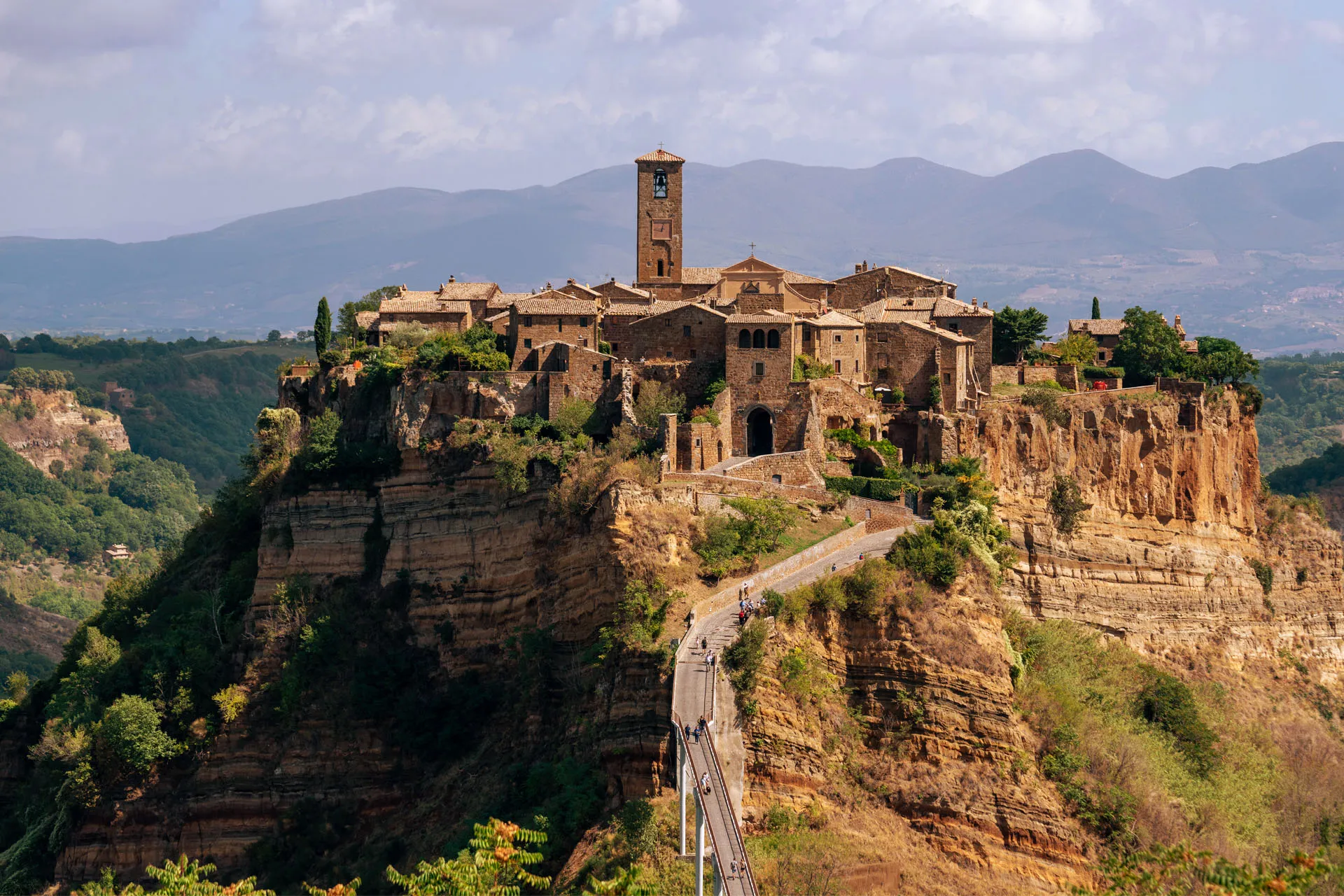
Welcome to Civita di Bagnoregio— benvenuti a Civita di Bagnoregio! We’re in central Italy in the province of Viterbo, about 75 miles northwest of Rome. perched atop a rocky plateau. Perched atop a rocky plateau, the town was likely founded over 2,500 years ago by the Etruscans who preceded the Romans in this region. It’s now home to a small, vibrant community committed to protecting this symbol of human resilience. During your time here, you’ll learn how the town’s unique environment has shaped the character of this place and its people, including the impact of new risks posed by climate change. Along the way you will meet members of the community; Mayor Luca Profili, local resident Ilaria Rossi Doria, and journalist Roberto Pomi as they share their perspectives on Civita.
Stop 1. Living on the Edge
The journey to Civita showcases the dramatic history of this small town. Constructed on top of a long narrow plateau of volcanic rock high above the verdant badlands valley, Valle dei Calanchi, Civita di Bagnoregio looks like something from a surreal dream. The town covers the entirety of the plateau built with the brown-beige volcanic tuff rock from the surrounding area. For those traveling to Civita, they will need to walk along a 366 meter bridge over the valley before following the zig-zag path up to the town. From our vantage point looking down over Civita, we can see the town’s density but also its precarious position. The story of this town begins 3 million years ago when the surrounding valley was a seafloor composed of clay deposits. Today, this base layer of clay is buried under the rock but is one of the reasons that the land is so susceptible to erosion and landslides.
Luca Profili
Hi, I am Luca Profili, the mayor of Civita di Bagnoregio. Welcome to our hamlet.
Ilaria Rossi Doria
It means a lot. It's a it's a family place. My grandfather bought this building in the beginning of the seventies, with the idea to get to be retired here when he was at the end of his job. But then this never happened and the building was quite ruined. So it was a very long process of refurbishment. So I don't remember to have my, my childhood here, but I remember we were coming on day trips to have picnics here and sausages in the big fireplace downstairs. In time with my sister, we were coming to study during the summer and we got really attached to the place we were walking, especially, we like to walk a lot in the in the valley so we knew all the trees, we were picking fruit. It was good. Very nice time. And then a certain point with my my husband, we have decided to, to leave to stay more here. And then a certain point we were asked from my parents to run Airbnb at the bottom level. We decided it was better to live here, to invert our position, to live here and go to Rome when we needed instead of being there and running here all the time.
Roberto Pomi
It is a one-of-a-kind-land, and it is unique thanks to its naturalistic and geomorphological features, but also thanks to the interaction humans had with them. The mesa on which Civita is built, the entire inhabited area, was created from a continuous relationship between man and nature. This nature, in many ways, is harsh and full of critical issues. One of them can be easily observed in the hamlet: I am talking about erosion which, during the centuries, caused the collapse of sections of the hamlet. But the inhabitants have always fought back and did some interventions to reinforce the cliff, the buildings on it, and managed to find a way to live together with a territory full of critical issues. And their work transformed it in something unique in the world.
Stop 2. Entering the Town
All travelers to Civita di Bagnoregio, whether they’re a tourist or local, enter here: the Porta, or gate, di Santa Maria, named after a church that once stood nearby. Built into the cliffside, the entrance is part of a Medieval tower which was once used as a defensive structure to protect the town from invaders. The Porta’s arched doorway leads visitors through an enclosed passageway on their final ascent through the village walls. The doorway is framed by two small bas reliefs of lions holding human heads in their claws, thought to commemorate the town’s overthrow of its tyrannical occupiers in the 15th century CE. The Porta is a reminder that this town emerged as a place of resistance which continues today in Civita di Bagnoregio’s long-fought battle against the laws of nature.
Roberto Pomi
The Santa Maria Gate is the only access to the hamlet left and we can say that it possess a clear Etruscan structure and on it we can see images, icons, such as a lion head eating a human head, a representation of the revolt against the Monaldeschi who used to rule these lands. They were a severely oppressive family and the inhabitants revolted and destroyed their castle. On the gate, this historical moment is portrayed, and it could also testify the pride and ability of self-determination of the inhabitants, who have faced not only nature but also many historical events.
Stop 3. Piazza San Donato
We are now in the central town square, the Piazza San Donato. This has been Civita di Bagnoregio’s primary meeting and marketplace for several thousand years. The surrounding view of the piazza highlights centuries of both change and tradition. The stone buildings bear traces of many historical eras: Etruscan, Roman, medieval, and Renaissance. In one of these buildings at the geologic museum, visitors can explore the science of the town’s precarious foundation and ingenuity. Spanning the width of the piazza, the Church of San Donato provides a religious refuge, while its bell tower serves as a beacon for those traversing the small town. During the holidays, you might find a live-action nativity scene, and in June and September, the piazza is home to “Palio della Tonna”—traditional donkey races.
Ilaria Rossi Doria
I like the fact that it is a very special place. You wake up, you are in the nature, you are not in the city. It's very quiet, especially-- at least at night. It's interesting that Civita-- although it's so crowded during some days, and during the days in general, at night, after seven, it's very quiet. And it's incredible. Nobody has understood that the best moments is the evening.
Roberto Pomi
Yes, the church of Saint Donato is a key place in the hamlet of Civita, a landmark that tourists must visit, and inside we can find a crucifix that is worth mentioning. It was made by the Donatellian school, but most importantly is the key element of a very strong veneration which has its tangible representation in a four-century old tradition: the Good Friday procession. Every Good Friday, during the Holy Week, the crucified is taken off the cross, and it has a particular feature: his arms are jointed, so they are recomposed and brought closer to the body that is then carried in a procession from Civita to Bagnoregio, where the main event is, that is a procession in old costumes that evoke the Roman period when the crucifixion took place. The procession, also from a folkloristic point of view, is very beautiful and interesting, very appealing, but more importantly for the locals it is a part of their identity. So this crucifix is, in a certain way, a cornerstone of the identity of Civita and the Bagnoregio territory.
Stop 4. Battle Against Nature
For at least 700 years, protecting Civita di Bagnoregio has been a major priority for its residents. From this viewpoint whisked above Civita, the small town appears to be a floating island rising up from the valley and its precarious position is even more visible. The steep cliffs surrounding the town show evidence of past landslides, and it’s clear why the town’s safety has been a focus. Early records from 1373 detail prohibitions on tree-cutting and cave excavation to prevent landslides. In the last few decades, The townspeople have used concrete wells and steel shafts to reinforce the rock and mitigate further damage. The town isn't fighting nature, but rather trying to soften its impact.
Luca Profili
Let us say that the motto of the inhabitants of Civita is definitely resilience. Resiliency against weather events, against natural events such as earthquakes, that have conditioned and basically created Civita as we see it today. They have resisted, as I say, with great love, always. Love for this place that they never wanted to abandon and have always tried to preserve and rebuild. Like the bridge, for example, because the current bridge is a bit of a symbol of the will of the inhabitants of Civita to keep living inside the hamlet. A bridge that has been subjected to weather elements, to World Wars and finally, from 1965, is the one we see today and is the only access to the hamlet. So the inhabitants of Civita have always shown a great resilience in wanting to preserve their life, their habits, in their hometown.
Roberto Pomi
There have been many interventions to protect the hamlet of Civita, which were essential for its survival, because the erosion is a very cumbersome and problematic phenomenon, so there was the necessity for these work of reinforcement, especially in the last decades. The most problematic face is the north one, the one facing Lubriano. There, wells where dug and anchoring systems were put in place to anchor that part of the cliff to the rest of the hamlet. They are very important and made it possible to prevent the collapse and destruction of part of the hamlet, it is an engineering work of the utmost importance. The wells with their anchoring chains are an important work of engineering.
Stop 5. Symbol of Resilience
Overlooking the town from above, you can see buildings surrounding the entire perimeter and the very real dangers of potential landslides. While Civita was once called “the dying town”, the residents of Civita have been overcoming adversity for centuries, From invading armies to natural disasters. These challenges have shaped the place you see today. Civita’s unique history and resilient community continues to attract visitors and new long term residents from around the world. The Civita di Bagnoregio offers inspiration and hope for other places facing the destabilizing impacts of natural disaster and climate change. We hope you enjoyed learning about this unlikely place and that you carry a bit of Civita di Bagnoregio’s spirit of resilience with you on your future travels.