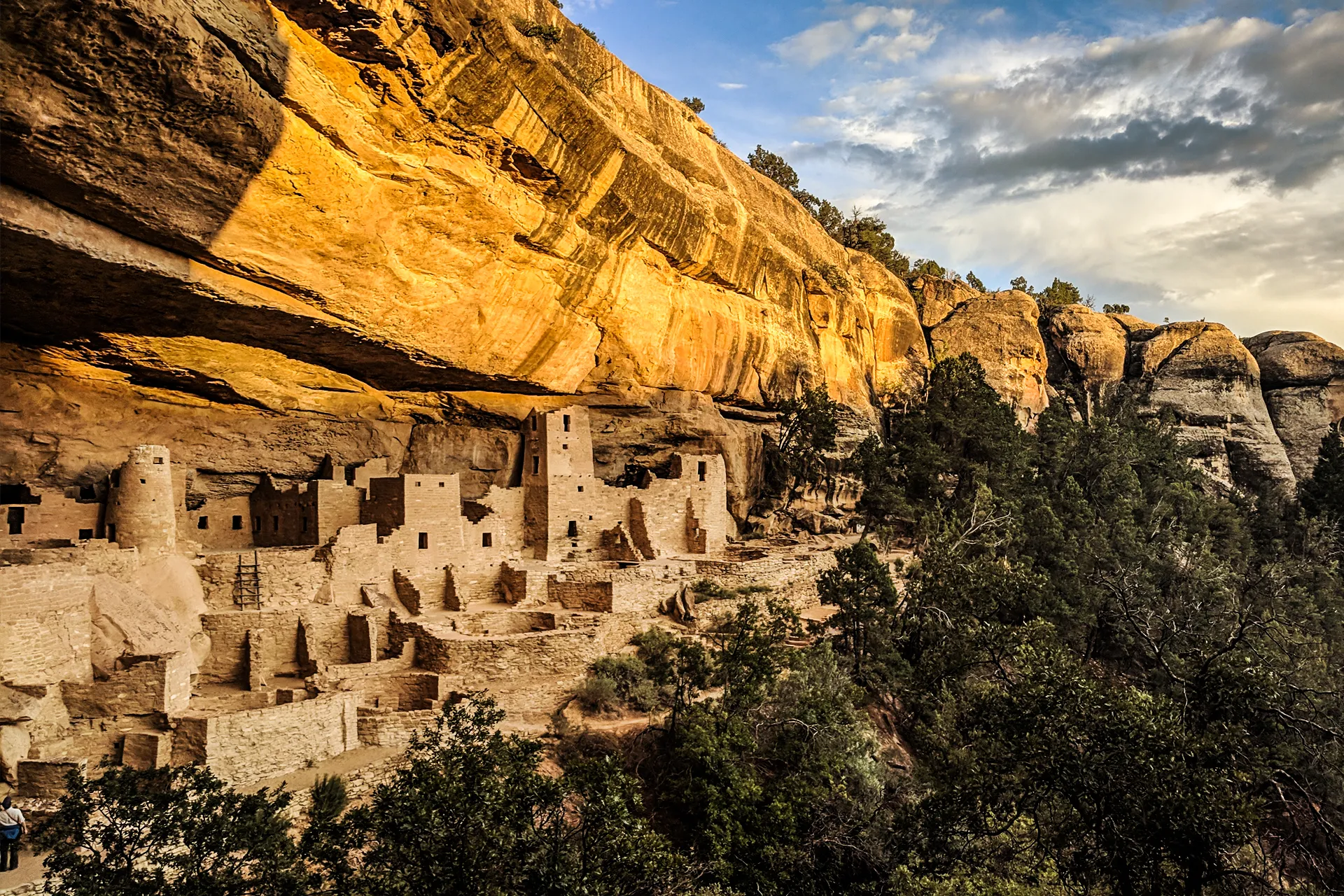
Cliff Palace, Mesa Verde National Park
Welcome to Cliff Palace, nestled within Mesa Verde National Park in southwestern Colorado. As the largest cliff dwelling in North America, this site consists of over 100 stone rooms that rise up to four stories tall, constructed underneath a large overhang in the sandstone cliffs. Built of mortar and shaped stone, the roofs and windows of these interconnected walls provided panoramic views of the tree-filled canyon below. With its remarkable preservation, Cliff Palace offers a vivid window into more than 700 years of human history. It is a sacred site for modern Pueblos and Tribes. As you explore this ancestral dwelling, consider what this place means to you and why it is important to protect it. There are many ways of understanding and connecting with this place. By honoring diverse perspectives, we can fully immerse ourselves in the rich tapestry of its history.
Stop 1. Introducing the Guides
Guiding you through this experience will be Christine McAllister, a seasoned park archaeologist. Additionally, you'll be introduced to Indigenous perspectives from three dedicated interns: Satchel Martin of the Hopi Tribe, Ian Bowekaty from Zuni Pueblo, and Jordan Fragua from Picuris Pueblo. Mesa Verde holds deep spiritual and cultural significance for 26 modern-day Pueblos and Tribes from the region, and on this tour, we hope you’ll learn about how the inhabitants made this place home and some of the challenges it faces today from climate change.
Chris McAllister
Hi I'm Chris McAllister, I'm an archaeologist who's been working at Mesa Verde over 20 years now. I've gotten to do lots of different things throughout the park. From survey to architectural documentation. And I had the pleasure of doing condition assessment here in Cliff Palace in 2011 and 2013 after we were noticing structural stability issues uh mostly in the South End of the site, that way. During that process, we look at the condition, architecture, features, rock art, plaster, lots of great details about the site as well as the larger picture. And that experience just really increased my respect for the Ancestral Pueblo architects, builders, stonemasons that constructed this site. And it's going to be great to be able to give you the opportunity to do a virtual reality tour through the site, get to see these spaces up close and personal and without any impact to the site.
Satchel Martin
(Satchel speaking Hopi) Hello, my name is Satchel I'm from the Hopi tribe of Arizona, the westernmost Pueblo group associated with Mesa Verde. I'm here today to talk about Cliff Palace and offer the perspective that I have, as a young man from Hopi. We will talk today, of course about the architecture and the archaeology, but what I want to highlight the most is that here in Cliff Palace, we have these sacred connections that can still be felt today. I want to talk about my ancestors here, the Ancestral Puebloans. I want to talk about the effort, the care, the attention, and the love that they brought to places like Cliff Palace. They turned places like Cliff Palace from not just houses but into homes. Today, I want to highlight the human connection that can still be found here. I don't think you have to be a member of a descendant community to understand places like these are special. They are places that should be honored and places that should be visited with respect. Today, you will be hearing perspectives from different indigenous voices as well as an archaeologist from the park. These multiple perspectives will come together to paint a more complete picture of Cliff Palace. Here within Cliff Palace, within Hopi, we believe that there's still people living here, they never left. When you look at the walls, when you look at the architecture, that is what's behind that's what we can see physically. With these perspectives, we hope to show the lives that were led here as well. When you come to Cliff Palace, don't view it as just the walls of the architecture, we want you to see it in the complete picture. We will discuss today about the lives that were led here. We'll discuss about care and attention that you see within all the walls and everything is a part of visiting with respect. Visiting with respect here with the Mesa Verde, when you finally come visit us in Cliff Palace, it's going to look like treating Cliff Palace just like any home. In the same way, you would respect your neighbors, we ask that you do the same here within Cliff Palace. Because these are homes, people live their lives here, children were born, grew old, and they married, and lives were led throughout Mesa Verde. We can still feel those connections when we look into places like Cliff Palace. This window to the past is going to offer us an excellent perspective about how my ancestors lived here within Mesa Verde.
Jordan Fragua
(Jordan Fragua speaking Tewa) Hello everybody, my name is Jordan Fragua, and I come from Picuris and Ohkay Owingeh Pueblo in Northern New Mexico And I'm really honored to be amongst you all and tell you a little bit about Cliff Palace here. Our ancestors have been calling this place home for a long time, and I'm really honored to be talking about it and sharing my own perspective coming from the Rio Grande area, so thank you.
Ian Bowekaty
(Ian Barracati speaking Zuni) Hi, how are you days? My name is Ian Bowekaty, I am from the Zuni Pueblo. One of the 21 descendant tribes of Mesa Verde. So it is an honor to be here and the reason why I'm here is to share my people's history, language, and culture. As many people don't know the lives that were lived here within Mesa Verde.
Stop 2. Why Live in the Cliffs?
You have just been whisked above the site on an overlook, looking down directly into some of the many rooms, towers, and circular kivas of Cliff Palace. These cliff dwellings represent only a small chapter in the history of Indigenous communities who have called this region home for millennia. Many generations lived atop these mesas. They hunted deer, bighorn sheep, and small game, raised turkeys, and grew crops like corn, beans, and squash. They also gathered many wild plants, including ricegrass, berries, and potatoes. Their farming successes led to the establishment of stone villages with populations in the thousands. However, around 1100, there was a change. They began constructing homes within these cliff alcoves. You might wonder, "Why this shift?" Was it for added safety or protection from the elements? Let's explore these questions together.
Chris McAllister
So, movement into the alcoves, there were a lot of reasons we think for this. Archaeologists believe a lot of these reasons were environmental, there were a lot of stressors occurring on the Mesa top in the mid-1100s as population increased and resources were dwindling, and there was a megadrought. So it would make sense to move into an area where there was a more reliable water source. And these alcoves most of them had seeps and springs. Cliff Palace does not have an active seep anymore but we believe that they did at the time of occupation. Not to mention you can also get water from alcove runoff over the the top of the mesa. These places also had abundant building materials right here in the alcove and the alcove itself would help form a roof and walls to some of the back rooms. So there's lots of advantages to to building in an alcove. Also, safer food storage, restricted access into these places. And these places were part of a larger Canyon Community uh most of the alcoves were occupied. Here in Cliff Canyon there are sites to the north and south of Cliff Palace there would a lot been a lot of movement within the canyon and up to the mesa top. And we've got Sun Temple right across the canyon here that's another unique ceremonial site with a direct line of sight to Cliff Palace here. We've got Kokopelli House across the canyon, Sunset House is just down canyon so uh it was part of a larger canyon community.
Jordan Fragua
Why live in cliff-dwelling sites? That's been a question archaeologists have been trying to answer for a really long time. Since people started to find sites like Mesa Verde. And so definitely you do have a lot of good hypotheses like drought of course, being an issue and maybe getting out of the elements too as well. But I definitely think that Pueblo people have a different perspective on this too as well. Definitely a spiritual sense maybe a different adapting to your environment of course, and just being one with your landscape too as well, because you want to utilize it to the best of your ability. And I think that definitely happens when utilizing your cliff side as well. And it's not just happening here at Mesa Verde but it's happening throughout the Southwest. It's happening at here at Mesa Verde, of course, Bandelier (Ntl. Monument), Walnut Canyon, Gila National Monument, and down in Southern New Mexico and, of course in northern Mexico too as well. So it's a very vast movement if you will, and so I definitely think that there are some type of social change happening at that time too and it's happening at a rapid pace and it's happening amongst a lot of people in this area.
Stop 3. Central Role of Water
The large sandstone overhang sheltering Cliff Palace is natural, mainly made by water seeping into cracks. When water freezes, it expands, enlarging cracks in the rocks. Eventually, this causes chunks of rock to break away from the cliffs. Over time this action creates alcoves. In this arid region, water is a vitally important resource. Today, climate change is raising temperatures and intensifying droughts which has major implications for water availability. In the past, communities gathered water on the landscape in various ways, including collecting snowmelt in reservoirs and capturing rainfall in cisterns. However, in the driest of months, seep springs located in and near the base of these alcoves would have been an important source. Perhaps it was the springs in the cliffside that enticed families to build their homes here.
Ian Bowekaty
So these alcoves are natural formations, formed by water. And so the Ancestral Puebloan people relied heavily on the water as it had the power of life and death. And so for the Zuni people we call water "Ky'awe" which means it has its own spiritual, it is a spiritual being. And so we have a deep connection to it, where we give offerings in order for more water to come to this area, replenish the land, give us enough water to mix the mortar, and create these homes you see here.
Stop 4. Making a Home in the Cliffs
Whatever compelled families to settle on the cliff side, it's clear it was an excellent location. Now, at ground level within Cliff Palace, you can observe how homes were built next to one another, similar to modern-day apartments. The sandstone blocks used to construct these square room walls were carved and held together with a mortar made of mud and water. Each family would have used multiple rooms built around a small plaza atop a round subterranean structure called a kiva. Based on the number of kitchen spaces in these side-by-side apartments, archeologists estimate that around 120 people lived at Cliff Palace.
Jordan Fragua
Yes, you do see this for like an architectural and archaeological wonder, which it definitely is, but you have to use your imagination when going into these sites too. You gotta remember what you're seeing here is what's left over, and what was left behind. Definitely, they took a lot of their valuables with them, but you also have to realize too that these walls have been plastered, that life was in these alcoves too as well. So you also have to remember that fact that people call this a home. And so you have to add that aspect to everything too, and you have to use your imagination coming into this place. So definitely consider that and especially remember too that artifacts were left behind too. Some, not everything but definitely the things that they felt were so precious they took back with them, and they took with them everywhere. And that's why you see in modern contemporary pueblos today a lot of the same artwork. A lot of the same tools are still being utilized until today too as well. So we still have that same connection with the people that lived here.
Stop 5. Kivas
Take a moment to look around. Have you noticed the many round rooms in Cliff Palace? These are kivas, special circular rooms still constructed and used by Pueblo communities today. Kivas like the one in front of you are built into the ground, creating a chamber with a bench around the perimeter where individuals could sit. The bench is interspersed with vertical columns where a wooden roof structure would have been supported and plastered over to make it waterproof. With a total of 23 kivas at Cliff Palace, both Pueblo descendants and archeologists believe this indicates this location was a special gathering place used during ceremonies.
Chris McAllister
This is one of the 23 kivas at Cliff Palace. Keep in mind there would have been a roof on top of this, and on top of the roof would have been a plaza or courtyard area. But the roof construction is really interesting; most of these had cribbed roofs. Kivas in general are a great example of Ancestral Pueblo engineering. They have a lot of features in common, although each one is a pretty unique in these alcove sites because they conform to the size and shape of the alcove but they all have a banquette or bench which forms the lower wall. There's columns on top of that called pilasters which would have supported that cribbed roof. And they have a ventilator tunnel complex which regulated the airflow into the kiva. So the cool fresh air would get pulled down through that ventilator shaft and it would hit the deflector so it didn't put out the fire in the hearth and then the smoke and heat would get pulled out through the roof hatch which was generally in the center of the kiva roof. Kivas are great spaces because they maintain being mostly subterranean they maintain a fairly constant temperature. So they're cooler spaces to hang out in the summer and warmer in the winter. And although for many years it was believed kivas were strictly ceremonial, we believe they're more multi-functional spaces that they were also used for domestic activities.
Jordan Fragua
So, the Kivas here at Mesa Verde are very similar to me, and they actually hit home for me. Coming from Picuris [Pueblo], we still practice in underground Kivas such as the ones here that you see at Mesa Verde. So the ones that you see here are very similar to the ones back home, and I can just see myself being in these sites, too as well. And I can just feel their presence too as well which is something really unique for people coming into this area. And for me, a good story I always have is just me growing up in the Pueblo, you can hear the war chiefs hollering out for practice time and going to the kivas. And me and my little brother would get dressed up in our traditional regalia and we would just take off up for the Kiva. And of course, we always practice at night and the ceremony would happen a few days later. But every time we practice, it's always at night, so you just see that glow coming out from where the ladder is at. You can just hear the voices inside the Kiva, too as well. And then when you start to walk in, you get that smell of smoke and you see that little bit of haze to everything too as well. So these sites are very much alive for me for those facts. And I can just see the ancestral Pueblo people also utilizing [them in] that same sort of way and it's very home for me, too as well.
Stop 6. A Closer Look at Pueblo Architecture
Every block in Cliff Palace was meticulously handcrafted by Pueblo artisans using stone tools. Rectangular blocks resulted in more even masonry, producing sturdier walls that required less mortar. In this location on the right-hand side of Cliff Palace, you can see how, in some areas, the masonry rises three and four stories. To stabilize the walls and make them more uniform, a thin layer of plaster was often applied over the surface. Observe the precision of the square rooms and the perfection of the many corners. In certain spots, you can even glimpse the fingerprints of builders imprinted in the mortar between the stones.
Chris McAllister
So, in addition to doing condition assessments at spaces like Cliff Palace, we also do architectural documentation. During that process we're looking at the different spaces within the site; the rooms, the kivas, the open areas. And we're looking closely at the walls, their construction, the floors, the roofs, and the different features within them. We document size, shape, things like that as well as condition and we tried to determine a function for that space. Behind me is Speaker Chief complex that is a beautiful example of Ancestral Pueblo architecture, you can see all the finely shaped stones, how straight these walls are, the finely shaped features. Here are what we call wall entries, they are doorways. And they had the capacity to seal these doors, there's a slab right there below that one. And if you look closely, there were little loops on each side of the door where a stop rod could be placed across that to help keep that seal in place. We look closely at those wall entries because one of the things that we can determine is whether they were sealed from the exterior or the interior. And that helps us determine whether it was a living space or a storage space. And so we're looking at these individual units and then we're putting it all together looking at the site as a whole and what different areas were used for, how the site functioned um as a whole, as well as these different smaller courtyard complexes and things like that.
Satchel Martin
Architecture, architecture is why we're here today to see Cliff Palace. The beauty here, and the hard work and dedication done by these Ancestral Puebloan architects, engineers, and masons is why people travel the world to come here to see Cliff Palace. We have our far-away perspectives, but I want to come in a little closer and talk about the details. Because, even in the smallest piece of mortar and the smallest stone set into these walls, you can still see the hard work and dedication that is required to build beautiful homes such as Cliff Palace. The textures on some of these rocks is going to be done from rock pecking. An Ancestral Puebloan mason using his stone tools, crafted this stone to the exact form that he wanted. You can see how many stones there are here, and you can imagine the effort that was required to build Cliff Palace. We have 150 rooms here, and each one is going to show that same love and care that as much as any other room. Again, these are homes, the same way for us we want to live in a beautiful house and we want what's best for us and our families, Ancestral Puebloans we're no different. So look and remember, that every single piece of mortar, every stone, every piece of plaster is going to be done with those Ancestral Puebloan hands. Think about the person that was laying those stones, think about what they were thinking when they were building their homes for their families and for their neighbors for their villages.
Stop 7. Dating Cliff Palace
Cliff Palace's impressive preservation is, in part, due to the arid environment found in this part of Colorado. Many wooden beams, which once supported multi-story floors and roofs, remain remarkably preserved. Here, inside one of the square towers at Cliff Palace, you can look up through beams that delineate each level of the tower. These beams were reset in the 1930s to stabilize the tower. However, by analyzing the tree rings of beams that are still in their original context, archaeologists are able to determine the approximate construction dates of these rooms as well as tell us what the climate was like in the past. Don’t miss the designs that cover the walls in the upper stories.
Chris McAllister
So, dendrochronology gave us some really good advances in dating our sites such as Cliff Palace. They allow us to see when major building episodes took place, as well as identify more individual construction sequences within the site. Right here behind me you can see a beam that has been cored. These cores show the tree ring sequence and allow us to date when that beam was harvested. So that's where we get that information. And here at Cliff Palace we have a whole range of dates, we only got about 70 dates back because there wasn't a lot of wood in this site compared to some of the other large sites that we have. But we have a range of dates from 1190 to 1280. Some of the clusters where we had big building episodes here are in the 1240s and in the late 1260s and 1270s. And we just have one date from 1280, that's our latest date in this site, and it's from one of the kivas. The tower that you're looking at here those beams you see are stabilization- placed by stabilization, they're not original because one whole corner of that tower had been collapsed. We did get one date from the tower and that's 1264 it's from a piece of wood in the second Story. So I'll talk a little bit more about stabilization because I know that's an interesting topic and people want to know how much of the site is original. Well we do have about 75 to 80% of it is original. Iin stabilization, especially these days we try to preserve what's existing with very minimal intervention and we don't rebuild anymore. We also try to mimic the aesthetic of the Ancestral Pueblo and their construction style. So behind me you can see as an example below the beam, that's stabilization mortar, above it is original mortar. And they really don't look that different, but uh we can tell by by the type of mix that is. And we keep really good records of what we have stabilized using photographs and paper documentation. There's been quite a few stabilization episodes in Cliff Palace, as there has been in a lot of our alcoves because they're subject to constant deterioration. Even though they're well protected under the alcove and obviously the structures out in front get a lot more of that effects from weather rain and whatnot, so they need a lot more work. But the the major stabilization episodes we've had in this site started with Fewkes in 1909 he stabilized quite a bit to get the site ready for visitation. And then under the direction of Al Lancaster we've had a couple different stabilization episodes. In 1934- 35 he did quite a bit of work, and that included work on Speaker-Chief complex and the tower. He took out what Fewkes had done, which didn't look like it was going to be durable enough and he rebuilt that and he also took it up to the fourth story which Fuches had not done. So Lancaster did a lot of really good work, it was under the direction of Earl Morris and there was an architect who came up with a really cool documentation system. This was called the Morse mapping project and they developed a way to show using these cords wrapped around areas that were going to be stabilized. Just a good photographic documentation of pre-stabilization and post-stabilization and exactly what they did. So that's been really helpful to us today to determine the work that was done back in the 1930s. There was also stabilization done in almost every decade, the 60s = quite a bit done in the 80s and 90s here at Cliff Palace. And then after we noticed some structural problems in the South part of this site we came in we did that condition assessment and then our stabilization crew came in over the next few years starting in 2015 and worked on the most severe problems that we had identified. Especially some of the kivas down here that were starting to collapse inward
Stop 8. Pueblo Farming and Food Storage
Above the main village site at Cliff Palace are several small rooms likely dedicated to storage. Pueblo farmers, deeply attuned to the drought cycles, devised ways to prepare for them. The upper rooms of Cliff Palace were probably repositories for dried corn and beans, safeguarding food not only for winters but also during drought-impacted years. Today, just as in the past, it is imperative for communities to adapt and be conscious of environmental shifts due to climate change, ensuring the ability of future generations to enjoy these spaces.
Ian Bowekaty
Have you noticed these smaller rooms in the upper alcove? They utilized all the space they could, and so these rooms would be used for storage. As you can see, they would have plastered and maintained these rooms as well. And so, in the upper alcove, you do have its original plaster, and inside those rooms, you would have your food stored. A lot of dried corn, squash, and beans would be kept to sustain them throughout the entire winter months.
Stop 9. Thriving, Not Just Surviving
Despite frequent droughts, it's evident that communities here were able to prosper. The exquisite architecture and numerous cultural items discovered on-site underscore this prosperity. However, by the mid-1200s, families started departing from these sites and the broader Mesa Verde region. What prompted this migration? Persistent drought? Decisions made by community leaders? It's likely a combination of several factors. It's believed that by this time, many had migrated south to more fertile farmlands, with many joining Pueblos along the Rio Grande and its tributaries. However, while the populations of the Mesa Verde Region relocated, it's vital to understand that these sites were neither abandoned nor forgotten.
Jordan Fragua
When the Wetherill's and early archaeologists came into the site, they found a lot of items still within the homes here at Cliff Palace. And they show signs that people were not just surviving in the area, but thriving, too as well. In their items of clothing, and their ceramics, there were a lot of geometric shapes. And textiles had embroidery also on it too as well. So people were not just making these items for utilitarian use, but they're also making it for a style and for an aesthetic too as well. And a lot of this artwork and a lot of this designs that they utilize at this time period can still be found in Puebloan textiles and ceramics still today. And so imagine just being in these sites and imagine leaving too as well during time of migration in the late 1200s and early 1300s. You can only take what's on your back and so a lot of stuff you had to make a choice for. And a lot of these items too would have been heirlooms throughout that time period as well. And so you have to make a decision on what you take and what you don't. And so the ones that are left behind, were the ones that were left behind by the people when they had a priority of over something else, and they took it down south. And that's why you see a lot of the same artwork, and a lot of the same ideas also too of this textiles, they're still being utilized today And so just imagine how hard it would be to make that decision to leave beautiful art, pieces of art behind too I think that's just something to consider when looking at these items too as well.
Stop 10. Preserving the site for Future Generations
Thank you for visiting Cliff Palace. From this vantage point within Cliff Palace, looking out across the valley, it is clear to see why Pueblo communities called this place home. As a national park, Mesa Verde continues to preserve Cliff Palace for future generations. Working closely with Pueblo and Tribal leaders and community members, park staff strive to protect these special and sacred places for years to come.
Chris McAllister
So, one of our challenges in preserving and protecting these sites for future generations is climate change. And specifically the increased threat of wildfires, which is a big thing in the southwest, as you know. Since 1996, we've had quite a few large fires here that burned over well over half the park, I think it's close to 70%. And it affected hundreds or thousands of sites. We got really good at postfire mitigation, we learned what treatments we needed to install to mitigate those postfire effects, big one is erosion. We have installed log diverters, silt logs, excelsior matting and done reseeding to bring back native vegetation faster in the alcove sites. Because we get so much water runoff that lands right on the architecture, we experimented with silicone drip lines which helped divert that water. So lots of good things to mitigate the damage, but one thing we're trying to do now is be more proactive and get out to the areas of the park that have not burned, and document those sites while they're still intact. The Ancestral Pueblo also needed to be adapted to climate change, they definitely dealt with several extended periods of drought. They became excellent dryland farmers, water engineers, there's lots of water control systems throughout the park. And some of our big fires revealed that these were even more extensive than we had realized previously. The vegetation grows really thick in our drainages here and when the fire burns it off, suddenly, a lot of new features are visible. So we have lots of remnants of farming terraces and check dams, there's also water catchments, reservoirs, lots of water control going on in those times. The Ancestral Pueblo also used fire. There's evidence that they used fire to manipulate the landscape, to clear lands for agriculture, clear undergrowth for easier movement around, and such. Our studies have shown that there was increased fires during the occupation and then it dropped off after they migrated.
Satchel Martin
Thank you for visiting Cliff Palace today. I'm glad that you could join us as we offered our different perspectives, and I hope now that you have a better understanding, a bigger picture of Cliff Palace. Cliff Palace is more than just the architecture, it is the people that lived here, those dogs, it was the turkeys, it was the pottery, it was the weaving, there's so much more here in Cliff Palace that can still be found and still be felt. The Ancestral Puebloans they didn't disappear, we're still here. My ancestors left Mesa Verde, and we traveled out West to Hopi. But we also had journeys all the way down through New Mexico into Texas. The Puebloan people, our contemporary tribes, we're out here and we're a diverse group of people, but we all share that sacred connection here in Mesa Verde. And remember, don't think you have to be a member of a descendant community to understand how special Cliff Palace is. So I'm so thankful that you're able to join us here today, and that we were able to share our perspectives of Cliff Palace. "Kkwakwhay" Thank you.
Ian Bowekaty
All right, so as we look across Cliff Palace, we can imagine the lives that were lived here. From the dogs barking, and the children running on top of these homes. And so although they aren't here today, you can imagine the lives they have lived and continue to live beyond Mesa Verde, and throughout the entire southwest region. As this was a place of learning where many things were shared, such as the language, the culture, and stories that were passed on from generation to generation and continue to be practiced in our modern Pueblos today.