Elephanta Caves
Welcome to Elephanta Island or Gharapuri, a tranquil retreat just a short ferry journey from the bustling Indian metropolis of Mumbai. Amidst playful monkeys and lush greenery stands the main cave, an underground temple complex carved into basalt and dedicated to Lord Shiva, one of the principal deities in Hinduism who is revered as the supreme being by over a billion practitioners worldwide. This site, rich with intricate carvings, illustrates Shiva's cosmic roles as creator, preserver, and destroyer. Through the stories of Dr. Kurush Dalal, Dr. André Baptista, Professor A.P. Jamkhedkar, and village head Meena Mukesh Bui, you'll gain insight into the cave's history and how the carvings illuminate different aspects of Shiva’s character and his role in maintaining balance.
Stop 1. Cave Temple Design
Now, in the center of the Eastern courtyard, a smaller cave shrine emerges on the left, while the expansive open hall or mandapa unfolds to the right. This entire complex is known as the main cave and comprises the central gathering hall before you and two small shrines on the east and west sides of the hall. The Main Cave is one of seven rock-cut caves on Elephanta Island that were carved between the 5th and 7th centuries. The mandapa in the Main Cave features nine exquisitely carved bas-relief panels, each as tall as the cave, which showcases different aspects of Shiva's nature, surrounded by various figures and deities. Dive into the details of each panel by clicking below.
Stop 2. Earthly to the Divine
As you ascend the stone staircase from the courtyard, consider how this movement into the mandapa makes you feel. The stone staircase, with the semi-circular chandrashila or moonstone at its base, represents the first step from the earthly realm towards the sacred interior of the temple. This design relates to important aspects of Hindu practice, and the architectural layout conforms to ancient shastras or rules that inform temple architecture. At the top of the staircase, you arrive at the entrance porch, which opens to several rows of giant stone pillars topped with rounded capitals that rise 16 feet to support the cave above. The spacing of the pillars creates an expansive atmosphere, guiding your gaze and inviting you to delve deeper.
Dr. Kurush Dalal
So in the natural order of things, as we understand it to today, a temple has many constitutes and you walk into a temple through various different worlds, from the world of man to the world of God. And there are various different steps on the way. The Natyamandapa is usually the place where you engage with the divine, using music and dance as a form of worship. In the case of the Elephanta Caves, since the very early and a lot of architectural style has not yet been codified, what you are looking at is an amalgam of multiple mandapas being squeezed together to share the space between the two shrines, the main shrine and the subsidiary shrine, and to perform not just the function of the Natyamandapa, but of a Mukhamandapa or a Mahramandapa itself.
Meena Mukesh Bhoir
(Meena speaking Marathi) I believe when you visit the temple there, it brings happiness. It feels like a place full of energy... Whenever we have visitors, we make sure to take them to this place. They enjoy the experience as well. They often comment, "Gharapuri is a great destination." "The Elephanta Caves are a must-see." Everyone appreciates the visit. I just want to share with everyone that visiting the Elephanta Caves complex supports our community's, livelihood and that is something we truly value and appreciate.
Stop 3. Ravanaanugraha - Ravana Shaking Kailash
You're now standing before a panel just off the Eastern courtyard. Though now somewhat eroded, this intricate carving portrays Mount Kailash, the sacred home of Lord Shiva, with Lord Shiva and his wife Parvati by his side. The scene captures a moment of intense drama: Raavana, the king of the town of Lanka and a devoted follower of Shiva is frustrated by Shiva's indifference to his prayers. In a fit of rage, he attempts to lift Mount Kailash. As Parvati expresses fear, Shiva calmly presses his foot onto the mountain. This action instantly overwhelms Raavana with an unbearable weight, humbling him. Realizing the futility of his pride against Shiva's divine might, Raavana seeks forgiveness and receives Shiva's blessing.
Dr. Kurush Dalal
Ravananugraha-murti as it's called, is a panel where the impatience of Ravana leads him to shake Mt. Kailash. Mt. Kailash is the abode of Shiva, where he resides with his family, especially his wife, Parvati, and when Ravana shakes the mountain at its base, Parvati shows fear at this sudden intrusion into her life and with a very, very simple gesture, depending on which mythological story you believe in, or version you believe it's either his little finger or his little toe which is all that Shiva needs to send Ravana plummeting below into the lands below the Earth. To show you the might of Shiva and the fact that Shiva does this without any real effort on his part with a very, very beatific smile on his face of almost amusement, that Ravana thought that he could intimidate Shiva, whereas he did not realize his place in the universe.
Stop 4. Sadashiva - Eternal Shiva
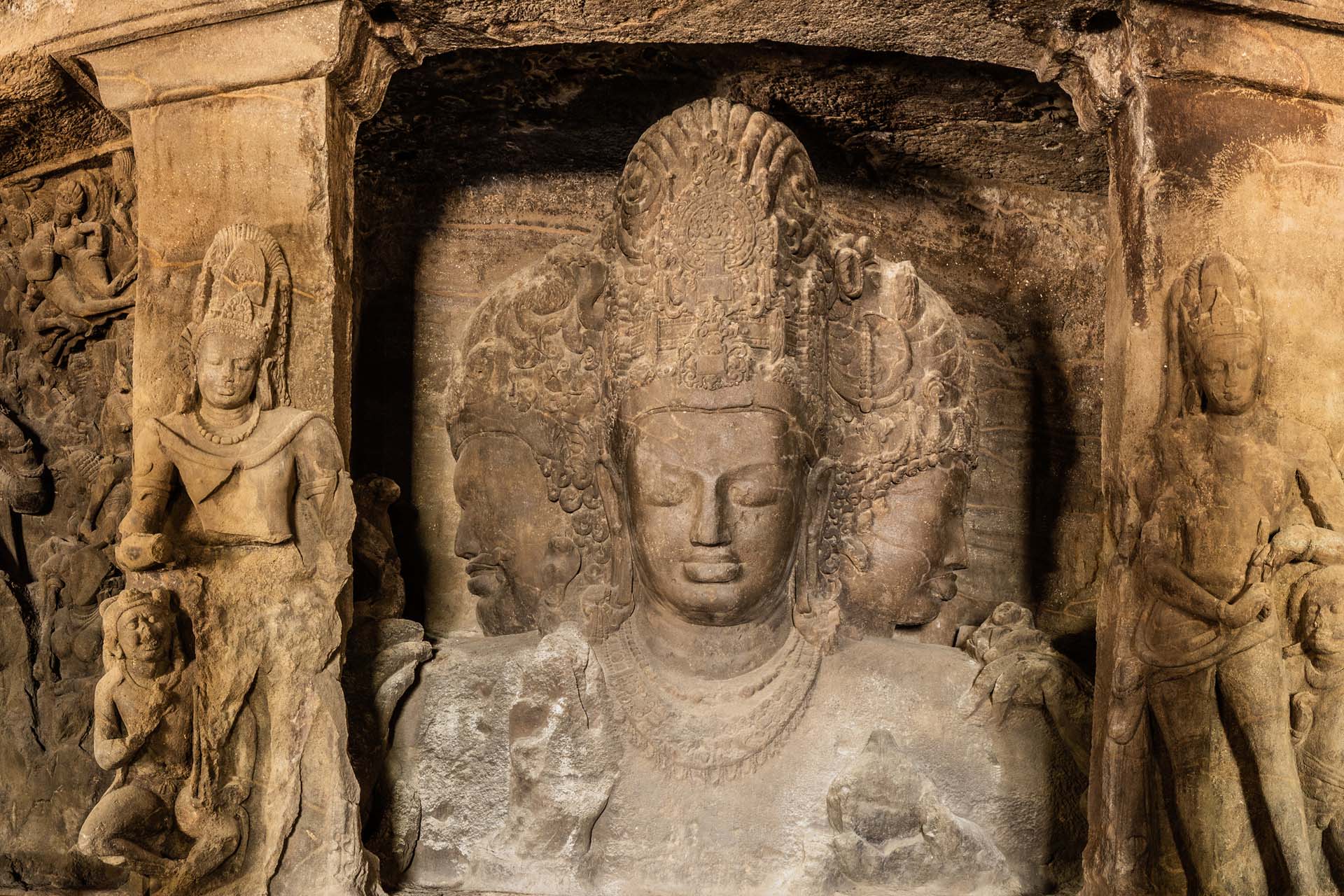
You have just been whisked to the base of the “Sadashiva” sculpture, a towering 18-foot testament to Shiva’s complexity. This panel, one of the best preserved, artfully depicts three visible faces, each representing a different aspect of Shiva's nature. What side are you drawn to? On the left, Shiva's masculine and destructive side is portrayed with a rugged expression, a mustache, and a snake. Moving to the right, the central face symbolizes Shiva's transcendent nature and harmonizes male and female qualities in serene meditation. Finally, Shiva's feminine and creative side is depicted to the right with a soft smile and a lotus. This sculpture hints at Shiva's emergence from the mountain and seamlessly melds his diverse attributes.
Dr. Kurush Dalal
So what you have to understand about these panels and this is what the modern viewer often fails to notice in this age of visual overload, is that in a time and an age when by and large people were illiterate, the stories that were told were told using these panels and that these panels are narrative. Very often the figures replicate themselves. You see, the gods, the rest of the gods, usually in the periphery, towards the top showing their subservience to Shiva and showing the fact that they had to approach Shiva to do what needed to be done, and therefore, his paramountcy is obvious, and the fact that when push comes to shove, only Shiva can maintain the balance. And whatever you may do, however far you may go, ultimately you are answerable to Shiva. And each of these stories comes with a whole set of morals guidance on how to live your life and how to be a better person, how better to integrate yourself with your environment, with your people, with your land, and with the universe in general.
Dr. André Baptista
The marquee image The panel is, of course, the Trimurti the Sadashiva. The Shiva with three faces, different aspects. The fourth one is conjectured. That has even become the symbol of the Maharashtra Tourism Development Corporation, the MDDC. It has, well, no pun intended, become the face of the organization.
Professor A.P. Jamkhedkar
As we enter it, now we see immediately at the other end a three-faced image which is called the Mahesha-murti. Actually, this is a misnomer, it should be called actually the Sadashiva-murti because of the other two faces of Sadashiva. Sadashiva has five faces, the five faces of Shiva. The face of Shiva which is at the rear cannot be seen because there is a wall. The face on the top is not to be seen at all because it is there, but it is not to be seen, the fifth face. The four faces represent the four aspects of you can say Shiva who has entered the world of cosmos.
Meena Mukesh Bhoir
(Meena speaking Marathi) For Mahashivratri, we wake up early in the morning, take a bath, and then the whole family goes together. We perform pooja (prayers) as a family. We worship the deities Brahma, Vishnu, Mahesh, and the second trinity, including Ganapati and Ardhanari Nateshwar, All of them are revered on this special day. The highlight is the grand Aarti for the Trimurti (trinity), a special one-hour prayer ceremony, the Mahaarti! There's an increase in tourists during this period. Our home also welcomes guests on this day. After an hour of prayers, we return home, Yes, this all happens before the caves are opened to the public. The caves open earlier on this day, and villagers start visiting from five in the morning.
Stop 5. Gangadhara - Shiva Bearing Ganga
This panel beautifully captures the descent of the Ganga, India's most sacred river, from heaven to earth. It illustrates the story of King Bhagirath, who sought Ganga's waters to cleanse his ancestors' sins and liberate their souls. Initially reluctant, Ganga feared her force would destroy the earth. Shiva, moved by Bhagirath's devotion, intervened, catching Ganga in his matted locks of hair to break her fall. Despite her immense power, Ganga remained contained until Shiva released a lock, allowing her passage to Earth. On top of Shiva’s headdress, the panel depicts the three streams of Ganga. Shiva is shown with one arm lifting his hair to release Ganga, and the other offering reassurance and protection. Beside him, Parvati provides support and balance. This scene symbolizes Shiva's stability and resilience against formidable forces.
Dr. Kurush Dalal
So Gangadhara-murti or what in English is often referred to as the Descent of the Ganges is a very interesting story of a king who performed great penance to Shiva to ask for the celestial river, the Ganges to come down to earth so that it would wash away the sins of his ancestors and so that they could ascend to heaven, too. What is very interesting here is that when asking for this, the first thing that occurs is that if the Ganges were to descend on Earth from the heavens, she would destroy the Earth with her sheer arrival, and therefore it's not possible. What's happening here essentially is that the Ganges is ego. The Ganges represents ego, and in her ego she hurtles down and Shiva catches her in his matted locks and she is lost in the matter locks of Shiva swirling around. He not only blunts the force of her arrival, he also humbles her into understanding that her ego is nothing but humility is far greater than ego, and that in this case it is all about balance. If the prayer is for the Ganges to come down and perform something good, then that itself should be enough reason for the Ganges to do so. And you have to understand that the Ganges is perhaps the most important river in India, and therefore she has a very special divinity to herself, and she's critical to the growth of civilization in India, the Second Urbanization.
Stop 6. Ardhanarishvara - Shiva as the androgyn
To the left of Sadashiva, is a sculpture representing Ardhanarishvara, a form where Shiva and Parvati merge into one. Ardhanarishvara embodies the synthesis of male and female energies. In this depiction, the deity is split down the middle, presenting an androgynous form that blends masculinity and femininity. The male half of the figure leans on Nandi, the bull “vahana” or mythical carrier of Shiva, while the female half, Parvati wears a jeweled crown and holds up a mirror. This masterpiece symbolizes the interdependence of men and women, suggesting that one is incomplete without the other. In the legend of Ardhanarishvara, a sage refuses to venerate and show reverence for Parvati, leading to her merging with Shiva, and highlighting the unity of contrasting energies.
Dr. André Baptista
The Indian, Indic ideas of aesthetics, the theories that govern aesthetic thought, theories of Rasa, theories of Dhavani, ideas of form, meaning, content, I would have to say the Ardhanarishvara, the conjoined conjoining of the male and female figures so seamlessly. It's speaks so much about balance and the complementary nature of two entities that have to come together to establish maybe not equality, but equilibrium, and that for me is encapsulated by the sculpture where the artist has so painstakingly crafted this panel, where you have Shiva and Parvati joined at the hip and they just complement each other so well. The male and female form.
Stop 7. Sancta Sanctorum
As you approach the sancta sanctorum, a square room on the Western side of the mandapa, you are met by the imposing Dwarapala guardian statues, protectors of one of the most sacred areas of the temple. These tall figures stand in pairs and flank the four doorways to the sanctum. Their imposing presence serves as a reminder: only those with pure intentions may proceed. Before entering, it is common for devotees to circle the temple to honor the subsidiary deities. This circumambulation enables the devotee to undergo a spiritual cleansing. At the center of this sanctum is the Garbagriha, the temple's heart, a 'womb chamber' symbolizing the universe's origin. This space, stripped of adornment, focuses devotion on the representation of Shiva at the center.
Stop 8. Storing Water
To the west of the Sancta Sanctorum is another courtyard with another small shrine. The South wall of the courtyard is covered by a fence and a green tarp that protects a large water cistern. Historically, this cistern was vital for storing rainwater collected during the monsoon months and sustaining the community throughout the year. For centuries, it served the essential needs of locals, pilgrims, and temple priests, supporting daily life and temple rituals. However, recent shifts in weather patterns, with longer summers and erratic monsoons, have left the cistern dry, posing challenges for the community reliant on this critical water source.
Dr. André Baptista
Water is something that is quintessential to human settlement. Every settlement, every culture, every city, every town, every civilization depends on a source of water, and the island of Elephanta has a fresh water tank, a reservoir that was built around the medieval period, and of course, at the main cave complex, in Cave 1, as part of that complex, you have a deep water system that has been excavated out of the rock at the time the caves were excavated. Water is very important in the worship of Shiva. With the increase in tourism, there is more consumption of water and the island, this year, also, because of the intense summer we've had, has resulted in the drying up of the reservoir and the water in the system. That has created a lot of problems for basic existence on the islands, especially for the locals. A lot of the facilities on the island like toilets have run bone dry. Simple tasks like bathing and washing can’t be carried out. For the most part of its existence, Elephanta has very much been dependent on rainwater harvesting and with the erratic nature of the monsoons with which run from June to September, with certain years that ended up being drought years, we need an alternative to ensure that nobody from the island, none of the tourists, but most of the locals aren't inconvenienced by this lack of water.
Stop 9. Conclusion
Concluding our journey through Elephanta's main cave, we are left with an appreciation for its ancient rock-cut architecture, a marvel of faith, engineering, and artistry. The bas-relief panels, narrating Lord Shiva's quest for balance, offer timeless insights into universal themes. However, much like the natural deterioration of the rock, the wisdom intrinsic to these panels is also fading. This visit not only celebrates the spiritual and cultural legacy of Shiva but also underscores the importance of preserving this invaluable heritage for future generations.
Dr. André Baptista
So with regard to the results, the deliverables of this exercise I’m particularly looking forward to seeing the three dimensional model of the gives up online. I think that it'll create a lot of easy access for a much wider global demographic that would otherwise not have had the opportunity to come to India and visit these caves. The three dimensional model offers them this chance to navigate the caves, not just navigate the caves, but also stop and reflect on each sculptural panel that we have painstakingly documented and captured. With regard to a tour, the virtual tour, I think it creates an amazing learning tool, not just for an audience, but also for teachers, educators so that they can take students to Elephanta without having to take them to Elephanta.