Inside Durango’s Living Museum
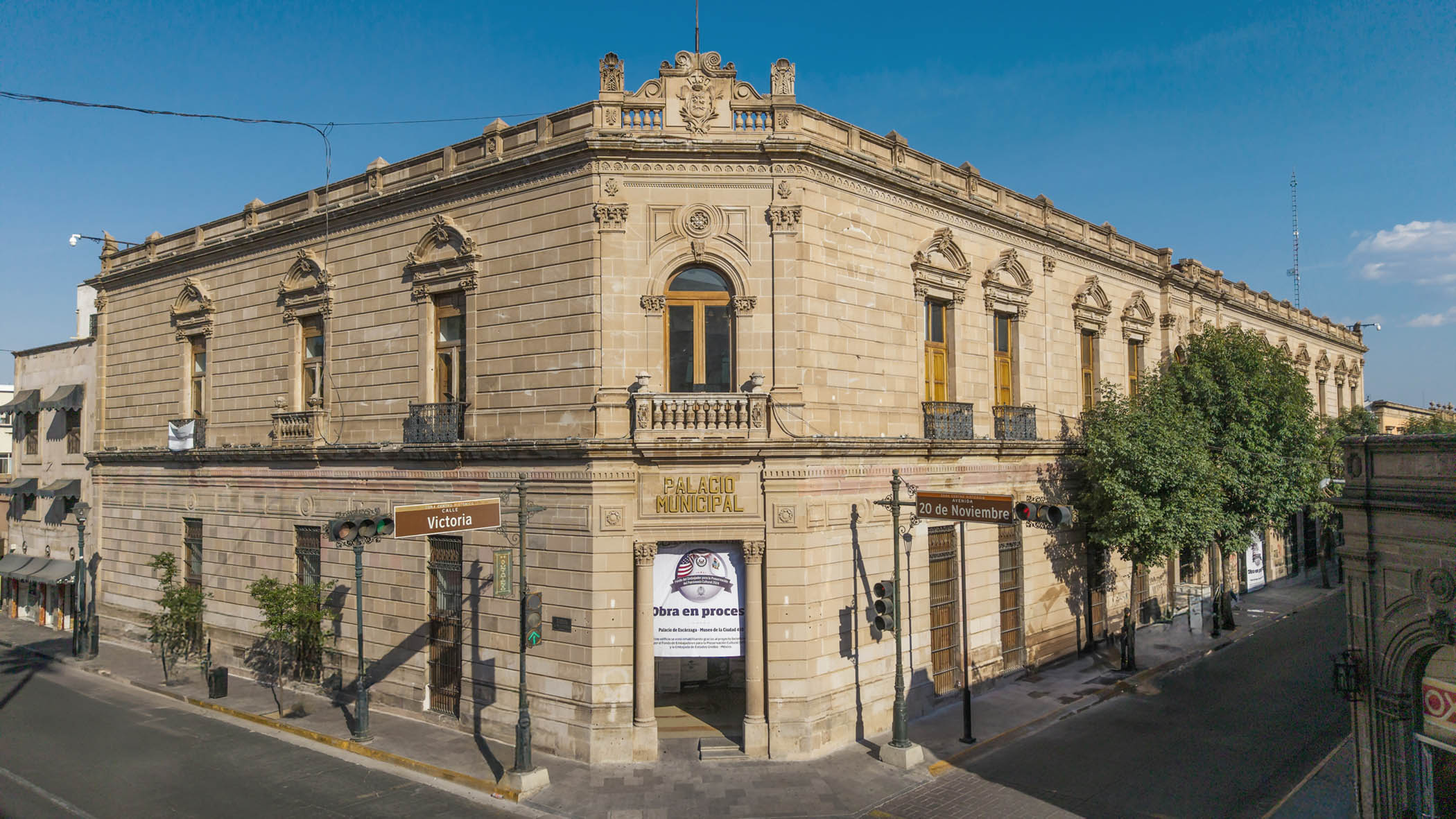
From above, you can see the heart of Durango's historic center, where the impressive Escarzaga Palace, now the Museo de la Ciudad 450, stands proudly. Built in the 19th century, this building has witnessed the city's transformation and holds the stories that define its inhabitants. In this virtual tour of the museum, you'll explore its architecture and galleries and meet the people who work every day to keep Durango's memory alive. Through art, history, and culture, the museum invites visitors to value their roots and strengthen the ties that connect Durango to the wider world. During this experience, you'll hear from the museum's director, a conservation specialist, and a local artist.
Stop 1. Escárzaga Palace, Still Telling Durango’s Story
The museum is a 19th century architectural treasure that reflects Durango's elegance and spirit. The building blends neoclassical influences with details from the Porfirian period, evident in its stone facade, wrought iron balconies and tall windows. Like all historic buildings, time has left its mark on these walls and structures. In 2013, after an extensive restoration, the palace was transformed into the Museo de la Ciudad 450. Later in 2024 the building received support from the U.S. Department of State's Ambassador's Fund of Cultural Preservation, which made further conservation and restoration possible. Thanks to this effort the palace retains its original splendor and continues to stand as a living symbol of Durango's history, art and culture.
Lucero Guadalupe Acosta Moreno
From the time this place was first created as the home of Don Pedro Escárzaga, and later became the offices of City Hall, and then in 2013 was restored and reopened as the City Museum 450, it has remained the only museum that truly tells the story of our customs, our traditions, and the origins of the state of Durango. From the very first founders, through every stage of its development, all the way to the modern era. For the people who visit us, it’s an attraction, because through its objects, display cases, and archways—within this beautiful French-inspired neoclassical building— they can enjoy themselves, be inspired, spend time together, learn, and have a place for families to relax and enjoy, for everyone who visits us here in the beautiful Escárzaga Palace.
Milton Escalier
I’d sum up these six or seven months of work as coordinating a team—a whole collective of carpenters, metalworkers, painters, stonemasons—and our own work overseeing and carrying out the project. It’s something we’re very proud of. Personally, I’ll carry it with me for the rest of my life. I hope we can repeat this experience in another historic building that continues to tell the story of our city.
Stop 2. The Courtyard: Light, Memory, and Murals
As you step through the entry hall, the magnificent central courtyard opens before you, framed by columns and filled with natural light. This home was built in 1898 for Pedro Escarzaga, a prominent Durango merchant, miner, and political figure. His success in mining, a defining industry in Durango's economic and cultural history, made it possible to construct this grand palace, a reflection of the era's wealth and ambition. Today, in this space, art and history meet through seven murals you'll encounter at different stops along this virtual tour. Niña Vendedora de Flores y Esperanza (Girl selling flowers and hope) by Durango painter and muralist Luis Gustavo Sandoval. Three large-format works by Ramón Alva de la Canal, belonging to Mexico's National Institute of Fine Arts. Two mural paintings, El Patio de los Poetas (Patio of Poets) by Guillermo Ceniceros. En Luz y Sombras (Light and shadows) by Carlos Cárdenas Reyes. And the most iconic mural, The Founding of Durango, created by master Francisco Montoya de la Cruz, which you'll explore at the next stop.
Lucero Guadalupe Acosta Moreno
This beautiful central courtyard of the City Museum is a symbol of Durango pride. So much has happened here over time. Ever since this palace was built by Don Pedro Escárzaga, it served for many years as a family home, and later became offices for the municipal government. Then in 2013, we worked to ensure that this space—the City Museum 450— would be opened and dedicated to Durango’s artistic and cultural community. So families can come and immerse themselves in the history of our beloved Durango— the history of who we are: our identity, our roots—our past, our present, and our future.
Milton Escalier
In the central courtyard, we replaced the canopy overhead because it had developed leaks. The new one is a single, seamless piece. We also refinished and re-stained the wooden handrails. And at the support points of the steel railing, we added welds to help prevent future accidents.
Carlos Cárdenas Reyes
We’re here at the Museum, and behind me is the work I created to celebrate the 450th anniversary of our city, the founding of our city. The theme mainly focuses on what has to do with the most important historical moments in our city’s history, and it’s titled *Light and Shadows*. The title basically has a double meaning. On the one hand, it refers to the difficult moments, as well as the bright, happy moments in our history. And on the other hand, it also gives another reading to the title *Light and Shadows* as something that has a lot to do with the art of painting. Lights and shadows are what in the end, are what give shape to the objects we see in nature, in reality. So I used this association of ideas to create this mural, which includes historical elements related to the colonial period, the Revolution, and the independence movement. And well, you can see all of these elements captured here.
Stop 3. Durango in three acts
As you climb the staircase, you're surrounded by a monumental mural by master muralist Francisco Montoya de la Cruz, created in 1952. The work is divided into three sections. The discovery of Cerro de Mercado and the Guadiana Valley, the growth of the colonial city through independence, the destruction of Durango in 1913 and its rebirth. This mural tells the story of Durango's beginnings, founding, and development, from early discoveries and the battles of conquest to mining and everyday life. Every brushstroke reveals the spirit of hard-working, creative people. Click the magnifying glass to explore details about the city's founding, Francisco de Ibarra and Guadalupe Victoria. Here, art becomes living history, and Durango emerges as a cradle of talent and identity.
Carlos Cárdenas Reyes
I’d like to mention that the mural located in the stairwell of Durango’s Museum 450— the City Museum—and created by Professor Francisco Montoya de la Cruz, is an especially important work, in large part because Montoya was part of a significant generation of muralists. In fact, when he came to this city and founded the School of Painting, Sculpture, and Crafts at the Juárez University of the State of Durango, it sparked a flourishing of mural art here in Durango.
Stop 4. Where City Life and Museum Life Meet
On the ground floor, a series of hallways leads to the museum's galleries. From here, you can explore exhibitions dedicated to the founding of Durango, its mining routes, and the city's path through progress and transformation, especially during the major changes of the 20th century. The City Museum 450 (Museo de la Ciudad 450) shares Durango's living story, showing how tradition and innovation continue to shape the city today, and what it may become in the future.
Lucero Guadalupe Acosta Moreno
For me, the City Museum 450, as its director, is a great source of pride, because it’s a cultural landmark—and here we welcome everyone with both professionalism and warmth, everyone who comes to visit us and learn more about our Durango—its customs and its traditions. And as someone from Durango, I’m very proud that these historic buildings can speak to the world—to the people and the community who come to visit. We’re truly happy to welcome you, and for you to enjoy this wonderful experience—taking this tour through the Escárzaga Palace, the City Museum 450—which is always waiting with open arms.
Milton Escalier
One story I remember especially fondly is that we were restoring the wood flooring in one of the rooms while children outside were visiting other temporary galleries, and the team felt so proud that we were doing something for Durango’s heritage—and for future generations.
Stop 5. What Makes Durango, Durango
On the second floor, the galleries celebrate what makes Durango so distinctive, and this building also remains an active part of the city's civic life. The former city council chamber reminds us that Escarzaga Palace still serves the community, bringing past and present together under one roof. In one corner, you'll find Cinema in Durango, a tribute to the state's legacy as the land of film, where more than 200 productions have used Durango as their backdrop. Nearby are "Flavors of My Homeland", a traditional kitchen that brings the aromas of the past to life. "Traditions" dedicated to mezcal and indigenous communities, whose legacy lives on through clothing, language, and costumes. And the "Scorpion Exhibit", a playful nod to the scorpion, one of Durango's most beloved symbols. Together, these spaces celebrate a rich cultural heritage, and remind us that Durango is a land of art, creativity, and pride in its roots.
Lucero Guadalupe Acosta Moreno
What makes the rooms of the City Museum 450 so unique is that you can experience a guided visit through each and every one of them— rooms that tell the story of our history, our roots, our traditions, and the culture of the municipality of Durango. In each one you’ll find different things that, as a family, will help you learn more about us—through our customs, our traditions, and what makes us distinct as people from Durango: what we can create and contribute, and what we can express and share with the world. What we want is for you to live this wonderful experience, and to take a little piece of our Durango with you—in your heart and in your mind.
Stop 6. An Open Invitation to Durango
It's easy to understand why this place is such a source of pride for the people of Durango. The museum is more than a collection of objects. It safeguards the values, traditions, and aspirations of a living community. Thanks to international partnerships and strong local commitment, the building has been restored and reimagined as a space for everyone. We invite you to step inside, explore its galleries, and let yourself be inspired by Durango's history, culture, and creativity.
Lucero Guadalupe Acosta Moreno
The message I want to leave with everyone who has shared this digital experience with us is a personal invitation to visit the City Museum so we can welcome you with the professionalism and warmth Durango is known for. Durango is known for. So you can experience this beautiful place in person—see it, appreciate it, feel it—and feel that excitement that we feel too, as people from Durango. What represents us, what identifies us wherever we are in the world. Thank you for being here with us, and for sharing your time and company. The City Museum 450 is open to all of you—families from every corner of the world who are watching. Thank you.
Milton Escalier
I highly recommend visiting the museum in person, because there are a thousand little details you can only truly appreciate firsthand. What I hope you take with you is all the culture and all the history we have to share here in Durango, Mexico.