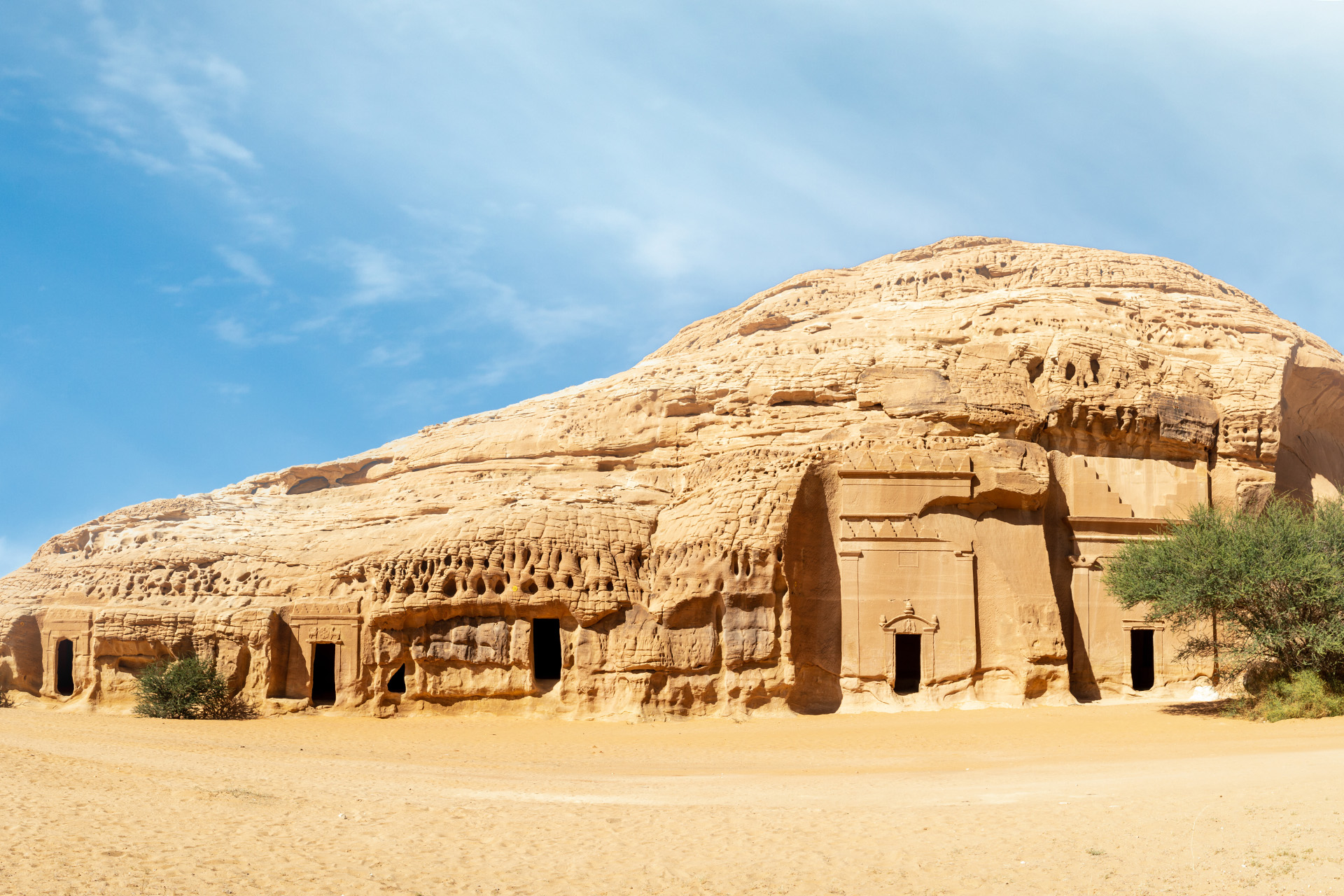
Welcome to Jabal AlBanat
[Music Plays] You have arrived at Jabal AlBanat, part of the Hegra UNESCO World Heritage Site, located in the region of AlUla, in the Kingdom of Saudi Arabia. For over 2,000 years, people have carved their presence here, traders, craftsmen, and families, who made this sandstone mountain their monument. The Nabataeans created the great facades you see, but the story of this place reaches deeper, into older burials and later Islamic traditions that continue to shape its memory and meaning. Some come to reflect, others to study or to marvel at the artistry carved in stone. As you move through this landscape, you'll hear voices of those who continue to care for it, an archaeologist, two Ruwat storytellers, and a conservator Together, they keep alive a dialogue between the past and the present in AlUla, one that now includes you.
Stop 1. Layers of Significance
The layers within the sandstone mirror the layers of meaning at Jabal AlBanat. Along the southern edge of the mountain, you see the oldest burials. Rectangular cuts marking simple, shallow tombs, carved high into the rock perhaps 500 years before the Nabataeans. These Iron Age graves seem to open toward the sky, perhaps expressing a wish to bring the dead closer to heaven. In Islamic tradition, this region is remembered as the land of Thamud, a people who carved their homes from the rock, their story a reminder of faith and humility. Today, Jabal AlBanat stands within the living museum of AlUla, where ancient memory and modern life meet. As the desert light brushes the stone, think of all who have stood here before and the meanings the rock held for them.
Dr. Mutlaq al Mutlaq
When you visit the Qasr al-Bint (“Palace of the Daughter or Maiden”) you find yourself surrounded by more than 30 tombs along the façade. They reflect the remarkable artistry and precision achieved by people of that era the level of detail and precision of the façade is extraordinary. To achieve such mastery in carving sandstone of this scale and precision, is truly remarkable. The diversity of cultural influences combined into a single architectural form gives the impression of a world united in one place. These represent the interaction of visual, cultural and technical traditions drawn from multiple civilizations. AlUla and Al-Hijr became a crossroads where several cultures met including the Thamudic, Dadanite Lihyanite, Nabataean, Roman and later Arab-Islamic civilizations. All of these flourished, one after another across AlUla and the wider Wadi al-Qura region.
Shouq Al Sharari
I always make sure to tell the human story of the people who lived here. It’s not just about history and civilization it’s about real people who lived and died here and whose memory was immortalized through these tombs. I feel deeply committed to sharing their story from every angle historical and human alike.
Ylenia Rubino
In our work, it is essential to respect both the culture and the natural dynamics of the site. We always seek a balance between the needs of conservation, the community, and tourism. We collaborated with the Royal Commission for AlUla, with the Rawi, with the site management, and tourists, explaining what we do and listening in turn to their knowledge and observation about this place.
Stop 2. The Nabataen Kingdom
[Camel groans] Caravans laden with frankincense, spices and balms once passed by these facades, stopping in Hegra on their long journey through the desert. The Nabataeans built their fortune through control of the incense routes that linked Arabia with Egypt and the Mediterranean. To honour their dead, they carved these tombs into the rock. Look closely at the facades, each one a blend of cultures that would have been familiar to travellers. Egyptian cornices, Greek columns and Roman symmetry combine with local forms to create something uniquely Nabataean. In the monuments they left behind, their owners found harmony between cultures and between the living and the afterlife. Facing the city of Hegra, the tombs glow in the sun, reminding all who pass of both spirituality and prosperity.
Dr. Mutlaq al Mutlaq
Al-Hijr lies at a crossroads of the ancient trade route that once connected the southern Arabian Peninsula with the north. From this point, routes branched from Al-Hijr toward Dumat al-Jandal and Mesopotamia and continued northward all the way to Petra, the Levant, and Egypt.
Shouq Al Sharari
Al-Hijr is located on a strategic site along one of the most famous ancient trade routes the Incense Route which connected the north and south of the Arabian Peninsula. Al-Hijr was also rich in natural resources and had many underground wells the Nabataeans carved more than 100 wells. Agriculture was also essential to their lives. I always believe that history is born from geography because it’s geography, its nature and resources, that shapes history and defines human identity.
Sahar Al Timani
For the Nabataeans, tombs were not just places for burial. They believed strongly in life after death and that the soul continues to live eternally. That’s why they paid such great attention to their tombs and decorated them beautifully — they were, at the time even more important and elegant than their homes.
Ylenia Rubino
From studying and working at Jabal AlBanat, I have learned how deeply the Nabataeans were connected with nature and how well they understood the rock. They were able to adapt their construction almost entirely to the shape of the massif, carving channels above the facade to drain the water away and preserve them over time. A remarkable example of harmony between technique and landscape.
Stop 3. Construction of the Tombs
[Music Plays] Imagine standing beside this tomb during its construction 2,000 years ago, the ring of metal tools echoing through the desert. The Nabataean carvers began from the top, shaping the mountain one stroke at a time with chisels and wooden mallets. The sandstone blocks they freed were carried to build the city below, nothing wasted. A facade of this scale might take a year or more to complete, each detail guided by skilled craftspeople with deep knowledge of the rock. Once the work was finished, the spaces within continued to evolve and adapt with each new burial, reflecting the life of the family it held. The men who carved these facades were not forgotten. Their names remain etched beside those they served.
Dr. Mutlaq al Mutlaq
Ordinarily, any builder or sculptor begins with a detailed plan for a façade. So it was common practice to make a plan for it first. While we haven’t found such drawings here the precision of the carvings and the accuracy of their artistic elements clearly indicate that careful planning took place. Each façade required deliberate design and preparation from choosing the right rock and determining the height to defining the material, shape, and style. A plan was made before starting the façade. The carving process used a chisel held at a 45-degree angle, applied in several stages. Work would begin from top to bottom cutting into the rock by about 1 to 1.5 meters until the sculptor felt all decorative elements had taken their intended form. This method is evident in many of the tombs particularly those found in the Mountain.
Shouq Al Sharari
The tombs were built by the Nabataean civilization. They began carving their tombs from the top down climbing the rocks using ropes and cutting steps at the base of the mountain until they reached the top. Then they divided the rock into horizontal sections like scaffolding, to support themselves as they carved the tombs downward toward the entrance. At the entrance, they carved deeper to create the burial chambers inside. After finishing the carvings and decorations they removed the stone blocks and reused them to build houses and temples in the residential areas.
Sahar Al Timani
The Nabataeans used tools that might seem simple today like hammers and chisels, usually made of copper or iron. But more important than the tools were the techniques they used. For example, they began carving from the top down to protect the rock from breaking or cracking. They also carved water channels along the mountains so that rainwater would flow away and not damage the tombs. For them, engineering techniques mattered even more than the tools and they mastered both beautifully.
Ylenia Rubino
When assessing the condition of a tomb, we observe its materials, processing technique and tools, marks, and previous intervention, eventually. All these help us understand both the process of creation and the current state of conservation.
Stop 4. Power in Symbols
Each of these tombs was carved for a person and guarded by symbols that carried deep meaning for the Nabataeans. On the eastern side of the mountain stands the tomb of Aydu, son of Ubayd, governor of Hegra. Look up. The eagle spreads its wings in protection while rosettes bloom in stone, symbols of life's renewal. Two urns flank the pediment, vessels of memory and offering. Between them, a carved face framed by snakes, believed to be Medusa, wards away harm. Around these symbols, the facade blends forms drawn from many places. Mesopotamian stair-ike crow steps rising toward the sky, an Egyptian-style cornice, and graceful Greek lines. For the Nabataeans, the tombs carried meaning, messages linking the living and the dead through their artistry.
Dr. Mutlaq al Mutlaq
First of all, there’s clear interaction especially in the overall sculptural style. The entire style shows a blend of influences particularly from Greek architecture represented by the pediment, the frieze the Doric frieze, and the Doric capital all elements of the Greek civilization. There are also elements from Arab civilization particularly the Nabataean one, seen in the stepped façades the inverted triangle at the top, and in the Nabataean capitals shaped in abstract forms resembling birds or similar figures. In addition, some doorways and entrances resemble those found in ancient Egyptian tombs.
Shouq Al Sharari
Finding the name of the sculptor on some tombs shows how proud they were of their work and that they practiced professions in Nabataean society. We also found references to doctors and other occupations evidence that the Nabataeans valued all professions, especially sculpture.
Sahar Al Timani
The symbols carved on the tomb façades carried many meanings. They represented eternal life and the journey of the soul from this world to the next. For example, pottery shapes symbolized water — the link between life on earth and life after death. Also, the 5 steps leading upward represented the soul’s ascent to heaven. Every detail on these façades had a meaning about life, death, or their connection to other civilizations. Some tombs even featured gods from Babylonian or Egyptian traditions each symbol telling its own unique story.
Stop 5. Belief in the Afterlife
[Music Plays] Night settles over the mountain, and torchlight flickers against the sandstone. The air grows still as we approach a tomb carved for a physician, Kahlan, and his family. Inside, the cool walls reveal a series of niches, the final resting place for some of this family. In addition to graves in the floor, the shallow ones were possibly for things of use in the afterlife or commemoration. To prepare for the burial, the Nabataeans washed and wrapped their dead in wool, linen, and leather, anointing them with fragrant oils. Imagine the quiet procession, loved ones carrying the body through the desert night, the scent of oil and smoke mingling with the wind. Families returned to these tombs over the years, each visit renewing the bond between the living and the dead, and reaffirming their belief in the life to come. Take a moment to feel the weight of this solemn space, and its peace in the darkness.
Dr. Mutlaq al Mutlaq
Unfortunately, we once found a broken burial inside Tomb No. 17 the body was wrapped in cloth tied with a rope that was wrapped around and the head was positioned on a piece of wood underneath it. In the National Museum, part of that cloth along with the Nabataean seal found on it — is still preserved. This was one of the unique discoveries we made at the site.
Shouq Al Sharari
The Nabataean burial rituals were different from those of the ancient Egyptians. The Nabataean began the funeral ceremonies in the residential area first washing the body, then placing a necklace of dates around it. After that, they wrapped the body in 3 layers of cloth wool, linen, and leather. They added fragrant oils and perfumes tied the body with ropes and carried it using a stretcher from the residential area performing religious rituals along the way until they reach the tomb. Inside the tomb, the body could be buried in 3 ways in a pit in the ground on carved shelves (loculi) or in a wooden coffin. Finally, they closed the entrance with wooden doors and the tomb could be reused according to the inscriptions or the number of people permitted to be buried inside.
Ylenia Rubino
For example, in tomb 44, that is particularly complex in its layout, with numerous burials cells, there are traces of mortar used to seal them with stone slabs, which are now missing. The interiors reveal a lot about how the tomb was conceived. The number of people buried there, the different size of the cells and the presence of secondary chamber, for example, all showing a remarkable degree of planning and care.
Stop 6. The Role of Women
[Music Plays] Jabal AlBanat is named for the number of tombs dedicated to women, translating to Mountain of the Daughters. At dawn, light spills across the tomb of Kamkam, daughter of Wa’ilat. Her inscription speaks of dignity and determination. A woman who commissioned her own resting place with her daughter Kulaybat. Together, they called upon the gods to protect it and to curse those who disturb its peace. The facade rises higher than most, with two rows of crow steps, and fine details that speak to strength and grace. Though time has scarred the surface, Kamkam's legacy endures. Her voice, carved in the rock, reminds us that women of Hegra also shaped its history. Today, echoes of her story live on in the women of AlUla, shaping their futures, crafting their legacy, and leaving their mark.
Dr. Mutlaq al Mutlaq
In the Qasr al-Bint (“Palace of the Maiden”) there is a tomb whose pediment, the triangular upper façade likely bears a female face mask. We usually refer to it as the Tomb of Hagar and it’s decorated with carved serpents along the façade. This is one of the façades that distinguish women’s tombs both in the arrangement of their elements and in the differences of design from other façades.
Shouq Al Sharari
As a local woman, I feel great pride when I share the stories of the women who once lived here. Women in AlUla played an important role, even in ancient times. Every time I talk about them, it feels as though history is speaking again through me. What I do today is not just a job it’s a mission and a passion, telling the story of women and their empowerment in both the past and present.
Sahar Al Timani
I believe the message of the Nabataean women to us today is that a woman is capable and empowered. They owned their own tombs just like men did and some of them even became queens who ruled their people. Their message is simple: a woman is capable, independent and her identity is everlasting something no one can erase or hide.
Ylenia Rubino
At Tomb 39 we found cracks in the lamination in the rock massif. A major collapse has damaged part of the façade. Our work focused on the conservation of materials and surface, but it is also essential to assess the broader geological and structural contexts. Comparing with geologists and structural engineers to coordinate intervention and achieve the conservation goals together.
Stop 7. Erosion and Stewardship
Along the southern edge of the mountain, the stone tells another story, one of fragility and renewal A great block has fallen away, revealing a tomb once hidden within. Stone may appear eternal, yet it, too yields to time, weather, and human touch. Across Jabal AlBanat, the rock bears the marks of erosion and age. Layers peeling like pages, white salt crusts tracing the slow rise of moisture from the ground. The lower stone weakens first, leaving the upper ledges to overhang in soft curves, forming the distinctive mushroom shapes seen across Hegra. Today, conservators, archeologists, and Rawi guides work alongside the people of AlUla to watch, clean, and preserve these tombs. Their efforts are quiet and patient, like the carving that came before. The protection of Hegra is a shared responsibility, as wind, water, vegetation, and people continue to shape the mountain as they always have.
Dr. Mutlaq al Mutlaq
Every community has its own character and the people of AlUla are truly unique I’m not saying that just because I’m from AlUla It's open and welcoming. I remember visitors came from all over the world 60 years ago, when I was only 8 years old we met them and they were speaking many different languages So when you see this great influx of visitors coming So, visits to Al-Hijr have never really stopped. The local community is highly aware and proud of its heritage a real blessing, given the rich archaeological and historical legacy that AlUla holds.
Sahar Al Timani
The people of this region have always had a deep, timeless connection with these archaeological sites. They lived among them, used them and over time they became part of their identity. Today, these archaeological sites have become part of their identity they have become part of the sites themselves. Thanks to God, and the Royal Commission for AlUla many of the local residents now work within these heritage sites contributing to their preservation and operation. They not only lived in this area and expressed their identity through these heritage sites they are now part of operating and bringing these sites to life.
Ylenia Rubino
At Jabal AlBanat, challenges exist on multiple scales, from the microscopic level of materials and surfaces to the macroscopic level of geological structures. The natural movements of the rock tend toward imbalance. Sometimes we lose only a small amount of material over a long period, while at other times, as in large collapse in tomb 32, we may lose a large portion of rock and decorative elements in a short time.
Stop 8. Final Reflections
[Music Plays] As we leave Jabal AlBanat, its sandstone monuments remind us that memory and landscape are intertwined. For over 2,000 years, people have come here to carve, to honor, and to remember. Each generation adding its own layer of meaning to the mountain. We invite you to explore Jabal AlBanat and the wider Hegra landscape in person. To stand where ancient masons once stood. To see how the light moves across the stone, and to feel the enduring connection between people and place.
Shouq Al Sharari
Jabal AlBanat means a lot to me personally. Every corner of it holds a special memory. I see a reflection of my own spirit when I look at its rock formations and mountains And when I watch visitors gaze at it with admiration and curiosity, asking questions about the place I feel as though I’ve taken them on a real journey through time.
Sahar Al Timani
Working in this place and being here gives me a sense of honor, pride, and responsibility because today, I represent those who once lived here my country, and my faith.
Ylenia Rubino
For us, caring of this site means protecting the legacy of Nabataean culture and above all preserving the perfect balance between what is natural and what was created by human hands. Neither element dominates the other. They exist in harmony and that is what must be respected and safeguarded.