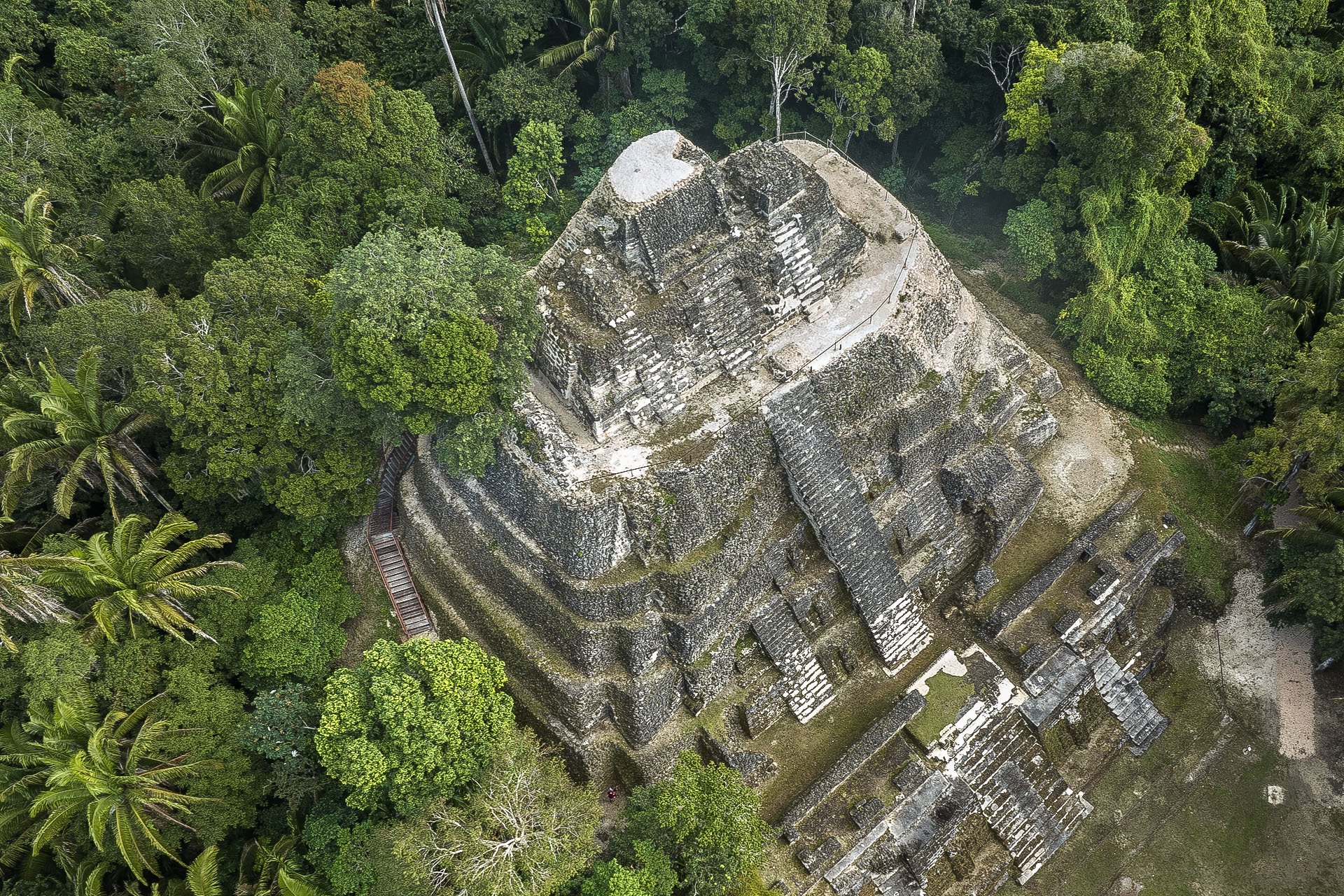
Lamanai High Temple
Nestled between a lush lagoon and a thriving community lies 958 acres of untouched terrain, hosting the longest occupied archeological site in Belize, Lamanai. Lamanai, meaning “submerged crocodile” in Maya, was once a thriving city inhabited by the Maya people as early as 1500 BC. Today, it stands as a testament to their ingenuity, artistry, and spiritual beliefs. In this experience, we will visit the High Temple of Lamanai, where excavations, research and continued cultural practices reinforce the long standing bond between people and land at Lamanai. You will also hear from Conservator Jorge Can, School Teacher Miss Sonia, Tour Guide Mr. Mauricio and Worker Miss Ada about their connections to this place.
Stop 1. The High Temple
As we go beneath the tree canopy of the reserve, we can see the full scale of the pyramid-like High Temple This site hosts one of the tallest man-made structures in northern Belize. You can imagine the impression a building of this scale would have made on the people of the site during ancient times. At 33 meters tall, the summit of the High Temple now offers visitors a glimpse of the expanse where a crucial trading port once thrived. Unlike many other Mayan sites that were abandoned in the Post Classic period, Lamanai remained a vibrant community through the colonial period and today The High Temple is constructed primarily of limestone, the material commonly used in Maya architecture. Limestone is abundant in the region and was quarried locally into manageable blocks. These blocks were then shaped and set in place with mortar to construct the impressive temple.
Jorge Can
Hey, my name is Jorge Can. Actually, I'm from the village of San Jose Succtoz, and I'm the conservator for the Institute of Archeology. I have been doing the conservation work all around Belize since 20 years ago. And this time we had the opportunity to get the grant and work at the Lamanai Conservation Project doing some most of the one of the most conservation work that we needed to do at the site, which was very, very crucial at the high temple, especially
Miss Sonia
My name is Sonia Maribel Tun, and presently, I am the acting teaching principal here at Indian Church Government School. And it's located right here in Indian Church Village. We need to do more when it comes to our Mayan heritage. I feel that we should be teaching, our young people how to play the Pok-ta-Pok. We should be teaching some Maya language to our students. There are many things that we are missing, and it's dying in the in the sense that our, our parents or grandparents did not teach us the Maya language. You know, they used to talk with their friends, but it was like secret, you know, And we we learned a few a few things, but it's not enough.
Mr. Mauricio
My name is Mauricio Aguilar, and I am from in Indian church village, and I've been here since 1981. Okay, so basically, I grew up in in the old Indian church village, which is a village that was once within the Lamanai reserve. And in 1993, my village was relocated to just outside the borders of Lamanai, where we all live now. Lamonai is one of the most important archeological sites in Belize. You know, of the many that do have the interesting part of Lamanai to me, not because I grew up here, but the most interesting part of it is that it is the longest occupied Maya site in this country and probably one of the longest ever in the entire Mundo Maya, as we refer to it, the Maya world. And what I remember is that when I was a child, when we used to live in this village within the reserve, now there used to still be a family north of the Mayan temples that you already know. I believe, you know, I'm north of mask temple. So there were still these folks living there while we were in this, and this village here within the Lamanai grounds. So Lamanai was occupied from roughly 1500 B.C., according to archeological evidence till I would say, I mean, 1900s. Okay. So that's what I would say is the longest occupied site.
Miss Ada
My name is Felipe Ada Zepeda. I currently live here at Indian Church. I was involved in the project here at the Lamanai Site and I've been doing more. We had the opportunity, my partner and I doing the excavation. as I mentioned, every time we discover It cheers you up to do more. There were trees that didn't, I had no idea were under or behind those trees There was such a beautiful place, because I didn´t know the name of the site that I was on this side, the one we composed. Aha!, Aha! It turned out so beautiful and at first it was unrecognizable. And now, when I come in and I look at the site, the mare, all of that was hidden. And every day you make a discovery, you do it, you do it. Discover and it encourages you more. But yes, it was an unforgettable experience being there.
Stop 2. Maya Waterways
From the top of the High Temple you are rewarded with an incredible view over the jungle to the New River lagoon. This expansive body of freshwater played a crucial role in the development, sustenance, and connectivity of Lamanai. The Maya used waterways as trading ports and as a source of sustenance, providing access to fresh water and a rich habitat for fish and wildlife. The lagoon connected Lamanai to the Caribbean Sea and other Maya cities, facilitating the exchange of goods such as obsidian, jade, pottery, and cacao. Today, we can envision the Maya connection to the lagoon and its contribution to Lamanai’s longevity as a continuously occupied settlement.
Miss Sonia
When you are up there, the feeling is awesome. You, you feel like you are you are a god. That's the feeling in the past when I am when I just came to Indian Church, I visited the Lamanai temple and I went up the high temple and I used to visit the high temple like every week. And then. I broke my foot, and doctors said I would never be able to walk again. And I came back and I recovered. And then you guys invited me. It was it was a feeling, a sense of, you know, of feeling like a bird. Being able to fly again.
Mr. Mauricio
They needed the water. So rivers and lakes and lagoons, whatever we may call them, they were highways for the ancient Maya. So they they they made use of them. And this lake is 17 miles long, roughly. We have a creek. It's called the Irish Creek. It goes up about nine miles from here and goes towards the west, which for me I think is where the ancient Maya used to come down with their canoes for trading. Go right to Lamanai, And this will also take you all the way to the Caribbean Sea, which is Corozal Bay. So its total length is about 80 miles total. Imagine that. And it was their highway. So for them was other than being beautiful, it was extremely important. And not only that, for trading, but also for farming. They needed the water right, for the raised field farming they had across the lake. So fishing, we get manatees, we get crocodiles, we get like 32 species of fish, including tilapia, which is an invasive species. But we have it here, is hard to deal with it. So I guess the lake has been for hundreds and hundreds of years a very important asset to this Mayan city.
Miss Ada
thanks to the work, the work, effort because it requires courage, because women like us, because I did not have the opportunity to work for the temple. But women do look at everything that the boys went through, the men. I call them guys, but it's the men. And it does help a lot, because this way people have a better, better view, a better view. And they also have an unforgettable experience, because already going up to the top we see things different. Look at the different view and thanks to the fact that all that is will be fixed because there is a benefit for the community as well.
Stop 3. The Need to Conserve
Here on the backside of the temple, it is easy to be swept away by the magnificence of the structure as it emerges above the tree line. However, this ancient structure and others like it are fragile and faced numerous threats. Located within the jungle, the roots of trees and other vegetation can burrow in between the stone facade, causing significant damage. If you look closely, you can see brighter white patches on the surface of the temple where conservators have stabilized the structure and made repairs. You will also notice a modern staircase on the right side of the temple, designed to provide access to this incredible temple while also limiting tourism impacts on the fragile resource. By conserving Lamanai’s structures, we ensure that the legacy of the Maya civilization lives on, inspiring curiosity and wonder in those who come to explore its ancient streets.
Jorge Can
We think conservation work at Lamanai is very, very, very important. What we see over there is that what we have to do is get more, get more of the what we call it, a maintenance program, because if you could, we could clearly see that we actually have we could call it is very low in the maintenance. And we know that it doesn't show a lot at the moment. We don't we don't see a lot of what's happening to the Stones or to the the architecture features. But in the longer term, we will begin to see because right now the Stones looked very neat and healthy. And you saw what later in the future, the long term, we will begin to see part of it. And what I would like to see is more attention and made more on the conservation area like maintenance
Miss Sonia
we need a lot of education in in the community when it comes to conservation. And then again, a lot has to be done with the the tourists that also come, you know, because sometimes, you know, people enjoy everything and so forth. But in many, many of them going up, you know, the high temple, at some point, you know, and it will start to deteriorate again. So something has to to be carried out. You know, some regulations about how many visitors and so forth.
Mr. Mauricio
So absolutely. And I believe that once we uncover something that has been there for so long, we need to protect it. We need to find ways to get funding to to really, really do a good job on them. You know, this is not a matter of just uncovering them and leaving them there, but we have to keep keep a good eye on them and be very responsible as tour guides.
Miss Ada
because they also damage the ruins. So, to conserve it one has to keep it clean and always Be aware that, if something is bad, one has to fix it. Do you understand? YES
Stop 4. Traditional Methods
Maintaining the beauty and stability of the Maya sites in Belize requires constant attention from conservators and community members. Their primary objective is to stabilize the structure and mitigate the impact of environmental and human threats. Conservation in Belize utilizes longstanding techniques first implemented by the ancient Maya in caring for their buildings. Methods include structural reinforcement, careful removal of vegetation that can damage structures, and controlled water drainage to prevent erosion. Traditional methods and materials from around Belize are used in the conservation activities, including soft white lime to create the mortar. Stabilizing the High Temple through traditional knowledge of the ancient Maya allows this wonder to retain its authentic beauty.
Jorge Can
we are trying to we try our best to use the same method as in ancient times which is the white lime white lime and the white marble, we just try to mix them together and then at some point we use a percentage of cement, depends how we go and how the stiffness of the terrace wall is. But that is how we use it in this in this high temple, what we did in the east and the north side, what we did is that we remove some of the trees and then we move maybe about 30 to 40 centimeters of the loose dirt. And that is where we began. We we went we never went in through to find architecture because we had to go deep inside of the structure. But we don't want to go deep because we will destabilize the top of the of the temple. So we just had to go and find a solid base or a solid backfill or fill that the Mayas used compacted dirt. And that is where we begin to do our retaining wall, we did a retaining wall to stabilize the building. In other words, we never used, we never did. So Masonry walls some facing walls some facing stones. We never did because we never had the remains of those terraces, walls. We never had nothing. So what we have to do, we we had to stabilize the building with our retaining walls. But the difference and actually you can say the retaining wall we had to base on the terraces and the floors like how they were, because we never had enough remains. But we had to follow had to see the levels that we were going through, and then we had to follow the stiffness of the heel of the amount that we had.
Miss Ada
specifically, we were digging. We use several. Tools? Tools. And so that was a daily job. Right? And then there were days that were harder than others. Most of us were digging, discovering over parts of the ruins. We also learned to do more. Namely the camaraderie at work. Because we learned to get along between men and women and by discovering parts of the routine, you get more and more excited every time you go looking more and more into the ruins.
Stop 5. Pok Ta Pok
Across the plaza from the High Temple stands the remains of a ball court. The Pok ta Pok Maya ball game is a famous sport within the ancient Maya community, highlighting sportsmanship and community strength. This court is unique for its smaller size and also the absence of the two stone rings mounted on opposite sides of the sloped court walls. This ball court also boasts some incredible archeological finds that provide greater insight into the activities and beliefs of the ancient Maya living at Lamanai. Today, Pok ta Pok is making a revival in Belize with new games and educational programs that aim to provide the tradition alive and foster a deeper appreciation for Maya heritage.
Miss Sonia
we personally I had seen it in TV, you know, but then that experience was marvelous. And I hope that it continues it's it continues to be done over there. And we get invited because children will will get to have that, you know, that closeness and they will get to to be motivated into learning something that happened here. It's not far from us, but it happened. It used to happen here. So I am hoping that in the future we can we can get to have people from our community learning the Pok Ta Pok game.
Mr. Mauricio
And of course, in the middle of the plaza we have the the ball court, which is one of the smallest ever. But the history of that ball court for me is amazing. The for what they've found under the center marker. I will definitely highlight that. I'll definitely make sure we talk about that and just recently with a project that we just had, they also uncovered the other center marker. And we say, you know, and honestly, we cannot talk. Or I should say we do not know much about the ancient Mayan ball game. You know, nobody is entirely sure of the rules and so on. But, you know, there's ideas. I have a book about the ball court in Chichen Itza, for example, that I have read a lot and it's really interesting.
Stop 6. Connection to Nature
Jorge Can
the work that was done at the site, which was very important, very crucial for the high temple. It was done and I hope I hope that we continue to to get more of these funds or make we try to see what we could get to make other structures, not only Lamanai now, because all the problems we have for us like Caracol and Xunan, So I would like to see if we could get more of those structures to be not at least to be completely restored, but at least make me try to get more attention to it.
Miss Sonia
Personally when I when I am there, I just relax and then, yes, you get to imagine, you know, how this people lived in the past. They were so happy they didn't had to worry about money or owing at the bank. They just had to just be there. You know? You feel hungry, just go fishing, take a bath. You have everything at hand. Perhaps in there was sort of over overpopulation. But, I believe that at some point they were they were happy, they were living a full life. They were experiencing nature at its best.
Mr. Mauricio
Well, it is an amazing archeological site, as I mentioned at the beginning. It's long existence, over 3000 years. The history of it is just amazing. And you can you can see a lot of wildlife and other stuff in this site here, If you come to visit, truly. It's got to be an unforgettable visit. Once you have time to enjoy and learn about it and it's just amazing. I mean, what else can we say other than as a site that it has so much to offer. Hopefully you have the time to see it all and, you know, please come and visit.
Miss Ada
1 I am very proud of this. It is a source of pride and benefit for the village. Many tourists come here, we have the lagoon, we have the reserve that attracts the attention of many. It is a source of pride. It is a source of pride to have all this in such a village that is Indian Church.