Welcome to O'Hara's
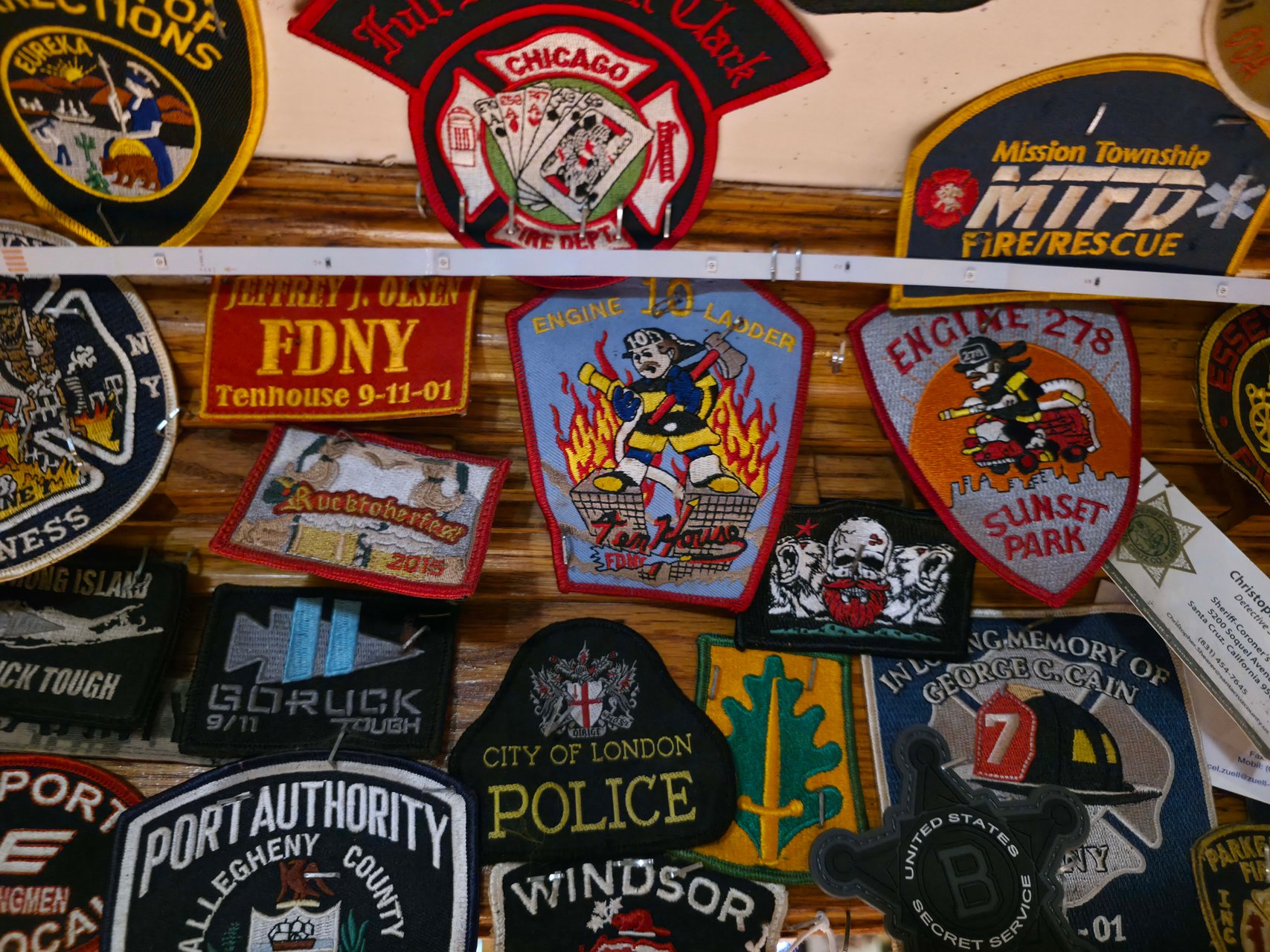
Nestled between the bustling, one-way roads of New York City, you’ll find the local neighborhood gathering spot: O’Hara’s Restaurant and Bar. Across from the 9/11 Memorial and Museum, this Irish pub is its own living memorial to those that were present the day of the 9/11 attacks. Thousands of patches cover the walls, ceiling, and bar tops. Each one a tribute to the first responders, military, and those that were lost. It is a gathering place welcoming everyone that may walk through the door. Throughout this virtual tour, you’ll hear from the O’Hara’s employees, firefighters, and local community members that have shaped this pub over the decades.
Stop 1. An Evolving History
Co-owner Michael Keane joined the team shortly after the 1983 opening and never left. Walking in O’Hara’s today is a very different experience than what you would’ve seen before September 2002. Throughout the pub’s history, it has evolved from an ordinary bar to the textured sanctuary and living memorial it is today. Before the patches and the 9/11 memorabilia adorned every surface, O’Hara’s was a typical “suits” bar, frequented by white collar patrons that worked in the financial district. Unlike today, the area was not a tourist destination then. There were very few residents that lived in this part of Manhattan and even fewer amenities for those that were in the area. The local fire station, affectionately known as “Ten House,” was built to serve the World Trade Center. Later, these firefighters would be some of the first on the ground after the 9/11 attacks.
Michael Keane
Yes, so the pub was opened in 1983 by two gentlemen and I started working for them here about six months later and then was working here for a few years before they had asked me to buy in with them. So then I was involved with the pub since 1987. I was one of the owners and then over time eventually had bought them out and had two other partners that I have, Jimmy and Paul, with me right now. I think everybody is surprised at the way things have changed here from back in the 80s and 90s.
Sal Argano
I remember exactly the first time I visited O'Hara's. My first tour in the firehouse was August 10, 1999. First shift I worked. After your first shift, the rule is the guys take you out for a drink. And where did we go? We went to O'Hara's. And the story began. Then it was— I thought, it was more of like a suit neighborhood worker bar. Until we—that's a bad word for it, but we called it a suit bar. You know, all the stockbrokers, traders, office workers, everybody was dressed up, always looking sharp. And it was more like a gentleman's bar.
Margaret Vesey
The previous owner went to school with my mom, and offered me a job when he was in Ireland. And I said I might come out for six months, which I did but didn't go back. And the time I was here it was a lot of the commodities, a lot of the stock market guys, they were just brilliant. We had a lot of traders coming in and going, and we closed at weekends. It was completely different then. It was just a lot of trading and dealing and office workers
Pat Moore
Before O'Hara's we had a liquor store that was here. And while we were doing construction on our building, we'd visit that liquor store quite often. And then they went out of business, and this older couple gave up the business. And then O'Hara's came in. And I don't really remember, I feel like O'Hara's, I know the liquor store was here, but I feel like O'Hara's has been here forever. Mike and the guys have been here forever. So I don't quite remember when they moved in, but I know we came over and we had a beer. And over the years we have come here to just get out of the house, because it's right across the street. But also during the time that we were trying to get back into our homes, because we were impacted by all of the debris that used to be the World Trade Center, all 17 of my windows blew in, and my neighbor's windows and everything that had been the Trade Center blew into our homes. And so O'Hara's we used the bathroom. They let us wash debris off our faces. They helped us if they saw us struggling out of the building, trying to save anything that we could. I remember going into my apartment and finding one pair of gloves. I spent hours in there and I came out with one pair of gloves. So community changing? Well, the community again, like I said, it used to be just a few of us who lived here. And after 9/11 this has become the fastest growing residential community in New York City. So our population is probably more than tripled. And we have a lot of young people out in the neighborhood. And then there are us old ones who are hopefully aging in place. But we've been here for a long time, so we've seen all the changes. When I first moved in, the elevated West Side Highway was up. And none of the other buildings, just the two towers, were built. And the Millennium Hotel, that's no longer really called the Millennium. Oh, there was no such thing as Bowery Park City. It didn't exist. So after years Gateway came in, those were the first two buildings to come in and took my view, because I used to be able to see New Jersey and the clock that's over New Jersey. That has been moved that used to be our clock used to go to our kitchen window, and look out and see the clock in New Jersey until time.
Stop 2. September 11, 2001
The attacks on September 11, 2001, fundamentally changed the United States and destroyed the surrounding blocks of the World Trade Centers. While O’Hara’s was closed immediately following the attacks, it remained a community space, supporting the first responders and support crews that came into the neighborhood to clean the area. It wasn’t until 2002, on the first anniversary of the attacks, that O’Hara’s became what it is today. That afternoon, the pub was packed with community members and first responders gathered in honor of the anniversary. A regular known as "Big John" ripped the "Ten House" patch off a local firefighter and stapled it to the woodwork above the bar. By the end of that night, patches and pins from other first responders and military found their way stapled or stuck into the walls—starting the legacy that O’Hara’s would become. In the back corner of the bar, a pencil sketch exemplifies the helping hand that you can find in O’Hara’s. The drawing shows a local firefighter in the rubble of the 9/11 attacks passing the American flag to a soldier saying “I’ll take it from here.”
Michael Keane
So everybody was in here. It was packed at first anniversary, and in the afternoon and one of the construction guys Big John was enjoying it. He ripped a patch off one of the guy's shirts, stapled it to the bar top, and then it seemed, you know, nothing at the time. There were about maybe 15 patches up at the end of the day, and that was a little nice, and then all of a sudden it just took off, and now what you see around us now, this is the result. There's no rhyme or reason of anything here. So you come in with your patch, we give you the staple gun, and now it's getting difficult to find a spot. The walls, the ceiling, we try to keep the big guys off the chairs when they want to put them on the ceiling. So I said, you're a ground guy, you stay down here.
Sal Argano
I was here shortly after the second building came down. Just like nothing I've ever seen. Nothing I've ever seen, nothing most people have ever seen. It just couldn't make sense of, couldn't make sense of anything. Couldn't make sense of the ground, what you were stepping on, what you were walking on, what block you were on. The size of the piles of debris. Cars and fire trucks and response vehicles were on fire still at the time. And not too many people other than the responders. Most of the people were already out of here. But it was just a war zone. A lot of visitors, a lot of firefighters, FDNY, city workers. They come to pay their respects. They go to Ohio to have a drink, to think about and talk about and reminisce, and remember friends, fallen loved ones. People they knew, people they heard of, stories that they were told and passed on to generations. The visitors from the other cities and other countries, they come and they're a part of it. You just become one big family. And O'Hara's plays a big part in that. And it's nice to see that.
Margaret Vesey
I have seen a lot of different reactions. I love to see them when they walk in the door, and some of them go, "Oh." And then some will go, "Oh." And then they start asking us how many patches do you have? Can't tell you that. Do you know where Boston, we'll say, patch is... haven't a clue! Too many. So they go around and there you look. And they spend some of them, spend hours looking for their patch. And then it's not if they don't have a patch with them, we do always say you can mail it in to us and we'll definitely put it up for you. Or I will say to them, say, "Somebody sat at Table 16" and he handed me a patch. I said, if you don't have it, mail it in and I'll put it up at Table 16, that you can tell the next person my patch is at Table 16.
Pat Moore
I remember coming in when there were very few patches on the wall. And now coming in and seeing all of these patches, it's amazing. When you think that each patch represents a person or a few people who came in and they, you know, actually came in and put the patches or gave the patches to Mike and the guys, but they also represent that they want to be part of the community of O'Hara's. So I think that's amazing that people from all over the world have been at work
Stop 3. Continued Resilience
Through more than 40 years of service, O’Hara’s has repeatedly shown its resilience and ability to endure. In addition to the catastrophic damage caused to the neighborhood from the 9/11 attacks, O’Hara’s has survived multiple disasters. In 1993, a structural fire shut down the pub for six months. In 2012, rain and flooding from Hurricane Sandy caused severe water damage in the basement. And, most recently, in 2020, the global pandemic reshaped all in-person gatherings and spaces. The ability to persevere and come back from each of these events is a reflection of not only the business, but the community investment in the space. With each disaster, the people have shown up and pushed through to do what needs to be done to make sure O’Hara’s doors are able to open and welcome patrons another day.
Michael Keane
When something happens, I guess you just put your head down and you know keep going along, do what you gotta do. I mean, it helps having family and friends to go, you know, to help you out through these things. You know, going home to my wife is very understanding with everything going through, where you know to have people supporting you when you're doing all this helps. But a lot of it, you have your head down and you're just plugging along and not trying to think of all the bad things, just trying to think about let's get to where we want to get to, and you just work
Sal Argano
After 9/11 the neighbor was fairly damaged. The block the bar the firehouse. We kept an eye on it. There was a lot of people in and out of the building, searching the buildings. Not in a bad way, but just to make sure everybody was safe. But the members of the firehouse kept an eye on the pub, making sure nobody was breaking in, stealing liquor or whatever. So be it. But we sort of kept an eye on it. A couple of weeks later or a short time after, we bumped into the owners and went into the bar to take a look. I remember going into the bar and seeing the debris, the rubble, the dust scattered throughout the bar. It was difficult to see it. You know it's sort of like your living room. You know it's part of the neighborhood, just to see that disaster in such a place that you know. It hits you.
John "Big John" Suter
I worked for Verizon. I had you know credentials to get in there. And I also, you know, I had a lot of friends that were police officers at the time. So, you know, I was able to get in and I just spent a lot of time down there. And words can't describe, you know, what it was like down there. Like you see pictures of everything, you know, but to be standing there in the middle of that rubble of something that you know I've been down to 9/11, you know, not 9/11, I'd been to World Trade Centers a million times in my life and to see what that looked like afterwards was very, very unsettling, you know. So, I ended up just being down there just helping out, you know, and then I seen, you know, and I did notice O'Hara's, you know, and then after spending a few weeks down there I went home. Obviously I had to go back to work, but I would pop up down there, you know what I mean. And see how the progress was going, you know, the cleanup and and I would always notice O'Hara's and just like, wow, this guy is really going to town over there. He's, you know, like it seemed like Mike was cleaning up the place a lot faster than everything else around him, you know. And, and like I said, I couldn't believe that he was open. I think it only took him seven or eight months and he was open down there, which was pretty amazing. I mean like I got pictures of us down there the first year that the streets weren't even, and it was big giant logs that the trucks were driving over. So, it was it was impressive how we got that place up and running.
Margaret Vesey
I was here in 1993. The fire started early in the morning, and we were closed; it happened in September, and we were closed and reopened for St. Patrick's night the following six months. I think it's because 1) of the staff- we've gone through a lot together, and we keep forcing Mike to reopen and get things going again, because I think we're just very resilient. We have the strength in our staff; the customers always help us out. We just love the place, and it just makes us want to keep going every day, every day, every day. Not just for Mike, not for any of them, just for ourselves, and for the people that walk in the door. We've got to be here to accept them, to come in and be warm and friendly, and let them go back and tell their story about O'Hara's.
Pat Moore
I think it's you know it's Mike and the guys. I think that New York is first of all resilient. You know I think Americans are resilient and I think that they love what they do. They love this place. It has its own spirit. It's in a building that we heard legend has it that Edgar Allan Poe lived in this building at one point. Yeah so this is an old neighborhood. This is the beginning of New York. My building, hundreds of years ago, was actually a window and Greenwich Street, which is the street that's right out here. O'Hara's is on Greenwich and Cedar. So Greenwich Street used to be where the river came. So Greenwich Street over is all landfill. So you know it's imbued with the spirit of the beginning of America. The beginning of New York. The guys love this place and they know that many people love this place and count on this place and come here to relax and come here to be up with friends and to meet new friends.
Stop 4. International Recognition
Twenty-five years after the 9/11 attacks, O’Hara’s reputation has gained global recognition, with people visiting from all over the world. In addition to patches from across New York City and the broader United States, you can find countless countries represented by patches from first responders and military units worldwide. The walls also feature other international tributes, including a plaque honoring the Afghan Female Tactical Platoon—an elite all-female unit that fought alongside U.S. Army Special Operations—that the community brought to O’Hara’s and celebrated their accomplishment. There is also a photograph of the Thai Navy SEALs involved in the 2018 Wild Boars Soccer Team cave rescue who were referred to O’Hara’s by a local police officer after a Good Morning America appearance and 9/11 Museum visit.
Michael Keane
It feels pretty good because there's a lot of people that come in from other countries all over the world, with their patch. I have my patch, can I put it up? You know, very excited to put their patch up in here. They'll come in with their families, take pictures of them putting it up, and you can find patches from all over the world in here.
Sal Argano
I've met so many people from around the world. The military is great, different countries. I wish I could visit, but cities I wish I could visit. Different agencies from all around the world that they come and they're able to put something in remembrance, and they're there for, they're there to leave, I don't want to say leave their mark, but say I was here and I'm here for a reason, I'm here to be a part of Ground Zero, the history of Ground Zero and they're able to put something, it's a nice thought. It's nice to see it, it makes me happy.
John "Big John" Suter
The following year people were coming in with patches. Instead of me ripping them off them. And the most amazing thing I think out of all was that some of these people would come from all over the world, and search me out to put their patch up and then what would happen is I would staple it, you know, make an announcement, thank everybody, and staple the patch to the wall. And they would take pictures of it and then the following year they would come back and show me a picture of hanging in a little pub somewhere in Ireland, and of me putting that patch up, down in O'Hara's, you know, and that meant the most to me, like to see that is like, wow, you know, O'Hara's is now you know spreading around the world.
Margaret Vesey
I think it's absolutely unbelievable. the patches that I've never heard of places and patches I've never heard of. I couldn't find them on a map, let alone find the patch itself. but I just think unless you've been here you can't understand it. no matter who tells you, you have to experience it. you have to come in the door and say, oh, this is what they were talking about. this is real; this is history right here. every patch tells a story. some of them we don't know, we couldn't — we don't have the time. but it's history, and it tells a story for each individual that put a patch up.
Pat Moore
Mike knows that if he needs anything from me I'd walk across burning coals for him. In terms of the community and what it is like, it's one of the anchors of our community. People come from all over the world and come to O'Hara's to visit. They've heard about it from wherever, whatever part of the world they've lived in. They've heard about O'Hara's, and obviously as you look around and you see all of these badges, from the military, the police, and the firemen, all of the people who worked at the World Trade Center to try in the beginning, rescue anyone that might have survived, and later on recover the bodies of anyone who had perished. You see that many people from all over our country, as well as the world, have come here to visit, and they proudly display their badges and their patches to let you know that we all feel like there's one community.
Stop 5. Creating Community
The patches on the walls represent more than just individuals, but the family of people that make up O’Hara’s. It is a communal gathering place for people to process their grief and connect with others. The patrons who frequent O'Hara's are predominantly connected to “protector” communities: members of the fire, police, emergency medical services, and military units. The pub has become a sanctuary space where their sacrifices are recognized and respected. O’Hara’s embodies the volunteer and first responder mindset of initiative to support one another through anything. One of the most prominent items on this wall of the bar is the red bandana with the number 19 featured on it. This bandana hangs in memory of Welles Crowther, who saved as many as 18 individuals in the South Tower by guiding them down a safe stairwell before ultimately losing his own life when the building collapsed.
Michael Keane
The whole area now there's a lot of people that live down here. Also before that there weren't a lot of people living here. Not a lot of tourists, so now we are a big tourist destination. So it's neat to come in here and you'll have construction workers sitting at the bar. A guy that lives down the street, you know, somebody from Utah, somebody from Ireland, and it's just a mix of everybody. And the one thing I like that you hear a lot is, well, the people in New York are so friendly because I guess we have this reputation of not being the friendliest people. And people come in, they're very surprised at how friendly everybody is in New York, which is nice to hear.
Sal Argano
More of a gathering, more of a gathering, almost like a family. The people, the locals that come, the visitors that come. You might only meet them for ten minutes and you feel like you know them. And they're part of your family; they're here, they're just there. You get a lot of people that come back and they remember your face. They remember the place; you try to tell them, you know, hey, have you been to O'Hara's? Yeah, of course, we've been there; what time you get off work, are you there tomorrow? It's a nice feeling. It sucks in and keeps you, keeps you coming back over and over.
John "Big John" Suter
I met a lot of good people, and we made a pact that first year that we'd all meet again the following year, and that pact lasted now 25 years. Same people every year, you know, the same— we call it the 9/11 crew. You know, one of the guys, Daniel Erickson, he's a firefighter from Hartford, Connecticut. He keeps us all together, you know, on the internet. He gets the same crew, keeps us locked in, and we're there every year. Nobody's missed a year in 25 years, going down there. So, we got a pretty special group, you know. And as long as they keep coming, I'm going to keep coming down there. So, now I travel from South Carolina to go there every year.
Margaret Vesey
Oh that was the greatest accomplishment that I've ever thought I would have. Never did I realise that my daughter or son would work here and then become a farmer and then my daughter become a nurse. It's just it was great to work beside them. And they knew because I would talk about it when I'd go home. And I'd bring them in here for the summers and then when they turned 16, fair play, Mike offered them jobs. And it started from there. We're not just a bar or a restaurant, we are a family.
Stop 6. Human Connections
O’Hara’s captures the attention of everyone who enters into an active space for anyone looking to understand and connect with the events of 9/11 through human relationships and stories. The evolution from local pub to living 9/11 memorial was shaped by and for the community, as those that work there and visit each took on the mission to honor those who serve. The pub invites people to come as they are, to view the thousands of patches, and feel the warmth of the community so they can leave uplifted, feeling a sense of hope, strength, and connection.
Michael Keane
My hope is really just that things continue the way they're going. I think everybody kind of likes the way O'Hara's is what's happening here. I know things change constantly, well aware of that, but if things would just continue going in the direction they're going, it would be my hope.
Sal Argano
O'Hara's isn't just a bar, it's part of the story down here. It's part of history. Probably one of the most famous pubs in the world. So many visitors from around the world, every state, every country. When you go in that front door, there's no way you're going to forget that place. And if you're coming to New York, you're going to visit it again. And I met so many people at the bar that said, oh, we had to come back. There's no way we weren't coming back. At least to come in for one. And that's a nice day.
John "Big John" Suter
How did it start? I was horsing around, you know, and it just turned out that it— I'm glad the way it turned out, because the bar is an amazing place and people come from all over the world now just to bring their patches and put them up, and you know it shows unity, and I love it. I love it.
Margaret Vesey
I just want to say. O'Hara's to me is not just a job; it's like coming home. I walk through that door every morning. I look forward to it. Now there's days that Mike and I have our little disagreements, but on the whole I absolutely—I cannot love the place as much as I just couldn't. And I thank God that I walked in the door the 2nd of May 1985.
Pat Moore
You don't have another pub that was part of a 9/11 experience. You don't have another pub where I mean you have different pubs in the city where police and firemen gather. There are police pubs there, there are fire pubs. This is for everyone. Everyone can feel like they either experienced 9/11 personally or experienced it just because they're a human being and they have humanity. Or they lost someone. Or they belong to a firehouse or a police house where they lost someone that was at their home. So that makes this place different. But also I think that people are curious. People who weren't in this country and didn't know, know, really experience first hand or even second hand 9/11. They come in after they've visited the memorial and they've gone to the museum. They come in and it's, I hate to say this, I don't want to make it, but it feels like a lighter side of the 9/11 experience. You know it's this camaraderie here, this memory, and there's some sadness. But people try to have a lighter experience here than they do when they go to the memorial or they go to the museum.