Iorana, Welcome to ‘Ō roŋo
(♫ Kaveheke - Mana Mā'ohi ♫) Welcome to Rapa Nui, an island known for its rich history and cultural heritage. From this elevated point above the island, you can begin to appreciate its position in the vast Pacific Ocean. Over a thousand years ago, our Polynesian ancestors arrived on the island, creating a unique and vibrant culture. The Rano Kau crater before you is the central core of one of the three volcanoes that formed Rapa Nui eons ago. This place is known as ‘Ō Roŋo and is associated with the Tāŋata Manu or Birdman competition, an epic test of strength, endurance and wisdom. In this virtual experience, you will hear from Ariki, a leader of the Ma'u Henua indigenous community that protects this site, Isabel Pakarati, Zoilo Huki, guardians of the Rapa Nui culture and other members of the community who will share their stories and knowledge as you explore this place virtually, walking in the footsteps of their ancestors who built this extraordinary site.
Stop 1. Haka Ara
You have just been transported to the edge of the vast crater of Rano Kau, with its steep cliffs plunging 300 meters down to the deep blue sea. Three small islands, or Motu, dot the horizon, as seabirds soar and cry overhead. Listen to the wind and the sound of the powerful waves. The landscape here is dramatic, with the green crater lagoon below, filled with native plant species. The Motu, such as Motu Nui, Motu 'Iti, and Motu Kau-kau, are home to numerous bird species, including the Manutara, or sooty tern, whose egg was the central focus of the Taŋata Manu competition. The sea around the Motu is rich in marine life, and remains an important food source. The interaction between land and sea, cliffs and islands, has shaped the lives and traditions of the Rapa Nui people for centuries.
Ariki Tepano
Standing at the edge of Rano Kau, the first thing I feel is a deep connection. I feel the presence of Hau Maka, who gave our volcano its name: The Dark Basin of Hau Maka. I also sense the energy of our ancestor, Tama Te Rano Kau, who cultivated our crops, ensuring our survival to this day. I honor all the ancestors of the Koro 'Ō roŋo clan, the Hau Moana Miru and Hau Moana Tupa Hotu clans, and all the clans who gathered here to shape a new future. They created and carried out the manutara egg competition, guiding the leadership of our homeland to this very day.
Zoilo Hucke
When I come to this place, I feel as though my spirit and my body are transported back to the time of our ancestors. The way I experience this place, when I look at it with my own eyes, feels very similar to how our ancestors must have seen it. This place has preserved its original character, even though certain areas have undergone restoration, with infrastructure being rebuilt and renovated. While some elements of its heritage have been lost, most of this place remains just as our ancestors knew it.
Nehe-Nehe Pakomio Atan
Take a look at this crater, it’s full of plants you can even bring home. There are also many medicinal plants, or what we call natural remedies, and it’s important information for visitors to know. For us, as Rapa Nui, before going down, we must observe *Tapu* — respect the ancient customs if we want to take anything. Whether it’s an ancestral item or a medicinal plant. We must care for and honor this place, starting by giving thanks to our ancestors, and asking them to protect us... as we move forward and here, in this sacred space.
Stop 2. Living History
Orongo is not just an ancient site, it is a living part of the Rapa Nui culture. Traditions are passed down from generation to generation and the community continues to honour its heritage through stories, songs and dances. This place is a testament to the resilience and continuity of the Rapa Nui people, serving as a vibrant link between the past and the present. Until a few decades ago, the community still used the crater lagoon for daily activities and as a crucial source of fresh water for drinking and washing clothes. Today, in addition to the many tourists who come to visit this place, some locals visit the crater to gather medicinal plants and raw materials, maintaining their deep connection to this site.
Ariki Tepano
When people were stripped of their ancestral lands and forcibly relocated to what is now the town of Haŋa Roa, it created a deep rift between the families and their spiritual connection to the lands of our ancestors. This severed their ties to their sacred territories. As a result, places like Rano Kau and 'Ō roŋo were abandoned for a long time, until the mid-1900s. When Western administrators finally allowed people to leave the confinement of Haŋa Roa, they returned to their territories, to their homeland of Rano Kau. There, they could collect water from the crater during dry months to bring back to their homes. They also revived agricultural practices introduced by our ancestor, Tama te Rano Kau, allowing crops to flourish on small plots in Haŋa Roa to feed our community. They were also able to return to sacred sites in 'Ō roŋo, such as 'Ō roŋo ruŋa and Ahu riki-riki. There, they taught children and youth about ancestral knowledge, sharing how ceremonies were celebrated in ancient times in these sacred places. This included the manutara egg competition. Today, as the Rapa Nui people, we must come together once again. We must teach future generations, our sons and daughters, about the richness and ancestral heritage of our homeland, and show them how to live, following the traditions of our ancestors, who lived in harmony with the spirits of our forebears.
Maria Cristina Manutomatoma Pakarati
When I was little, we used to hike up to Rano Kau with my mother, carrying sacks of clothes. We’d hike to the top, then go down to the lagoon to do the laundry. It was always my mother, my aunt ‘I’isi, and a few other aunts who went together. We washed the clothes at the bottom of the crater, and once they dried a bit, they weren’t as heavy to carry back. Many other families, including mothers with their children, made the same trip. That’s how we climbed up and down the crater to do our laundry.
Nehe-Nehe Pakomio Atan
In this place, I feel at peace, I feel a sense of calm. Every day, I give thanks to my mother, because she is a warrior, an expert, and a strong, capable woman who passed down many ancestral traditions to me for my survival, and so I can share them in the future. I am so grateful for all the knowledge she has given me, and I also thank my grandmother. I feel an immense happiness in my heart for everything I have learned about this place, about this island, and with this, we conclude.
Stop 3. The Ceremonial Village of ‘Ō roŋo
As we approach the ceremonial village of ‘Ō Roŋo, you can begin to see the stone houses perched on the cliffs, called hare keho. The Rapa Nui builders were experts with stone, and the houses found around the crater were built with carefully layered basalt slabs, known as keho. The village, unique in its construction and almost completely restored, was used as a domestic settlement during the Taŋata Manu competition. The Ariki Mau and spiritual leaders performed rituals here, connecting the community with the gods and the natural and spiritual worlds. Although you can no longer enter the houses in person, you can virtually sit inside, look out at the sea and the motu, feel the humidity, and hear the sound of the waves crashing below. Notably, the mōai Hoa Haka Nana ’Ia, now housed in the British Museum, was taken from House 13, whose name is Tāura Reɳa.
Ariki Tepano
The first thing I feel, standing here, before these stone slab houses of 'Ō roŋo, are questions in my mind and body, wondering how our ancestors came here during the manutara egg competition, and how leaders and important figures lived in this sacred place. This was where they recited chants, prayed to the territorial spirits, and where all the clans danced together, awaiting the first egg to crown the birdman and give him power. Through this ritual, they would appoint a new king to govern the island for the next year. This is the connection we feel when we visit this place, standing before the stone slab houses of 'Ō roŋo ruŋa.
Zoilo Hucke
Most of you know from where the English extracted the mōai Hoa Haka Nana 'Ia. It was removed from inside one of the houses in 'Ō roŋo. And that house still has its top part open. They took the mōai from inside that house. What I wonder, and what others wonder too, is: why was that mōai placed inside a house? Because if we look closely or remember, many mōai still remain inside caves. Or they are buried underground. But that mōai had a house. In my opinion, the ancestors did this because it was considered one of their treasures. And they protected it inside the house as if it were one of their ancestors. That must have been the reason, I believe, that it was placed inside a house. Just like many mōai that are still lost or remain inside caves. You all know this; you know that many mōai are still like this. So, this is what I wanted to share.
Stop 4. Ceremonial house
Upon entering one of the restored houses in ‘Ō roŋo, you can feel the humidity in the air and the closeness of the stone walls. The keho slabs, carefully fitted together, are stacked to form a sturdy frame. Photographs taken during the first expeditions show that the interiors of the houses were decorated with rock paintings representing the Taŋata Manu competition. Although many of these stones were removed from the island, the paintings can still be seen on some of the houses. Crawling through the small entrance, the space feels narrow and cozy, a refuge that offers a direct connection to the past.
Ariki Tepano
What do we feel when we enter and stand inside these houses? First, I must share that these stone slab houses were reconstructed and restored to look as they do today. They were rebuilt exactly as they were in ancient times, when, during the manutara egg competition, our ancestors, our leaders, would offer prayers, chant, and recite verses to transfer the energy of their spirits to the competitors called hopu manu, who took part in the contest on the islet. This is what you can feel when you stand inside these houses— the presence of our ancestors, their energy still singing and reciting to this very day.
Isabel Pakarati
Since I was very young, we would to climb to 'Ō roŋo (with my family). My father, koro Katipare, would climb up there, to look at the stones that had fallen (off the cliff), and he would observe the caves (stone-slab houses). In those stone-slab houses, all of them had drawings or rock paintings inside, and there were also ancient objects within those houses. All those objects were taken and moved from 'Ō roŋo to the museum. That koro (Katipare) would climb there because he wept and yearned for the ancestral objects to protect them. Perhaps, through his thoughts, he felt love, and he felt sorrow for all the ancient things left by the ancestors.
Rafael Rapu
Well, the truth is, I cry when I arrive at places that hold the heritage of our ancestors. I feel a deep emotion because, when I stop to reflect, I say: “here are the works of my ancestors, the Rapa Nui people of long ago.” The truth is, I cry, and I feel a deep emotion throughout my body. I also stop to think and ask, for example: How… why is this stone tilted? What was its original position? And I start speaking spontaneously, because, to put it simply, I get emotional. I start talking to the stones and asking questions like: Why is it leaning this way? Or why is the grass so green here, but half dry in this other spot? And I reflect on everything these works have gone through... because these works are the legacy of the ancestors.
Stop 5. Taɳata Manu - The Birdman Competition
Once a year, at the beginning of spring, the ceremonial village would have been full of activity. Competitors, known as hopu manu, descended the Kari-kari cliff and swam to Moto Nui, where they waited to obtain the first egg of the Manu tara, then swam back and climbed the cliff to reach Mata Ŋā Rahu. This arduous journey tested their strength and endurance. The winner earned great honor, crowning the chief of their clan and making him the Taŋata Manu. In some cases, the Hopu competed for themselves, such as Pou Va’e Tea, who won the competition seven times. Through this ceremony, the ruling clan of the island was chosen, highlighting the competition's importance in Rapa Nui society. Today, this competition no longer takes place. However, the local community competes in other activities during the Tāpati Rapa Nui Festival, held every February.
Ariki Tepano
Behind me stand Motu 'iti (small islet), Motu Nui (large islet), and Motu Kao-Kao (pointy islet). Their original name was Ko Te Ŋā Kope Tu-tu'u Vai a Te Ta'aŋa (The youths standing in the water, sons of (King) Te Ta'aŋa). On the large islet, the competitors, or hopu manu, would compete to become the birdman. By winning, they elevated their clan representative to the position of ruler of Rapa Nui for a year. How did the hopu manu obtain the manutara egg? From childhood, they were blessed with luck, fortune, and success (pō) by their mother or father to prepare them, imbuing them with supernatural energy to become competitors in the manutara egg ceremony. Girls were also blessed with their pō to be raised as virginal maidens, with the purpose of becoming uka neru (chosen maidens from each clan selected by the birdman as his wives) for the ceremony. During the manutara egg competition period, 'Ōroŋo was not the only territory filled with mystical energy for the event. From the area of 'Ana Kai ('Ana Kai Taŋata) to the site of the Te Koro Rupa and Te Kere Mea houses (near the local police station), up to the Mōai Pou Hoko, groups of people would dance, including the youth of each clan, channeling the energy needed for the competition. They also danced to transfer energy, or mana, to the clan representatives, who directed and sent the energy of their spirits to their hopu manu to ensure their victory, crowning them as the birdman and establishing a supreme leader to govern our homeland. This leader would rule during the time of our ancestors, in the era of our forebears.
Zoilo Hucke
From 'Ō roŋo, the hopu manu competitors would descend when the competition to choose the birdman took place. They climbed down the cliff, jumped into the sea, and swam using totora reed floats to Motu Nui. On the islet, they waited for the first egg of the bird called manutara. The competitor who found the first egg would then climb onto a rock on Motu Nui called Te Puku raŋi manu (the rock where they would call to the birds). From this rock, they shouted back to the coast. At the midpoint of the cliff, there were people stationed to listen for the message being relayed from the islet. These individuals would then loudly announce the message to those waiting up at 'Ō roŋo. They declared who had found the first egg. This was the protocol of the competition: announcing the winner and which clan or tribe had won the hopu manu competition. This was the connection between the islet and 'Ō roŋo. Additionally, on Motu Nui, there was a territorial marker, which was a mōai. That mōai was taken from the island by the Routledge expedition in the year 1914. That year, they removed the mōai. It was not a large mōai, but a small one. Unfortunately, its removal was significant, as the mōai was a territorial marker for a major division of the island. It would have allowed us, and future generations, to learn more about this history.
Nehe-Nehe Pakomio Atan
I will briefly share something about my life. During my candidacy for queen of the 2024 Tāpati Rapa Nui (Festival), I came to this place to ask the ancestors for their support and to offer my apologies. Since I was a child, they have seen me here. Before the 2024 Tāpati Rapa Nui, I came to this place along with my family to gather mahute plants and other materials to strengthen my participation in the festival, with the support of the ancestors and my extended family. On that occasion, my heart was overflowing with joy because they gave me the strength to take part in the various artistic performances and competitions at the event; together with my family, I felt the support of the ancestors of this place, the ancestors of my family, and, in addition, I thank the entire Rapa Nui community who offered their help and support to ensure the successful celebration of Tāpati Rapa Nui, which is the most important celebration for us as Rapa Nui people.
Stop 6. The Mata Ŋā Rahu Petroglyphs
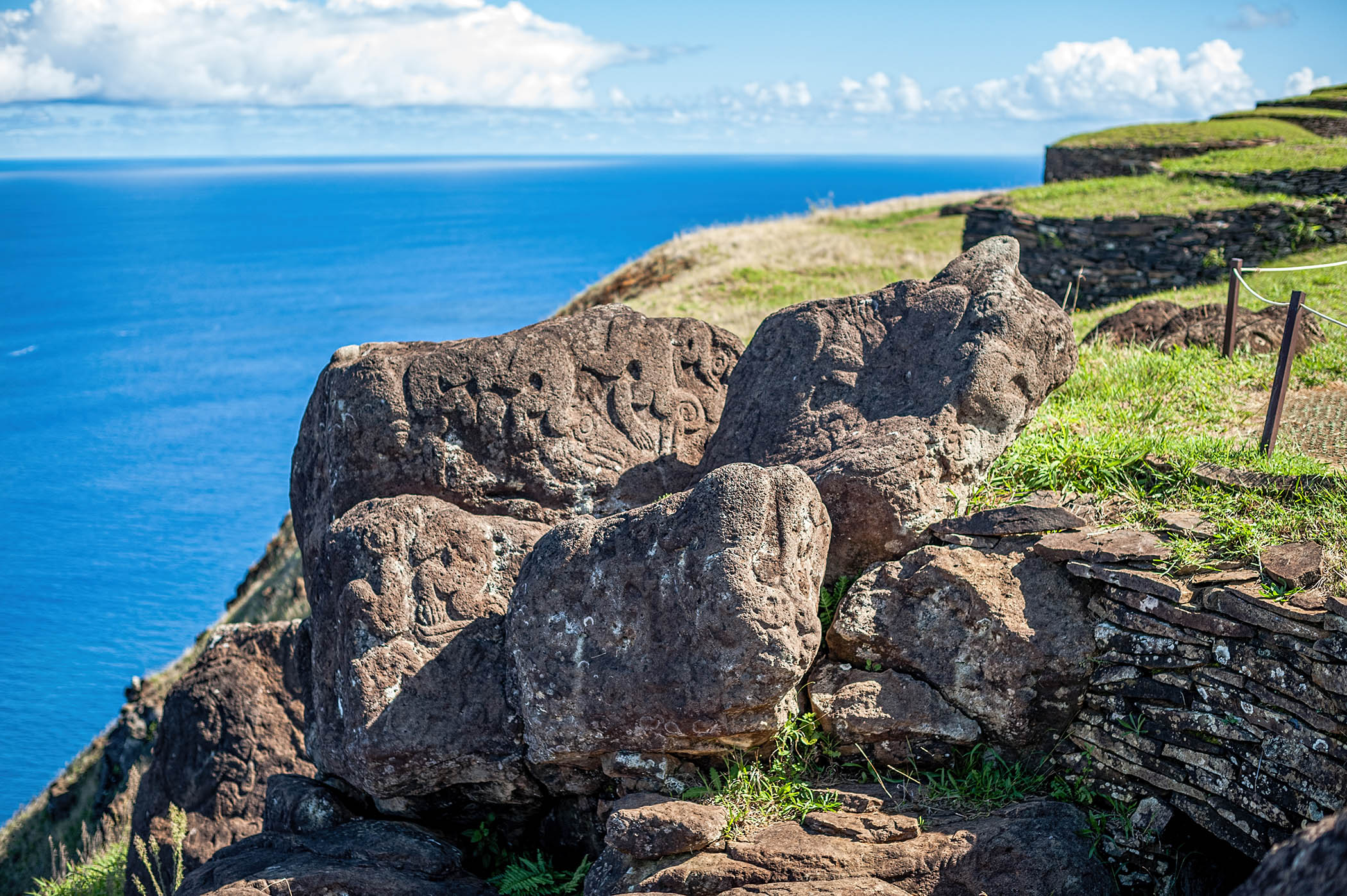
Moving from the ceremonial village towards the sea, we find the site of Mata Ŋā Rahu. These ancient carvings, once brilliantly colored, tell the story of the island's past and are associated with various legends. Look closely at the symbols. They represent the Taŋata Manu, the deity Make-Make, and symbols of femininity and fertility, elements of great importance in Rapa Nui culture. These petroglyphs mainly depict the winners and the ūka neru ceremony, where maidens were examined for their purity and presented to the winner. These carvings are more than art. They are a historical record, etched in stone for eternity, providing a window into the past and illustrating the beliefs and practices of the Rapa Nui ancestors.
Ariki Tepano
We are here at Mata Ŋā Rahu, where every year the coronation of successive birdmen was recorded in petroglyphs. From this spot, the hopu manu would descend the Kari-Kari (notch) and swim to the islets, and in the same way, they would climb back up here, returning with the first manutara egg. This allowed the winning hopu manu to earn the title of birdman and transfer the mana of the island to crown the reigning ruler for the year. The hand of Pou Va'e Tea is carved into the petroglyphs, as he was the first hopu manu to achieve the rank of taŋata manu, also crowning the first ruler of the era of the manutara egg competition. That ruler was King Ŋā'ara. Across from this site, on the other side of the crater, is Te mā'ea hono o Hotu Matu'a (The United Stone of King Hotu Matu'a), a place called Reīŋa Take, where King Hotu Matu'a spent his final days. This is the mana, the supernatural energy of our island, passed down to us and still felt to this day.
Isabel Pakarati
For those reasons, the elder would climb to 'Ō roŋo every year. He would climb up and spend time observing the rocks with petroglyphs from that place, which were engraved, and those engravings were called taŋata manu (birdman). On those rocks in that place, they carved different forms of the taŋata manu. That was the love, the bond that my father had with that place. Because there are stories about the place, there are also beautiful things, such as the islets, below as well, because it is believed that King Hotu Matu'a arrived there with all his traditions. These are the reasons why that elder wanted to go to that place. Additionally, my father used to make kai-kai, or stories depicted in string figures, with my mother, and there are kai-kai related to that place. These are the kai-kai: “E rua ŋā uka a Tori, a Ho'i 'Ata” (two maidens of Tori, of Ho'o 'Ata), and the kai-kai “'Ana Tahuna a Tāmata Pea,” which is the name of the cave located on the Motu Nui islet.
Zoilo Hucke
We are at the place called Mata Ŋā Rahu, where they would examine the genitals of the women chosen as virgin maidens for the birdman ceremony. According to what the elder Hati Reŋa told me, this is where the examinations took place. And those maidens who were found not to be virgins... were pushed down to the area below called Mata Ŋā Rahu. In this sector, the name Mata Ŋā Rahu does not refer to just one place. There is a spot called Mata Ŋā Rahu Ruŋa (Upper Mata Ŋā Rahu) and another spot called Mata Ŋā Rahu Raro (Lower Mata Ŋā Rahu) beneath the cliff. This is what the elder Fati, also known as Hati Reŋa, taught me. During the ceremony for the competition to obtain the first egg of the manutara, the virginity of the maidens representing each clan was verified. And those who did not meet this requirement were thrown off the cliff. This is what I can share about this place. There may be other people who can provide you with more information about this place, known as 'Ō roŋo.
Stop 7. Legends & Original Names
Beyond their artistic and historical value, the petroglyphs of Mata Ŋā Rahu also symbolize stories that have been shared orally and passed down through generations. These carvings, along with oral tradition, form a valuable legacy of ancestral knowledge. These stones, in their precarious positions, make it even more critical to document and preserve these stories. The Rapa Nui community has taken the initiative to use 3D technologies to restore this heritage site, ensuring that the stories and knowledge of their ancestors are not lost and can be shared with future generations.
Zoilo Hucke
Our island was territorially divided long ago by our ancestors. The great division of the island established territories for the two most important clans, where the first territory was granted by the first king to the clan called Ko Tu'u a 'Aro ko te Mata Nui (the royal lineage clan), and the second territory was given to the clan named Ko Tu'u Hotu 'Iti ko te Mata 'Iti (the clan of the king's servants). The dividing boundaries for these two clans began at the place called Pipi Tau Makohe (behind the Pōike peninsula), rising up to the summit of Pū a Kātiki (Pōike), and from there, continuing in a straight line to the hill Pu'i. From Pu'i, the line breaks and extends to Motu o Toka; from Motu o Toka, there are many stone markers (pipi horeko) that define the boundary line until it reaches this place, the Kau volcano. The crater of the volcano was divided in half and continues to Puku Māharo; from Puku Māharo, the dividing line descends and continues to Motu 'Iti (the small islet), splitting the islet in half. Then, it continues upward to Motu Nui (the large islet), which was also divided in half. Motu Kao-Kao (the narrow islet) remained on one side... the side belonging to the clan Hau Moana Miru (the royal lineage). And the other side of the place called Hoe belongs to the clan Hau Moana Tupa Hotu (the clan of the king's servants). This is how the island was divided. Later, these two large territories were subdivided into smaller territories for the lesser clans belonging to the two major clans, where the division extended from the central boundary to the coast.
Nehe-Nehe Pakomio Atan
There is something important we need to know as Rapa Nui people: Why was this crater named Poko 'Uri a Hau Maka (The Dark Hollow of Hau Maka)? Back in the time when the ancestors of the Rapa Nui lived in Hiva, the wise Hau Maka had a dream, a vision of Rapa Nui, or Kahu-Kahu o Hera, as the island was known at that time. One of the first places he saw in his vision was this place... giving it the name Poko 'Uri a Hau Maka. Today, as children and as a new generation of the island, we recognize the importance of this territory. We know this through our history as the Rapa Nui people, through songs, the kai-kai or string figure recitations, and body painting. This is how we have learned about our traditions. What I am saying is expressed through the lyrics of a song that says: “Hau Maka shared his vision with me, where his spirit traveled toward the sun, toward the rising sun...”; that song is something we can teach to the youngest ones. And now, many of them know it, and for this, we must give thanks to our ancestors for bringing us all our traditions and culture, through tattooing, ancient stories, and string figure recitations. Through songs, so that we may learn all these traditions from our childhood into adulthood.
Stop 8. Threats to ‘Ō roŋo
‘Ō roŋo faces many threats today, from wind erosion to violent storms that undermine the cliffs and endanger this sacred site. Ma’u Henua, the indigenous organization responsible for preserving the park, is committed to protecting ‘Ō roŋo. They lead efforts in erosion control and preservation to ensure that this heritage remains intact for future generations. The challenges they face and the steps they are taking to safeguard this cultural treasure are immense. The Rano Kao crater, with its unique flora and historical significance, is also under threat, making preservation efforts even more critical.
Ariki Tepano
Greetings to everyone. We are currently in the sector of Mata Ŋā Rahu, in this territory of 'Ōroŋo. Ma'u Henua is the one who, as part of this great effort, protects and cares for our riches and ancestral heritage, because many elements of this heritage have fallen into the sea, and have also suffered erosion due to water, rain, sea salt, and other kinds of damage that affect our ancestral legacy. Our mission is to care for, protect, and seek other alternatives that allow our descendants to appreciate this wealth in the future, to preserve it for them, and for it to be, in addition, a window through which to feel and admire all the heritage legacy left to us by our ancestors. Today, in Mata Ŋā Rahu, several rocks with petroglyphs have fallen into the sea, and as a solution, we now have a tool to carry out 3D mapping, which we’ve recently been given, with which we can observe very clearly this area from top to bottom, and from the sides as well, to identify the condition of these relics, to see if they have moved or shifted from their original state, or to check if any element has disappeared from its place, or simply to carefully observe the petroglyphs, since nowadays it’s not allowed to approach the petroglyphs to touch them. That’s why this is an excellent alternative and tool to pass down to these new generations, who are already becoming familiar with knowledge on these subjects, so that they may see and, over time, seek out other future alternatives to protect our precious ancestral treasures and relics.
Isabel Pakarati
We, the Rapa Nui people, must protect the ancestral heritage of the site of Mata Ŋā Rahu. Because at Mata Ŋā Rahu, ceremonies were held and it was shown that, at and from that place, our neru (women in seclusion) were chosen during the birdman ceremony, and this was done so they could later be fertilized to bear children, with the future goal of taking responsibility for the development and protection of the island; this was the tradition, and the ancient legacy left by the ancestors from the era of the birdman competition.
Stop 9. Conclusion and Invitation
Thank you for joining us on this journey through ‘Ō Roŋo. This site is a living testimony to the Rapa Nui people, their history, and their ongoing efforts to preserve it. As you reflect on what you've learned, consider how you can support the community and their work. This is not just a place of the past, but a vibrant, living story that continues to thrive with your participation and support. We hope you feel like special visitors, privileged to have accessed places and knowledge that are otherwise unavailable. We encourage you to feel reflective, respectful, and curious about Rapa Nui culture, and to visit the site in person with a new perspective. Māuru-uru 'Iorana!
Ariki Tepano
In our hands lies the opportunity to reflect and decide how we should care for and protect our ancestral heritage, so we can leave it as a legacy to our youth, to the future generations. What are the alternatives, options, or plans available to us? This is something we must reflect on deeply as a community. In recent times, rocks with petroglyphs from this place have started to fall; the first to fall and disappear was a great treasure: Ahu Riki-Riki, a site adjacent to Mata Ŋā Rahu. This situation must weigh on our minds and hearts, as we think about how to manage our ancestral heritage, to ensure its protection and care for the future.
Isabel Pakarati
That legacy is something extremely positive that our ancestors carried out and passed down to us, it was what my father and my mother, as well as the elders of the past, taught my siblings and me, telling us: "You must protect your treasures (heritage), you must safeguard your ancestral traditions… to develop them in alignment with your way of thinking, for all of that legacy is there, and you only need to develop it and bring it to light for the good of the island." That is all I can say, thank you very much.
Zoilo Hucke
I cannot fail to acknowledge the names of the people who taught me, those elders who shared their knowledge with me, such as... Fati, Hati Reŋa, Marcial Tuki, whom they called Tāvita, León Tuki, Alberto Huki, and Alberto Hotu. Because they took me to places... they didn’t just point things out from the house. They brought me to different parts of the island, and there, they taught me. That experience is incredibly valuable, because I still hold onto that knowledge. And now I’m passing it on to the children... I share this knowledge with them or with others who come to ask me about it. This sharing of our knowledge is something truly important. Because with this knowledge, we share our island with the world, and we share ourselves as Rapa Nui. If all these traditions and this knowledge are lost, it is like saying that our people and our culture will disappear as well. That’s why, with this task or this work, I am not selfish. And for this, they must come... those who hold this knowledge must come. And as our saying goes, stand on the ahu (or ceremonial platform), to share and pass on all of this wisdom. To families, to children, and so the world can also know the way we live.
Nehe-Nehe Pakomio Atan
I currently work at a preschool called 'Ohana, where I share what I know with the youngest children. Every day, I also try to teach others from my generation who haven’t learned. Many people from my generation know very little about our culture and ancestral traditions. That’s why I share this knowledge with them, so they can pass it on to their families, to their parents, to their siblings—just as I do when I teach my family, my younger brother, and all the children.