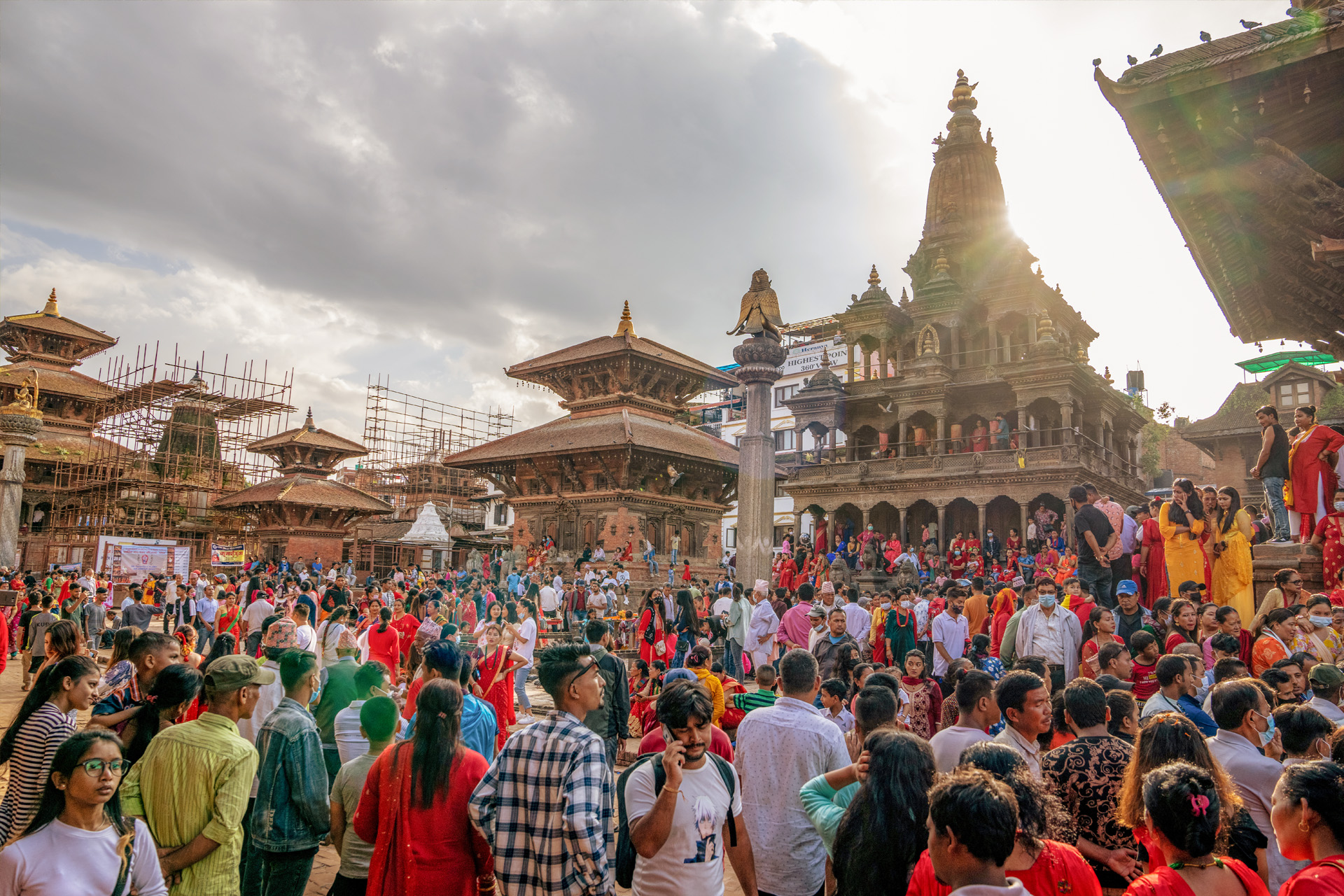
Patan Durbar Square
Namaste and welcome to Patan, also known as Lalitpur, in the Kathmandu Valley of Nepal. The population of Nepal is very diverse, including people of many different ethnicities, cultures, and religions, including Buddhism and Hinduism. The brick buildings include detailed wood carvings and multi-tiered pagodas, representative of the Malla Dynasty that created the buildings nearly 500 years ago. On your visit, you will see how the beliefs of the Malla Dynasty continue to influence the spiritual practice of Nepalis today. You will also hear from Shivesh Sharma, Padma Joshi, and Indra Prashad Silpakar about their connections to this sacred place.
Stop 1. Durbar Square
We are overlooking the southern edge of Patan Durbar Square, or Royal Square, consisting of palaces, courtyards, and deities adorning the temples and buildings throughout the square. It is one of three Durbar Squares in the Kathmandu Valley. The term Durbar Square refers to plazas and areas near royal palaces in Nepal. The significance of these royal complexes goes back to a time before Nepal became a unified country. The presence of Hindu deities in the form of idols and shrines throughout the Square creates both public and private sacred places.
Shivesh Sharma
My name is Shivesh Sharma; I am from Patan Durbar Square. So my home is right here. It is like 6 kilometers south from the capital city of Nepal, Kathmandu. So this is one of the... Patan is known as the city of fine arts. So being [full] of artistic images like those around. So that's where I am from.
Stop 2. Palace Wall
This is the exterior of the Royal Palace in Patan Durbar Square, a large building that dominates the square. This palace was built by the Malla Kings in the 17th century. The palace and the square were damaged by earthquakes, including one in 2015, but they've been restored. The many shrines and temples provide a place to experience the presence of their deities and practice puja, an important form of worship that involves ritual offerings. Along the corner of the façade vendors will set up shop selling marigolds and other supplies used as part of the puja. From here, you can see how the palace fits into the spiritual as well as practical daily lives of the citizens and visitors of Patan.
Shivesh Sharma
It's like a morning ritual, but we say like uh we always have to perform morning ritual to every um deity. Like every goddesses temples, gods temple, god's temple uh there's like rituals going on around every temple, uh every day. Like we cannot miss like okay I wanna do today, okay I will do, [but] tomorrow I won't be going. So there's not like nothing like that way. Like uh there are no holidays you have to go every day. Even if it's raining, you have to go, even it's sunny, you have to go, even it's like okay earthquake maybe you will you go or not go. But uh but we have to perform certain rituals so it's like uh even the disaster arrives or anything happens, uh you have to do the morning ritual.
Padma Sundar Joshi
I'm Padma Joshi. I'm by training I'm a civil engineer and I work in the urban context, in urban areas, particularly the urban environment. And water is one of the areas of interest of my work also.
Stop 3. Sundari Chowk
This is one of three chowks, or courtyards, inside the royal palace at Patan Durbar Square. This chowk is called Sundari Chowk, meaning “beautiful courtyard.” The other two chowks are Keshav Narayan Chowk and Mul Chowk. This structure is made primarily of brick and intricately carved wood and is a masterpiece of Newari style architecture. The wood used is from the sal tree, a hardwood which is sacred to many Hindus. This courtyard was intended as a private space for the king, reflecting his devotion to religious practice. Although this space is no longer used for daily spiritual practice, it is still used for certain ceremonies.
Padma Sundar Joshi
This is all the three uh what you call the laku or the Durbar Square in Kathmandu Valley has a very special water system Tusa Hiti is from Lalitpur and similarly in Bhaktapur and Kathmandu they do have their own system and these systems built inside the palace is more from the religious perspective. So that is why this is so much important and this is the inner court of the king that the King's family at a time but it has got so much religious meaning on that and apart from that he that the family also have a water source just next to this courtyard there's in the open there's a there's a pond and you know the the spout and that water is mainly for taking bath washing and other other purposes now water is always public so if you see all the Hitis, it doesn't belong to this or that person it belongs to the community and everybody all cast and creed they are allowed to come and collect water there use that water.
Indra Prashad Silpakar
Hello, Namaste. I'm Indra Prashad Silpakar, from Paktapur. I'm a woodcarver. We use sal wood which is only found in Nepal and India. It's a hard and heavy wood, and this is also difficult to find this really good wood. Sometimes we have to wait for, you know, for one year for like a big structure, a big project, but for a small one, we can find easily.
Stop 4. Tusa Hiti
The central attraction in this chowk is undoubtedly the step-pool in the center, known as Tusa Hiti. Water holds a significant place in Hinduism, used in almost all religious rituals and ceremonies for its purifying properties. The stone walls of the pool are intricately carved with an array of Hindu deities. The water tap itself is topped with the dual representation of the Hindu deities Vishnu, also known as Narayana, and his consort, Lakshmi, atop a mythic bird- creature Garuda. This pool was originally built by Siddhinarasimha Malla, a devout Hindu, in the mid-17th century. The King likely used it and the surrounding deities in his own daily practice of devotion and prayer.
Padma Sundar Joshi
Well, this Hiti is uh very much famous for its architecture as well as its... the use, the spiritual use. The King, King Siddhinarasimha Malla who constructed this. He is a very religious person, and this chowk, this courtyard particularly, is very much famous for his very much religious activities he performs [in it]. So the water here is more, you know, for the spiritual purpose for the god. It's more than taking a bath; it is more for the religious purposes. And he used to, you can see the bed here, he used to sleep here during winter on that uh the naked stone. And in the summertime he used to have a fire in front of him is a kind of very much religiously conscious person. So he built this to offer the best water, the pure water, to the god that is the main purpose apart from that once you have got to water they have it has got other use as well
Stop 5. World Heritage
The Kathmandu Valley, of which Patan Durbar Square is a part, has become increasingly urbanized in recent years, which poses a threat to historic districts such as the Durbar Squares. Earthquakes in the region also pose a threat to these structures, but the skilled artisans of today continue age-old practices of wood carving and metal work to maintain these intricate buildings. The historically significant parts of the valley have been designated as a World Heritage Site in recognition of their cultural and architectural significance. Efforts to preserve this area’s unique heritage from dangers, both natural and made-made, is ongoing to ensure that it will remain a place of importance for generations to come.
Indra Prashad Silpakar
We really like to work like for heritage you know if we work for heritage you know everybody can see that. We can also work in our works of making, I mean one of one kind of, you know this sculpture that is only for one person, and they only put in their room. But we really love to work for heritage