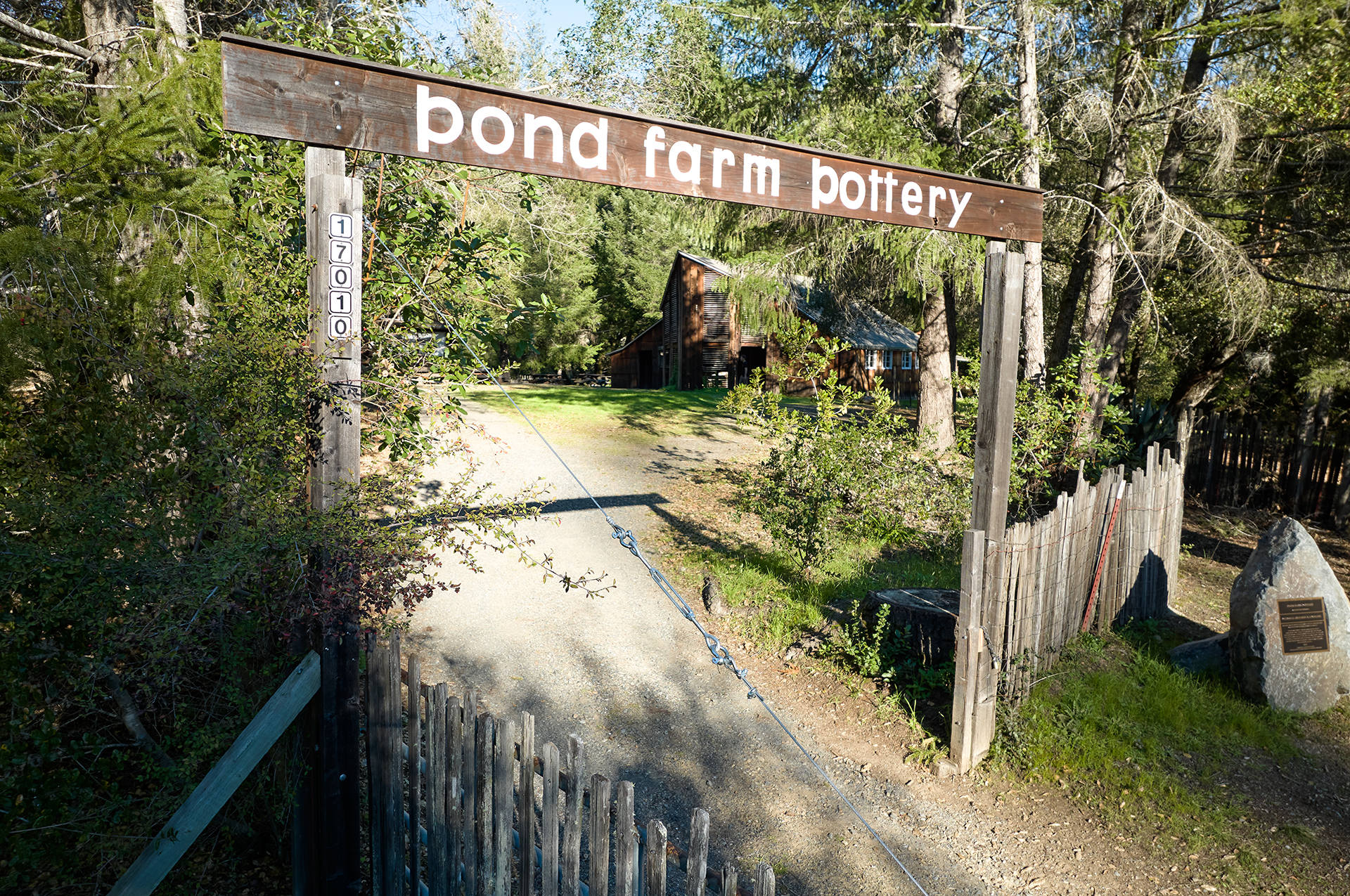
Pond Farm Pottery
Welcome to Pond Farm Pottery, part of Austin Creek State Recreation Area in Northern California. This site was once the home and studio of Bauhaus-trained ceramicist Marguerite Friedlaender Wildenhain. After being forced to flee Europe during World War II, Wildenhain established Pond Farm Pottery to continue her work and teaching. Here, pottery was more than a craft; it was a way of life that shaped a generation of students who continue to carry on her legacy. In this experience, you will explore Pond Farm Pottery alongside former students and park interpreters who share their firsthand stories and reflections on this transformative place.
Stop 1. Marguerite Wildenhain
Along the hillside of the southern part of the property is Marguerite Wildenhain’s rustic cabin, a place that served as a personal refuge after a life of displacement. Born in France, she received training as a potter in Germany at the Staatliches Bauhaus. As a Jewish woman, she was forced to flee Nazi Germany, first with her husband to the Netherlands, and later alone to the United States. At Pond Farm, she joined an artists’ colony founded by Gordon and Jane Herr that welcomed European artists forced from their homes. In 1942, Marguerite and Gordon Herr built this simple house. She added to the home when her husband joined her at Pond Farm after seven years of separation. In the early 1950s, Jane Herr passed away, and Marguerite and Franz divorced. The community disbanded in 1953, and once again Marguerite reinvented herself, choosing to stay at Pond Farm and rebrand the school with the new name Pond Farm Pottery. In addition to continuing her own work as a ceramicist, each summer she ran a 9-week-long session where she trained students in her process.
Birgit Nielsen
I think her life in Europe informed every aspect of her life in the United States. In a way she was already a fully formed artist with a portfolio and many awards, and her career in Europe was taking off. And she would have become one of the influential European designers if Adolf Hitler hadn't happened. So she came here, and I think two things probably had a major impact of how she managed to build Pond Farm Pottery and make a successful life for herself here in the United States. And that was her training, I think, was essential during the seven years that she spent at the Bauhaus, because it taught her discipline; it gave her a purpose. And she had learned during those years not only discipline but also how to make money, how to survive, and how to become self-sufficient. I mean, during the Bauhaus years they were encouraged to tend their own garden and grow their own vegetables. And so those skills and that rigorous training that she underwent was no doubt essential to her being able to pack up at a minute's notice in 1933 and flee to Holland with her husband and started from scratch in Holland. And they built a successful pottery studio there, found new clients, learned another language, and basically made a life for themselves for seven years until 1940, when again she was threatened by the Nazis who were about to march into Holland, and she had to flee again to the United States. So by the time she got here I think she had learned that if push comes to shove you can do it, you can reinvent yourself, you can start again. And so having done it already once she knew that she could do it again.
Stop 2. Grounded in Nature
Here by the peach tree in front of the barn, students part of Marguerite’s summer sessions gathered for their morning break. Here, Marguerite shared ideas from philosophers, writers, or current events surrounded by the landscape that shaped her life and work. Marguerite’s practice was grounded in nature at Pond Farm. In 1956, She purchased 7.8 acres of this land from Gorden Herr and lived simply, working hard in her garden and steadily improving the buildings on site. She believed nature was essential for artists and her students in their training. This natural landscape was one of her classrooms. Here, she reminded students, “Observe how nature solves its many problems.” Over time, Marguerite’s pottery grew more naturalistic, drawing texture and color from the land. Today, flowering quince and daffodils she planted still return each spring.
Jane Rekedal
Marguerite loved being outdoors. When she was a young woman in Germany, she used to go on long hikes up in the mountains, and where she lived was just stunningly beautiful. And so she had a great appreciation for outdoors. She was trained as an artist, so she appreciated all the nuances and the life forms and that those were expressed in her work. Many many drawings and paintings of her leaves and things that she observed, and with her keen observation skills showed up on her work, and it showed up in our work as well as students. She would, when we got good enough, we got to start decorating things, and also from our drawing classes we were always drawing things from nature. So she would just be able to go out and you know collect 25 things, and there we had something different for every person to draw. And it might be a leaf. She always — she had this beautiful fig tree that she would bring fig leaves, which, of course, for me was super exotic because I was from the Midwest. I'd never seen a fig leaf before except on a statue of David. And so these kind of things were both unique and intriguing to us as students. But then learning how to draw them was an important part of what we did. So she drew from nature, and we all did. I know I still do. So it's carried through to my work today. I do a lot of that kind of decorating.
Wayne Reynolds
So the environment you're up on this mountain, and it's all this natural nature. And she has you go out, listen all the students, you all go out and find things you need. You're gonna make textures with. And so you're out there working through the bushes, like trying to find things. Would be a good texture tool. That'd be really trying to get really nice one, you know. So you're really looking; you're looking at the plants, you're looking at the seed pods. You're looking at the snails, looking at everything. And I never looked at nature before like that. And so she opened your eyes to the natural world in a way that had never been open to me. I was born and raised in the city. What do I know about the natural world? Nothing. Ants. Our house had ants.
Birgit Nielsen
Well the natural environment. I believe has been important to Marguerite throughout her life. I mean she grew up in a family where particularly her mother, I believe, was very fond of taking the kids out and encouraging the kids to explore nature. What nature ended up becoming for her was a safe haven, a refuge. I think we can think of Pond Farm Pottery as her personal refuge from what had happened to her. How nature inspired her is because of that attention to detail, that willingness to spend time in it in order to really understand what it is you're looking at. And you can't do that if you just glance at things. So I think her own practice of looking at different plants and seeing how they grow out of the soil. Do they grow straight up or do they curve or do they bend to the light? And so there's this incredible wealth and richness, and that is, I think, what inspired her as an artist. And that appreciation, if you will, then informed everything in her life. I mean not just her art and not just the pottery. Because I think it's a skill once you start practicing that interest and pursuit of finding the beauty in the detail. It's a skill that once you learn it you cannot unlearn it.
Stop 3. Craft of Pottery
As we enter the south studio in the barn, we see Marguerite’s wheel in the corner. In Germany, she became the first woman to earn the title of master potter. Her craft and teaching here reflected that Bauhaus training: rigorous, focused, and rooted in fundamentals. Many steps are involved in creating pottery, starting with preparing the clay and shaping the pot. The final parts of the process include drying, glazing, and firing. In Marguerite’s teaching, she focused her students on honing their skills in observation and form. Here she taught her students a limited set of basic shapes, believing that these forms were fundamental to developing an artistic voice. At the wheel, her students would focus on observing and iterating on these forms. Pieces were never fired. After Marguerite’s critique of students’ work, the clay was recycled for reuse.
Jane Rekedal
You get on, you're on your wheels. You know you're there. You're never ever ever late. So everybody was given their own individual assignments for whatever they should be working on to develop those skills. Might be, if you're a beginner, it might be the dog dish, or they move on to the flower pot, whatever. And the more advanced students would be on cylinders, and you know, maybe teapots eventually. So we would work pretty quietly. What you'd hear in the barn is like, you know, the wheels being kicked or wedging clay and patting the clay down. You'd hear those noises you didn't hear conversation. And people just really working, you'd hear the wheels turning, murmuring a little bit. And then when Margaret would come through, like talking to individuals about their work, everybody would like tune in and go, "what's that comment?" You know, because they wanted to learn from every moment. And so then you know, circulate through the room.
Wayne Reynolds
I had really a profound experience with her. And so I'd been making pottery in college and all of us were trying to make really big pots and all that sort of thing. And so she wasn't going for that at all. I had to start with these little dishes and after a couple of weeks of that I found it very difficult to make these little dishes. I was criticizing it, but at the same time I really couldn't do it very well. So after a couple of weeks up there I was starting to get a little bit of skill with the potter's wheel. And she asked us all—she wanted all of us to make a hand built pot. And I said, Marguerite, I don't want to make a hand built pot. I came up here to learn to throw and so that's what I really want to do. So I'll just go back, I'll just continue throwing. She says, no, no. You either do it or you leave. And so I was—my young brain I was kind of upset by that. Angry at that actually. So I made out of slabs this kind of big obstrosity and I was going to shock her. I thought, my brain, I thought I was going to shock her. So after a couple of hours she had to go around to all the students. She'd come around and give you your critique and advise you. So she stopped at mine and she looked at me and then she looked at it and she looked at me again. And she said, well, you know, Wayne, it's not so bad if you had just refined it more and changed some things. And she just took off her—I mean she just went up and started working on my pot. And she was changing things and refining it. Her hands—I hadn't noticed her hand yet. Her hands were really thick, cracked hands that had been working with clay for all her life. And they were just dancing over the clay. I mean it was just amazing. It put me in a hypnotic state, I think. And it seemed like after maybe five minutes my thing really started to take life. It started to look—wow, that's pretty nice. And I realized at that moment, that instant, boy I wanted to learn what she could do. And she was the one to teach me. And after that I was just the most obedient student I could be. And I didn't become the best student by a stretch, but I certainly became a dedicated, serious student and ended up going back seven summers to study with her.
Birgit Nielsen
So the core teachings of what I understand of the summer sessions actually originated from her own learning experience at the Bauhaus. So you showed up every day you know for work. You started from the beginning; you know you started with a simple form. No matter whether students were already accomplished potters themselves or whether they had been here before and already gone through the program, you know every time they arrived it was the same program. So you start with a simple dish and then you go through the forms and you make from every single form you have to make as many as it takes until you have mastered that particular form. Until you know it, you know your body and your mind. And another core teaching I think is you know don't fire anything you make here until you've made at least a thousand or several thousand pots. You know don't get attached. If you've mastered the skill, if you know what you're doing you can redo it and it will be better.
Stop 4. Workshops & Community
Inside the barn’s main studio, you can see rows of kickwheels built along the north and south walls. During the summer sessions, this space would have been filled with the sounds of kick wheels turning and Marguerite’s occasional short critiques. The community that developed through the summer sessions played a significant role in shaping the lives of Marguerite and her students. From 1952 to 1980, about 25 students came here each summer for nine intensive weeks, calling themselves the “Pond Farmers.” Students worked six hours a day, five days a week, and cultivated a bond through what for many of them was the most challenging and rewarding experience of their young lives. Here, Marguerite taught not just technique but life lessons, encouraging students to let their observations inform their creativity. The students Marguerite taught here became her extended network who she would visit and stay with when she traveled. The bond that the Pond Farmers established continues today, with many involved in site preservation efforts.
Jane Rekedal
The summer before I came here. I came on a trip just to visit, because I had fellow college students who were here. So we just came here on a little trip, and I was on a Friday afternoon. We knew what day to come — Friday afternoon, just shortly before classes were over. So we came in and we met Marguerite and greeted her and all that. And then we didn't spend much time, but there was this one of the students there wedging clay. You know, he's like this down on his knees in the alcove and he didn't have a shirt on. It's a hot summer day. He's wedging clay, and people are working at their wheels. And so I'm kind of looking around and saying that's a good-looking guy. And then it was because it was Friday after classes were over we went down to the campground and stayed with our friends there. This guy actually went home for the weekend, but he and I had kind of caught each other's eyes a little bit. And so I was hoping, Oh, I hope he comes back before we go home, because before my friends and I move on. So we stayed until Sunday and yes, he did come back — Sunday afternoon or something. And so then I got to know him. His name is Seth Capron, and he was — that was his second summer here. And he had his pottery studio just like two hours south of where we are now. And so we kind of cemented that relationship on that Sunday afternoon and evening, and then became pen pals for two years while I finished my college education. And he was making pots and he's like, what do you need to do to a degree to make pots? You know, you just got to make pots. So I, but I I've toughed it out and got my degree and then moved out here and we are now married almost 50 years.
Wayne Reynolds
And those of us that went summer after summer we referred to ourselves as Pond Farmers. And it was a brotherhood. And many of us that went not everybody you had to study with her before to go those summers. Those later she was kind of slowing down. She went from nine weeks to six weeks teaching, which is fine with most of us because we had all been there several summers. And we had projects we wanted to work on. But we had studios and we had a life to earn. We couldn't just not do anything. Yeah, it was kind of a brotherhood of Pond Farmers. And it still is. Whenever we see a Pond Farmer we just embrace each other. We went through boot camp together. We were Navy SEALs together. But she was a tough teacher. I mean, she almost never said it was good. She said well, not so bad. That's not so bad, not so bad. I don't think I ever heard her say oh that's good. She didn't. She felt it was corrupting. She'd, it's good but compared to who? Compared to Picasso you know, I mean that's what her level was, you know.
Stop 5. Marguerite’s Impact
Upstairs in the barn’s showroom, overlooking the kickwheels below, is where Marguerite displayed and sold her work—quietly. She didn’t believe in marketing, but that an artist's work should speak for itself. From Europe to the United States, Marguerite made her mark and became a major influence in the American Studio Art Movement. She was outspoken, unafraid to stand her ground among renowned artists, and deeply committed to teaching. Though Marguerite left Germany behind, she carried forward the Bauhaus ethic of discipline, attention, and dedication, outlasting many of her peers in building a true school. Her influence continues to live on through the students she taught here. One student, Dean Schwarz, later taught at Luther College, inspiring a new generation of “Pond Farmers.” He went on to help found the South Bear School in Iowa, now taught by his granddaughter, Marguerite.
Jane Rekedal
I just wanted to be working. and I just worked, and so yeah, I had two summers here and I'd had three years and two other summers with my former teacher who was, you know, all in the same tradition. So I had a good grounding, and it would have been nice to come more, but that's what I got. So I am now still a practicing potter, still the same old studio from 1969 and still working in the Pond Farm tradition. My wheel. There are two wheels in my studio that were built by former Pond Farmers, and I work on those. They're kick wheels, although I have a motor on mine also, and I still wedge my clay the same way, prepare the same way, throw the same techniques, and so I feel like I really carried that through my decorations, that they are often nature inspired, and I value the things that she taught us about: "you can always make it better; if it's not right, don't keep it."
Wayne Reynolds
Those that liked her, and liked it, she had a profound influence. I mean, we already loved her and I think because of that we lived a better life. We were better human beings for knowing her. From simple things like sipping champagne and saying good morning in the morning, by just being honorable and honest in our work, trying to do the best we could, and I didn't try to fake anything and all that transferred, I think it certainly did to me. So, as I said as a younger person, I was sort of a hoodlum, and I think back on that part of my life with great regret. But I think some of the reasons I'm who I am now is, I'm knowing Marguerite, yeah, and oh no, she wouldn't want that me to do that, no, no, you know I don't have anything to say, but I would think of that, you know, and what would she say about it, and it occurred to me I cared about what she said, and many students felt the same; I wasn't unique. I was unique in the sense that I lived closer and so she could call me if she needed something or wanted something, and I would absolutely, of course, I'll be right there, Marguerite, and then we moved to Santa Rosa actually because of her, because she was getting older, and we wanted to be closer. When she was not feeling that well, I visited her regularly, and she had just a couple of spells in the hospital for a few weeks at a time. I went to every day to visit her, and I would read to her, just talk to her, and tell her what was going on with our life, and then we had a baby, and we named Maya, and Caryn would take her, take our baby up to Pond Farm every month or two to visit with Marguerite, and Caryn would stay the weekend up there, and so she had this— we have some pictures, we had some pictures of her holding our daughter, and anyway one time I was—I was in hospital visiting her, and I get emotional, and I'm sitting there nice next to her saying, 'God, Marguerite, thank you so much.' I could have never had a life that I've had because of you. God, I love you, Marguerite; thank you, thank you. And she said, (none of this was allowed), and she said, "me too," well, she even left me her will, yeah. Wow, what can I say?
Birgit Nielsen
Everyone that walked through the gate to start learning here during the summer sessions, and spent the weeks here with Marguerite. I believe was on some level or another changed by it, and many of them have said profoundly. Outside of that, I think she was beginning to be renowned in Europe in major ways before she even came to the United States. So that example, for instance, that comes to mind, is when she arrives in the US in 1940 and is invited, and she's trying to find a job for Franz so that he can get a visa, and actually come and join her. And she's also trying to place her work and trying to see whether she can exhibit. So she's arrived and she's trying to make connections. And one of the things she's invited to a meeting with the trustees of the Museum of Modern Art, and they serve her tea, and they bring tea to her in one of her cups. And this trustee from the museum had purchased it in Paris, and apparently had no idea that Marguerite Friedlaender had made this. So that tells you something about the role and the renown that she was beginning to, or had already had. And so much so that she became known in the United States as a major influence on the American studio pottery movement. So much so that she went to conferences and was invited to speak as the representative, if you will, of the studio pottery movement, and of her teachings. And she stood her ground. She had something to say, and she defined it. She put it into words. She wrote books about it. She engaged with people. She engaged with other potters. She fought with other potters that she did not agree with. So in that sense she was sort of an eminent force in her field. I think, and she was very respected for it.
Stop 6. A Historic Site
While Pond Farm has changed in the decades since Marguerite lived here, the care and community that shaped this place can be seen in the structures and landscape. Marguerite stopped teaching the summer sessions in 1980, but she continued to live and work here, carrying on her craft until the end of her life. In 1963, California State Parks began acquiring the land through eminent domain for what became Austin Creek State Recreation Area. Through a letter writing campaign of hundreds of students, Marguerite was allowed to stay on the property. She remained a permanent resident here until her death in 1985. In 2023, Pond Farm Pottery was designated a National Historic Landmark, recognizing its lasting cultural significance. Today, this site continues to inspire visitors from around the world. As you explore, we ask that you treat this place with respect. Take photographs, memories, and knowledge with you, but leave what you see exactly as it is.
Jane Rekedal
It's been many decades since I was here 1975 and 76. And we've lost a lot of students, you know, they've gotten old. We're all getting old. We're dying off. And it's like we really want to try to preserve something about Pond Farm that can go on to the next generation. Her legacy is one that we want to be heard and seen by many people because it's valid for many people in different ways than it was for us as students. It carries into many different stories as a woman, you know, female artist, but also someone who had to do it alone. She was married for only a short time. As an immigrant, as someone, you know, who had to flee Nazi rule. So, Jewish, as someone who started over and over again from nothing and yet made a life for herself that was truly fulfilling and then shared with so many people to help us become real humans. So it's a really valid story for today. I think many, many people can find a piece of themselves in this story. It's not just relegated to history. I think it's still alive. And so I do hope that that story can continue to be told.
Birgit Nielsen
It is important to protect the site because it was such a site of transformation. If you will not only in terms of this beautiful old redwood barn that has been here since you know the California ranching era in the late 19th century, and the modifications that Gordon Herr added to it that make it such an iconic sort of building. But then what happened when the artist colony was here and then when Marguerite started Pond Farm Pottery here in 1953, and what happened here, the hundreds of people that came through here and were changed by their time that they spent here, and that influence endures. It's our job now, you know, to bring more people to Pond Farm Pottery and have them learn about it and appreciate it, and see the need to protect it for future generations.
Stop 7. Continuing Marguerite's Legacy
Thank you for visiting Pond Farm Pottery, part of Austin Creek State Recreation Area. Marguerite’s life at Pond Farm illuminates the power of dedication to craft and the lessons learned through the process. We encourage you to learn more about Pond Farm Pottery as well as the movements this place continues to inspire.