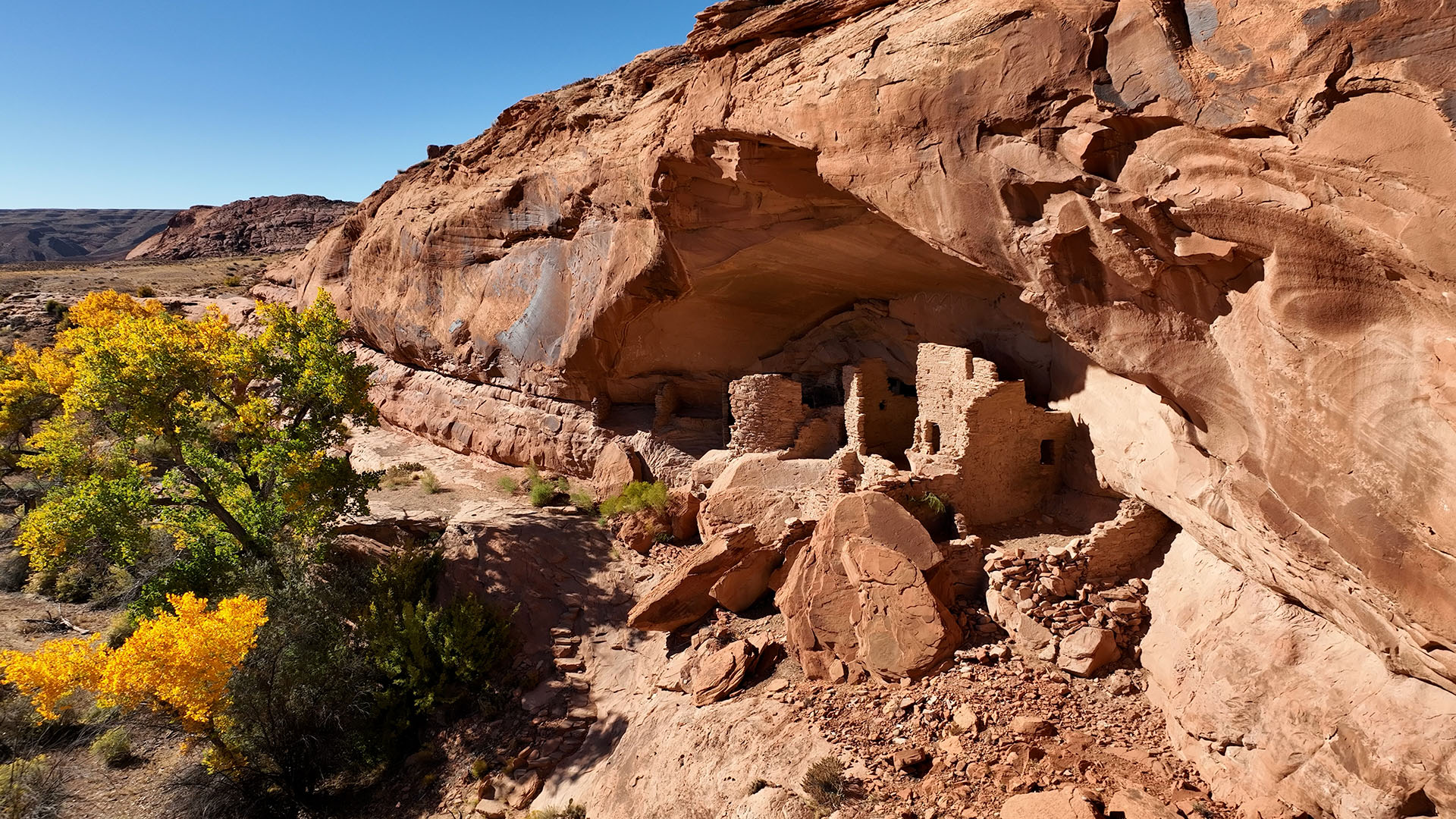
River House, Bears Ears NM
[Speaking Zuni] Welcome to River House, an Ancestral Pueblo village at the southern end of the Comb Ridge landform in Bears Ears National Monument, known in the Zuni language as [speaking Zuni] [speaking Zuni] [speaking Zuni] is part of the A:Shiwi people's heritage and Zuni people's ancestral lands. The Pueblo of Zuni is one of many sovereign tribal nations with ties to Bears Ears and River House. In this experience, you will learn about River House and the Zuni peoples ongoing connection to this place since immemorial. You will also hear from members of the Pueblo Zuni’s tribal government, including Mr. Arden Kucate, Ms. Cordelia Hooee, Ms. Birdena Sanchez, and Mr. Edward Wemytewa.
Stop 1. Listening to the Land
The high desert landscape along the San Juan River in the 80 mile long Come Ridge in southern eastern Utah, is one of many locations that are part of Zuni ancestral lands for the A:shiwi, River House, and other Ancestral Pueblo sites, are places where ancestors remain as part of the landscape, including the river, the rock, the sky, and the wind. Listening to the landscape is an important part of entering these places and informed ongoing ceremonial practices and decision making at Zuni. Today, Zuni Village is the largest pueblo in what is now the state of New Mexico. Bears Ears and other ancestral lands are essential to maintaining connections with Zuni ancestors and sustaining cultural life in Zuni today.
Mr. Kucate
Very, kind of like Ground Zero to me. I mean, I felt like I felt very welcome here, you know, because every time we first set foot in a lot of these areas that I've never been here before, I have to make sure I give my offerings to the spirits. So that way I'm just not coming in uninvited or what have you. But that's just, you know, our way of practice in life as Pueblo people. This place is very living. And, what I mean by that is that every time that we come to these very special places, cultural sites, ancestral sites and what have you, you know, there's probably, you know, sacred shrines and other things here that, you know, continues to have that, you know, spirit in perpetuity. And the reason why I say that is when we said our prayers this morning, and then we walked down to the river to give some offerings, you know, we saw yellow-shafted flicker. Those are not very, very common to see, even when it’s just one bird. To me, it was a sign that the spirits here were accepting our presence here by seeing this yellow-shafted flicker, because those are very hard to see where I come from.
Ms. Hooee & Ms. Sanchez
Because we hear about, you know, our ancestral lands, our ruins. I don't like to call them ruins, our ancestral homes. Because, our ancestors, they're still here. We can feel them. We greet them when we come in. We make our offerings to them so we know they're still here. And it's until you really come in. I guess the personal experience when you come up here and walk through, walk through the ruins, if you're able to, or just to stand there and look at them and it really is, It brings an emotion that part of us is here. I don't know. I don't know how to put it that it's a huge impact on you, on your identity. Like, whatever tribe you come from. Like, for us, you know, we have ties here to Bears Ears, and it really makes you think of all the things that make up your identity as Zuni, and this is a part of it. And so I think there has to be some, I don't know, reconnecting to the place where you came from kind of thing. And I think with our we were talking about our youth and our and our women and even our elders, I think there has to be in this day and time when there's so many social ills, so many things that negatively impact our communities, and we talk about the preservation of our culture, the perpetuating of our language, then this is the kind of thing that has to happen. It's got to be there that we have to remember our past. You know, I guess our past past, but not remember, not forget our ancestors who have brought us this far. And I think coming to places like this really does that.
Mr. Wemytewa
The point here is that when we visit these sacred sites like River House or Chaco Canyon, we have to approach that place and greet the ancestors and to walk that space with this clear heart and mind so we can get signs back. We can hear messages, voices from the river, the land, and the rock. And so today, being here, I have to just reminisce that how did our ancestors live? And I know that we have to respect the spirit of the space. What is the spirit of the space? Is it the land? Is it the human? I imagine is the spirit of existence. And so we're not just here, but to remind ourselves why we're here.
Stop 2. Zuni Emergence & Migration
The area around River House is part of the migration path of the A:shiwi people. According to Zuni tradition the A:Shiwi emerged when the sun sent his two sons through a bolt of lightning to the fourth underworld. There they made it possible for people to climb up to the world of light. The sons changed the people so they could survive in the New World by cutting their tails and splitting their webbed fingers and toes. The A:Shiwi people split into groups that went north, south, and east searching for a home. Those who went north lived in and migrated through Bears Ears. Those who went east crossed the Little Colorado River, and as they crossed their children turned into water creatures. Today, all aquatic life is considered the ancestors and kin of the Zuni people. At Hard Scrabble Wash, people prayed for rain, which exposed symbols informing them of their clans. They eventually arrived at a place where the water strider stretched across the lands, with its legs planted in the seas, showing them where they would settle. Surrounding its heart in the middle place.
Mr. Kucate
Well, to be here today again really reinforces my upbringing and understanding about how we were always orally told about our emergence and migration stories and the ancestral people that, you know, settled in different areas. I'm a very fluent speaking Zuni man, and our language is isolate itself. There's no other language like Zuni elsewhere. We have a one of a kind language here. And in Zuni, present day Zuni, we still have our ongoing Kiva ceremonial, you know, rituals. We have medicine societies that continue the rituals. We have rain priests that continue the rituals and other cultural associations, which all basically connects to all these ancestral places from all directions. There's no end to it. There's no, “Oh, that one’s lower than that's the higher one.” It's all an equal balance in terms of how we try to understand where we are today.
Mr. Wemytewa
When we talk about migration stories, it's not a migration story that leaves a place and leaves it forever. Our migrations are cyclical. They're in cycles. And just to give you an example, why it's really important to tell this account is that when we visited places, we always come back to pay homage. For us, Grand Canyon is the birthplace of the A:Shiwi. And that's where our migration story starts. And of course, when we emerged from the Grand Canyon, our goal was to find a middle place. And so when we left the Grand Canyon, we went easterly. Part of the people went southerly. And the third group, they went around to the north, northern part of the Grand Canyon and moving easterly. And so these three trails were these three paths. Their again, their goal was to find a middle place which is located in New Mexico. Now, let me just briefly talk about our our migration route north. And that's particularly why we're out here long before the division of the North and South people. There was an earlier division who went north. They were called the [speaking Zuni], sword swallower clan. The Ice Clan. They're the ones that ventured north. They're the ones that ventured most likely to Bears Ears and on to Chaco Canyon and back on down to the Middle Place in in northwest New Mexico. The reason why we're very elated to be a part of this national monument conversation is because we're here to reclaim the land for our cultural knowledge. I have a map in my backpack. In this map is a rock. A rock was about this big, and it used to belong just outside the village. But in the around 1879, 1880, there was an expedition that came to Zuni. They saw this rock with a map on it. It's called a map of the [speaking Zuni] migration. It's the map of the Sword Swallower migration. It's the northern pilgrimage, or the northern migration of an aspect of the Zuni people. That was the third migration that happened simultaneously in search of the middle place. So in this rock, there was this place where the migration was identified as started. And, it describes a place as a hand. And we know where this place is. We know the name of that place. Well, the migration started there, and it went north and up around the cold mountain lands. And, eventually they were the ones that ended up going to, Bandelier [speaking Zuni] This place, the Bandelier National Park, I think it is. We know it as [speaking Zuni] our Pueblo relatives in along the little not the little Colorado River, but our relatives who live along the Rio Grande, central Rio Grande and northern Rio Grande. They're also familiar with the place called [speaking Zuni] It's sacred to all of us. And there's many stories to that place. But the Sword Swallowers the [speaking Zuni] Easterly migration at [speaking Zuni] and they work their way back down to our present village of Zuni. And so the sword swallowers were a critical part of our peoples. And we reflect 100 years back, they were still performing in the plaza. They were still performing their sword swallowing. And, they had initiated members. And so it was still an active society, a sacred society, a religious society. But for some reason [speaking Zuni], they all disappeared. And it was about 20 years ago that the last member of the [speaking Zuni] had passed away.
Stop 3. Water is Life
The San Juan River, flowing parallel to River House, is an essential part of Zuni life, spanning ancestral lands and migration paths. Water holds great significance for the A:shiwi and other Pueblo people, symbolizing life itself. The Zuni ancestors who resided in this area relied heavily on the river and water sources, not only for physical survival but also for maintaining spiritual connections with the land. The underground springs near the River House; hold particular sacred importance for the Pueblo people. Water served various purposes within the village, including drinking, agriculture, cooling, cooking, crafting clay, pottery production, and construction.
Mr. Kucate
Regardless if it's kind of like the the main stream body of water, like the San Juan River, the Grand Canyon River, the Colorado River, wherever it may be, you know, and then also in connection to that, you know, the underground springs, you know, they're like, you know, the veins of life. Water is life no matter how you want to cut it. And so how we look at it is that when you try to connect the river life, water channel ways, you know, it starts somewhere, and then it continues. So when you really think about it, it connects into the most highest peaks, you know, and then so this is where in Pueblo and understanding when you want to talk about water then you, you make that correlation to, to the thunder beings. Without the thunder beings they provide the rain, they provide the snow, they provide moisture, they provide. So everything is universally interconnected. So in order for that to continue to give that life of the needs that we have pertaining to water, no matter where it is. Again, this is something that ancestral people were able to kind of really, I guess, master, in terms of rituals, prayers, songs, especially prayers and songs, because I could be way down in Zuni, but I could still be relating to these places with the water channel ways. And so, you know, those are critical areas because nowadays, you know, in the modern times, they talk about drought conditions. You know, when you talk about job conditions, sometimes these rivers get an adverse impact to it or the springs dry up, you know, because we're either taking too much out of it. We're not giving it enough time to recharge. So that's that's the I think the natural balance is that native people has to always worry about and think about. And the way that we do that is through our prayers, through our songs where we have to be humble, to Mother Earth, to the flesh and blood of Mother Earth, because without, you know, there's like certain native people have prophecies. We drain everything out, the whole globe is just going to tilt, and so there we go. Because, and it's meaningful because in our history, you know, we grew up with a lot of oral history about the times of the great flood. You know, when you look at the geology, no matter where you're at, when you look at the geology and you understand those traditional, you know, stories and what have you, I think the geology that you see speaks for itself about the great floods, how all the mountains were shaped and all these mesas and everything. And in between, you know, the geology of it and everything to me is is so fascinating that that's to me, I think when this earth was very moist and fertile and the great divine decided, well, I'm going to create life here, you know, that's kind of our way of connecting back to to ground zero. Very complex. But we try to understand it from that point of view.
Ms. Hooee & Ms. Sanchez
Well, everyone says water is life, which is the truth. And for our if you look at our pueblo settlements, they’re along rivers like just like present day Zuni is, along the Zuni River. Although we have no water in there anymore, you know, because, you know, we use that for everything: Cooking, drinking, watering your crops. And since Zuni, in the early years, was an agricultural tribe that was important. And, a lot of our ceremonies ask for moisture, rain, snow. So, water is important not only for our day to day life, but also for our, spiritual life. When. When a child is born in Zuni, the paternal grandparents or the paternal aunts bring, I guess, the child into our society or into your life by washing the child with water. So that's how the baby is brought into, I guess the family. And then when a child, when an individual dies, it's also the paternal, family that cleanses the blood with the water before we send up to the heavens. So, you know, it's it's from the beginning of life, to the end of life that we use water along with a lot of the other things that Lieutenant is talking about. So spiritually, religiously, culturally, it's very important.
Mr. Wemytewa
[speaking Zuni] We are living in the Valley of the Middle Place as A:Shiwi As A:Shiwi We continue to remind ourselves of our philosophy. And it's really critical that we continue to speak our language because the language really is the key thing that carries our ceremonies. Yes, ceremonies can continue without a language, but without language the ceremony can't be renewed and cannot be understood by the Indigenous word, by the Shiwiʼma, the A:Shiwi language? Because we can talk about words and daily sentences, daily descriptions, but we have to look at translation when we're dealing with other communities to look at landscapes, for example, the waterways, the waterways that are our life giving properties, not only for human, not only for wildlife, but the waterways, help our Mother Earth renew itself. In fact, springs by the A:Shiwi we are sacred sites. All springs are sacred sites. River ways are sacred site springs are the places where our water spirit live. [speaking Zuni], the water serpent. Its spirit live in the waterways. The children whom we lost to the river in the Little Colorado River. That Little Colorado River is home to our children that died during a great flood. Those children that became the frogs, turtles, and other water beings. So the river and waterways, they are homes to our relatives. And also the underground waters, the springs. They're really critical for us to understand the health of our Mother Earth. If the rivers continue to die out and the springs, we know that the springs are dying out [speaking Zuni] all our springs in the southern quadrant of our reservation in New Mexico, all the springs are disappearing. That tells us that our mother is suffering. It's not just us people. And so we have to continue our language because it's about daily communication. But it's also translated our understanding to the agencies and to other communities and peoples that we converse with. And the most critical thing is about using the language to paint our world.
Stop 4. An Ancestral Home
The River House is a stunning example of stone structures built into the alcove below the mesa. It offers a fascinating glimpse into the lives of ancient peoples and their enduring connection to this place. The village at River House boasts walls that resemble the adobe pueblos at the Pueblo of Zuni, reflecting the exceptional craftsmanship of the skilled stonemasons and builders who constructed them. The careful selection of this location, with its strategic orientation to the sun and night sky and its proximity to the river, showcases the thoughtful consideration put into its creation. These walls were fortified using a combination of large slabs and smaller stones bonded together with clay. Additionally, nearby trees provided the necessary wood for crafting the beams that divided the structures into different levels. These rooms served a dual purpose, providing shelter and storage for those who lived here. The circular kivas built into the ground are particularly noteworthy, as they hold profound spiritual significance for the Zuni and Pueblo people
Mr. Kucate
Well, I think the way that, some of these, room blocks are, are still, you know, standing together in Zuni, you know, some of the, the old homes that we have, like, for example, in Nutria, our old house on the north side is an original wall. It's really thick, but it's made out of a lot of small pieces of rock and clay. It's thick and it's solid. And so I think, you know, Zuni people way back, you know, when they were still building Adobe homes and these type of structures that led to even where our elders were like very well, trained, Masons with building huge rock, you know, homes and what have you. That was just kind of, I think inheritance with the way that we all you know, grew and learned about the mixture of, putting together walls because, you know, they had to be very, very, very, you know, beyond just putting a wall there and not thinking, well, if I put this up here, I want to make sure it's going to last me a hundred years. I mean, these walls are so old, but they're still standing. And so I think that type of, you know, understanding the texture and the structure of putting together walls and, and stuff of that nature is something that a majority of the Zuni people, still continue to, to use that same technique, because in Zuni, we have what they call the Shalako were, six families, sponsor a Shalako in getting a home built. It takes them about a whole year to build a home. And so at the end of the year, when they have the Shalako ceremony it is like an open house to everybody. Everybody can go in and there's all night, you know, ceremonies and people eating and what have you. And I think it was similar here a long time ago with the ancestral people.
Ms. Hooee & Ms. Sanchez
I think for me it was like the structure of the houses, because we see that, some of our, ancestral homes back home, how they built the houses into the walls. You know, especially, seeing the, the masonry. That's familiar because some of our old homes are built like that. That's the patterns that we followed. If you look at other ruins like Mesa Verde or Chaco Canyon, they're along the same lines, but they use that same same type of structure. So that was like, okay, this is Pueblo. These are Pueblo homes. My thought is always or even just looking at the houses, it's like, who built you? Did one of my ten, eleven, fifteen times great grandparents live here? And what were the the clans that were associated here? What were the different societies that were associated here? And, I don't know, it just makes you wonder if you're if you were really closely tied, if one of your ancestors lived here, basically. But it really does bring out an emotion in you.
Stop 5. Daily & Seasonal Life
The village of River House offers valuable insights into its residents' daily and seasonal lives, highlighting the values of hard work and resilience. Key features such as pot shards on the ground, petroglyphs and paintings on the walls, and the rock blackened by smoke provide a glimpse into how the landscape was used and the communal life of the culture. It is evident that men and women likely performed different activities to support the community, and these activities would have varied seasonally based on the land. Although life for A:shiwi has evolved over time, the values and lessons passed down from the Zuni ancestors at River House continue to endure and are still imparted to future generations today.
Mr. Kucate
In terms of the rock art, you know, you have to almost be from that certain, I guess, generational growth of understanding and maybe belong to some of these different religious fraternities groups and what have you to really get a true understanding about well, all of these markings on the walls really, really, truly mean. But, you know, these are very, very sacred, very, very, very special and unique because it depicts the different evolutions of time, the ancestral people, way, way eons of years ago, of the illustrations of what they experienced or what they first saw. You know, because when in our Zuni way, in times of emergence and migration, I mean, that's like thousands and thousands and thousands of years ago. But when you really want to put some kind of equation to it, for me, as a traditional practitioner, a lifetime traditional practitioner, I see that it was in the times of where power and medicine and magic and everything was just like as a I could see, you know, and but those things along the way in life had to change for a reason. So those people were very, very special to be able to live in those types of world, to depict, you know, what they experienced or what they were a part of, to put it onto the walls. And not only that, you know, a long time ago, some of these areas, some of these very special, high energy areas connecting, you know, to the, to the universe up there is where ancestral people would use this, these walls that was like, you know, the church, the markings that they would put because nowadays in, in our societies, like for my society, that's the big fire charcoal society, you know, now we have altars that we can set up, you know, as a medicine society altar. But before any of that came into place, these walls was what it was used for as a form of, you know, church, prayer rituals and what have you. Because ceremonialism took place utilizing the walls that connects, you know, to the sky and to the earth and everything all around. So to me, that's the way I interpret it. And so they're very special. It's very, very, high significance of meaning. And people that have the opportunity should really, you know, understand the, the sacredness of it and, and take it as good energy and when you deface or try to, you know, take something away from that sometimes we don't know karma can come back at you, you know. So we don't know those things. Those are the unforeseen.
Ms. Hooee & Ms. Sanchez
Well, I'll just say that, like I mentioned, Zuni is a matriarchal society. I don't know how many other of the pueblos are, but, women, of course, carried out a lot of the work. The gardens, of course, the cooking, taking care of the children and raising children, giving birth and all that stuff. So, you know, they the people continued because of the women. So, I think that's where we come from, when we came into office, as, you know, empowering our women. And that's that has kind of gone away. So I think when we come up here, there, this, this not only for our youth, but also our women that, you know, these places should be reminders of the role of women in our societies, that this is why our peoples have, you know, persevered, you know, it's not just the men, but it's the women as well. They had an equal role in communities like these. And it makes you wonder. Makes you wonder what what they really did and how much of, the responsibility the survival of the community was on them. And I think with, again, going back to the social ills in emotional ills that we have within our community, I think just bringing women here and having them see what we saw today and get that emotional ties that we have felt would at least decrease some of that internal stress that they might be feeling. Because Lieutenant and I have been talking about doing a kind of like a summit with our women in Zuni, even if it's just to sit there and talk about what they're going through, how we can help just to verbalize to each other, and bringing them to a place like this and seeing where we came from, how our women were strong, that can make them feel that strength within themselves just to make our women strong, because, as Lieutenant was saying, we’re a matriarchal society. And if it weren't for the women, the men won't get a lot of things that they they are doing done because were the backbones to who they are. And we're not just saying that because we're women and radicals.
Mr. Wemytewa
A while ago, we were pausing at noon. I sat there and I just looked at the buildings. The houses that are built within the alcove of the cliff. And, I was trying to imagine what they had to do to prepare for the winter months. Obviously, there's enough wood They had, they have to have enough grains. And, I was thinking about what they did during the winter months, the long nights. And, I couldn't help but just reflect on what we do in our winter months as Zuni people. My people, the A:Shiwi or the Zuni. We still follow our lunar calendar. Our festivities are during the summer solstice and the winter solstice. And the winter solstice in particular, it's really filled with a lot of activities, particularly because it's a time when harvest had happened. I imagine they did a lot of arts and crafts. And sometimes when we talk about art, art is not in the sense of just looking at aesthetic value, but the way we see art, there's an art of making offerings. There's an art of making ceremonial regalia, and what we call artifacts. They're really not artifacts, but they were gifts that were going to be deposited in the land, gifts that were going to be given to the river, and gifts that only other individuals that were in higher level esoteric societies whom were initiated into such societies that would administer those ceremonies. And so I imagine looking at how tightly woven the houses are, I imagine the community was really tightly woven. And I imagine during the winter months there was a lot of prayer and offering and giving back.
Stop 6. Agriculture & the Land
The area around River House likely offered opportunities for agriculture in the past. Residents would have planted seasonal crops such as corn and squash and saved the seeds for future use.A small structure built into a rock opening near the main homes at River House would have probably been used to store food and seeds. These spaces provided a cool environment for storing goods away from the sun, close to where people lived. Additionally, people would have relied on naturally growing plants in the area for food, tools, and medicine, including prickly pear cactus, yucca, and cottonwood trees.
Mr. Kucate
Being close to the river was another thing that I was looking at in terms of how they were probably I mean, I think this whole terrain was way, way different a long time ago. It's changed. The environment has changed. And so I think they had some kind of a very, you know, system where they were able to look at the nutrients of the soil, you know, from within the river bed area and some of these other areas before all of these salt cedar, bushes came around. There's probably this really, really nice clear, you know, garden terraces and things of that nature. And then across from the river, there was a place just right up here that seemed like there was a place where they could store some of their grains and what have you. And even right here on the north side of the wall, there's a couple of chambers that was probably used for storing some of their seeds for the winter here. And, you know, as, as they, as they grew in into the different span of years, you know, they started mastering, you know, farming. We are agricultural people our southwest ancestral people were always agricultural people.
Ms. Hooee & Ms. Sanchez
Well, you know the rivers here. We know that there was some crops that were growing at one time by the evidence that's here. Lieutenant and I were just talking not too long ago, in fact, while we were up there on the mesa about both our grandmothers had gardens, what they call waffle gardens in Zuni, and they ran right by the river. And as Zuni and as young, when we were young kids, we would go down to the river to get water in little buckets and bring them up to the garden and water our grandmother's gardens. And so I was just thinking, can you see kids running around down there doing exactly the same thing that we used to do with our grandmothers, the rivers there, the gardens were there. Plants were there. So, you know, I'm sure they're life was somewhat familiar to what we used to do as we were when we were children. Because life has, time has really changed from when we were kids to now. And our kids aren't able to be fortunate enough to grow up with what we did. So but I think what we did when we were younger is basically what might have been happening back then. Yeah. Just envisioning, like, Councilwoman said when we were standing up there, just envisioning this, this area full of maybe cornfields or little garden plots and people coming down to the river to get water and to water their crops.
Mr. Wemytewa
And so just looking at this landscape here and just thinking about the cornfields and probably squash and whatever they had raised here once, the harvest was made, I was imagining how much people were involved. And of course, everyone from children to the elderly, everyone had to have been out there to make that harvest. And, unfortunately, Zuni today, we, our river dried out, our valley is drying up, our bosques to the west have disappeared because there are there's no longer a river. We can't plant corn anymore because the water table has dropped since the river died out some 50 plus years ago. And, so just just knowing how how I was raised working in the corn fields, hunting, that's that was a part of the life here at River House.
Stop 7. Respect & Stewardship
When visiting River House and other ancestral villages, please treat them as you would someone's home. For Zuni and other Pueblo people, River House is the home of their ancestors. Please keep a safe distance, do not touch or take anything with you. Items left here are significant and play a crucial role in maintaining A:shiwi cultural connections to ancestral lands for future generations. The migration of A:shiwi through Bears Ears to present day New Mexico is circular, not linear. A:shiwi ancestors remain part of these lands, and pilgrimages to these places are a critical part of spiritual and cultural life today for Zuni people.
Mr. Kucate
When we're talking about stewardship, you know, we're very, very responsible. And it's our duty, I call it, that's what I say. It's like the unwritten laws of ancient times where we have the duty to protect. You know what's there in terms of not just on the surface of the Mother Earth, but the ancestral sides, the walls, even the subsurface, everything. It's all connected because it's still a living part of from the time of emergence. I think that if the people want to continue, you know, having access to all these special places, I would just strongly encourage that, you know, people will just refrain from vandalism and picking up broken pottery sherds and what have you, not to pile into one place because they're basically desecrated in a way. Just leave it in place as natural, so that way the next person coming in can enjoy and understand and learn that same feeling of, you know what what are these ancestral sites all about? You know, most people even just walking on the trails can be an impact. Vandalism, what have you. Because these are ancient, ancient, old, old, you know, markings and sites that, you know, it's meant to stay because it's a part of, you know, in our Zuni way of life, it's a meant it's meant to be the balancing, you know, of our worlds. Elahkwa. Thank you.
Ms. Hooee & Ms. Sanchez
I think one of the things that they should feel and do is respect what what this community was like at one time. Because I think sometimes when visitors come to see areas like that like this, they tend to go beyond, I guess, how they're how our ancestors are welcoming them by, by touching the things, picking up stuff. Just taking things. Taking things. Just leave it. Just leave it. It's how I feel. Respect. Yeah, I think so, too. Respect the place, respect the cultures that the place represents. That, you know, they're not long, long gone. We’re their descendants. We come back here to places like these. We leave offerings. We say our prayers because we know that our ancestors are still here. And it's. not a dead place. It's still a living place. And I think that's the one thing that, maybe non non-natives tend to see oh it’s like these old ruins you know are people of, they're long gone. But no, we're here. We're, we're, we're, we're, we're a part of it. And I think that that is the biggest thing is just respecting that what you like you. They always tell you if you see, if you see like stuff on the artifacts, just leave it, leave it. And we're even told the same thing. They may be ruins, but the spirits are still here. Yeah, our old homes. That's what I like to refer to them as, one of our cultural heritage folks told us. He uses that term a lot, old homes, which I think really fits because they're still occupied. We may not see them, but they're still here.
Stop 8. Ongoing Connection
Thank you for visiting River House and learning about Zuni life and its connections to Bears Ears. Learning about the past is crucial for shaping the future. Please share what you have learned about River House and Pueblo culture with others so that they too may visit these places with respect. We encourage you to continue learning about the diverse communities connected to Bears Ears and the significance of the landscape and sites located throughout the monument. Elahkwa - Thank you