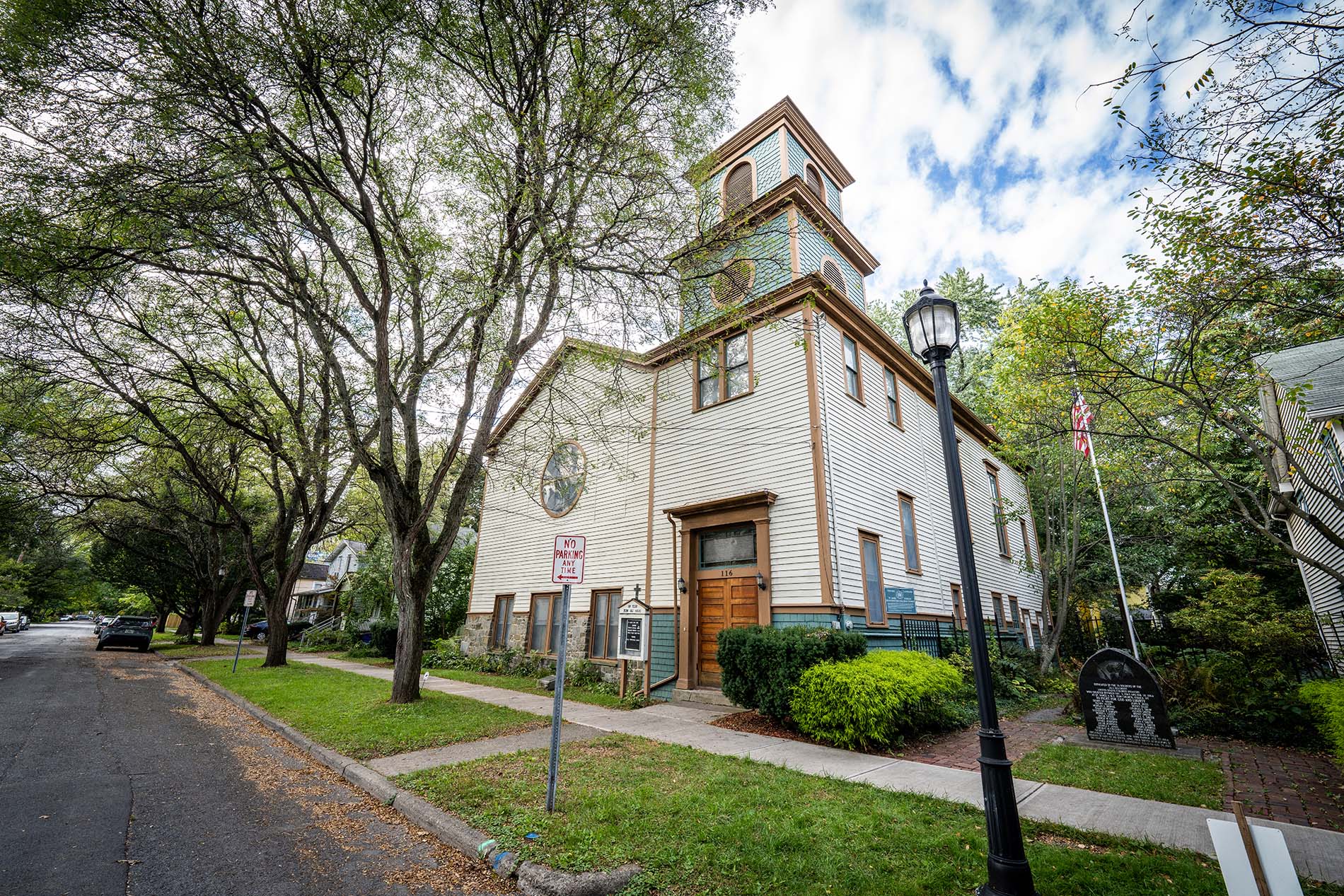
St. James AME Zion Church
Welcome to the virtual experience of St. James A.M.E. Zion Church. St. James is the oldest original church structure in Ithaca, New York, and one of the oldest AME Zion churches in the world. With connections to the Underground Railroad and abolitionist movements, St. James has been a place of celebration, resistance, and resilience for almost 200 years. In this experience, you will explore the history of St. James and its significance along with Reverend Terrance A. King, members of the congregation, and scholars from Cornell University.
Stop 1. Foundations of St. James
From its cornerstone to the monument honoring soldiers who served in segregated units, resilience and advocacy are built into St. James’ foundation. The first congregants of St. James A.M.E. Zion Church gathered in homes before buying this land in 1836 for five dollars. Founders of the church included formerly enslaved people like Peter Webb, who had purchased his own freedom. By the beginning of the 20th century, St. James was expanded to a two-story building. Over time, additions like the four-story bell tower, which includes a bell donated by white citizens, and the Civil War memorial reflect the congregation’s commitment to honoring and supporting the African American community. From 2021 to 2024, a community archaeology program, led by Cornell University, conducted excavations at the church and studied the historic building. This work underscores how the congregation has remained rooted in resilience and resistance while adapting and changing over time.
Reverend Terrance A. King
Welcome to St. James A.M.E. Zion Church. I am Pastor Terrance King, the pastor of this historic church and congregation where we are known for the beacon of light that we are and will always be to the African American community, station on the Underground Railroad, and historic beyond decades and generations of persons before us that have come through the doors of this wonderful and historic church. So please, come in and join what you are going to see and experience the power, the richness, the history, the resilience and the respect that is St. James A.M.E. Zion Church.
Angelo Hickman
St. James was founded in 1833. Initially the meetings were held in different houses around the community, where members got together to devise a way to physically create this church. So they met several times in different houses, mainly at the house of the future Reverend Henry A. Johnson, and the Reverend had many meetings there. And finally they got up enough funds to buy the property and also to build this church
Nick Sledziona
As the congregation grew and it incorporated more members, maybe had a little bit more money, they would have added on additional rooms, additional sections on to the church. So at one point in time, one of the sections they added on was the bell tower, and at the time that the bell tower was constructed, the church could not afford a bell to even put in the bell tower, and so as a result, the white community of Ithaca had actually got together, pulled together a whole bunch of money, and they actually purchased the bell and donated it to the church and had it installed. So, you know, it just goes to show that this has, Ithaca's always had a very close knit community and different individuals, whether they're connected to the church or not, they're always willing to help out to make sure that everything kind of works as it's supposed to, because the church really it would be almost embarrassing if we didn't have a bell. So it was nice of the community to come together and donate the bell for us.
Stop 2. Part of a Network
Located in Ithaca, New York, St. James is connected to broader communities and networks grounded in movements for justice. Part of the African Methodist Episcopal Zion Church, this denomination was formed in the early 19th century to counter discrimination experienced by Black congregants. The denomination would later become known as the “Freedom Church” for its role in abolition and emancipation. Oral histories indicate that St. James served as a station on a northern route of the Underground Railroad. This network of people and places guided enslaved people, often in southern states, to areas that were safer. Freedom seekers traveled in many directions to northern states, western territories, and other countries such as Mexico and Canada. Since the United States was established, northern states had gradually adopted emancipation laws making these states safer. Slavery was officially abolished in all northern and southern states in 1865 with the end of the Civil War and passage of the 13th amendment. Because secrecy was a crucial part of the Underground Railroad, very little written documentation exists about places associated with it.
Gerard Aching
I think the way that we would talk about St. James' connection to the Underground Railroad is to think of it as one of those spots along a network that shifted very often. A great sort of motivator within the Underground Railroad are the Vigilance Committees which existed in the cities, for example, in New York for Philadelphia, but also in the rural areas. And these Vigilance Committees were there to assist. These Vigilance Committees would have been composed of abolitionists, both white and Black, Quakers, members of the Black church and community. These are the people who are around and looking out for people coming through the region. So it was a matter of taking people from one safe house to another. And just imagine again, the courage of the freedom seekers, because here are people they are putting themselves into the hands of complete strangers who are sort of taking them through these regions that they do not know. And so St. James was part of that and St. James was an important stop along the way because from here you can go to other parts of central New York, western New York, depending on, you know, the safety of transportation. And the transportation could have been foot or could have been on horseback, it could have been ferry, it could have been several ways. And that's what we understand by the activities of the Underground Railroad. The abolitionists often referred to the Underground Railroad as practical abolitionism during the 19th century. That is to say, doing the work of getting people through up to this part of the region, and especially after the Fugitive Slave Act of 1850 when it became a federal crime to assist freedom seekers, then making sure that people could get to freedom in Canada. So St. James is important along, you know, the path and we know, you know the case of Harriet Tubman who didn't live far from here, about 50 minutes from here the back and forth. That was part of her itinerary to the extent that we could reconstruct that included St. James.
Stop 3. Resilience & Resistance
Welcome to Fellowship Hall, the church’s original sanctuary and a community space that facilitated change with impacts far beyond Ithaca. Historically, this place was central to religious and civic life for Ithaca’s African American community, where both formerly enslaved and free people would have gathered to worship, socialize, and organize. Oral histories link this lower level to St. James’s involvement in the Underground Railroad. During the early to mid-19th century, Ithaca stood along a route from Virginia through Pennsylvania and eventually to freedom in Canada. Some freedom seekers settled in the Southside district around the church. Fellowship Hall is also where the founders of Alpha Phi Alpha Fraternity, students at Cornell, transformed their study club into the first Greek-lettered African American fraternity in the world. Fellowship Hall is a reminder that sacred spaces have been foundational not only for worship but also for social changes.
Reverend Terrance A. King
So the original function of this room is the original sanctuary of the church. Built in the early 1830s, it was where the African American community both consisting of freed and un-freed slaves could meet and join for worship or religious services and meetings. At the time of the inception of the sanctuary, in progression with the fact that it became so popular with the African American community, students who were members of Cornell University, who are African-American, could not meet on the campus. So they chose the church and other various houses around the Ithaca community to collectively meet, and pivotal to this sanctuary, this place, this location is the founders of the of Alpha Phi Alpha Fraternity Incorporated, who are members of Cornell, decided to turn their social study club into the first Greek lettered African American fraternity in the world. And because of that meeting, taking place here, it has been the catalyst and a catapult for what we now know as the National Panhellenic Council, which consists of a total nine fraternities and sororities of the Black and African American diaspora.
Gerard Aching
The oral history of this particular site is that some of the older members of the congregation recalled that there was a spot that was covered up on the ground that was possibly a hiding site or you know entrance to a tunnel, which is one of the things that they thought about. So there's a great deal of interest, you know, that what is actually there. So I think the importance of the site as well is to give this history something of a more comprehensive nature, because it's not documented. We were not supposed to know this is clandestine, but still the congregation, community members hold on to the idea that there was something there right. So I think that's very important.
Stop 4. Strength in Leaders and Community
Welcome to the main sanctuary of St. James, a space shaped by powerful leadership and faithful community. From its earliest years, the church was an active space for Ithaca’s African American community. One of the Church’s first pastors, Thomas James, was active in the anti-slavery movement. St. James also saw visitation from well known abolitionists and underground railroad operators such as Harriet Tubmann and Frederick Douglass. In 1852, Douglass visited the church and spoke at the pulpit, addressing race relations in the United States. From Syracuse, Rev. Jermaine Loguen, who was called the “King of the Underground Railroad” during his lifetime, oversaw the clandestine networks in central New York. He had also served as St. James’ pastor. The church has also persisted through the strength of its congregation. A 1956 letter to the Church from Martin Luther King Jr. thanks the congregation for their donation in support of the struggle for justice. Contributions of the congregation resonate throughout the sanctuary with names in the stained-glass windows and the hymns and music that fill the space every Sunday.
Reverend Terrance A. King
As I stand behind this sacred desk of every Sunday, which I'm allowed to preach, I'm humbled by the opportunity to which I acknowledge the persons and the pastors that existed before me. We had Reverend Henry Jesse Callis, who pastored for a couple of years in the church, in the denomination, and he had a son who would run around the sanctuary and little did he know that years later his son would be a founder in Alpha Phi Alpha Fraternity Incorporated. Then we also had Reverend Minister Frederick Douglass, who pronounced a famous speech here in the church about the state of race relations in America and in Ithaca. Little did we know that Henry Arthur Callis is actually the cousin of Frederick Douglass. Then as well, we had a reverend who solidified and canceled, with the help of the congregation, the debt that the church had on this building, and they were able to burn that mortgage in a ceremony. So every Sunday, as I stand behind this sacred desk, I'm humbled again by the fact that I stand on the shoulders of legends before me. And it is my hope that as I stand here in this stead, that I produce a legacy for those that follow.
Nick Sledziona
Here's one of the stained glass windows. Now, there's many of these in the church. Each one has kind of a dedication plaque at the base of the window. And like, for example, this one says Sunday School. So very likely the Sunday school class at the time either paid for the window to have been to been constructed or made or it was just simply dedicated to the Sunday school in 1945. The other thing that the windows feature is names of previous members that served within the church. So for example, here we have Harry Green and you know he lived from 1870 to 1942 and so he's memorialized in the plaque on the window. And one of the other wonderful features of these windows are these images that each one contains. So for example, here we have the wheat and we have grapes. And so this is supposed to basically represent the body of Christ because you can make bread out of wheat and this would be the blood of Christ because you can make wine out of grapes. So that's kind of how each window is kind of put together. And, you know, it's nice because not only does it incorporate a little bit of symbolism into each window, but it also has a memorial plaque incorporated as well. So that's basically, you know, that's basically it for the windows.
Stop 5. Harriet Tubman
As you stand among these pews, notice the image of Harriet Tubman on the wall. She was not only a legendary conductor on the Underground Railroad, she was also a visitor to St. James. On numerous occasions, Tubman visited the Church and sat in these pews. After freeing herself from slavery through the Underground Railroad, Tubman returned south again as a conductor, guiding others to freedom. She directly helped free approximately 75 people, including a number of her family members, in approximately 13 clandestine missions. Sharing her knowledge of escape routes, she helped scores of others to free themselves. Harriet Tubman frequented Ithaca both before and after the Civil War. Known locally by family as “Aunt Harriet,” her relatives continue to live in the area today. After the war, she settled in nearby Auburn, New York, where she founded a home for those with disabilities. Her story lives through the history of this place and the active community that carries on its legacy.
Glenda Phillips-Hickman
Harriet Tubman was one of the leaders on the Underground Railroad, and she traveled from the South up through Maryland, Virginia and Pennsylvania. It was the first state that they could make it to. That was the free state. And then they traveled all the way through the different roads, the back roads, predominantly, they traveled wherever they could trust people. There were many Quakers at the time that also helped them on the Underground Railroad up from here. They would try to get to the extension bridge, which is in Buffalo crossing over that bridge, gave them their freedom and to Canada. And I've met her. Her great, great niece of Rose Washington that lived around the corner on Corn and Green Street. And I even now I still see her great, great, great niece, Paula Johnson, and her daughter Deidre at the different conferences when they're around. And she never lost a person. She did carry a gun. She had to be tough in order to do what she did. And so many people admire her still to this day. And we that's part of the history of the church that she's been here. Yes, and she was seen here. Yes, and she spoke here, and she came many times, even when Frederick Douglass himself was here. So it was nice to have that as part of your church history.
Annie Lovett
Harriet Tubman to free the slaves, she was a very important person, and I learned about the hidden room we have here that hid slaves, and I probably would have done the same thing if I was back in the era. And there's a song that Harriet Tubman sang, and I didn't find out the meaning of the song until later on in life. So I'm just going to sing you one tune of it if you don't mind. It's called Wade in the Water. So basically talking about people wading in the water and God's going to trouble the water. And I'm like, trouble the water? What do you mean? Why were they wading in the swamps and stuff when there's snakes and pythons and alligators and all kind of barracudas? How do they get freed from slavery and survive? So as I got older, I connected it well, God, most troubled water so that nothing would happen to them. So that's basically what happened. And I actually have a CD of the song I sing. I made a couple of CDs. I don't let anybody listen to it, but the song went: ♪ (Wading in the Water, Lovett) Wading in the water, ♪ ♪ Wading in the water, children. ♪ ♪ Wading the water. ♪ ♪ Gods gonna to trouble the water. ♪♪
Stop 6. A Living Legacy
As you stand outside the church looking at the garden on the west side, you can see how the legacy of St. James continues to unfold. The building was recognized as a local historic landmark in 1975 and later listed on the National and State Register of Historic Places in 1982. In 2021, St. James partnered with Cornell University to launch a community archaeology project, engaging students and neighbors in uncovering and learning more about the church’s past. St. James is not only a historic site, but remains an active place of worship and gathering. Through its congregation and community partners, the church continues to preserve its story while inspiring new generations to understand Ithaca’s connections to broader movements of faith and empowerment.
Reverend Terrance A. King
So the congregation today is continuing the ongoing legacy of the church by making sure that the church's story is viable and relatively relatable to younger generations, which is why it's so important that we embark upon things such as the excavation so that we continue to share the story, the richness of what St. James was and what St. James is. It's important to understand and know that even though the congregation may be small in size and specifically within this building, this edifice, that even the community definitely comes out to make sure they support us in any which way we can, as well as to maintain that story. That is essential to understanding St. James's history beyond just the Underground Railroad, but culturally and politically. And not only are we responsible for keeping those memories and those stories alive, but we also are stewards of God's house. So we make sure that everything, the needs of the church are definitely met, and I serve a great congregation that will do anything they can to make sure that this church is viable for the next 188 years.
Adam T. Smith
So one of the things that I find most incredibly interesting about St. James is its role in the Underground Railroad, as part of a clandestine activity that was purposefully kept secret and it was necessarily a secret activity. And one of the things that archeology is really good at is revealing secret activities, activities that were not captured by the historical record. So when I think about the role of St. James within the wider global archeological record, I think of it as a key site in thinking about how human's clandestine activities are preserved in the earth and the ways in which archeology can be a tool for revealing those activities. So there are several issues that structure the excavations at St. James and our strategy for conducting testing of the underground materials here. The first and of course foremost in our minds was trying to understand the history of the church building itself. To that end, what we've been investigating here in this operation is trying to get an understanding of how the building itself was put together, by looking at its lowest foundations. One thing that we don't know as yet is what the original church of the 1830s would have looked like, and one idea was to use archaeology to begin to get under to the lowest levels of the construction process, and as you see in the operation right behind me, we're looking particularly at the door sill as a way of perhaps understanding the very first pieces of the church that were put down over a century ago. We're going to be using some advanced technologies in archaeology, particularly dendrochronology and others, to begin to try and understand the timing of this particular aspect of the building structure. The other component that we're interested in associated with the church itself is trying to understand if there were perhaps any areas where the clandestine activity of the Underground Railroad might still be detected. This is an open question for us as to whether or not archaeology can bear upon this. But one of the things that's particularly interesting is we don't know at the present moment exactly how this church was built and what's underneath it as a foundation. And so some of the archaeological work will be dedicated towards that discovery as well. And hopefully saying more about what potential sites of hiding and cloaking of the activities of the Underground Railroad we can document here.
Stop 7. Faith, Hope, and Change
Thank you for visiting St. James AME Zion Church. Through the legacy of this Church, the place continues to inspire faith, hope, and change for the future. We encourage you to visit and carry on the efforts to keep this history and space alive.
Reverend Terrance A. King
Wow! We hope that you enjoyed what you saw and what you heard as a result of your tour. It is my hope and my prayer that whatever you've seen, whatever you've heard it charges you to continue to tell the story and the richness of our history, and the Underground Railroad. Please do me a favor: whatever you do, please share the life in the Ministry of Churches and Institutions, which are pivotal in understanding who we are as a people, because Black history is American history.