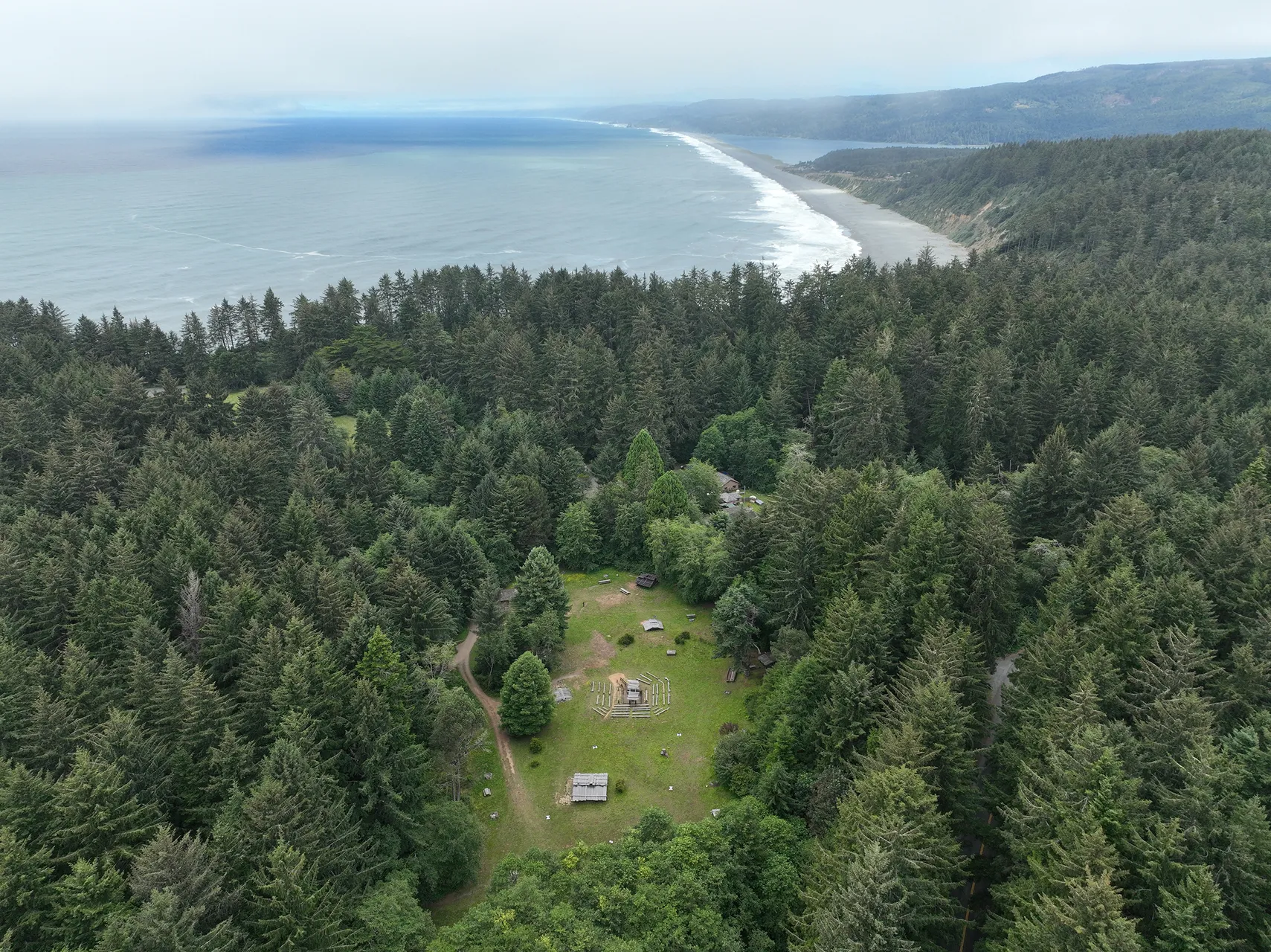
Welcome to Sue-meg State Park
Welcome to Sumêg Village, part of Sue-meg State Park and Yurok ancestral land on California’s North Coast. In this experience, you’ll explore a replica village rebuilt to support cultural teaching, gathering, and ceremony, an entry point into Yurok lifeways that continue today. As you explore, you’ll learn how Yurok communities have continued cultural life and connection to this land through life at this ancestral village. As you visit different features of the village, you will learn how Yurok people have lived sustainably with the land through cultural practices such as basket weaving, acorn preparation, and redwood canoe building. Along the way, you will hear from three descendants of Yurok culture who will provide unique insights into the history and stewardship of this place. Sue-meg is a living cultural space. Please move carefully and be mindful of how we all can be stewards of this land.
Stop 1. Ancestral Lands
Sue-meg State Park sits on Yurok ancestral land, stretching along the coast and inland through the Klamath River corridor. From the Little River area up through Klamath and toward Weitchpec, this is a homeland shaped by watersheds, travel routes, and a long history of stewardship. As you explore, be respectful. Stay on designated paths and move gently through Sumêg village. Structures and canoes are part of a living cultural space, and access is guided by community practice. Sue-meg is also a place that sheds light on the importance of public memory. For many years, the park’s name honored a figure associated with displacement. Through a process of sustained organizing, the name was successfully changed in 2021.
'Aa-wok Skip Lowry
Hello 'Ai-ye-kwee' nek 'new Skip Lowery. My name is Skip. Pek-won mey'-wo-me-chook'. I'm Yurok from the village of Pek-won on the Klamath River. We are interpreters here, North Coast Redwood District's Sumêg Village, Northwest California. Hello, my name is Princess Colgrove, and I am Indigenous to this place. I am Hupa, Yurok and Karuk. Hi, my name is Maiya Rainer. I'm also Indigenous to this place. I'm Yurok, Apache, Toas Pueblo and Creek. This is special! You have three descendants of Yurok culture interpreting for the first time, our own culture here in our district. Now, this actual site is a replica village of the original village, which was closer to the ocean. This place has changed due to European contact. Our culture was damaged. Environment has been damaged. Sumêg is so special; this replica village that was completed in 1990, because it was designed through 80 years of rebuilding relationships between Indigenous communities and state agencies. I was 10 when I came here and learned about my culture because the legacy of leaders built this place for that to happen. We're here today sharing a little bit of our culture to whoever's interested, because that was also the purpose of this place, to spread knowledge and, hopefully, appreciate each other's cultures and show that Yurok culture is alive and well. We're not gone, and we have a lot of knowledge, the most knowledge about this geographic place, because we have always been here.
Princess Colegrove
So Sue-meg is a part of Yurok Ancestral Territory, and the Yurok Territory goes down to a place called the Little River and up into a town called Klamath which it then goes up the Klamath River into a town called Weitchpec. And so all of that is Yurok Ancestral Territory, and that is a part of what Sue-meg is. When we are here at Sue-meg, we ask people to always be respectful of the place. It is not a playground, so do not climb on the houses; stay out of the canoes that we have here because this place is living. We use this place for ceremony and for gatherings, it's a really special place to us, so please be respectful of that. Sue-meg is an important part of non-Native and Native communities here in the Northeast. Click to see the various points of Sue-meg and learn about Yurok culture. Thank you for coming to Sue-meg!
Stop 2. Yurok Houses
Ahead is a Yurok living house, built from redwood and held together using ties from a hazel plant. These houses reflect a meticulous system of building knowledge: how to select materials, how to prepare them, and how to create strength through joinery and binding. Hazel becomes rope through careful timing and technique. Gathered in the right season and worked with heat and skill, it becomes pliable and strong. Over time, ties are renewed as part of ongoing care—maintenance as an expected cycle that keeps both the structure and the knowledge active.
'Aa-wok Skip Lowry
Hello, I'm going to share a little bit about the Yurok house right now. In Yurok language it's 'oohl 'we-'o'l. Everybody say 'Oohl 'Wo-'O'-lehl. That means "the people's house, the people's home." So what's really cool about this place, Sumêg Village, is that these houses that are here showcase a relationship that's immemorial, beyond memory, between people and their place. And their Traditional Ecological Knowledge is profound and very, very sophisticated. So I'm going to show you a little bit about the house today. Right behind me is a living house made out of redwood. It's tied together with hazel and you can see this one is damaged. This is a hazel. I'm going to show you a piece of hazel rope here that I've made already. So this part is the stick, it's the hazel tree itself, and I couldn't twist that if I tried. I can't even bend it if I tried. There's a really cool process of making rope so that hazel can be turned into something that's pliable and you can hold your house together with it. It takes fire and you have to gather it at the right time of the year, preferably, and then you can tie it into rope. So every two years you have to repair these hazel ties that hold your house together. And so you can see these ones have not been repaired in over two years. Here we have some brand new hazel ties that are holding this front piece along. A lot of times people talk about indigenous cultures like they don't have technology. Now, we didn't have computers and electricity, but we have technology. And some of our technology is state-of-the-art, organic, sustainable, and we can learn a lot from experiencing more places like this.
Stop 3. Basket Weaving
Basketry is one of the most visible lifeways you’ll encounter at Sue-meg. You’ll see open-weave baskets for carrying and gathering, and closed-weave baskets woven so tightly they can hold water. Different baskets support different needs: burden baskets for transport, leaching baskets for preparing acorn meal, cooking baskets used with heated stones, and smaller baskets for everyday use. Each form reflects a specific purpose, honed over generations. Materials come from the region—spruce roots, hazel, willow, river roots, and plant-based dyes—gathered with knowledge of season, place, and stewardship.
Princess Colegrove
Baskets are a very important part of indigenous cultures here locally. There are two different types of basket weaves. There's an open weave, like these here, and a closed weave which is watertight. This is a burden basket, and it is used kind of like a backpack. It has straps that go around your arms, and it's used for gathering materials or food. This is a leeching basket, which we leech our acorns in. We have an acorn powder that goes inside, and we let water run through so that it's not bitter. This is a steaming pot, and it is used with different herbs and different medicines, and our red hot rocks, and it's used to kind of cleanse the mind and the body, kind of like a sauna. This is an acorn cooking pot. So, like, we have pots that go on the stove to make soup; that's what this is used for. It is for our acorns, which is something that we would eat every day traditionally. We still use these acorn cooking pots during ceremony and different times of the year. And this is an eating basket, and we eat our acorns in this. And each basket has a different design and a lifeline that kind of sticks out of the side. All of these closed weave baskets are watertight, so nothing can get through them.
Maiya Rainer
These basket materials that are used to make all these types of baskets. They're all made from generally the same materials. There's spruce roots, hazel sticks, willow sticks, river roots, and there's different types of dyes and things that you can put designs in like this. This one has bear grass in it. There's black fern, there's red alder that is able to dye different types of grasses, and there's porcupine quills that are dyed with wolf moss, which is found in high elevation. Baskets are an example of cultural continuation and are still made and used in local communities today.
Stop 4. Using Acorns
Acorn preparation is a practice that would be a common sight at a village such as this. Acorns have long been a foundational food across this region, valued for the nourishment they provide. Preparing them is a process grounded in skill, patience, and timing. After gathering, acorns are cracked and ground into a meal. That meal is then leached—often over several days—until bitterness lifts. Cooking can involve hot stones placed into a cooking basket with water, stirred until the meal thickens into something sustaining. These steps carry more than technique. They carry continuity taught across generations, strengthened through practice, and renewed through community life.
Princess Colegrove
Acorn is a very important part of our diet. and is a major food that we eat here locally and for indigenous people in surrounding areas and neighboring tribes. It's also very important food. It has a lot of the nutrients that we need in our bodies to keep us alive. It's very, it's a very healthy food. Traditionally it would be eaten every day for dinner for lunches, breakfast, all of that. That's when we would eat it. Now we use it more for ceremony and for our people who are fasting and our medicine people, and it's gathered during certain times of the year.
Maiya Rainer
There's a whole process of cooking and preparing these acorns. Acorns can be a long process depending on who it is and what their ending result is. Here we have a burden basket with acorns in it, and this is something we would gather with. So depending on acorns, different types of teas and different herbs or different things we would gather. And here we have acorns straight off the ground. And then right next to it is the cracked acorns, and that is the next step in this process. And then after they are cracked, they are grinded down into almost a flour consistency. And this right here is really bitter. And so there's a whole other process to this, which is leaching. And leaching takes several days depending on who is leaching them and what their ending product is going to be. And the next step is to heat up rocks, which we have some of the cooking rocks. And we put them into this acorn cooking basket. And we put the leached acorns in here with water. And then we stir it. And then after all that we put them into these bowls. Then what you eat with are these spoons, which are for men and women. So this spoon is an elkhorn spoon which is used by men. And this is a mussel shell that's used by women, that they eat their acorns with. And acorns, the process of making acorns has been in people's families and has been passed down for generations and generations. And it's going to keep getting passed down by generation. And this is something that is important to us as Yurok people.
Stop 5. Yurok Redwood Canoes
Resting near the edge of the village is a traditional redwood canoe. Prevalent throughout Northern California, redwoods hold deep significance, and canoe-making reflects both craft and responsibility. Canoes are made from trees that have fallen, then carefully shaped and finished. Handling matters: these canoes can be extremely heavy, and they require respectful movement and storage to prevent damage. On the water, paddlers learn to read how a canoe responds, moving with attention rather than force. Canoes are part of an ongoing tradition—skills taught, practiced, and carried forward.
Princess Colegrove
So this is a traditional redwood canoe. And we make our canoes out of redwood trees because Yurok people believe that the redwood tree is the heart of our people. We never cut a redwood tree down, but we use it after it falls. And so when it does fall, we bring it and make a canoe or a house, and we always give our canoes and our houses body parts, like a heart, lungs, kidneys, a nose, cheekbones. We give them those body parts because we believe that they have their own life just like we do. So for Yurok people we call ourselves 'Oohl. We call our canoes an 'Oohl 'We-'Yoch and we call our houses an 'Oohl 'Wo-'o'-lehl. And so we're all connected in that way, and we all have our own life that we live. And so when we're in a canoe on the water, we always kind of listen to where our canoe is trying to take us. If we want to go straight across the lagoon but the canoe decides it wants to go this way, sometimes there's a reason for that. And so you just kind of go with the flow and let it take you where you need to go. Canoes can weigh up to 1,000 pounds and so when they're in the water, that's when they weigh the most because they have all of this water weight, and the redwood kind of soaks the water in. And so that makes it a lot heavier. So when we move our canoes we always grab it on the side and we slide it. And so we grab it on the side and slide it because when you pull on the nose that's the most sensitive part of the canoe. So when you pull it, it's very easy to break, and sometimes it can be fixed and sometimes it can't. We're always just extra careful and respectful of the canoe, and we know that it's not indestructible and that it can be damaged. And when it is damaged we can't use them and it's not here for people to learn about. Redwood canoes are a living part of Yurok culture. We still are learning how to make them, paddle them, use them, and take care of them. I learned when I was very young how to paddle and take care of a canoe. My sister is learning; my family has taught us that, and it's something that we are continuing to pass on to future generations.
Stop 6. Dance House
You’re looking at a brush dance house, a ceremonial space with purposeful design. This is a place where community comes together through prayer, healing, and responsibility—especially for babies and young people. Song is central. Some songs use words; others rely on melody and intention, carried by voice and rhythm. Regalia supports the ceremony as well—items made with care and meaning, worn in ways that strengthen the purpose of the gathering. When ceremonies take place here, visitors can be welcome. The village provides a way to witness living culture while following the lead of community practice.
'Aa-wok Skip Lowry
This is our Brush Dance house. So this is just a house, a living house that's been taken apart for a spiritual, purposeful reason. Our ceremonies are alive and well today, and one of them is a prayer ceremony that we have every year to help protect and to heal a baby or a young person. I'm gonna share a song with you to kind of show you the regalia, talk to you a little bit about how our songs as humans are backed up and supported by the songs of our regalia. And so I have a song I'm going to share today. A lot of our Yurok songs don't have words. We sing from our heart, from our essence. Again, energy in physical form and cosmic energy at that. And so you can bring the spirit literally out of yourself and share it with the world, and it can have a profound impact. Thoughts matter. Words matter. Actions matter. And the Yurok people have always known that. We're always gonna know that. So I'm gonna share a song today that is coming from my heart, and it does have words.
Stop 7. Changing House and Regalia
Changing houses, like the one you see here, provide space for preparation and care. Built with the same redwood-and-hazel logic found throughout the village, these structures support ceremonial life and protect items used in dance and prayer. Regalia is treated with intention and responsibility. Necklaces, shells, and other items carry meaning through their making and through how they are worn. Care includes safe storage, respectful handling, and allowing items to rest between ceremonies. This scene highlights a core theme at Sue-meg: cultural continuity lives in practice, preparation, and care.
'Aa-wok Skip Lowry
'Aiy-ye-kwee', Skip Lowry. I'm going to share a little bit about our regalia house and our changing houses here at Sumêg Village. They are made out of redwood with the hazel ties, just like our living houses and our sweat houses. This is for the purpose of holding and caring for what we call regalia. So we have necklaces; we have a lot of things that we use in our ceremonies that just, like, humans need to rest. They have a job, a will and a purpose. They were designed for specific reasons, specific ceremonies, and we give them the same respect that we have to give ourselves. We have to rest from time to time. I'm going to share a little bit of regalia, my own personal regalia, with you. These are abalone shell necklaces that my mother made for my boys and myself. And so each one has its own song and its own purpose, and they're unique and individual, and they have a will and a desire to fulfill what they were made for. So we have different ceremonies, and when you make necklaces you put yourself — what I've been taught is that you put your prayers and energy into the necklace, and then it has its own song and it reflects and resonates your prayers out for all times when it's singing. That's why it's not okay for museums to hoard our prayer items, because they want to dance, they need to be part of our communities. So when we have a ceremony which exists today, every year, the communities come together, the Native communities come together here at the public park. The public is welcome to come as long as they are respectful to the culture. You can be a part of the community that has always been here and is always going to be here. The Yurok people.
Stop 8. Sweat House
The sweat house you see here is partly underground, built from redwood planks, and centered on health and balance. It has long been a space for learning responsibility—toward family, community, and the natural world. This is a dry sweat, heated by a wood fire, often using dense woods to create lasting coals. Time inside can be shared or solitary, depending on purpose. Two doors reinforce a ritual pathway: entering with intention, and leaving with renewed commitment. The sweat house reflects a worldview where wellness is practiced—through discipline, reflection, and care for the relationships that hold a community together.
'Aa-wok Skip Lowry
So I'm going to share a little bit about a Yurok sweat house right now. So you can notice it's subterraneal; it's in the ground. It's made out of redwood planks just like our redwood houses. Our living houses. So the sweat house was really, really important for the health and balance of our young Yurok boys, our men. What I've been taught is that when you go into a sweat house you come out a better person. You're supposed to come out clean. And so there was a duty as a man to be the best you could be for your community, for your family, for your women, for the world, the nature around you. And the sweat house was an instrumental place where that health, the teaching from the elders to the young boys to raise them up to be good, strong, healthy men for their community happened inside the sweat house, a lot of times. This is a dry sweat; it's not a wet sweat. So there's no steam on the rocks. You just have a hot wood fire. We have wood like this; this is madrone. So we would use hot madrone or manzanita to make a bed of coals and then you would go in and spend an amount of time in there collectively or by yourself; depends on what you're doing it for. And you would just have that hot heat. And so there's two doors; you go in one door and you come out another one because Yurok people understood that we're a part of energy. We are just borrowing this physical form. And so you bring energy in that you're wanting to clean, and you don't want to go back across that wake of energy that you want to maybe clean off. You come out brand new, out a new path for the world, so you're the best you can possibly be. And that's what these sweat houses were designed for.
Stop 9. A Place of Renewal
Sue-meg State Park invites reflection on how public lands can be spaces of resilience. Sue-meg is one example of how persistence, respect, and shared responsibility can reshape a place, and support a healthier future. Thank you for visiting. We encourage you to carry on the legacy of this place through learning more about Native communities and visiting with respect.
'Aa-wok Skip Lowry
This place is testament to social justice and environmental justice. I believe social justice and environmental justice spawn from testimonial justice. When damage has been done to anybody, goes through pain and suffering, the first step to healing is the truth-telling process. And it's your story to tell if you've been hurt. And the openness to have someone listen without judgment, maybe without response, just be there to listen, to someone testify about what their history is, what their experience is, and respect that and honor that. Then you get it back. That creates social movement, social justice. And in social justice, as a park taking care of a landscape, you can generate the environmental justice through testimony and social justice. To keep these places healthy, to keep them in balance for everybody to share and experience.