Exploring Ancient Greece
In this virtual experience, we begin over the Aegean Sea — a region that has long connected mainland Greece with its many islands and the wider Mediterranean. For thousands of years, these waters have supported travel, trade, communication, and the exchange of ideas. The sea also shaped some of Greece’s most famous myths, where sailors, heroes, and gods moved between islands in stories still retold today. Our focus is Naxos, the largest island in the Cyclades, a group of more than 200 islands that includes Mykonos and Santorini. While Naxos is less well known today, it is renowned for its beauty. In ancient times, it was valued for its fertile land, bustling harbor, and high-quality marble. In this tour, we will explore the Portara, also known as the Temple of Apollo. This massive marble doorway is part of an unfinished Greek temple dating back more than 2,500 years. As we move through the site, we will see how architecture, island life, religion, and myth came together in Ancient Greece.
Stop 1. Where Naxos Meets the Sea
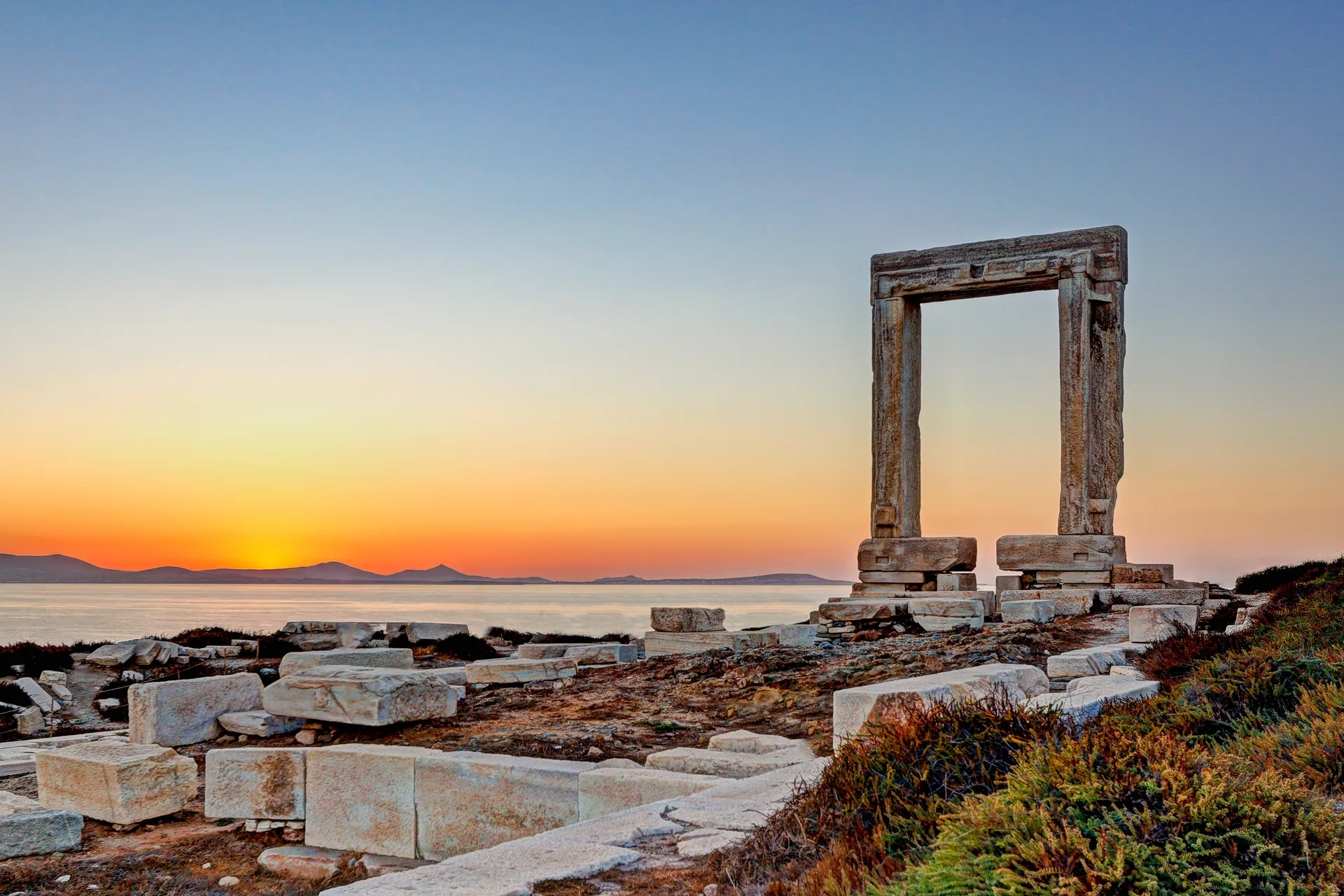
You have just been transported down toward Naxos, flying over the bright blue waters of the Aegean. Below you is the small rocky island of Palatia, connected to Naxos by a narrow walkway. At the center of the island stands the Portara — a massive white marble doorway rising above the ruins and low vegetation. Behind it, you can see Chora, the main town of Naxos, spreading across the hillside and around the harbor. For travelers arriving by sea, the Portara is one of the first landmarks they see. Although the temple was never finished, its location was carefully chosen so it could be seen from the water. Today, only parts of the building remain, but the doorway still faces toward Delos, traditionally known as the birthplace of Apollo.
Stop 2. A Temple Left Unfinished
The Portara is the main surviving part of an unfinished ancient temple begun in the 6th century BCE, more than two thousand five hundred years ago. Although the full building was never completed, the doorway and parts of the temple’s footprint are still visible at the site. The doorway stands about 6 meters high and is made from massive blocks of local Naxian marble. Its size gives us a sense of how ambitious the original temple project must have been. The temple is usually associated with Apollo, the god of light, music, poetry, and prophecy. Naxos was also strongly connected to Dionysus, the god of wine, celebration, and revelry. This reminds us that ancient sacred places often had many layers of meaning. As we explore around the monument, notice how Portara changes from different viewpoints.
Stop 3. Myth on the Shoreline
This small island is often linked to the story of Ariadne, daughter of King Minos of Crete. According to myth, Ariadne helped the hero Theseus escape the Labyrinth after he killed the famed Minotaur. But on the journey home, Theseus left Ariadne on Naxos. In many versions of the story, she was later discovered by Dionysus, who then married her. As we look around the site, we can imagine why myths became attached to places like this. The sea, the island, and the monumental doorway all create a powerful setting. The Portara is not only an ancient ruin. It is part of a larger landscape of stories that helped shape how people understood the world around them.
Stop 4. Stone from the Island
Looking down on Palatia, we can see that the Portara belongs to the same rocky landscape as Naxos itself. The island is known for its marble, formed over millions of years as limestone was transformed by heat and pressure. Ancient builders used this local Naxian marble to create the massive doorway we see today, connecting the monument directly to the geology of the island.
Stop 5. An Enduring Symbol
The ruins we see today have survived for more than 2,500 years, enduring earthquakes, weather, changing religions, the reuse of ancient materials, and centuries of visitors. Many stones from ancient buildings were later taken and reused in newer structures. But the Portara remained standing on Palatia, still facing the sea. Its survival gives us a rare chance to experience a piece of ancient Greek architecture in the place where it was built. Today, the Portara is one of the most recognizable landmarks in the Aegean. Visitors see it from the harbor, walk around it on the islet, and gather here at sunset. As our tour ends, the Portara reminds us that even an unfinished building can become a lasting symbol of a place, its history, and its stories.