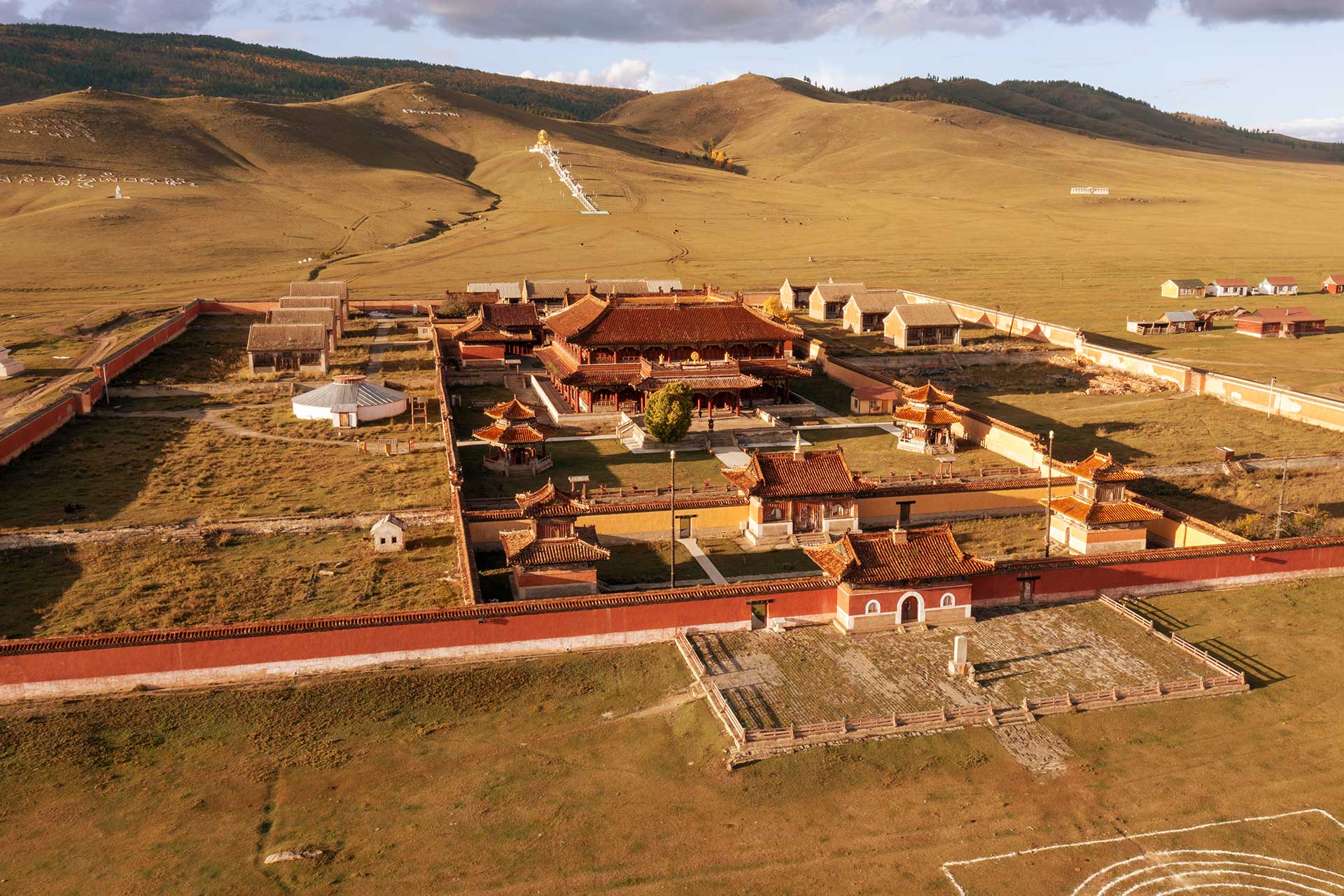
Amarbayasgalant Monastery
Welcome to the serene grounds of Amarbayasgalant monastery, a symbol of Mongolia's spiritual history and resilience. Established in the early 18th century, this site was constructed in the sacred memory of Saint Zanabazar. The first bogd or supreme spiritual authority of Buddhism in Mongolia. Amid the vastness of the Mongolian steppe, the monastery’s intricate architecture and glazed roof tiles offer a striking contrast to the natural beauty of the landscape. Once a bustling spiritual community with over 6,000 monks, Amarbayasgalant withstood the trials of communist repression, preserving its rich cultural practices and legacy of training new monks. As you explore Amarbayasgalant, you will be guided by the insights of Abbot Molom, Ochirkhuu Lama, local resident Narantsetseg, and conservation expert Bayanmunkh, each offering a unique perspective on this special place.
Stop 1. Buddhism in Mongolia
Standing outside the red walls of the monastery the curved tiered roofs of the dozens of intricately designed structures shed light on the site's grandeur and active cultural traditions. Mongolian Buddhism, a crucial part of Mongolian history, traces its roots to the Xiongnu Empire around 121 B.C. Buddhism spread in Mongolia through three key phases. First, from the second to 11th centuries. Then, during the errors of emperors from Genghis Khan to Toghon Temür Khan in the 13th and 14th centuries. And lastly, expanding further from the 16th century with the teachings of Bogd Zonghov. The walled complex must be entered in accordance with protocol, with visitors entering on foot through the small door on the left. The circular white markings on the ground in front of you are used as part of the Tsam Dance, a masked religious ritual performed by young lamas or teachers in Buddhism. In Mongolian Buddhism monks prepare for many days by fasting, praying and meditating in a strict order and then perform a ritual ceremony according to a precise schedule on the planned day and time. People who don't have the knowledge would think that the monks just dance.
Molom Abbot
How am I related to the monastery? Well, I've studied here to become a monk since I was a little child. I started studying here when I was 6 in 1991. Every minute of my life is connected to this monastery.
Ochirkhuu Lama
I first joined the monastery in 2010 to become a novice. My mother suggested me... at the beginning of summer vacation, "Perhaps you'd like to... spend your three-month break at a monastery for the experience." I agreed to it and came here after school in June. My three-month stay here was astounding... thus after discussing it with my mother and the senior monks... I've decided to continue my monastic studies. That's how I've begun my journey here.
Narantsetseg
Well, for me, it's my parents' birthplace. So I feel nostalgic. I don't know what others feel. Historically, the first Bogd was here. Bogd's grave used to be here. It was also burnt back there. Thus I think it's a very important monastery.
Bayanmunkh
My name is Bayanmunkh. I worked as a director at... Arts Council Mongolia's Cultural Heritage Program. US Ambassadors Fund for Cultural Preservation... has funded Preserving Amarbayasgalant Monastery project. I got to know Amarbayasgalant monastery through... this project, working as a project coordinator. During that time I... through this project... renewed the electricity system, and installed CCTV cameras... to prevent the monastery from fire hazards and theft.
Stop 2. A Place of Legends
Many legends and stories surround the founding of Amarbayasgalant. Here within the inner walls of the temple grounds near yellow pagodas and the main temple’s gracefully curved roofs and upturned ewes. We are reminded of the significance of this chosen location. The Qing Dynasty dispatched teams of geologists to find the perfect location to construct a monastery in honor of Zanabazar, the Qing Emperors religious mentor. It is said that separate teams all came to the conclusion of building the monastery on this site. This spot was chosen for its serene and peaceful surroundings, a valley nestled at the foot of a mountain with a river flowing nearby. An ideal place for reflection and prayer. In another story, it is said that the monastery received its name from one of these teams who encountered two children playing at this site. One of the children was named Amar and the other Bayasgalan, giving the monastery the name Amarbayasgalant or Monastery of Blessed peace. From its founding story to the young monks who walk these grounds today, children have always played an important part at the monastery.
Molom Abbot
after the Qing emperor ordered the building of a monastery... he sent geologists to the Khalkha land. Even though two different teams took off at two different times... these two teams have chosen one similar location. This is an oral story, which I was raised hearing it... as a young monk in the monastery from the elderly monks. So when the emperor's vice officer went to... see the locations chosen by these two teams... it turned up to be the same location. He then decided that this land is truly sacred and embodies nature's... beauty in it, and has chosen the location for Amarbayasgalant monastery. Also, this mountain towering right behind the monastery is called Mount Burenkhan. I believe it has been called this for hundreds of years. So why it's called "Buren" is that... all materials necessary to build the monastery... wood, stone, roof, bricks, every other materials... were collected from the mountains in the area.
Stop 3. Unique Architecture
As we approach the main temple known as Tsogchin Temple, we can see the unique architecture and beauty of the building itself. Conceived for Zanabazar, the first spiritual leader of Buddhism in Mongolia, this structure was envisioned as a castle for a divine ruler. The main temple is constructed with an open W-shaped roof adorned with glazed red ceramic tiles. This shape allows for the collection of rainwater, which runs down four square columns inside the monastery and out to the four corners. Decorative ridge poles adorned with ceramic animals and mythical creatures highlight the connection between the spiritual and the natural world. The temple interior is used for prayers, while the second floor veranda offers a stunning view of the rolling grasslands and open sky. Depending on the season from this view. You may see herders with their cattle in the pasture or a wide expanse of snow covered fields. On the second floor of the main temple at Amarbayasgalant Monastery, a Treasury once held valuable Buddhist texts and a library of Mongolian intellectual works from Buddhism's early days in Mongolia. Thanks to brave patriots and scientists, the monastery still preserves the complete 108 volume Mongolian Ganjuur and 226 Volume Danjuur created in 1628 encompassed ancient philosophy, medicine, geography, arts, music and astronomy.
Molom Abbot
The main temple we are in, known as the Tsogchin Temple... has a unique feature distinguishing it from other temples in Asia: It has an open roof. An open roof allows rainwater to flow inside. So, among all these columns behind us, there are four square ones. Inside these square columns are steel tubes to let the water flow down... and underneath the pavement, we're standing, water flows... through stones and pebbles to the four sides of the temple. This is one of the architectural excellences of this temple. There are thousands of temples with so-to-say normal... roofs around the world in regions with Buddhist religion. All of them have similar features. The open roof makes this temple distinct from them. Religious historians and specialists believe that... this temple might be the only one in the world. Religious historians say there were five temples in total... around the globe that were built with the same blueprint as this temple. But the other four of them, which were all built in China, had been demolished... and burnt down during the Cultural Revolution in 1966. Hence this temple is the only one left intact. This makes this temple highly valuable both as a... cultural heritage and as an adept architecture. This is one of the unique characteristics of Amarbayasgalant Monastery... that both domestic and international visitors can witness.
Ochirkhuu Lama
Coming to our monastery, I hope visitors can learn about Buddhist cultures... get a glimpse of what enlightenment and mental knowledge is.
Bayanmunkh
It was in January, winter, when... the project was first handed out to me. So I hit the road to Amarbayasgalant in January to get introduced to the project. The asphalt road was fine, and then I had to drive for 30 minutes off the road. When I drove over a mountain I saw a beautiful valley... fully white with snow, and... amidst a beautiful brownish-red monastery was standing out from afar. Seeing that, I thought what a beautiful monastery this is... built in a beautiful landscape that's just appropriate for the monastery.
Stop 4. Repression Period
Picture Amarbayasgalant Monastery at its peak - ten teaching schools, 108 stupas and over 50 temples, a vibrant hub of spiritual activity. Today within its walled courtyard. Only 28 buildings remain intact, including Buddhist temple, the temples of Ayush, Ten Hangals, Mahgal, Maidar, Narkhajid, Saint Bogd’s Palace, and His Highness's Mausoleum found in this rear courtyard behind the main temple. Although it is now an active place of worship and learning Amarbayasgalant monastery, like other monasteries, suffered significant damage during the communist repression. Begun in 1921 and intensified under Soviet influence, Religious practices were severely repressed as part of the government's atheistic policies. This led to the destruction of hundreds of Buddhist monasteries, writings and art, and the persecution and death of monks. This period lasted nearly 70 years until the Democratic revolution in 1990. Since then, there has been a revival of religious freedom, allowing Buddhism and other religious practices to reemerge openly. This led to the restoration of many Buddhist monasteries, including Amarbayasgalant and a resurgence of cultural and spiritual traditions that continue to flourish in Mongolia today.
Molom Abbot
Amarbayasgalant Monastery is located in the territory of Selenge province's Baruunburen sum's 1st "bag". In 1990, the democratic revolution succeeded in Mongolia, hence granting freedom of religion to the people. One of the old monks who took part in restoring the monastery and its functions was my grandfather. He served as an abbot of the monastery until the end of his life. His name was Jamiyandagva. So, since 2013, for around 10 years, I have been the person who has carried the responsibility of being the leader of Amarbayasgalant Monastery.
Ochirkhuu Lama
In the 1930s, horrific repression has taken place... In international terms it was a genocide, which resulted in huge cultural devastation. During this time, we've lost our significant intellectual immunity. After shifting to democracy in 1990, the freedom has been achieved. In a democratic society, we have the freedom to... believe in a religion and to pursue religious studies. It has been 33 years since... but we still lack the intelligence, conscience, mind, and culture... we had a hundred years ago. We're still progressing.
Narantsetseg
Who was your father's father? His name was Chultem, saddle maker Chultem. He made saddles. - Your mother? - My mother's name was Natsagkhand. Her father was a wise monk, had a reputation here in... river Burgaltai. He was just a monk with no special ranks. Was your mother's father, being a monk at that time, a victim of repression? He was killed. Is that so? Yes. He was captured along with the other monks and was executed. Because he was a wise monk in Burgaltai? - Yes. So he was executed? - Executed. Yes, my mother was a child during that time. She was 10 something in 1930s, being born in 1920s.
Stop 5. The Bogd’s Ger
Nestled among the ornate temple buildings sits a traditional Ger, also known as a yurt. Built on a wooden frame that includes a circular base, lattice walls and a domed roof with a circular opening, this traditional form of building can be found throughout Mongolia today and has historically been used by nomadic peoples throughout the region. This white ger with decorative blue patterns at the base and roof holds a special significance as being the Bogd’s ger. The Bogd is the most significant spiritual leader in Mongolia, and it is believed that the Bogd’s are eternally reborn. Each new Bogd is identified as a child and is considered the rebirth of the previous Bogd, thus ensuring the continuity of religious leadership. Amarbayasgalant was built for the first Bogd Zanabazar, and his body was preserved and kept inside the building just behind the gur. This site remains a revered space, ready to welcome the 10th bogged for study and reflection.
Molom Abbot
This monastery was built in the sacred memory of Saint Zanabazar. To offer some brief insight into the history... this monastery was built with money from the Manchurian emperor's fund. At the time this monastery was built, Mongolia was under Qing rule. So, the reason the Qing people would... want to build such an enormous monastery for Khalkha people is that Saint Zanabazar was actually the Qing Dynasty's... emperor's educator and religious mentor. So, based on his religious faith. The Qing emperor has given the order to build this monastery.
Narantsetseg
Historically, the first Bogd was here. Bogd's grave used to be here. It was also burnt back there. In the nighttime, those people used to burn things in Shar Nokhoit. People say that those people burned the icons... statues and scriptures of Amarbayasgalant. Shar Nokhoit is actually a small ditch. In that ditch, they burned everything from the monastery. Every night there was a fire... Well, not like a wildfire... they were just burning things. It was every night. - In the repression era? - Yes, in the repression era.
Stop 6. A Dream for the Future
As we look out over the monastery, we turn our attention to the future. The young lamas of today are the bearers of an ancient dream to restore the monastery to its former glory. The challenges are many, with restoration techniques needing to adapt to Mongolia's unique climate. The monks and the local community share a collective aspiration to see a new temple rise, one that honors the past while embracing the future. They stand in hope, seeking the means to transform this vision into reality. As we conclude our visit. Let us reflect on this enduring hope, a desire that keeps the spirit of Amarbayasgalant alive, inviting us all to be part of its unfolding story.
Molom Abbot
In four seasons people get four different feelings visiting Amarbayasgalant monastery. During the summer season, herders settle down... nearby in the area pasturing their cattle. Thus in the summer, the land here becomes overcrowded. Winter is the ideal time for meditation and experiencing tranquility... and I believe it's also ideal for those who seek a 3-day or 7-day... break from excessive information and turmoil of modern life.
Ochirkhuu Lama
Just to say it in one word, life here gives me tranquility. Unlike the other societal lifestyles. We live a totally different lifestyle here. It's much more tranquil. In other words, we have much more time to focus on ourselves.
Bayanmunkh
Currently, there are a very few monks in the monastery. Because it's located quite far from the city. Monks are mostly young. Nonetheless, they take care of the monastery only by themselves... with their heart, not looking for any help from the government. Private sectors also provide funding and... put in a significant effort to ensure the safety and maintenance of the monastery... as well as International Funds and NGOs. I wish private sector, NGOs and citizens to unite... to make a real impact on preserving cultural heritage.