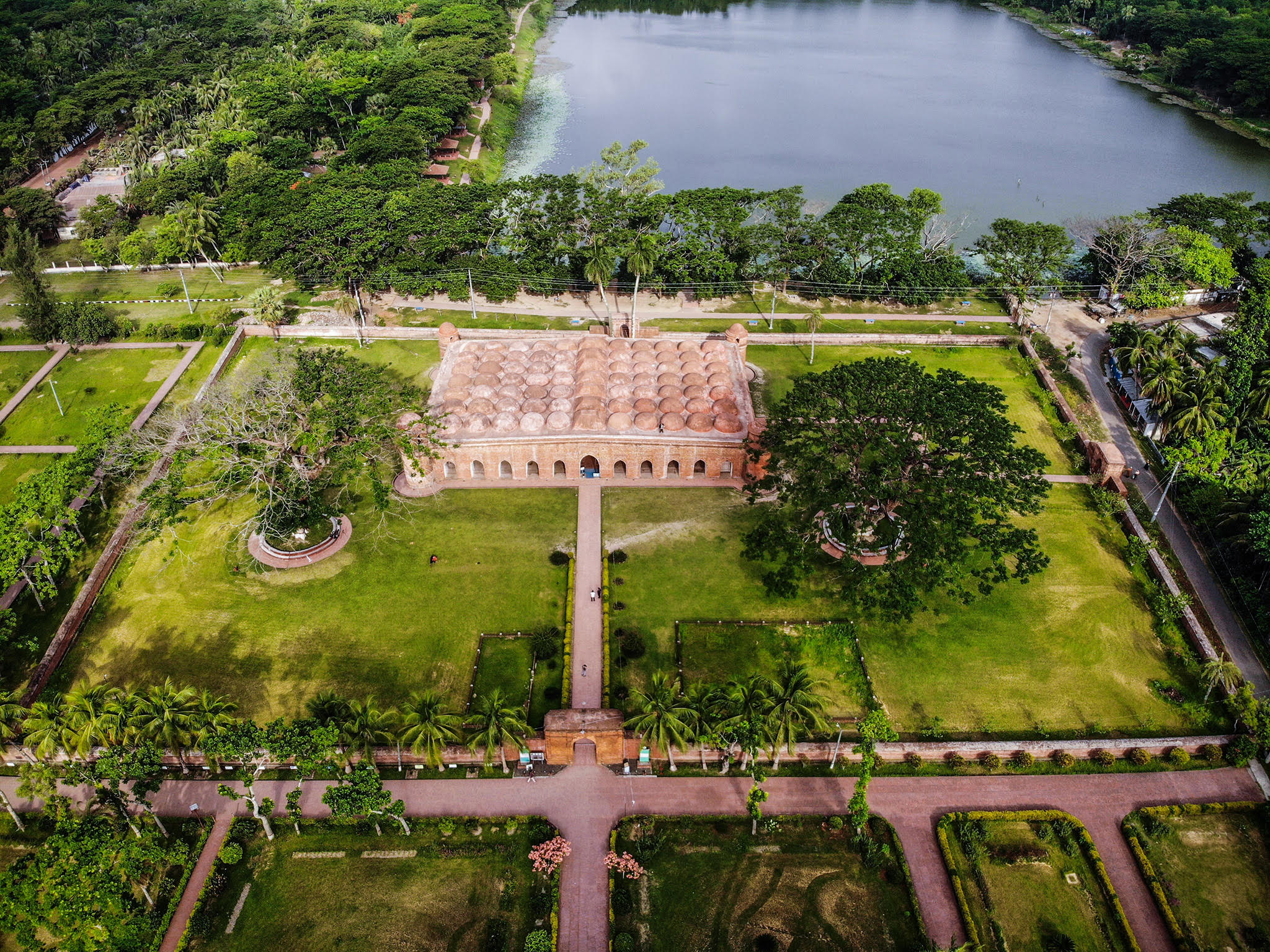
The 60 Dome Mosque
[Music] As salamu alaykum. Welcome to the Sixty Dome Mosque in Bagerhat. a cherished religious site in southern Bangladesh. The old city of Bagerhat was founded by Khan Jahan Ali in the 15th century and was centered around the Sixty Dome Mosque. Located just north of the largest mangrove forest in the world, this low lying region is known for its fertile soil and severe weather. Today the Sixty Dome Mosque serves as a cherished sanctuary for prayer, and a testament to the tenacity and resourcefulness of the local community. Join Maruf Hossain, an architect, and Ms. Afroza Khan Mita, the regional director for the Department of Archaeology, as they guide you through the mosque's construction, its importance to the community, and the challenges it faces due to climate change.
Stop 1. Spiritual Serenity
Constructed with vibrant red bricks, the mosque's distinctive square shape is topped with 81 domes and stands in contrast to the lush vegetation around it. Notice the freshwater ponds that surround the mosque, mirroring its elegant architecture. These ponds highlight the significant role of water in Islam, as well as the necessity to store rainwater in this low-lying area where groundwater can become contaminated with saltwater. The atmosphere around the mosque is one of tranquility and devotion, and five times a day, you will hear the melodic call to prayer inviting the community to pray.
Maruf Hossain
I must say... like more beyond academic [appreciation] this Kahlifatabad (Bagerhat) this Shait Gambuj (60 Dome Mosque) behind me the Shait Gambuj and other dome mosques and single-domed mosques all these places are merged with this landscape. It's like within the trees a monument is peeping out saying hi I am here. So it's very peaceful, very peaceful and humble and it invites people. And it makes [it feel] very intimate. To me, it's not a place for serenity, it's a very peaceful place for my soul as well. When you sit here beside this mosque, or you recite Quran within the mosque, or you sit beside the large pond of Khan Jahan Ali, it's amazing. It just cools down your inner hesitation and I must say it's for me this is a place for my spiritual serenity.
Afroza Khan Mita
All around the world, the Muslim community that comes and take this place as a holy pilgrimage site. And people from other religions, they come to see the magnificent creation and buildings of 600 years ago.
Stop 2. Place of Refuge
When entering the mosque, notice the decorated ceramic tiles that embellish the doorway, and the sturdy walls, which are more than 6 feet thick. During the summer, Bagerhat experiences soaring temperatures, often surpassing 100 degrees Fahrenheit or 37 degrees Celsius. The mosque's thick walls help keep the interior cool. Situated North of the Bay of Bengal, the mosque is also no stranger to powerful cyclones. During severe storms, many community members living in Bagerhat seek shelter and safety behind the mosque's reinforced walls.
Maruf Hossain
The climatic comfort of this 60 Dome mosque, so... you know it's a tropical region and for climatic comfort, you need a thermal mass. So for thermal mass, you will always get cooler inside and warmer in the cold time. So in this mosque, particularly in this mosque when you have a 10 to 12 feet thick wall and it creates a very cool ambiance in the summer season, and again if the winter it's warmer compared to other places. So this thermal mass was a very good particular point of the structure because it is holding the multiple domes and you need a good buttress here. And at the same time, it's creating a big thermal mass keeping the inside cool and comfortable.
Stop 3. Holy Architecture
Upon entering the mosque, you are immediately struck by the sight of numerous stone pillars, gracefully supporting the domes overhead. These pillars create an awe-inspiring atmosphere, evoking a sense of reverence and spirituality within the vast space. As you venture further inside, your attention is drawn to the far wall where ten beautifully crafted niches or mihrabs face toward Mecca. These mihrabs serve as focal points for prayer, guiding the faithful as the imam leads them in worship. Be sure to take a moment to admire the exceptional artistry, reflecting the devotion and dedication of those who constructed this sacred space.
Maruf Hossain
Particularly at this 60 Dome Mosque, when you enter for prayer, it's a very large gathering hall, and if you will go for prayer it's a very comfortable and cool environment. And you will feel the inner peace inside and you can pray your prayer very nicely and especially the acoustics inside it's perfect. When someone is reciting Quran it's not booming in sound, it's a very cool and very soothing sound, and it can be heard from any corner of the mosque. If you are just reciting Quran mildly loudly, it can be heard from other parts. So it's very good acoustical combination and both visual combination from every corner you see the arch, arch, arch too many arches. So it's a whole monolithic space with very multiple details so many people coming together, but forming a monolithic spirituality, that's the very thing I feel inside this mosque.
Stop 4. Climate Change
This region of Bangladesh is particularly susceptible to flooding, a vulnerability made worse by climate change. The Sixty Dome Mosque, primarily constructed of brick, faces erosion due to persistent exposure to water and moisture. Bricks, while abundant and affordable, are less resistant to the damaging effects of flooding and deteriorate over time. Recognizing this vulnerability, the builders of the mosque made a significant effort to obtain stone, a much sturdier and more resilient material. Stone is used to reinforce the mosque's foundations and pillars in the interior.
Maruf Hossain
Bangladesh is more a riverine country, so we have very soft clay here, no hard stone. It's very rare here and if you want to bring hard stone here it's very difficult. So whenever you want to build something, brick is the only solution to you available here. But the only problem with brick is it's life, it decays fast and it collapses fast. So if you want to make a permanent structure like this one, this magnificent structure, then you have to protect it from water. So at least the plinths and the supports should be, it should be protected. So I think those great builders analyzed and started to research on this and they decided to combine all those things. The minimum part you need to keep for the sustainability of the structure so they've built on the part only stone and the remaining part with bricks because this is very available to them. And you have to bring your local craftsman, so stone is not very well known here and cratfsmen are very rare so you have to build minimum part with stone, and for this mosque only the supports are stone but the remaining massive part is of brick and Bengal is with brick.
Afroza Khan Mita
We just... we are just the custodians or keepers of these sites. We do the regular cleaning sometimes. We do the conservation preservation works. And every day preservation Conservation was going on through the staff of the Department of Archeology.
Stop 5. Eroding Bricks
As you closely examine the mosque's interior, you may notice patches of green growth and a white film on the bricks. These are signs of algae growth and a phenomenon known as efflorescence. Efflorescence occurs when porous materials, such as the mosque’s bricks, are exposed to salt in the groundwater, which then migrates to the surface of the brick. This movement of salt through the brick damages the historic structures over time. Although commonly seen at archaeological sites in southern Bangladesh, many experts believe this problem will worsen with rising sea levels due to climate change.
Maruf Hossain
If you want to build something in this southern region, salt is your main enemy that decays all the structures here. So whatever you're building in other parts of Bangladesh and whatever you are building here, has a very big difference just to salt. We are struggling for the salt. And here in these Bagerhat mosques there are lots of complaints of the efflorescence. You know, when we went to that Zindapir mosque, we saw a false ceiling was there to protect the efflorescence falling from roof; they want to protect it. So they devised a ceiling of cloth to protect from that. So it's a very big challenge here, and we have we are trying to develop so many chemicals to protect them from salt, but still no good result has been found yet.
Stop 6. A Sufi Saint
If you visit Bagerthat, you may notice how the 60 Dome Mosque resembles many other historic structures in the area. Archaeologists and architects refer to this style of building as the Khan Jahan style, named after the founder of the city. While limited information exists about this 15th-century leader, locals credit him with clearing the jungle and overseeing the local community's conversion to Islam. In this period, Khan Jahan supervised the construction of over 300 structures in Bagerhat. Due to his efforts to share Islam during his life, Khan Jahan was recognized by the community as a Sufi saint. Today, Pilgrims from around the world still come to visit Bagerhat and show their respect.
Maruf Hossain
There are a lot of debates [about] who was Kahan Jahan Ali; there are many many references regarding his origin. But the most accepted and common was he was from the central Delhi Tughlaq and then he came down to the river from there and he secured himself primarily at Jessore Burrabazar and then further he got down to this place. And you know uh at that time, this was a very popular naval route and you need security there. So he convinced, (well, this is what some say about this, it's not very concrete), but some say he secured this Naval route, and the Delhi said okay you can stay there; you don't need to pay any tax. So it was a very well-understood give and take. He was securing, giving security to this naval route and the Delhi government, Delhi ruler secured him over here to expand and preach Islam.
Stop 7. Community Resilience
Thank you for taking the time to explore the Sixty Dome Mosque in Bagerhat, which continues to serve as a spiritual center for the local community. As you depart from this site, we encourage you to contemplate the remarkable community that constructed this enduring monument. Bagerhat bears testimony to the tenacity and resourcefulness of the people who have persevered in this challenging environment. At the same time, it underscores the pressing need to safeguard and cherish our heritage in an era of a rapidly changing climate.
Maruf Hossain
This is not architecture only, it's an artifact of some builders who had a vision, and who knew how to engage with their community. So this place is a learning ground for those who want to do some work with the community, engaging community or inclusive community, so this is a very good example where you can learn how to build such a magnificent structure or magnificent things magnificence include inclusiveness with the community, developing inclusiveness with the community. At the same time developing some places, spaces where you get the inner peace. That's what that's the message I want to share you've come to this place and visit and see how your inner peace develops.