Welcome to Balcony House
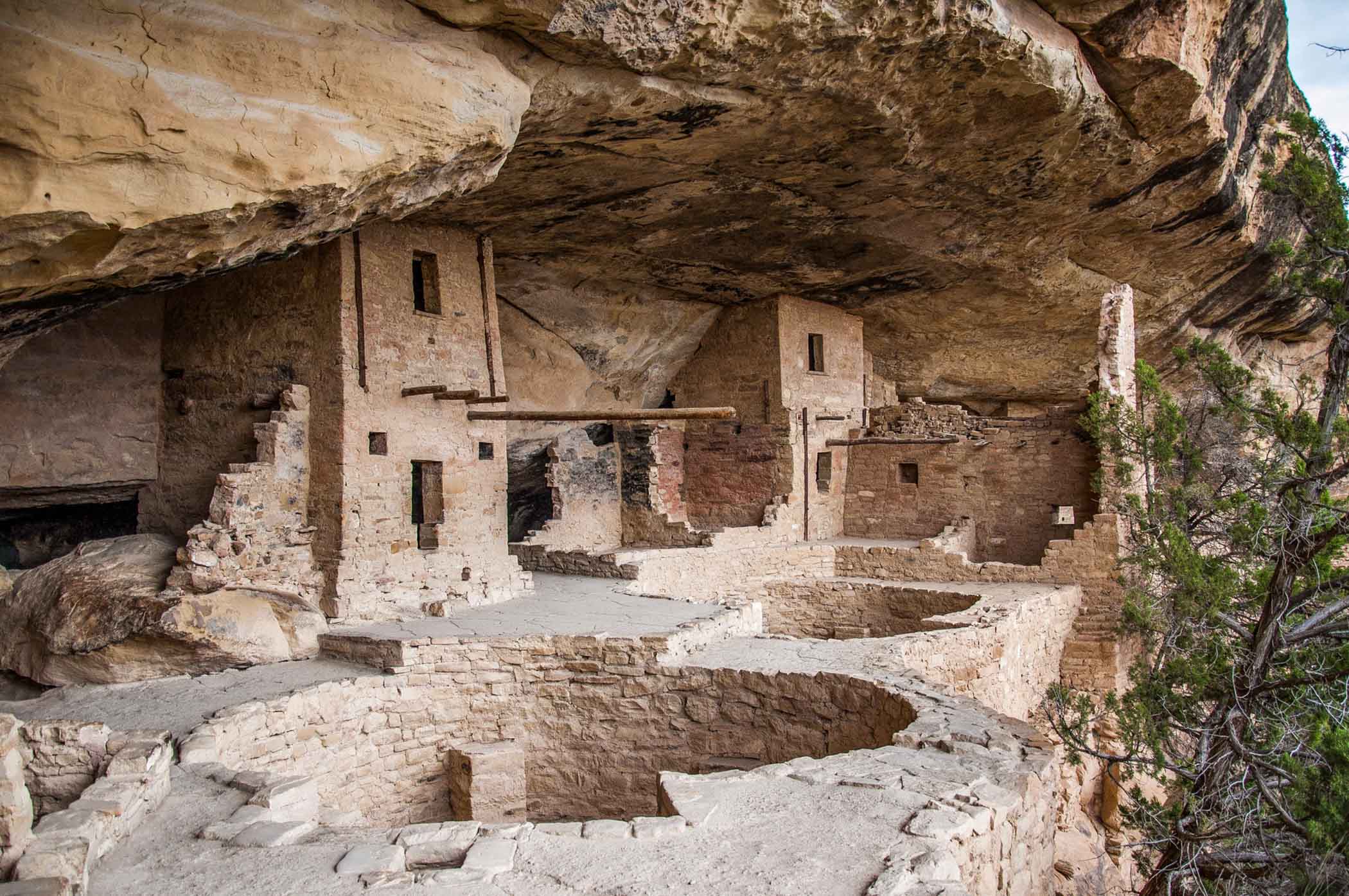
Welcome to Balcony House, an 800-year-old cliff dwelling built by the Ancestral Pueblo people at Mesa Verde. Sheltered by a natural rock alcove and crafted with durable stone masonry, it remains remarkably preserved. As you explore, look for clues in the architecture and landscape and remember these places remain deeply meaningful to Pueblo communities today. Along the way, you'll hear from Ranger Drew Reagan, who'll provide insight into life here in the cliff dwellings and the enduring legacy of the people who built them.
Stop 1. Introducing Cliff Dwellings
Cliff dwellings are Mesa Verde’s most iconic homes, but they weren’t always the most common. For centuries, communities lived mainly on the mesa top, close to their fields of corn, beans, and squash. Because Pueblo communities were, and still are, farming communities. In the 1100s and 1200s, more families began building in cliff alcoves like this one. The steep hand-and-toe holds and narrow entry corridor show that reaching Balcony House took effort. As you move forward, consider what needs might have shaped this shift.
Drew Reagan
While cliff dwellings are the most well-known types of homes found on Mesa Verde, they're not the only type. For hundreds of years, the Ancestral Pueblo people lived primarily on the mesa top, their stone built villages surrounded by fields of corn, beans, and squash. Pueblo communities were and still are farming communities. It wasn't until the 11 and 1200s that cliff dwellings became a popular trend. But why? In order to get into Balcony House, one must first descend a series of steps carved into the cliffside. These steps are known as hand and toe holds. They are found all over the mesa, linking cliff dwellings to mesa top villages and farmland. Once below the canyon rim, all who came and went into Balcony House had to pass through this narrow natural rock corridor. This entry was made even smaller by the addition of a tunnel built of stone and wood that further restricted access into the site. The difficult-to-reach nature of many cliff dwellings and the added restriction of access by features like this tunnel lead some archaeologists to believe that safety and security were one reason some people moved from the mesa top to these alcove villages. Let's keep exploring to find out other reasons cliff dwellings became so popular.
Stop 2. Stone Architecture
Balcony House is built from carved sandstone blocks stacked carefully with mud mortar, forming sturdy walls that have lasted for centuries. Look closely, and you can still see the peck marks left by the tools that shaped each stone. These rooms weren’t all the same, some were places to sleep, cook, and gather, while others stored and processed food. The grinding stones found here remind us of the daily work of turning corn into meal and the meals shared afterward. Many Pueblo families today continue food traditions rooted in corn, carrying forward knowledge that began in places like this.
Drew Reagan
The rooms of Balcony House are built primarily of shaped sandstone blocks neatly laid one on top of the other with mud mortar in between. Look closely and you can see the dimples and peck marks made by the craftspeople who shaped each individual block with stone tools. Like homes today, these rooms served a variety of purposes. Some were living quarters where families slept, cooked, and relaxed after a long day of working in the fields. Others were used as storage to process and keep food. Metates or grinding stones such as these, were found in this site and were used to grind corn into cornmeal. Think of all the amazing meals that were prepared and cooked here. Today, Pueblo families carry on the tradition of making and enjoying a variety of corn dishes, including piqui, a crisp, paper-thin bread made of cornmeal, ash, and water.
Stop 3. Interior Plasters & Designs
Many rooms here were once bright inside, finished with mineral-based plasters in reds, whites, greens, and even blues. Painted designs such as triangles, figures, and geometric patterns, linked this community to a wider Pueblo world where ideas and styles traveled across the region. Art was part of how people expressed identity, meaning, and connection. Objects found in cliff dwellings reveal a highly skilled, richly decorated material culture. Those artistic traditions are still alive today in Pueblo weaving, pottery, and craftsmanship.
Drew Reagan
Many of these rooms were adorned with interior murals of red, white, green even blue plasters made from locally found minerals. Designs include human and animal figures, geometric patterns like the red and white triangle design you see here. Such designs are not just found on the mesa but all around the Pueblo world indicating an exchange of ideas throughout the Four Corners region and beyond. Art was and remains an important part of Pueblo culture. Many highly decorated items, including baskets, ceramic bowls, and mugs cotton clothing and yucca fiber sandals were found inside cliff dwelling rooms. Today, Pueblo weavers, potters and craftspeople carry on these traditions.
Stop 4. Dating Balcony House
Some of Balcony House’s best-preserved rooms still feature original design elements, including T-shaped doorways, intact floors, and roof structures. The alcove’s natural ceiling protected the village from rain and snow, helping preserve even wooden beams overhead. Those timbers are especially important because they can be dated through dendrochronology. By taking small core samples, researchers can estimate when a tree was cut and when a room was built.
Drew Reagan
Let's take a closer look at another room. This one is really well preserved with its defined T-shaped doorways and an intact roof and floor structure. It provides an excellent example of what many other rooms might have once felt like. Step inside, take a look around. The natural rock ceiling of the alcove has protected the architecture from rain and snow, preserving the site remarkably well, including the wooden beams above you. Perhaps this was another reason why the Ancestral Pueblo people chose to live here. The intact original wood provides archaeologists with a wealth of information, including a way of dating the site. By taking core samples, scientists look at the rings to find out what year the tree was cut down, thus providing an approximate date for when the room was built. This science is known as dendrochronology. Tree ring dates tell us that the Balcony House was constructed between 1180 and 1270
Stop 5. Kivas
At the center of Balcony House are two round rooms known as kivas, spaces that supported community life in powerful ways. On mesa tops, kivas were dug into the soil, but here the floor is hard sandstone, so builders created kivas by building retaining walls and backfilling. Each kiva once had a flat roof with a small opening, entered by ladder, and a hearth for fire. Kivas at Mesa Verde likely served multiple purposes, and for Pueblo people today, kivas remain important spaces for ceremonies, gatherings, and community traditions.
Drew Reagan
The two round underground rooms at the center of the site are called kivas. On the mesa top this required digging down into the earth. Here in Balcony House, the alcove floor is hard sandstone so digging down was not possible. In order to build a subterranean room, the builders of Balcony House constructed a retaining wall at the front of the site and backfilled it with earthen debris. Both kivas would have had flat roofs made of stacked beams with a small square opening in its center that provided entry via a ladder. Look down into the kiva, Can you see where the hearth or fire pit once was? Well insulated and warmed by a fire, A kiva would have been a welcoming place. Evidence suggests that kivas at Mesa Verde were used in a variety of ways. Today, Pueblo people build and use kivas for religious dances, ceremonies, celebrations, and as a gathering place for the community.
Stop 6. Seep Springs
The back of the alcove feels darker and cooler, and the ceiling is stained with soot from fires that once lit this space. Nearby, a shallow depression in the floor once collected water from a seep spring. In an arid landscape, dependable water could make all the difference. This spring would have supported daily needs and added resilience during dry periods.
Drew Reagan
Today, the back of Balcony House is dark and cool. Look at the alcove ceiling. Notice how the natural sandstone ceiling is covered with a film of black soot. This soot is from small fires that once illuminated this space. As you continue to explore this back area, pay close attention to where the ceiling dips down to meet the alcove floor. It might be a little difficult to see, but look for a depression carved into the ground. Water from a seep spring once pooled in this carved-out feature. Rain and snowmelt will slowly seep into the sandstone rock above. Some of it will exit the rock and collect in small springs like this one. In this arid landscape, I can imagine water was a very important resource just as it is today. Perhaps these springs, located below the canyon's rim, provided yet another reason to live here.
Stop 7. Narrow Passageway
Balcony House is organized into two main sections, each centered around its own open plaza. A narrow passage connects them, a tight corridor that guides movement through the village. It’s the same route used by visitors walking through Balcony House today. Passages like this can tell us about how the village functioned as a community.
Drew Reagan
Let's continue our journey through the site. Balcony House is divided into two main sections, each with its own plaza area. During the summer season, rangers like myself lead groups of visitors through this site. This narrow passageway, used by the Ancestral Pueblo people to go between these two main areas, is the same route we still use today.
Stop 8. North Plaza
The name “Balcony House” comes from a striking feature in the North Plaza: a preserved balcony extending from a two-story structure. Balconies like this created more usable space and helped connect upper rooms. Many Pueblo villages included similar features, but few remain intact. It’s also worth remembering that “Balcony House” is a modern name, assigned long after the original residents left the region.
Drew Reagan
You might be wondering by now why is Balcony House called Balcony House. Here in the North Plaza, a balcony extends from a two-story structure. Balconies like this one allowed residents to pass from one second-story room to another and provided more usable space Many Pueblo villages had similar balconies; however, this one remains incredibly well preserved While we call this village Balcony House, it must have gone by other names in the past Spanish explorers, ranchers, and other visitors long after the ancestral Pueblo people left this area gave these sites the names we use today. Pueblo people have different names for these places. Mesa Verde, in the Hopi language, is known as Bear Ridge. The people from Acoma Pueblo know this whole region as the Wide Area of Dwellings. I wonder what the people who lived here called their village.
Stop 9. Parapet Wall
Along the edge of the North Plaza runs a parapet wall, creating a protective barrier between daily life and the steep canyon drop. The incredible view, the skill in the stonework, and the objects we find here point to a community that valued beauty as well as function.
Drew Reagan
One of my favorite features in Balcony House is also in this north plaza. Running along the front of this open area is a parapet wall. A protective barrier between the plaza and the steep cliff edge. As someone who's a bit afraid of heights, I can appreciate this added security element. As you look past the parapet wall, the model shows a gray abyss where the most spectacular canyon view exists. Facing northeast, the residents of Balcony House enjoyed a sweeping view of a 600-foot-deep sandstone canyon scattered with, a forest of pinyon and juniper trees. Rising from the horizon beyond the canyon's rim, the snow-capped peaks of the La Plata Mountains can be seen against a deep blue southwest sky. On a clear day like today, I'm left to wonder, did the incredible view add to the residents' decision to live here? Based on the items the Ancestral Pueblo people left behind and the skill and care with which they built their homes, it's apparent they valued beauty.
Stop 10. Viewing the Entire Site
As you’re whisked out into the canyon and turn to look back, the whole site comes into view, rooms, kivas, plazas, and passageways tucked perfectly into the alcove. It’s breathtaking, and it raises a hard question: why would families leave a place like this? Some lines of evidence suggest that during the 1100s and 1200s, prolonged drought, shifting resources, and social changes may have contributed to migration, and by the late 1200s, many people had moved south toward the Hopi mesas and the Rio Grande. Yet these homes were never forgotten, descendants still return, and Balcony House remains a powerful record of ingenuity, community, and living tradition.
Drew Reagan
For our final stop, let's take a step back and view the entire site. Isn't it remarkable? It's hard to imagine the circumstances that caused the families who lived here to move away from such a beautiful home. When cliff dwellings like Balcony House were being constructed in the 11 and 1200s, massive changes were occurring across the Pueblo world. While many residents of Mesa Verde moved from the mesa tops into cliff dwellings, others began to migrate away from the region entirely. Archaeological evidence and oral histories point to prolonged droughts, diminished resources, and social upheaval as factors that may have contributed to these migrations By the end of the 13th century, the once bustling Mesa Verde was almost completely depopulated. The sounds of construction that had filled the air, moved southward to the Pueblos of today on the Hopi Mesas of Arizona and along the Rio Grande River and its tributaries in New Mexico. Though the people left, these homes were never forgotten. Today, their descendants continue to return to Mesa Verde to learn from and connect with their ancestors. I hope you've enjoyed exploring Balcony House together. As we part, I hope that you take what you have learned and share it with your friends and family. Places like Balcony House provide us with an incredible window into the past of a continent filled with creativity ingenuity, architectural and artistic achievements, and a diversity of cultures that persist today. To learn more about Mesa Verde, visit our website, or better yet, come visit us and step into a cliff dwelling and into the past.