Casa Barrientos
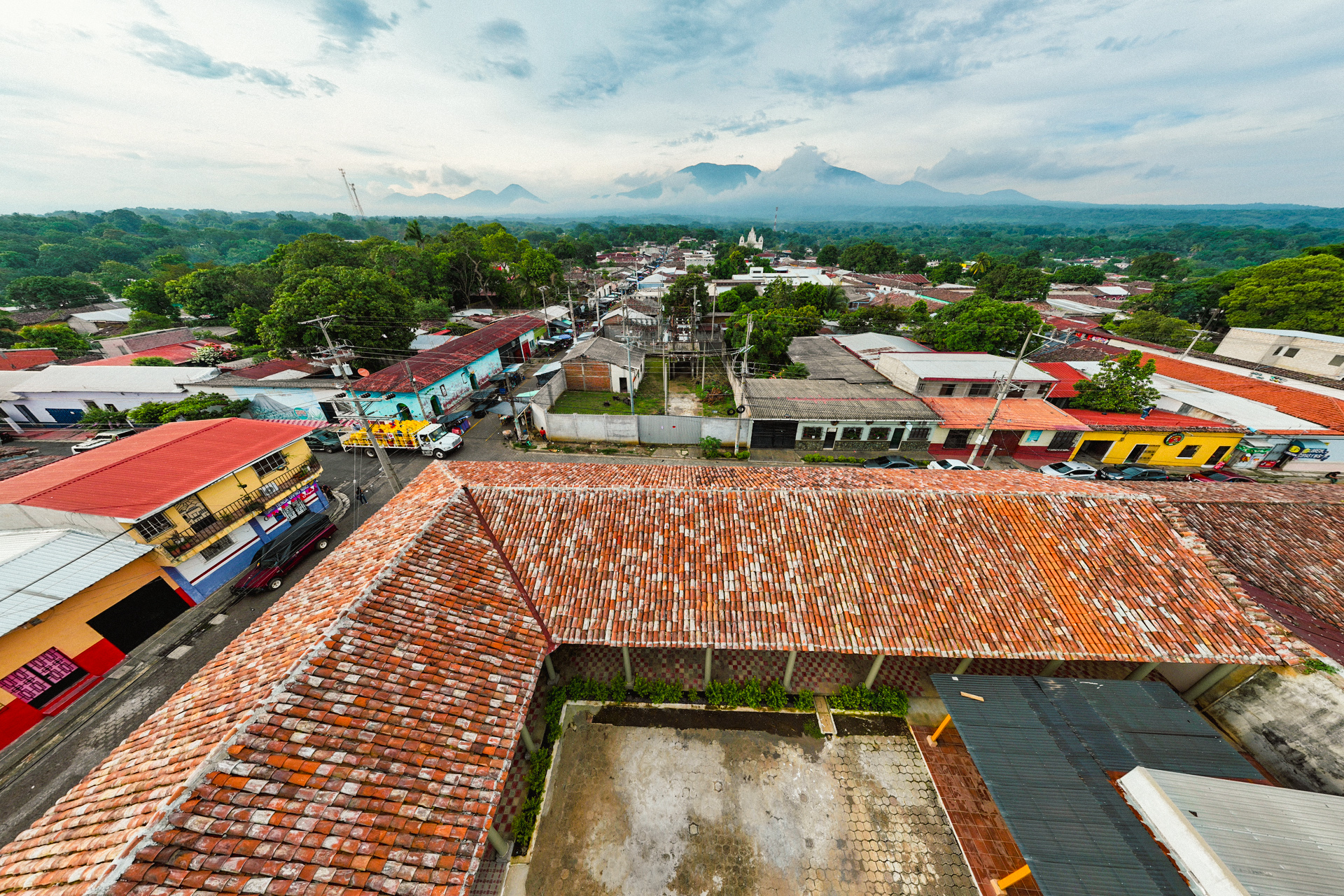
Welcome to the virtual tour of Casa Barrientos or the Barrientos Home, a site that illuminates the deep historical and spiritual roots of the city of Izalco. From this vantage point overlooking Casa Barrientos, the city spreads out in every direction in a tapestry of rich colors and lush vegetation, with the majestic volcano marking the horizon in the distance. This tour will shed light on the unique convergence of indigenous and Catholic traditions within Izalco, reflected in the intricate design of Casa Barrientos. Throughout the tour, you'll hear from expert guides, including Don Benjamín, a local guide with deep ties to this historic home, offering a personal perspective, and architect Sara Paredes, who played a pivotal role in the building's restoration.
Stop 1. Casa Barrientos and the town of Izalco
Looking to the north of the city, atop the mountains, is the Izalco volcano, the youngest volcano in El Salvador that originated on the slopes of the Santa Ana volcano. Izalco is a municipality located 55 kilometers from the capital of El Salvador and has a population of over 70,000 inhabitants. The original town was founded in 1054 and consisted of two distinct villages: Asunción Izalco and Dolores Izalco. By studying Casa Barrientos, one of the oldest buildings in El Salvador, we can learn more about the history of this town and understand why preserving it was so important to the community.
Mauricio Benjamín Bautista Arucha
Good afternoon, this is Benjamín Bautista, currently employed at the municipal hall but with a desire to know more about my town and its history. For this reason, I have taken it upon myself to research its culture, the history of this beautiful town or city or ancient road as it's known, of which I am proud. Such is the importance and value that I hold, and the love I have for my town of Izalco, that through research and reading, field research I have done on my own, you could say as a hobby or personal interest I became very interested in its history and culture and thus decided to become a guide. And through this job and service I provide, I enriched my knowledge about the town's history, about its culture, and that's how I became acquainted with the historical data of the Casa Barrientos and memories from my childhood related to this house came back.
Stop 2. Preserving History
The restoration of Casa Barrientos was led by the Izalco City Government with support from the U.S. Embassy through the Ambassador's Fund for Cultural Preservation. Traditional restoration techniques were employed, allowing for the stabilization of the property and the installation of security systems, fire protection, and lighting. In this community project, neighbors helped make adobe blocks, while the community and church also donated tiles to complete the roof restoration.
Mauricio Benjamín Bautista Arucha
Casa Barrientos was acquired by the municipality, by the town hall or the municipal council in 1986. It was purchased from a descendant of the family and, let's say, it was in quite suboptimal conditions and from being a private family home, it became a communal house. Part of Casa Barrientos functions as a cultural center. From the time the municipality took possession, it was presented to the Izalco community as a venue for events and became known as the cultural center. Later on, and I repeat, it served as a school for a couple of months due to the reconstruction of Marroquín School. Over time, the building, unfortunately, started deteriorating because no interventions were made, as the aim was to preserve Casa Barrientos as it was.
Sara Guadalupe Paredes Pérez
The restoration and rehabilitation of Casa Barrientos had an approximate duration of 2 years. In this, both skilled and unskilled labor was employed, but all were from Izalco. Among the men and women who worked on the project, there was also the will to train those who had no specialized experience. Experts in the fields of history, anthropology, archaeology, and restoration were also involved.
Stop 3. The Barrientos Family
Now we descend to the level of Avenida Norte, one of the main streets of Izalco. This house was built in 1864 by the Barrientos family, who had a significant impact on the development and formation of modern Izalco. Originally from Spain, the Barrientos family helped establish many institutions in Izalco and also played an influential role in events related to El Salvador's history. Many people still remember how, just a few decades ago, descendants of the family still lived in the house.
Mauricio Benjamín Bautista Arucha
Casa Barrientos belonged, or was owned, by the Barrientos family, descendants of Don Pedro Barrientos who came to this city from Spain. He met Doña Felipe Vega and they married, and from that union came seven children. Of the seven children, the fifth birth of Mrs. Vega were twins. Among the twins was the one responsible for the construction of this beautiful building, Don Ramón Barrientos. We can say that the Barrientos family played a part in the economic and social development of the town. They founded the first health center, now known as the health unit. A descendant of theirs also introduced potable water service here in Izalco. They were responsible for paving the main entrance of the town from El Tepillo to the Dolores church and constructed the first market in 1948. This is without mentioning other activities they undertook not just in Izalco but also significant events in El Salvador.
Sara Guadalupe Paredes Pérez
The roof structure and its false ceiling had to be restored significantly. This was due to extensive damage caused by moths and moisture issues. We're talking about the roof structure being practically open at the part where the ridge is located, allowing water to enter the building during the rainy seasons.
Stop 4. Religious Symbols
Known as the "second church of Izalco," Casa Barrientos stands out not only for its abundance of religious images but also for the deep devotion and faith of the Barrientos family evident in every corner of the house. Beyond its design, the home features countless religious symbols and motifs, especially the meticulously carved limestone blocks that decorate the tops of windows and doors. These intricately detailed stones have led to various interpretations over time, showcasing the depth and complexity of their symbolism.
Mauricio Benjamín Bautista Arucha
That's the past context of Casa Barrientos, due to its cultural, historical value and the significance Casa Barrientos has held. Because aside from being the house where important figures or the townspeople could gather, Casa Barrientos was also known as the town's second church. Since the Barrientos family was very devout and religious, they safeguarded and possessed many images of the Virgin of Nazareth, angels, which were later donated to the Dolores Church. This is a crucial aspect of the relationship between Casa Barrientos and why it's known as the second church, not just because of the religious images they had but also due to the symbolism of the limestone stones each room still possesses.
Sara Guadalupe Paredes Pérez
The corner window, like the rest of the windows of Casa Barrientos that are only on the main or exterior facades, has a wrought iron guard. On this are engraved the initials of Don Ramón Barrientos, on all the window guards. This was also quite typical back then, similar to the main door key, engraving the initials of the property owner. Their restoration involved mainly cleaning and treating the material, which was in excellent condition. The corner window was a significant challenge in the restoration of the building as it had damage in the wall and also the structural elements like window lintels, and the same limestone frame it has. So, some elements like the window lintels were replaced like the rest of the damaged parts of the window. These are pieces from six rods in length with quite large sections, whose installation was a great challenge. In such a way that we maintained safety for the workers doing the work, as well as the integrity of the building. These were originally closed with bricks of clay, intending to provide more stability to the building to prevent it from falling. The roof structure also reaches the corners, like the corner column and the corner window, is a single structural element. We call it a truss. It is a single piece and is the largest of all. Also, this was one of the biggest challenges because we are talking about structural elements of greater length and weight in relation to the rest of the building.
Rodrigo Alberto Calvo Guerra
On the night of August 11, we begin to prepare for the feast of the Virgin of Transit. We bring down her glass urn in the Asunción church. We take it out and clean it. The women take off her old dresses and dress her in her new clothes. The men place her in the center of the church, her feet to the south and her head pointed north. The candles are placed around her. Everything is part of a rite and the mysticism of the Virgin. On August 12 at six in the morning, the celebrations begin. The figure originally comes from the Barrientos family– they had it made in Guatemala at the beginning of the twentieth century. In the 1970s, the Barrientos sisters decided to donate the image to the Asunción church. That church has been my parish since I was a child. Today I am in charge of the custody of the virgin. I support the church taking care of this image and preparing it for its celebrations. I asked the older people in the church, and they told me stories about her. They told me that when the virgin was owned by the Barrientos family, a group from the church walked in a procession to the house, which is two blocks away, and the Virgin was handed to them. A group of girls dressed in white took the ribbons attached to the image and walked her to the church. At the end of the party, they returned her to her house. They say that in the Barrientos house, the Virgin had her own room where a series of angels were placed around her, and she always had tuberose flowers placed near her. My job at the mayor's office requires me to be at Casa Barrientos frequently. When I visit the site and walk through the halls, I wonder where the original room would have been of this part of our city’s heritage.
Stop 5. Main Doorway
Here, at the main entrance of Casa Barrientos, the large wooden door has a rich history that sheds light on the history of Izalco. Above the entrance, a limestone block is carved with the initials DRB (representing Don Ramón Barrientos, who built this house). On the lower part of the stone, you can see 1864, the construction date of Casa Barrientos by the Barrientos family. The hefty wooden doorway also bears marks from a dark chapter in Izalco's history, dating back to 1932 when thousands of indigenous peasants rose up in rebellion against the regime, armed primarily with machetes.
Mauricio Benjamín Bautista Arucha
We will start by referring to the main entrance gate of Casa Barrientos. At the top of the gate, a semi-circular gate, a carved limestone is embedded with the letters "D R B." Which stands for Don Ramón Barrientos, the name of the owner, the person who built this building. Besides that edifice and the intriguing limestone, that piece of wood, that gate, just in that small portion of the gate, in that spot, we have a historical richness to narrate and convey to our young people and those who might be watching us from abroad and may recall the history of Izalco.
Sara Guadalupe Paredes Pérez
Casa Barrientos, unlike other buildings of its time, features a unique entrance. This is a straight opening crowned with a flattened arch. And its surroundings are made up of limestone blocks, which are composed of different pieces that are overlaid on each other, forming the entrances. This pattern is repeated in both the doors and in the nine doors the main building has, as well as in its windows. The main door has been restored and still retains the original upper panels of the building. This was possible thanks to a process of architectural carpentry restoration. This was feasible both because of the quality of the material - they are cedar wood doors which due to their quality, could be restored. These doors still bear traces or memories of all the events, particularly those of the year 1932. They are part of the elements of the door panels that still remain.
Sara Guadalupe Paredes Pérez
The classic central courtyard of that era is flanked by extensive corridors, which are protected by large eaves, supported along with their roof structure by 15 columns of substantial proportions. These are columns made of different species of wood. During the restoration, we found cedar wood, as well as loquat and balsam wood. The restoration of the columns essentially involved the incorporation of four new single-piece columns, each made from a single piece of wood. While the rest that were preserved were restored and also reinforced through grafting with new wooden elements. All this work was carried out by Izalco labor. We had our restorative carpenter who, without an industrial lathe, manually turned the columns, all of which were also made inside the property. Nothing that belonged to the property or was being restored could leave Casa Barrientos; everything was worked on internally.
Stop 6. Entering Casa Barrientos
Upon entering the courtyard of Casa Barrientos, a set of wooden doors framed by delicately carved stone lintels stands out. While these doors now lead to government offices and meeting rooms, they once belonged to the Barrientos family. Just like on the outside, these doors feature distinctive religious symbols. On the tour, you will be able to select some of the carved stones, which will activate with a photo, text, or video explaining their meaning.
Mauricio Benjamín Bautista Arucha
The house is designed in an "L" shape. Starting from the main gate towards the left, we can find what is the living room of the house. And next to the living room, we find the bedroom of the Barrientos couple, Don Ramón Barrientos. Where we can also find a very important symbolism referring to what is known as the "room of sin."
Stop 7. A Center for the Community
Casa Barrientos in Izalco is not just a structure but a treasure of memories. Many locals fondly remember gatherings held within its confines. With terracotta tiles and supported by graceful columns, the building stands as a jewel of architectural history. If its walls could speak, they'd share tales of generations attending dinners, festivities, and religious events. After a careful renovation, the community eagerly anticipates the new stories that will unfold at Casa Barrientos.
Mauricio Benjamín Bautista Arucha
El dia de la fiesta de mis quince años fuimos a la iglesia primero. La misa se celebro en la iglesia Asunción - una cuadra y media de la iglesia a la Casa Barrientos. Mi papá caminó en medio de mi hermana gemela y yo, agarrando a cada una de un brazo. Fuimos desfilando, primero mi hermana y yo, y despues las veintiocho primaveras y sus veintiocho chambelanes. Desde los once años asistía a la Casa Barrientos para diferentes actividades. Me gustaba mucho el centro cultural, donde podía ir a hacer mis tareas o leer libros. Nunca pensé que tendría una fiesta de quince años y menos en Casa Barrientos. Dos semanas antes, mi papá nos sorprendió con que tendríamos fiesta. Pensé que se haría en el terreno de la familia, donde ahora vivo yo. Pero como necesitabamos veintiocho primaveras, entonces requeríamos un lugar mas grande. Logramos alquilar el patio de Casa Barrientos. En dos semanas, organizamos todo. Pidiendo apoyo con los compañeros de escuela donde mi hermana y yo teníamos muchos amigos en nuestros respectivos salones, ya que cambiabamos de lugar seguido. Con los vecinos, y familiares, logramos reunir la gente necesaria. Mi mamá, que es costurera, trabajo casi sin dormir, por dos semanas para coser los veintiocho vestidos rojos para las primaveras y los vestidos rosas de mi hermana y yo. El día de la fiesta, llegamos a Casa Barrientos. Mi papá bailo el vals con nosotras. Cada una de un lado de el, mientras el confeti caía de una esfera. Mis amigos estaban todos chicos y querían bailar. El grupo de música de la iglesia nos apoyo con la música gratis, pero solamente estaban dispuestos a tocar música religiosa. No logré convencer a los músicos que tocaran música mas moderna. Una amiga se trajo su equipo de sonido, y con eso bailamos. Fue una fiesta inolvidable. Y ahora, 25 años después, estoy trabajando en Casa Barrientos. Cuando regresé, la casa había cambiado y no me acordaba bien de ella. Pero al ver las fotos, recordé los lugares que siguen aqui como el patio donde sucedio la fiesta.
Alicia Rebeca López Olmedo
The day of my fifteenth birthday, we went to church first. The mass was celebrated at Asunción church, one and a half blocks away from Casa Barrientos. My dad walked between me and my twin sister, holding each of us by the arm. We walked in a procession, first my sister and I, and then the twenty-eight attendants and their twenty-eight escorts. From the age of eleven, I attended Casa Barrientos for different activities. I really liked the cultural center, where I could go to do my homework or read books. I never thought I would have a quinceañera party, let alone one at Casa Barrientos. Two weeks before, my dad surprised us that we were having a party. I thought it would be done on the family property, where I now live. But since we needed twenty-eight attendants, we needed a bigger place. We managed to rent the patio of Casa Barrientos. In two weeks, we organized everything. We asked for support from our class, where my sister and I had many friends in our respective classrooms, since we exchanged places often. When we included the neighbors and relatives, we managed to gather the necessary people. My mom, who is a seamstress, worked almost without sleep for two weeks. to sew the twenty-eight red dresses for the attendants and the pink dresses for my sister and me. On the day of the party, we arrived at Casa Barrientos. My dad waltzed with us. We danced on either side of him, while the confetti fell from a sphere. My friends were all young so they wanted to dance. The church music group supported us with free music, but they were only willing to play religious music. I couldn't convince the musicians to play more modern music. A friend brought her sound equipment, and with that we danced. It was an unforgettable party. And now, 25 years later, I am working at Casa Barrientos. When I returned, the house had changed, and I didn't remember it well. But when I saw the photos, I remembered the places that are still here, like the patio where the party took place.
Stop 8. A cultural legacy
We hope you enjoyed this virtual tour of Casa Barrientos. Beyond being an architectural landmark, it connects deeply with Izalco's rich history, showcasing its wealth, pride, indigenous culture, and the profound faith of its residents. We invite you to visit in person and experience Izalco's diversity. We look forward to welcoming you.
Mauricio Benjamín Bautista Arucha
The intention of reconstructing the Casa Barrientos was to establish a cultural center here. And how great it is with this opportunity given to express what we want to convey and for people to know that beyond the historical richness of Casa Barrientos, its architectural design, Izalco also offers its culture, traditions, faith, passion, and landscapes. Izalco is a town rich in history, and any spot we stand on would take a long time to explain any event or story, but what we want is for people to recognize and see that Izalco is a very joyful and festive town, a town which, in the entire Salvadoran territory, consists of two villages and has two festivals a year. Additionally, the indigenous culture is present, with its festivities and the confraternities, which number 35 if I'm not mistaken, both ladino and indigenous, celebrating the saints they venerate. They celebrate during their assigned times and share with both locals and visitors their delightful cuisine. Each confraternity showcases its music; for the indigenous, it's the drumbeat, and their gastronomy includes chicha, corn husk bread, tipujos, and tamales. While the ladino confraternities feature the marimba, guitar, cinnamon drink, and pastries like marquesote. And of course, there are the dances that take place in honor of each saint celebrated in this beautiful town.