Story outline
-
The Church of San Bartolomé
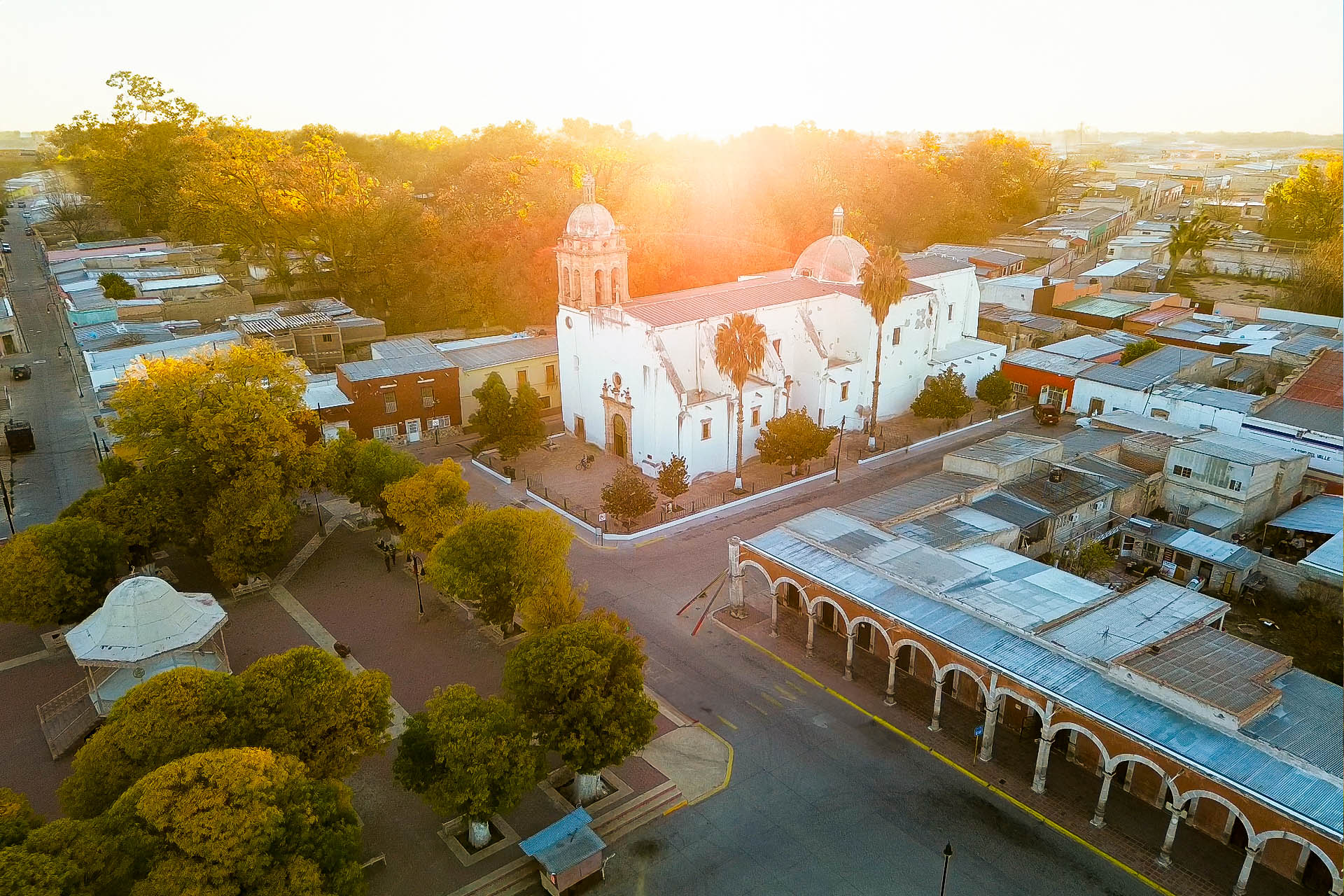
The San Bartolomé temple stands as one of the most significant architectural gems in northern Mexico. With a history spanning over 200 years, it proudly showcases its importance along the route of the Camino Real de Tierra Adentro and continues to offer a space for religious worship to this day. Through this exploration, we will delve deeper into its architectural appreciation and discover the treasures safeguarded within its walls. -
Stop 1. A fertile valley in the desert
Nowadays, the scenery of Valle de Allende is defined by old-growth walnut trees, particularly in the main square, with walnut cultivation being very significant. However, back in the days of the Spanish Crown, agriculture was more diverse, with fruits, vegetables, and grains supporting the sustenance needs from the Valley to major mining centers such as Santa Bárbara and Hidalgo del Parral. -
Stop 2. The Royal Road and Historic Monuments
Since 2001, the community of Valle de Allende has boasted a national designation as a Historic Monument Zone, a distinction that includes 110 buildings, including dwellings, temples, and other essential structures erected from the 16th through the 19th centuries. Among these, the Temple of San Bartolomé is particularly distinguished. -
Stop 3. The First Franciscan Mission in Chihuahua
Because of its dedication, this area was known as San Bartolomé, which included the valley and the river that ran through it. In 1852, the name was changed to Allende in honor of the insurgent leader Don Ignacio José Allende. -
Stop 4. Current Church of San Bartolomé
Erected in the latter part of the 18th century, the existing Temple showcases the use of local resources such as stone, wood, lime, and raw earth, crafted into what are known as adobe blocks. This method of construction remained standard practice into the mid-20th century, at which point a transition to cement represented a significant evolution in building techniques. -
Stop 5. Quarry carving
During the Spanish conquest in the north of Mexico, the architectural approach to buildings was driven by functionality and defense due to the challenging relations with the indigenous populations. Many temples initially emerged as basic chapels built from wood and earth, evolving over time into imposing structures, relegating decorative aspects to a lower priority. -
Stop 6. Interior lighting
The construction materials' weight and the walls' considerable thickness, over 80 cm, limit the feasibility of adding openings to the building. Thus, every window is tailored to introduce interior light, casting a stage-like atmosphere that elevates the visual experience of the main altar and chapels. -
Stop 7. The preserved treasures
Within one of the lateral annexes, which doubles as a museum, visitors can find an array of liturgical artifacts and mainly 18th-century oil paintings, each of significant historical, aesthetic, and artistic worth. -
Stop 8. Our Lady of the Rosary and Festivals
As of 1750, the trade of merchandise had become so pivotal that the area boasted its own customs house, reflecting the booming local economy. Furthermore, the offerings at the fairs included goods from as far as Durango and Guadalajara. -
Stop 9. A Living Legacy
The historic Temple of San Bartolomé embodies the living heritage of northern Mexico's conquest and development. Despite its contentious beginnings, for over 200 years, its walls have been part of the community's life, marking significant milestones from births and weddings to the communal festivities that unfold at its doorstep.
Voices
-
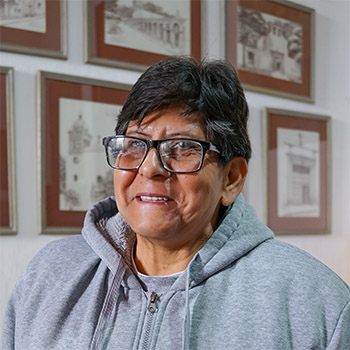
Rosario “Charo” de Monserrate Montes Payan
Parish secretary
Rosario Montes, better known as Charo to the community, has served as the Parish Secretary for over 30 years. In this role, she is responsible for managing and maintaining all the churches' documentation, including baptismal certificates, marriage certificates, first communions, confirmations, and death records. Additionally, she safeguards the churches' historical archive, which holds very old documents dating back to the town's founding. Her dedication and commitment have been crucial in preserving the integrity and proper management of the parish records and archives. -
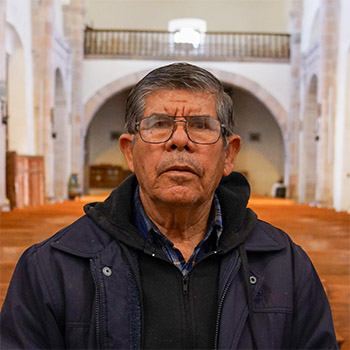
Atanació “Tacho” Rodríguez Rodríguez
Sexton
Atanacio Rodríguez, affectionately known as "Tacho" by the community, has been the sexton of the Church of San Bartolomé for over 40 years. His life has been dedicated to religious activities, serving as a faithful steward of the building. Throughout his extended tenure, he has assisted several priests who have made their mark on the community, fondly recalling their time at the temple. -
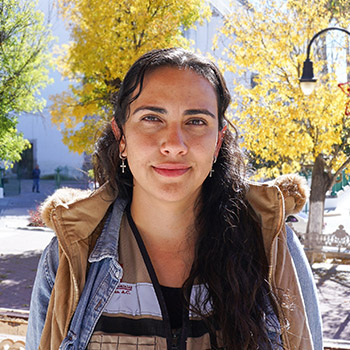
Karla Isabel Morales Porras
Architect
Karla Isabel Morales Porras, born in Hidalgo del Parral in 1994, is an Architect specializing in Sustainable Regional Architectural Design from the Technological Institute of Chihuahua II. She holds a diploma in Built Religious Heritage from UNAM. Since 2019, she has been working as a Project Architect at the Civil Association Colonial Missions of Chihuahua, leading the development, management, direction, and supervision of restoration projects. She represents the association in the Regional Laboratory for the education and conservation of cultural heritage. Karla has extensive knowledge of religious symbolism, has coordinated projects in various locations, conducted workshops on traditional intervention techniques in heritage buildings, and currently employs photogrammetry to develop projects with digital twins and virtual tours. -
Rey Fernando Montes Trevizo
Architect
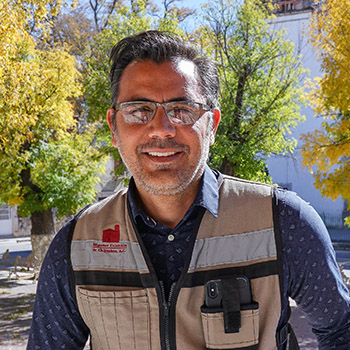
Rey Fernando Montes Trevizo is an architect focused on Sustainable Regional Architecture, with qualifications in Cultural Heritage Management and Earth Architecture Conservation, and a Master's in Cultural Heritage and Tourism. Since 2008, he has restored 28 historical temples with the Civil Association Colonial Missions of Chihuahua and is on the Historical Heritage Commission of the Chihuahua Architects' Association. He has contributed to publications on Northwest Viceregal art and architecture and a Cultural Heritage Atlas of Chihuahua. Montes Trevizo received a grant from the David Alfaro Siqueiros Artistic Creation and Development Program (PECDA) 2021 in Visual Arts for a project on virtualizing Chihuahua's key archaeological, historical, and artistic heritage. He also won the EKA 2022 call from the Chihuahua State Culture Secretary with a project on "Digitalization of Historical Heritage: Emblematic Ex Haciendas of Chihuahua."
Gallery
Partners



About the Project
The San Bartolomé Church stands as a prominent architectural marvel in the north of Mexico, with a history spanning over 200 years. It played a pivotal role as an important site located along the Camino Real de Tierra Adentro or Royal Road of the Interior. Today the church remains a vibrant center for religious worship. Through this tour, we'll delve deeper into its architectural splendor and uncover the treasures nestled within its walls.
Credits
The Tapestry tour was crafted by the Chihuahua branch of the National Institute of Anthropology and History (INAH) in Mexico, led by César de la Riva and Ana Karen Zaragoza Rey under the leadership of Director Jorge Carrera Robles. The Connecting Crossroads project was made possible through the generous support of the US Embassy in Mexico City and was implemented by CyArk.