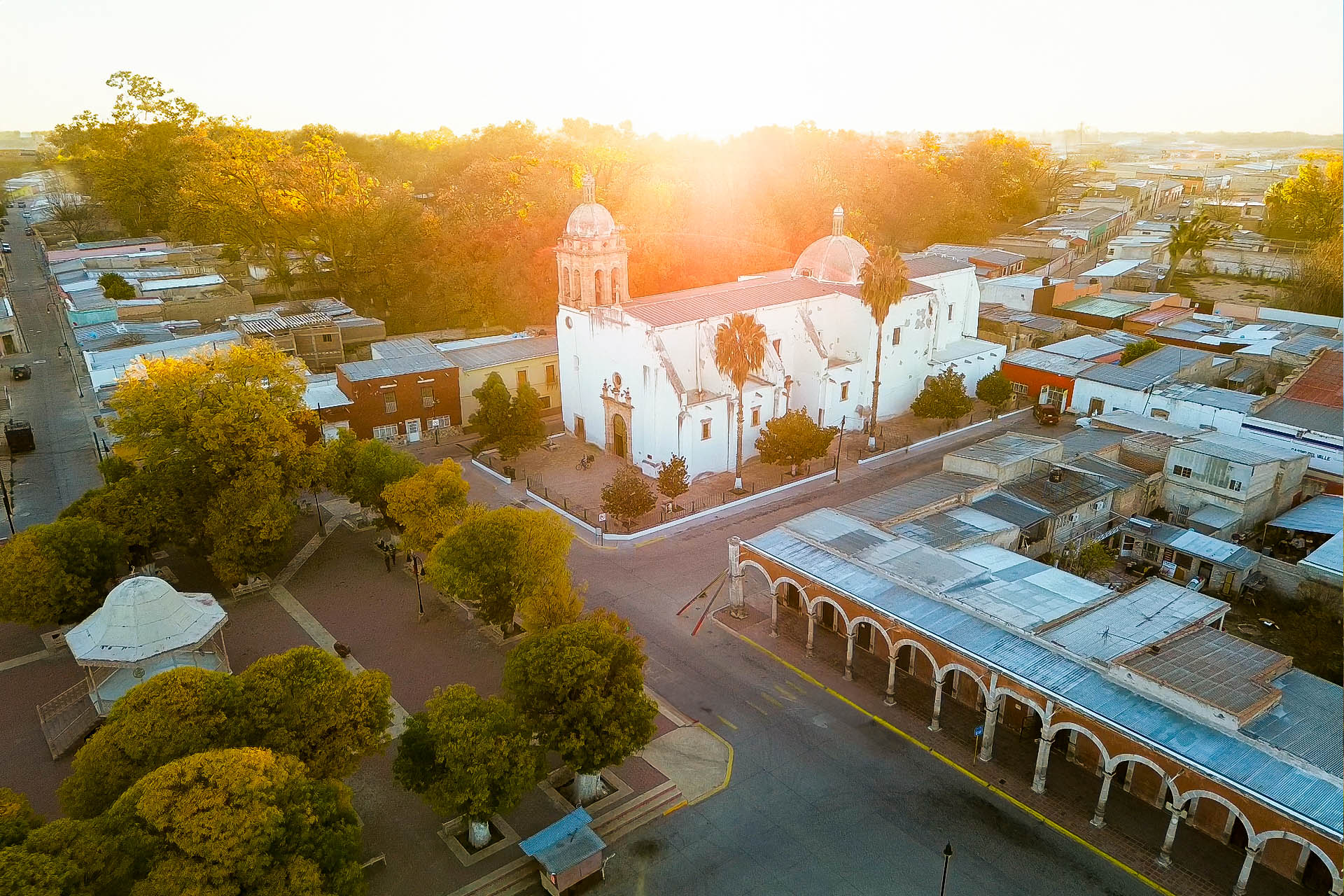
The Church of San Bartolomé
Greetings and welcome to the virtual exploration of the Church of San Bartolomé in Valle de Allende, Chihuahua! With a history spanning over two centuries, this site is a vibrant testament to the colonial period when the Spanish were particularly active in the north of Mexico. On this tour, local guides "Charo" Montes, "Tacho" Rodriguez, Karla Morales, and Fernando Montes will offer insights into their personal and professional experiences alongside a detailed examination of the architectural and symbolic significance of this masterpiece from the late 18th century.
Stop 1. A fertile valley in the desert
The church is in the heart of the original old town, surrounded by greenery and the sound of birds. Valle de Allende, a fertile oasis in the Chihuahuan Desert, benefits from a river and canal system that continues distributing water across the town. This irrigation system has shaped the city's distinctive layout, with orchards at the center of each block and residential houses lining the periphery. Adjacent to the church, the Town Hall, known as "Los Portales" for its arched portico and elegant columns, once served as the town hall for government officials. Today, however, this building is home to different small shops that sell locally-made ice creams in flavors such as persimmon. From this central point, other buildings are laid out according to their importance, with larger homes located closer to the center and workers' houses placed in less favored areas, across the main canal.
Rey Fernando Montes Trevizo
Historically, these buildings follow an ideal pursued in Europe, stemming from the regulations issued by Charles Borromeo in relation to the Council of Trento. Thus, by specification, the church was to be located at the center of the population center. It was supposed to originate from a square, which is where we are, a kiosk like this one, and in front always stood the most important building, which was the church. If we look at an urban profile of the city, we can precisely distinguish this building by its scale in relation to all the buildings within its perimeter, indeed, from here to four, five, six times larger than the other constructions.
Stop 2. The Royal Road and Historic Monuments
The Royal Road of the Interior, also known as the Silver Route, passes through Valle de Allende. Although the route has pre-Hispanic origins, it was used by Spanish conquistadors for over 300 years, providing a vital link to their northern territories in North America. Traversing the entire route took six months each way and was driven primarily by the trade of precious metals, facilitating exchange among diverse communities. Principally established for silver and gold, the route also helped spread ideas, foods, customs, and artistic expressions blending Spanish and local traditions. In 2010, UNESCO recognized the Royal Road of the Interior as a Cultural Itinerary of Outstanding Universal Value, emphasizing its global significance and the need for its preservation and promotion. This designation underlines the idea that this heritage is a shared treasure, belonging to all world peoples, irrespective of their geographical location.
Stop 3. The First Franciscan Mission in Chihuahua
Religion played a significant role during colonization and the founding of settlements in Mexico. The community of Valle de Allende began with the construction of a convent, the first Franciscan mission established in the state of Chihuahua. Missions were more than just churches; they also served as places of administration, defense, and production, where friars looked after indigenous people, both from the region and others brought here from central Mexico. The friars aimed to convert these people to Christianity, teach them Spanish norms, and help pacify the territory for colonial development. These relationships were often coercive, marked by tension and violence, leading to uprisings and, in some cases, the destruction of Spanish buildings, which is why no trace of the original convent is present.
Karla Isabel Morales Porras
The church holds a vital relationship with the community, reflecting the architectural design and the deep roots of evangelization of the community. This town itslef began with the founding of a mission designed to convert the area, In those early days, the town was named after the mission. These are some of the reasons why the community feels a deep connection and appreciation for the church. Today, this connection is inherited from our ancestors, who regarded the church as the community's heart and soul. Their love for the church has made it a central point for communal life, serving not just as a spiritual hub but also as the architectural centerpiece of the town, emphasizing its position at the very core of the community's daily life and its physical layout. Indeed, the church stands at the literal and figurative center, echoing its foundational role in shaping the community's identity. It's the heart around which everything else revolves, anchoring the community in both place and spirit.
Stop 4. Current Church of San Bartolomé
The current building dates back to the late 18th century and was constructed using traditional materials from the region, such as stone for the foundations, wood for the roofing, lime for the coatings, and adobe for the walls. Adobe was widely used in northern Mexico to build everything from small houses to churches like this one. To create the large bricks, mud is mixed with straw and dried in the sun. As a result, the Church features very thick walls, which measure over 80 cm at the base. Although these materials may seem simple and even fragile, they can be preserved for centuries with proper care.
Karla Isabel Morales Porras
In the Church of Saint Bartholomew, we find a church with a simple nave and chapels along the sides. There are three entrances through which we can enter this church. The main entrance is adorned with quarry stone details, and it's very typical of builders, architects, or stonemasons to date the stages as they progress. On the main façade, we can find two dates that tell us about the start and completion of this part of the church. On the keystone of the arch for the main entrance, there is a papal shield holding the two keys that Jesus gave to Saint Peter, and we have a tiara and a heart with a cross, which is the papal symbol.
Stop 5. Quarry carving
Buildings in northern Mexico are characterized by their simplicity, marked by small windows and thick walls finished with lime. This design, influenced by material scarcity and the harsh climate, gives the buildings a robust, fortress-like appearance. In most churches, decorative elements are focused on the main entrances and key architectural features like the bell tower or dome. The doors are usually framed with religiously themed carved stone pieces strategically placed to convey a message, acting as a stone bible. Until recently, reading was reserved for the wealthy or clergy, so these carvings made sacred texts visible to all.
Rey Fernando Montes Trevizo
Look, I would emphasize the tower. The tower is one of the tallest I know of. Yesterday when we were documenting it, we saw its height is just slightly shorter than the two towers of the Chihuahua cathedral. It would have a cathedral-like scale, but if we compare it as a building, if these two were to compete. The architectural layout in terms of a basilical plan also gives us that idea, not just a central nave with side chapels but also with light entrances eh with windows, with light entrances on the sides, not just that. So it essentially gives us this idea of the temple in its origin. Another characteristic that I see is the ornamentation, indeed. It has very decorative ornamentation, especially on the side facades; the main facade is more austere. But even so, it has all these traces of the richness from when it was built, when it was finished, and in general. The whole work it houses inside also gives it a special characteristic among other temples that usually do not possess. The dome is a beautiful thing; the pendentives are decorated, and this Latin cross plan in some way always stands out over the basilical plan that refers to the cross of Jesus Christ.
Stop 6. Interior lighting
From this perspective, the small windows on the lateral facades are visible and are strategically positioned to illuminate the main nave. Inside, the typically subdued lighting is pierced by narrow rays of light. These rays spotlight the intricate decorative details, particularly on the side chapels and the main altar, crafted from finely carved pink stone.
Atanació “Tacho” Rodríguez Rodríguez
My job is to open the church early and prepare what's needed, such as the celebrant's vestments and the items for Mass like bread, wine, and collection plates, everything that's essential for the Mass. I started around 1975, but got more involved around 1985. The most important part of serving is to do it with enthusiasm, dedication, knowing what you're doing and for whom. It's very important because a community without a church lacks, well, it lacks life.
Karla Isabel Morales Porras
On the north facade, we have the sculpture of Saint Francis of Assisi. This area was evangelized by the Franciscans, and the sculpture here depicts or shows us an image of Saint Francis of Assisi with a dove. Saint Francis is known as the universal saint. He loved all creatures because they were created by God. He had this closeness with animals and nature itself, referring to them as brother sun, sister moon, and that's why Saint Francisof Assisi is often depicted with doves or with some animals.
Stop 7. The preserved treasures
The church's interior is a repository for the town's religious heritage. It houses Valle de Allende's historical archives, along with a valuable collection of oil paintings and liturgical items, notable for their historical significance and aesthetic and artistic qualities. These items are valued more for their craftsmanship and the stories they embody than for their material worth. Most of these items were specifically commissioned for the temple and came from workshops in central Mexico, including paintings of the Virgin of the Rosary and a silver monstrance from 1732. One of the oldest items is a 17th-century painting of Saint Gregory, predating the temple and originally belonging to a neighboring estate named after the saint. As mining declined, nearby estates lost their importance and were abandoned, leading locals to move the painting to the temple to ensure its preservation.
Rosario “Charo” de Monserrate Montes Payan
I've been the parish secretary for a little over 30 years. My duties include creating necessary faith documentation for baptism, marriage, and first communions, confirmations, and maintaining records of baptisms, marriages, and confirmations, first communions, and various functions. Occasionally, upon request, we access the parish archives or the historical archives to fulfill requests, sometimes for baptismal records from the 1700s or 1800s or marriage records, which are most common because marriage information is frequently requested. Essentially, this involves accessing an individual's marriage file, but the oldest document we have is from around 1570, a lawsuit over water rights filed by Mr. Martín Iradi at the time.
Karla Isabel Morales Porras
On the main facade, right at the center, in front of the oculus, we find no saint; however, it's important to highlight or mention that there was a chance for a saint to have been placed there, possibly one of the patrons. Either Saint Bartholomew, Our Lady of the Rosary, or even Saint Peter himself. Given the hues of the quarry stone of the sculptures on the facades compared to the jambs that adorn these entrances, we can see a difference in shades that may suggest that the sculptures were added after the facade or the entrance was built, after which the other quarry stone was used.
Stop 8. Our Lady of the Rosary and Festivals
The town's location on the Royal Road of the Interior endowed it significant commercial importance. Travelers were directed to what is now the main square; an open space in front of the church, which hosts one of the most important festivals in the territory. The patron saint festivals continue to this day, albeit with music, mechanical rides, and typical foods in addition to the traditional religious activities. The most significant festival is held in October and is dedicated to the Virgin of the Rosary. The community's devotion to the Virgin is so profound that in 1888, the temple changed its dedication and was officially named The Temple of Our Lady of the Rosary.
Rosario “Charo” de Monserrate Montes Payan
It's a historical monument with significant importance for us at the parish level. We cherish it deeply and have a strong affection for our church, notably because it is home to the image of Our Lady of the Rosary, who is deeply revered in our community. She is considered a co-patron saint, even though the main patron is Saint Bartholomew. Here, we often show greater enthusiasm and reverence for the Virgin of the Rosary than for Saint Bartholomew, the official patron of our parish.
Atanació “Tacho” Rodríguez Rodríguez
In terms of worship, it's the devotion to the Blessed Virgin of the Rosary because since olden times, she was chosen as the town's patron saint. According to history, this was around 1700, mid-1700s because before that, it was dedicated to Saint Peter during the early days of the church's activity here in the town.
Stop 9. A Living Legacy
The Church of San Bartolomé in Valle de Allende is far more than a historic building; it symbolizes identity and continuity for past, present, and future generations. Through this Tapestry experience, we hope to have provided you with an enriching experience, inspiring you to learn more about the fascinating history of this gem in the state of Chihuahua. Thank you for joining us on this journey!
Rosario “Charo” de Monserrate Montes Payan
We've succeeded in supporting each other for the benefit of both the parish and the community, which truly fills us with pride. Our church possesses features that many others simply do not have, such as its architecture, its dome, its bell tower, and the altar of the Virgin of the Rosary, all crafted in pink quarry stone—a rarity. It's an ancient church, the very first parish in the entire state, making us especially proud to belong to the first parish.
Karla Isabel Morales Porras
For many of us, the heart of our community is the church. It's central to our faith, which is why I believe the church remains vibrant and alive, cherished for its deep roots. This affection comes not just from local residents but also from those who've moved away. They hold a special love for it, remembering where their grandparents belonged or where they themselves have been. The church often springs to mind first, embodying a significant part of their Christian journey and faith. Beyond religious significance, the church is a cultural icon too, even for those outside the faith. It stands as a monument, a key architectural piece, vital for preserving our history. Its design tells the story of our town's past, making it crucial for our community's collective memory to always keep the church in mind.