These are the full narration and interview transcripts for the interactive 3D virtual tour: Busanyin Shrine. You can click here (Opens in new tab) to begin the tour.
Busanyin Shrine
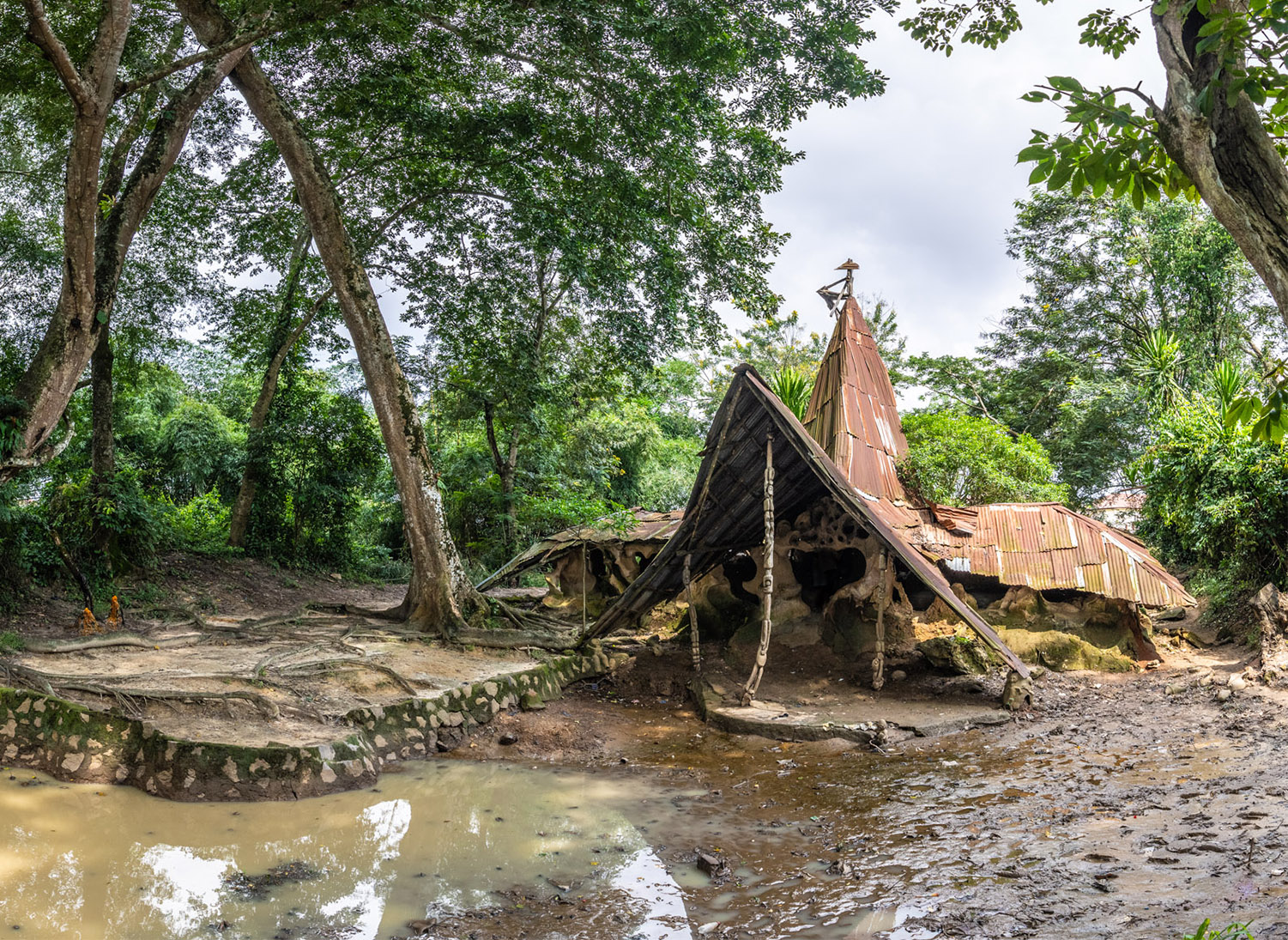
Explore in 3D: Busanyin Shrine (Opens in new tab)Welcome to Osogbo. Located on the banks of the Osun River, the World Heritage Site of Osun-Osogbo is home to hundreds of monumental sculptures and works of art depicting Yoruba deities and folklore. Every year, thousands of visitors and locals alike come to connect with the history and traditional culture of this region. In 2019, heavy rains caused severe damage to the Busanyin Shrine, one of the iconic sites of the sacred grove. This experience is part of a collaborative project to restore the shrine and document its significant place in Yoruba culture. Join me in exploring the Busanyin Shrine, and hear from local community members about their efforts to protect their heritage and the sacred grove.
Stop 1. The Shrine and Its Priestess
Explore in 3D: Stop 1. The Shrine and Its Priestess (Opens in new tab)A century ago, sacred groves were common across Yoruba towns, with areas of forest set aside for the orishas, the gods of Yoruba religion. Many have since disappeared or shrunk to small patches. The grove at Osogbo is the largest to survive, and it is still used for worship today. Its 75 hectares protect one of the last remaining stretches of ancient tropical forest in southern Nigeria. Through the forest winds the Osun River, the spiritual home of Osun, the Yoruba goddess associated with fertility, healing, and water. Shrines are found along the river's banks, each with its own religious traditions. The Busanyin Shrine is one of them, located at the water's edge, surrounded by forest.
Dr. Ijeoma Harriet Onyejekwe
Here we are, this is the Busanyin shrine. Surrounded with the Osun river, green vegetation, untouched. With monkeys and birds. It's a beautiful place. But I know it needs some work to be done. It still is part of the Osun Osgobo grove. It is located in Osogbo town in Osun state.
Osunyemi Efunsola
I am Osunyemi Efunsola, Osun Priestess at Busanyin. my role with Busanyin is that, as the priestess of Busanyin, to look after Busanyin, provide Busanyin food from time to time, so that people's prayers will be answered. That’s my role here.
Stop 2. The Sacred Forest
Explore in 3D: Stop 2. The Sacred Forest (Opens in new tab)Look at the forest around the shrine. It was protected by tradition long before it was protected by law. Hunting, fishing, farming, and cutting down trees are forbidden within the sacred grove. These traditions are upheld by the local community, including the Ataoja, the king of Osogbo, and his council. Thanks in part to these protections, the forest is home to more than 400 species of plants, over 200 of which are known for their medicinal uses. Nigeria declared the grove a National Monument in 1965, and in 2005 it was added to the UNESCO World Heritage List. But long before these official protections, the forest was preserved because of its spiritual importance to the Yoruba people.
Osunyemi Efunsola
This environment is like this because you know, they say the forest is full of spirits. Osanyin forest, all the spirits were here from the onset, so these trees you see here are all deities, there are several spirits in them also. Therefore no one must cut any of the trees in this forest. This place is a forest of spirits. That is why you see all these trees still here. And you know, the spirits reside in cool and quiet places all these trees have their unique spirit.
Stop 3. A Living Sacred Tradition
Explore in 3D: Stop 3. A Living Sacred Tradition (Opens in new tab)Osogbo was founded around four hundred years ago, and its history is closely tied to the sacred forest and the deities worshipped here. The grove is where that connection continues today. Its shrines honor Osun and other gods of Yoruba religion. Each year, a twelve-day festival brings people together to celebrate Osun and renew the connection between the goddess, the people of Osogbo, and their king. This shrine is dedicated to Busanyin, a hunter spirit associated with healing and traditional medicine. Much of its history has been passed down through generations by storytelling, while the sculptures and carved figures you see here reflect the religious beliefs and artistic traditions of the community.
Dr. Ijeoma Harriet Onyejekwe
Our own history beyond the colonial, coming of the colonial masters. You know, I'm talking way back so many centuries before the 19th century, were not written in books. You know, the only way you get evidence of the history is the antiquities you see, the statues you see, these give evidence. So from the story of the priestess, how this place came to be, the Busanyin shrine, Busanyin was said to be a spirit man, a hunter. Who resides, came here and resides here. Like I say, there's a spirit man. And this area was known as Oroki. It was not originally Osogbo.
Osunyemi Efunsola
Busanyin is a brave warrior, a caring parent, and a conquering warrior. All those who look to have children, once we give them this medicine (river water) they will get pregnant. Those who are job searching, once they take it they get employment, anyone looking for a promotion or a new position. Busanyin is one deity that is brave. All the children Busanyin gives ends up brave. You will notice that one of them is his grace Royal Highness Larooye Atawojagbeja of Osogbo. He came from this river. And so on, all the children that come from the river are all brave. So, prayers get answered here and all you come for, you will get answers.
Ayeni Imokhai Oisewmime
These sites and monuments represent physical evidences, tangible manifestations of documented history. Why people resorted to certain things at certain times, and how that manifested in their beliefs. Because it's often this is the physical expression of their belief, but also an expression of what they were facing or managing or handling physically, emotionally, politically, socially at the time as individuals and as a community. So all that becomes part of history for us.
Stop 4. The 2019 Flood
Explore in 3D: Stop 4. The 2019 Flood (Opens in new tab)The Busanyin Shrine stands at the river's edge, reflecting the river's importance in worship here. But this closeness also puts the shrine at risk. Many of the sculptures throughout the grove are made from mud, cement, and iron, materials that need regular care. Even before 2019, some of the grove's shrines and artworks were already in poor condition. Then, in 2019, heavy rains caused the Osun River to flood. The rising waters weakened the shrine's supporting pillars, causing its roof to collapse and damaging much of the artwork inside. What you see here is the shrine as it stood two years later, with its collapsed roof resting over the sculpted walls.
Osunyemi Efunsola
I am not happy because this is the source of Osogbo, it must not be destroyed. I am not happy at all with its state. But our cry for help is that, the museum [will intervene] I go to plead quite often to the King, saying this place is in ruins and they should please help with rehabilitating it because its the source of Osogbo, we can’t afford to lose it. So, the state of things makes me very sad.
Mr. Adekunle Fatai
In 2019, that year in Osun state is a year everybody will not forget. The rains came down. The rain really destroyed a lot of things in town. Unfortunately, it affected one of our beautiful dedicated shrines, the Busanyin shrine. It caved in, this whole structure caved in because the volume of the flood entered everywhere that's one. Secondly, the volume was so high that if you stand where we are standing now then, you cannot see yourself. So the height of the flood went as far as covering 75% of the building leaving the roof. So after the flood receded for a while the roof of the building started giving in little by little to the extent of what it is now.
Stop 5. Caring for the Grove
Explore in 3D: Stop 5. Caring for the Grove (Opens in new tab)Caring for the grove is a shared responsibility. The National Commission for Museums and Monuments manages the site, while the Ataoja and his council uphold the traditions that have long protected it. Priests and priestesses continue to lead worship at its shrines. Since 2005, the Adunni Olorisha Trust has worked with the local community to conserve the grove's artworks. Many of these are large sculptures standing in the open forest, exposed to rain, heat, and humidity. Without regular care, they can develop damage that is difficult and expensive to repair. Protecting them requires the knowledge of the artists, priests, and worshippers who understand their meaning, alongside conservation specialists who know how to preserve them for the future.
Dr. Ijeoma Harriet Onyejekwe
Global warming climate change is a problem, yes and it's a combination of indigenous knowledge and modern science and integration of the two. Not just the modern science or not just their indigenous knowledge system because you can see the shrine is going down and the only way it can now really be saved is to bring in modern science. But also like I said modern science will not work well if they don't integrate the indigenous people's knowledge about the site so that's why they're just not just an EIA environmental impact assessment it needs to be an integrated cultural heritage impact assessment.
Ayeni Imokhai Oisewmime
Art forms evolved over time. Sometimes there was no proper documentation of these. [Therefore] Restoring something that has been damaged becomes a bit of a challenge. So this week has been another extension in that process, a condition of that process where we've begun, of course, going back to 2019, when CyArk came with AOT (Adunni Olorisa Trust) for the first meeting, the first documentation. So this week we've carried that on, actively documenting the Busanyin shrine particularly to see how it has been affected by flooding to see how parts of the building have collapsed. So to see how we can document what's there. In states and on-site such that it becomes easier to do a restoration of the sculptures, the artworks, the building ensemble altogether.
Stop 6. Preserving the Grove for Future Generations
Explore in 3D: Stop 6. Preserving the Grove for Future Generations (Opens in new tab)The work of protecting and restoring the grove continues today. Local artists and craftspeople play an important role in repairing damaged sculptures and caring for the shrines, drawing on skills and traditions passed down through generations. But restoration takes time, resources, and ongoing support. Organizations like the Adunni Olorisha Trust work with the local community to preserve these artworks and the traditions they represent. Visitors, too, can play a part by learning about the grove, respecting its sacred spaces, and supporting local conservation efforts. Thank you for visiting the Busanyin Shrine. Its future depends not only on protecting its sculptures, but also on supporting the people who keep its stories, traditions, and art alive.
Osunyemi Efunsola
♪ I will make Busanyin my rock ♪ ♪ We will take refuge in Busanyin ♪ ♪ Amongst all the incidents of war. none has happened in Oroki ♪ ♪ We will take refuge in Busanyin ♪ ♪ Springs of medicine ♪ ♪ floods of medicine ♪ ♪ Busanyin healing portion for his children. before the doctors arrive at the scene ♪ ♪ She who gave birth without a midwife. we refer to Osun ♪ ♪ Everybody say: "the blessings of a mother" ♪ ♪ "Blessings of a mother" ♪
Toyin Ajayi
My name is Toyin Ajayi, Principal Technical Officer under Heritage Department for the National Commission for Museums and Monuments. I so much love these work of arts I love the work of restoration because we need to preserve, we need to conserve all these things. All these things, if we allow them to go away like that, the next generation will not be able to lay their hands onto it. So thereby I implore you to please, give us a very good assistant, so that we continue the restoration work. We are trying to keep the legacy. We want to keep the legacy. We hope to keep the legacy. We need your assistance.