Butler Wash
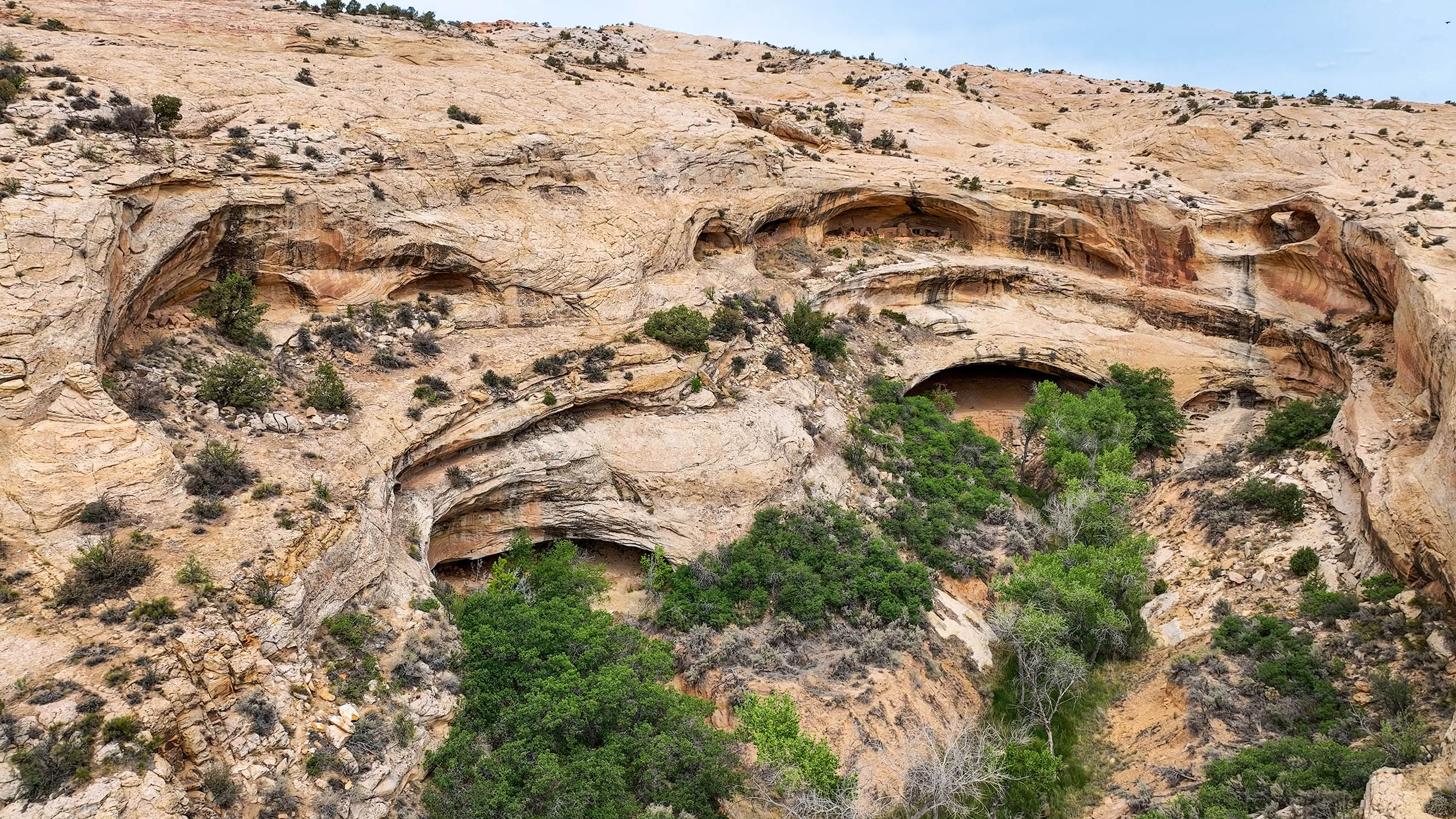
Kwahkway, uma pitu, yéese’e. Welcome to Butler Wash Developed Site. This place is part of Siraya, the landform known to many as Comb Ridge. Today, this feature is part of Bears Ears National Monument, or Hónmuru, in Southeast Utah. As Hopisinom, or Hopi people, the Butler Wash ancestral home reminds us of Hopi traditions that have been passed down through generations since time immemorial and the importance of respecting this living home of ancestors. Hopi are one of many sovereign nations throughout the region that are connected to these lands, historically and today. During this experience, you will visit Butler Wash and hear from Hopi Tribal members and cultural caretakers, including Leigh Wayne Lomayestewa (Sutaqwma) and Clint Lomawunu (Sonewiwma), about Hopi connections to this place as part of Hopi people’s emergence and migration.
Stop 1. Footprints of Hopi Ancestors
Beginning at the trailhead, the path leads half a mile through a sparse juniper forest to a rocky overlook where you can view the Butler Wash home. Hopi people have lived as part of this land since time immemorial. With 33 living clans today, each has its own migration story. Butler Wash is part of the Hopitutskwa— all the lands that our Hopi ancestors traveled through. Hopi people traveled through three worlds prior to our current life in the Fourth World. When entering the Fourth World, the Creator instructed Hopi people to be stewards of the land as they went in search of the center of the universe. This place and all other sacred ancestral sites are the footprints of our ancestors that they left for us and are crucial to understanding our clan histories and spiritual power of who we are as Hopisinom.
Leigh Wayne Lomayestewa
The way that we know this area is through the, you know, the different landscapes. And because it looks like, you know, the two Bears Ears, you know, our uncles, you know, we get all our information through our uncles and they call this area [speaking Hopi], which kind of, which translates to Bears Ridge. At Hopi, you know, I'm a member of the Bear Clan and they called us the Paleo-Archaic people because we were the first ones there. And then we established a village of Songoopavi and then from there all the other villages were established. Today we live in 12 villages in Northeastern Arizona. Our population is about 14,000 to 15,000 now. And, you know, we still practice our Hopi ceremonies, religions, rituals. And we don't do that for just the Hopi, but for everybody on, you know, this planet and all the living things that live on the land.
Clint Lomawunu
The connection is always going to be there, you know, whether we're in the city, whether we're out in nature, whether we're in space, whether we're down below in the middle of the earth. [speaking Hopi] [speaking Hopi], that connection.
Stop 2. Respecting Ancestral Sites
From this viewpoint overlooking the Butler Wash home, you can see stone structures built within a protective sandstone alcove. When Hopi people come to this place, we are visiting our ancestors. Impacting these places through digging, collecting, or vandalizing erases Hopi history and disrespects our ongoing connection to these living places. Butler Wash and all other ancestral sites are protected under the Archaeological Resources and Protection Act, also known as ARPA. Violation of this act is considered a felony. We ask that people visit these places from a respectful distance. Do not disturb or take anything from the site. During your visit, you may see disrespectful ways people have engaged with this place. Please learn from what you see and pass on your knowledge of how to respectfully visit ancestral sites to others.
Leigh Wayne Lomayestewa
These are our Hopi ancestral sites and, you know, other Puebloans, you know, came through here also and just want to let them know that, you know, this is our sites and when you go into the site or look at them, you know, just have respect and not to be picking up anything and putting them in their pockets. Before we went, entered the site, you know, we asked for permission to go into the site and we use a cornmeal to do that and then also to pray that they bring us the rain, the much-needed rain that we into this area and also onto Hopi. So, hopefully, you know, they received our message to do that. So, we'll see when we get home.
Stop 3. Footprints of Hopi Migration
If you follow the rocky sandstone landscape above Butler Wash, you will reach the top of Comb Ridge, known to Hopi people as Siiraiya, or Saw Ridge. Siiraiya is a steep ridge line that stretches 80 miles from north to south through the Bears Ears landscape. The Butler Wash site is one of many homes built along Siiraiya that was historically connected to a broader community in the area and Hopi migration history. There were likely different Hopi clans that lived at Butler Wash at different times, indicated through images carved or painted on the walls. Around 30 or 50 people may have lived in this area at one time.
Leigh Wayne Lomayestewa
We were told to go throughout this land, marking our territory, so this place might have been settled maybe three, four times, because, you know, we would get to an area, live there for maybe a few years, replenish our supplies, and then go again, and then another group would come and settle, and then do the same thing, too, also, yeah, so maybe that's how, you know, a lot of these, like, we saw the Hopi pottery shard in the collections here, and that's how they got here, you know, they probably went through Hopi, um, settled there, and then they brought that pottery up here, and then left it here, and then, you know, that's what the archaeologists found, and then they moved on to another area, so each area, you know, um, you know, like they said, there's a hundred, hundreds of sites around here, so that's all these sites that were probably lived by, um, different, either Hopi or ancestral Pueblo.
Stop 4. Building a Home
As we move into the alcove, you can see the base of a series of circular and rectangular structures built from stone brick. How did people create a home here? When people were looking for a place to build their homes, they would have looked for nearby water sources not only for drinking but also for making mud and plaster for home construction. Like Butler Wash, Pueblo homes are usually built facing southeast or directly east, providing warmth and protection. Today some Hopi people continue to maintain traditional homes utilizing similar techniques to those seen here and with knowledge that has been passed down. Building and maintaining homes is grounded in values of perseverance and hard work.
Leigh Wayne Lomayestewa
All of the homes that, you know, the Pueblos build are usually facing southeast, southeast or directly east. So they could, you know, take in the sunrise when the sun comes up, then they would, and also it's protection from the winds. They usually come from the west, so they're all facing east, southeast, and for the sunrise and the heat from the sun and then the protection from the winds also.
Clint Lomawunu
As far as building techniques, yeah, it's quite similar, you know, but actual building itself, for its position and, you know, the purpose it serves, that's the only thing that is different [speaking Hopi] And I'm coming out here with, you know, with my personal endeavors, you know, my projects, you know, I'm building a house, you know, for my wife, and I'm trying to continue. [speaking Hopi] You know, how, you know, how it was two, three thousand years ago, you know, how, you know, two people met, you know, how they established their life and how they progressed into where they are today, you know. There's so many ways to modernize it or, you know, get it faster, you know, but that's, you know, that's one thing that I wanted to, you know, take a break from, from the fast-paced world. [speaking Hopi]. All the houses, structures, they're still standing the same way as they were as when they were built, you know. [speaking Hopi]. Everything else, you know, modern buildings, wood, metal, it all deteriorates, you know, it's not forever, but these things, the artifacts, that validates it, you know, the beams, all that [speaking Hopi] It's validated, you know, and it's, you know, that it's really astonishing that, you know, they had that type of power or that type of understanding [speaking Hopi]. You know, we're so many generations and a lot of things change, you know, people, time, the surrounding, the land, everything, [speaking Hopi]. You know, and that was, you know, in, [speaking Hopi] you know, considered, you know, traditional, you know, because, you know, that's my choice to, [speaking Hopi] you know, stop and appreciate what they, you know, had to offer and learn from it and actually built because [speaking Hopi], you know, [speaking Hopi]. You know, it's meant to last forever, [speaking Hopi].
Stop 5. Living as Part of the Land
The structures built below the ground level are known by Hopi people as Kivas. These Kivas at Butler Wash indicate ceremony was part of the people’s lives who lived here. The round kivas were created by people who were still on their migrations. We are told that when they stopped the migration, people built square kivas. It is possible that people made the square Kiva when they saw the blue star and were told to go to the center of the universe. Today, Hopi people continue to practice ceremonies, not only for our communities but for all living things.
Leigh Wayne Lomayestewa
I saw in the site, you know, they had a ceremony because they had the kivas, and the three kivas, and one was square, you know. They tell us, you know, when the people were on migration they made the round kivas, but when migration stopped, that's when they get to, got to the square kivas, and it was a sign telling them to go to the center of the universe, and that's at Hopi, and they call that place Tewanasawe, the center of the universe. So, that's what they did. They went into Arizona, northeastern Arizona, where we're at today,
Clint Lomawunu
The architecture, you know, I noticed up there in one of, where we were at today, you know, that a lot of circular structures. You know, [speaking Hopi], There's a lot of circular structures, except that one square kiva, you know, [speaking Hopi]. You know, it's exact, it's exact same building as we do it, you know, our modern day kivas are built. You know, they have the sipapu, [speaking Hopi]. All those things, you know, that's, you know, that validates that they're, they're our Hopi. They're our Hopi people, [speaking Hopi]. You know, maybe the next canyon over, you know, might be totally different, you know, they might not even be Hopi. You know, [speaking Hopi]. But that site that we visit today, we can say that for sure that [speaking Hopi], [speaking Hopi], you know, at one point that there was Hopi people that lived there.
Stop 6. Food and Farming
In addition to ceremonial use, some of the kivas may have been used for food storage along with some of the smaller rectangular rooms you see built against the walls of the alcove. At Butler Wash, the springs running through this area were critical for cultivating foods like watermelon and corn. Soils on top of the rock surfaces would have been good for growing foods such as beans. In the Hopi Mesas of Arizona Hopi people have cultivated corn for more than 2,000 years, building on the learnings and practices of Hopi ancestors who migrated through this area and the broader ancestral landscape. Today, Hopi people practice dry farming, which relies heavily on rainfall. Farming is an essential part of being Hopi that is tied to values of hard work, self-sufficiency, and humility.
Leigh Wayne Lomayestewa
We also practice farming, dry farming, and in this area also, too, we found that, you know, the people that went through this area also practice dry farming, but, you know, there's a lot of springs and, you know, creeks running around, running with water here, so that's how, you know, these people lived in this area.
Stop 7. Passing Down Knowledge
Imagine a vibrant community of all ages living in the rooms in and around the alcove before you. Despite the challenges of living in this area, communities persevered through communal strength and resilience. During the day, the men and boys likely would have been away farming or hunting for food for their families. The women and girls would have been caring for the home here in the alcove and preparing meals. Family and knowledge passed down from generation to generation at Butler Wash would have been crucial to cultivating community and living sustainably with the land. As a matrilineal society, Hopi communities today continue to pass down clan membership through mothers in the family. Our uncles, or our mothers’ brothers, pass down Hopi knowledge and history to the younger generations, continuing a legacy of our ancestors.
Leigh Wayne Lomayestewa
It's important because, you know, that's what we should, you know, be doing. You know, a lot of people, you know, we're matrilineal, so we take after our moms. So my mom was a Bear Clan, so I'm a Bear Clan. And then all the brothers of my mom are our uncles. So they're the ones that are supposed to be teaching us these things. And, you know, that's what they did. You know, they taught us, so this is what we know. But today, I don't think a lot of their uncles are not teaching their nephews and nieces.
Clint Lomawunu
[Speaking Hopi], at one point, [speaking Hopi], it wasn't a knowledge, it wasn't a lesson, it was a lifestyle. Each day, [speaking Hopi], from the oldest down to the kids, [speaking Hopi], each has their own contribution. [Speaking Hopi]. That's where, you know, we [speaking Hopi] [Speaking Hopi], We have short cuts nowadays. Now, you know, we've gone, we've strayed so far off the path that, you know, we have to, now it's a lesson. Now we have to take college credits, now we have to pay fees for interp-services, you know, now it's a lesson. You know, at that time, [speaking Hopi], that was their life, you know. Each day, they got up and did something in contribution to their over-long-term goal.
Stop 8. Utilizing Plants
Looking out at the rocky landscape dotted with green spaces, what do you see that sheds light on life at Butler Wash? The green areas on the landscape indicate the presence of water. The plants thriving in the wash below the site, such as the cottonwood and oak trees, would have been crucial for wood logs used in building. Other plants would have been used for food, ceremonial purposes, and creating tools such as baskets. For Hopi people, living sustainability with the land means farming and cultivating during different seasons throughout the year.
Leigh Wayne Lomayestewa
Every place that they go, they would use certain plants to make their homes with. There's several plants that I noticed around them. One of them was the yucca, the three -leaf sumac. What's the other one? There was the oak down in the bottom. Maybe they used those for their logs. And then the cottonwood. You know, there's a lot of the plants that I noticed that they would use in building mostly the ceilings, the roofs. And then the mud, you know, the minerals that they use, the rock. So yeah, there's a lot of plants, rocks, minerals that I noticed that, you know, they would use to build their homes.
Stop 9. Resilient Communities
If you take a close look at the alcoves, you will notice how people lived with and shaped the land. Notice the black color on the alcove ceiling. People who lived here would have lit fires for light and warmth but also for ceremonial purposes. As different communities migrated and settled at Butler Wash over a long period of time, they would have each made their own mark on this place. Each brick of the structure, the pot sherds found on the ground, and the paintings on the wall were touched and shaped by people who left what is here for future generations. Places like Butler Wash are essential for Hopi communities and other descendant groups who continue to carry on the legacy of living as part of a broader landscape.
Leigh Wayne Lomayestewa
You know, we were told by the Creator to go throughout the lands and mark your territory, use rocks to build your homes, put your markings on the walls, and that's what the archaeologists called the petroglyphs, and they also use pictographs, make your pottery, and when you leave an area, you know, break your pottery or, you know, just leave it there so they'll serve as a record that, you know, somebody was here also, and that's how we went throughout this land. It's just like in the Anglo way when explorers get to an area, a land, you know, they mark, you know, they put up their flag, and this is our flag, and this is how we marked our Hopi ancestral Puebloan territory for us.
Clint Lomawunu
What I mentioned, you know, that's, that's all me. You know, if, you know, if you have a different drive or anything, you know, that's, that's what I want. I want to encourage you, you know, [speaking Hopi] [speaking Hopi], come out, see it, you know, see it for your own self, experience it for your own self. It's, you know, each time it's going to be different, you know, and next time, you know, [speaking Hopi] [speaking Hopi], you know, if I do make it out here again, you know, that experience is going to be different. [Speaking Hopi], you know, and like I said, this is just my own personal perspective of things, you know, and that's what I told him. [speaking Hopi] [speaking Hopi], come out and learn for yourself, you know, see for your own, your own, you know, put in your own work and put in your own adventure. And, you know, you're going to come out with your own, your own purpose and, [speaking Hopi] [Speaking Hopi] It all goes back into like that, enlightenment, enrichment, you know, finding yourself, finding holiness, knowledge, you know.
Stop 10. Past and Future
Learning about the past is vital for shaping the future. Please share what you have learned about Hopi people with others so they may also visit these places with respect. We encourage you to continue learning about the diverse communities connected to Bears Ears and the significance of sites located throughout the monument. Páas uma anqé náatsamnumyani, Kwahkwa.