Chan Chan
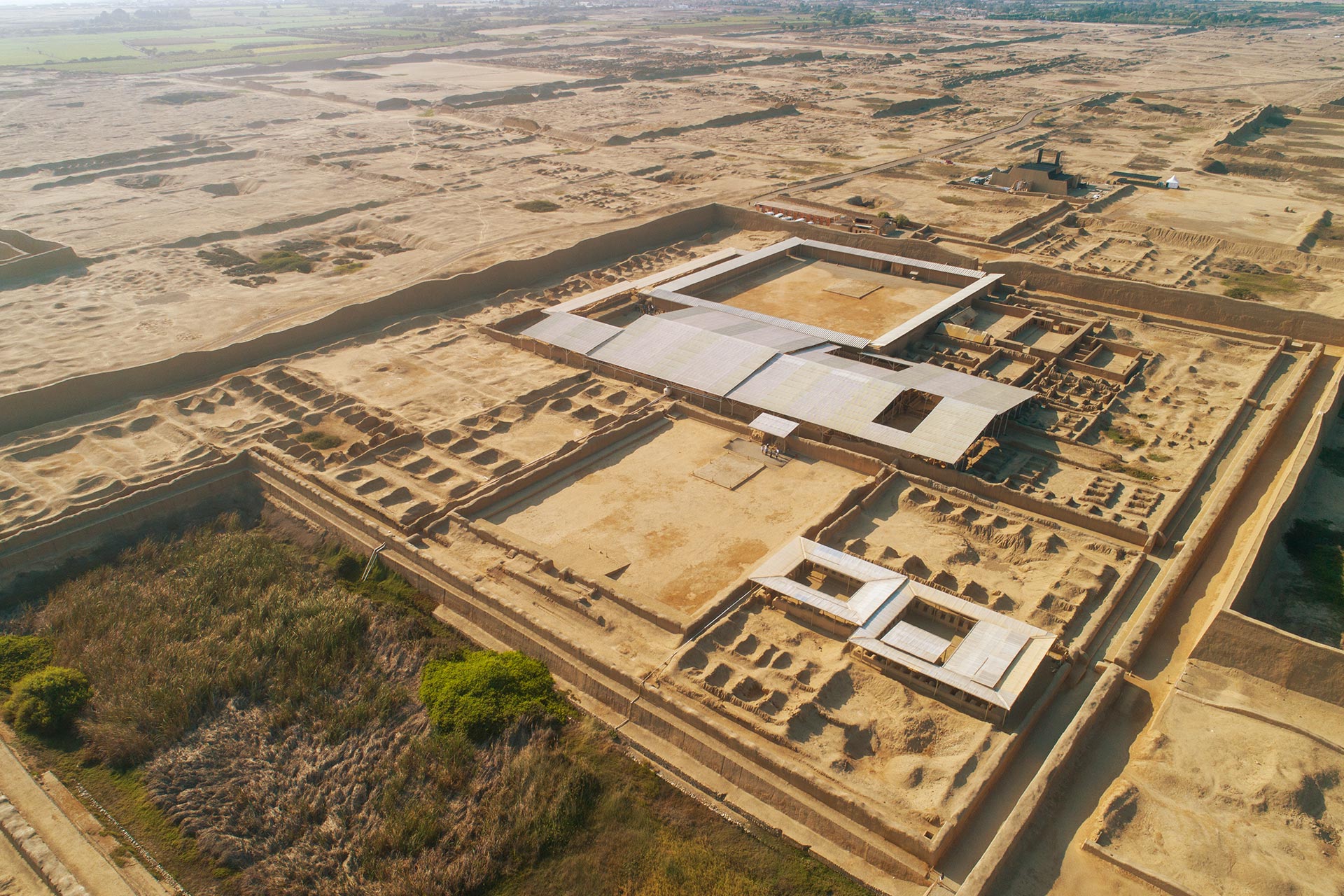
Welcome to the archeological site of Chan Chan. We are high above the Moche Valley looking down into this ancient complex that was once the largest city in pre-Columbian South America. In the arid deserts along Peru's northwestern coast, the Chimu civilization cultivated a relationship with the land to engineer a series of complex irrigation systems to build the sprawling metropolis of Chan Chan and establish it as the capital of their empire. Today, this site is under threat due to climate change and volatile weather patterns. Chan Chan is a world heritage site at risk and in need of urgent preservation efforts. Please join me in exploring the history of Chan Chan and learning how people's relationship with the environment is just as important today as it was thousands of years ago.
Stop 1. The Chimu Civilization
Between 900 and 1470 CE, the Chimu civilization flourished along the coastal deserts of northwestern Peru. They cultivated this arid region by settling within fertile valleys carved by rivers carrying runoff from the Andes Mountains to the east. The Chimu had a consolidated empire with a regimented social hierarchy, they were able to organize and execute various feats of engineering in order to create sustainable and prosperous settlements in the desert. It's no surprise that the Chimu are known for their artisanship, feats of engineering, and visual culture. The city of Chan Chan is exemplary in showcasing the Chimu's talent as craftspeople.
Arturo Núñez
Good. Chan Chan is the capital of the kingdom of Chimú or Chimor and this kingdom, this society, extended from Tumbes the first department of northern Peru to Lima Carabayllo valley. It's a coastal kingdom that at one time had similarities to what Cusco was and then at another time they entered into competition and finally Cusco that is, the Incas, came to dominate to conquer the Chimú. The headquarters that Chan Chan has a story that goes from approximately 850 after Christ until 1470. 850 AD founded by a mythical character named Taiz Candamo. This man comes from the sea, with a fleet of rafts many people and arrives at the Moche Valley and theoretically is the founder of this kingdom and this headquarters and the final moment 1470 establishes a researcher and defines it from what would theoretically be the date in which the conquest of Chimor by the Incas occurs.
Stop 2. The City of Chan Chan
The city of Chan Chan is best known for its unique urban plan that reflects the Chimu's strict political and social structure. The Chimu organized the city around several ciudadelas, also known as citadels or palaces. These autonomous sections of the city were areas of residence and worship for the Chimu ruling class. Each citadel contains their own temples, burial chambers and water reservoirs. Surrounding the citadels were thick, ten foot high mud brick walls, which separated the compounds from the rest of the city where lower class workshops and residences were located.
Blanca Sanchez
Well at the entrance of the audience we find a space where the four sides represent geometric elements like small rhombuses. These are represented both in this space and in all audiences that represent the marine networks. These networks that are capable of housing the great quantity of the wealth of the sea so that they can bring as much as offerings as the material of consumption elements of consumption for the people. So this representation of the networks means a lot to them is the wealth that they and the sea is giving them and they can keep. That is why in the audience the construction of this type of walls that are the virtual walls let the wind pass and this and try to have what the representation of what happens in the sea they try to bring to land so that this be it a religious language for all the people who come here to visit the east or bring their tribute their tribute or the surplus production they had. These were the most relevant products, the biggest ones that are best preserved so that they can be grateful to their gods. Then they brought here to the audience that it was a place of reception of both these products that were surplus production or perhaps were some of some elements to thank their gods and were deposited in niches.
Stop 3. Nature and Architecture
In order to create a flourishing city in the desert, the Chimu engineered a series of canals that diverted water from nearby rivers to irrigate the land surrounding Chan Chan. Imagine the incredible transformation that took place when the Chimu civilization cultivated the desert to become a lush landscape with crops and gardens that supported the city. Within the architectural features of Chan Chan there are visual motifs of agriculture, the ocean and other iconography representative of nature. Given Chan Chan's reliance and relationship with the environment, it's no surprise that these motifs are central to Chimu visual culture and can be found throughout the architecture of Chan Chan.
Blanca Sanchez
So they had a lot of respect for everything that nature provided. That is why many divinized many objects and many animals. The same sea is divinized in the central square would grab it that we have that are parallel represent the sea waves. In the main square if they used 3D to also represent the four walls of the squares if we expand it and tend it down they represent the terrestrial world to the center. There are the seabirds that are always on the seashore and those rays represent the sea, the waves of the sea and at the top we have nothing to reproach the horizon represents the distance what is lost and some symbols that are represented as the chacana, also represent like the moon caressed elements such as the Andean cross.
Stop 4. Climate Change and the Environment
Just as the Chimu cultivated the landscape in order to build the city of Chan Chan, so too do present day site managers contend with shifting weather patterns caused by climate change that put the site at risk. El Nino is the name given to a climate pattern caused by warm surface waters in the eastern Pacific Ocean. El Nino cycles caused dramatic increases in precipitation, soaking the arid desert of northwestern Peru in rain. Increased rainfall erodes the adobe mudbrick structures of Chan Chan and overwhelm the region's underlying water table, which undermines the structural foundation of the site. Without intervention The city of Chan Chan is at risk of disappearing forever
Arturo Núñez
First, because we are very close to the sea. That is, Chan Chan starts from almost less than half a kilometer with the proximity to the sea. So we have here a lot of humidity and a lot of salinity. Second, we are in the lowlands, we have the problem of the water table. This issue was not we did not become aware until the year 2000 when the hollows of the entire Chan Chan topography appeared here. The first water mirrors from 2000 to 2004. Well, in principle very heavy rains just sweep all the headers. The decoration in this parietal case without disappearing it is the shatter and the lower parts. Due to the proximity of the accumulation of water, they are simply too wet and some sculptures fall off. And then the issue of moisture infiltration and again coming out the walls affects the issue of saltpeter. So it is a subject that is not simply the direct physical affectation due to the impact of the rain, but it is again the accumulation of water that is going to be recycled, leaving inside the walls and generating the problems in these decorated areas.
Blanca Sanchez
One of the most degrading agents here in Chan Chan is wind erosion because our material is too vulnerable to these climatic changes in humidity and temperature. When these factors cause it to weaken and make this site more vulnerable, wind erosion comes. As we begin to wear this wear we cannot see it with the naked eye. If not with special measures using some test pieces that we manufacture in the laboratory. But for this the monument has layers of protection of the site so that it cannot be affected by erosion. One of the most important agents we have as degrading is always wind erosion. The winds that we have here are different not at different times of the day we will have winds from zero to 14 kilometers per hour in different places we reach up to 20 kilometers per hour. So it is very varied. This type of winds is not only going to affect the surface part of the structures because this is added that the wind collects the sand. So we are talking about wind haulage because the wind is going to carry all the sand and the wind wear that it does with a small friction to all surfaces constantly but this way the structures gradually wear out.
Milagros Flores
Here on this site in particular. Chan Chan is an archaeological complex where the matter that prevails is the sand land is a fragile resource. Fragile, to the increases of the climate to the rain, to the wind to the acidity, to the impact not only of the nature but also to the human impact. It's a large area that is difficult to control. Therefore, this effect is being seen in the structures. A database is also needed where they can compare as time goes by. What are the effects, what is the speed of these effects of climate change. In order to scientifically analyze what the measures are and what are the specific reasons that are affecting this resource.
Stop 5. Preserving Chan Chan
in response to the environmental threats that Chan Chan faces, Peru has taken action in order to preserve, manage and protect the site. Not only have there been significant efforts to preserve the site on a local and national level, but international organizations have dedicated themselves to saving Chan. Chan, including UNESCO, An incredible and interdisciplinary team of scientists, archeologists and other experts have come together to develop effective preservation and management strategies for the site. Looking out over Chan Chan today, you can see one of these strategies in the form of large roofs that cover various sections of the site. This helps to protect vulnerable areas from rainfall and erosion.
Arturo Núñez
But somehow, these phenomena or impact we believe that we have a little better way of handling this type of covers in some way and in other places we just don't open them. That is, keeping the structure there as it is kept covered if the research has to be done, the research is documented and covered again because in the end the covering as it has left it over the years is the best form of conservation. But in this case that it is the only site exposed to the visit, it causes us long problems and we must always be looking for mechanisms but this seems to us somehow a better mechanism because a thousand things have been tested here. Materials have sometimes been put these chemicals that are irreversible by the subject of plastics and then this in the end was more expensive to find the way out. It is not true, to the disease. Yes, we are constantly in this type of search to find the least cost of the monument in its maintenance.
Blanca Sanchez
However, the archaeological site is covered by some layers of protection so that this process is much slower and does not affect the original structures. We were constantly monitoring with various equipment such as weather stations some multi parameters to measure these winds. And what do we do with the results? We can build the roofs that are not only for the rains and also the winds to stop the force of the wind and can not reach the walls directly.
Milagros Flores
This project of documentation of specific cases of where the effect of climate change on heritage is seen. The idea behind it is to create a database where you can establish a comparison between a monument between heritage within a historical site and another and then work based on that base of those scientific references. By then, analyze what is in common or what may be in common among those elements of climate change that can then be helped to clarify or find some kind of formula or prevention projects.
Stop 6. Cultural Heritage Legacy
Chan Chan lies at a unique intersection of climate change, cultural heritage preservation and ongoing research to help better understand what the future holds for cultural heritage at risk. Organizations have used Chan Chan as a testing ground for pressing climate change mitigation strategies that have potential to help save other cultural heritage sites in the future. The people involved in the conservation efforts at Chan Chan often feel a personal and significant connection to this place and the importance of preserving it, not just for the descendants of the Chimu but for all of humanity and our shared cultural heritage around the world.
Blanca Sanchez
Our responsibility is that each architectural element is protected. The conservation of an archeological site The conservation of an archeological site is of the utmost importance because it is what we have as a legacy. And what in the future will identify us with others. However, it is a responsibility and a great challenge in this archaeological complex because we have the extension and the type of material we have.
Milagros Flores
Heritage is, all heritage above all universal, it is a living heritage. It is a heritage that exists within a community. It is a heritage that interacts with a community because either in a low passive way, let's say from the point of view of recreation, people come to visit it or from the most active point of view either a support element and sustainability of a community where there are people who live on a product that is directly or indirectly related to that heritage site. Therefore, heritage is a living element. It is a living element is an element that is part of the daily life of many people who live on that heritage to some extent, therefore it is fair. And it is an important element in climate change called justice and equity. Where it is sought to identify who are the ones that most contribute to that impact and how that can be balanced, that can be minimized. Tourism is an element that contributes to the greatest impact of climate change. But tourism is an element that can be learned, you can educate the public and the community of a less impact tourism and that entails a heritage education.
Stop 7. Conclusion
Thank you for joining me on this incredible journey exploring the history of the Chimu civilization and the city of Chan Chan in both the past and present. The city is a testament to how important it is for humanity to cultivate a sustainable relationship with the environment.