Dinétah | Crow Canyon Petroglyphs
Yá'át'ééh and Welcome to the Crow Canyon Petroglyphs site, located in the heart of Dinétah—the ancestral homeland of the Navajo, or Nihokaa’ Diné people. The red sandstone walls and archaeological sites in this picturesque valley are a living testament to the Navajo people's enduring resilience and spiritual beliefs. As you explore this sacred place, you will be guided by video interviews with Diné Educator and Historian Harry Walters, Bureau of Land Management Tribal Coordinator Tim Begay, and Archaeologist Erik Simpson. On this tour, you will learn how this landscape and the figures carved into the rocks are part of the ongoing beliefs and ceremonies that continue to be a vibrant part of Navajo culture.
Stop 1. Protecting this place
Looking down on Crow Canyon from this vantage point, you can see down into the green valley between the light-brown flat-topped mesas on either side. This region is home to one of many significant concentrations of Navajo rock art and offers a window into understanding Navajo culture and beliefs. Carved centuries ago, these images help shed light on the Navajo ceremonial life and how it has changed over time. These petroglyphs are not merely art; they're a living connection to spiritual practices and the landscape that continue to bring balance and harmony to Navajo people. The Bureau of Land Management, which oversees this place, encourages you to visit it with respect so that it can remain vibrant for future generations.
Harry Walters
Dinétah is the traditional homeland of the Navajo. You know, the Western civilization you know you look to the Middle East, particularly Israel, as the place where the Western World began, including the religion. And so this is how we look at Dinétah. And then so when I see the rock art, these are not scribbling or graffiti to me because they're they are done with the same precis[ion] as the sand paintings today and then they relate to the sand painting. And so these are ceremonial, sacred, rock art. And then it tells me a lot about the development of the Navajo culture, particularly the ceremonies. And that uh so when I go there, I feel very humble and very uh spiritual and so this is why I think uh we need to uh to protect these and then uh for the future of our Nation.
Tim Begay
I think these petroglyphs represent an identity of the people on the landscape, and how they came through time and where we are at today, you know. I look at this, you know like I said, I look at this, and to me, that spells resilience. In [the] Navajo way of life the history is on the landscape, the chapters are on the landscape, the words are places like this. For Western people, you know you can pick up a book and that tells you the history. For Navajo people, it's written on the landscape. It identifies you know where ceremonies happen, it identifies where the healing happens, it identifies where to go if you forget about yourself, forget about who you are. And these petroglyphs are a perfect example. So when we sing songs, we sing, we sing about places and that's on the landscape. So that ceremony, the whole chapter, the whole book, is the landscape that's, you know, that's the words that are the that's the letters that make up the words, and the landscape is the paper that it's written on
Erik Simpson
So one of the things I I really would like people to take away from this experience and realize that these places exist, you know, first of all. They also exist within a larger cultural landscape, not just a past landscape but also part of the modern cultural landscape as well. With descendant communities holding these places, such as Crow Canyon, in high significance and placing a lot of value on them. Not just in the past as as places of past behavior and activity, but also how they relate to modern communities and their their ongoing cultural practices.
Stop 2. Navajo World View
As you journey up the winding trail towards the petroglyphs, the green sagebrush and the dry wash are on the right, and the large sandstone rocks on the left are revealed to be much larger than they first appeared. The designs and motifs are artfully carved into the sandstone and feature an array of plants, animals, humans, supernatural beings, and geometric designs that illustrate the Navajo connection to this landscape and common themes in Navajo oral and ceremonial histories and traditions. The way in which many of these designs are drawn reflects the significance of balance and harmony in Navajo culture, including figures that are associated with male and female counterparts for various elements.
Harry Walters
There are two sides, the Hózhójí, we call it the blessing way, or the beauty way, and then the ‘Anaaʼjí means something that has protection, protection and also has a little bit of evil in there. And then so you never mix those, but they are connected. So this is what when I look at the the rock art, I see the beginning of this where it came from, when it first emerged into the Navajo culture. And then so, contrary to the Western history where the religion tends to have evolved 2,000 years ago, and still stayed the same, no new things have been added to that. But with Native people, new things, technology, new ideas that people use tend to have uh crept into not only their personal life but their religion, their spirituality, their ceremonies, and so the basic elements of these ceremonies are still there.
Tim Begay
The medicine people I worked with, they always told me that, you know, we've always been here, we've emerged here, we're still here, and we still take care of the land. So I guess that's what I mean by when I say when you come to these places respect it. Because people are still here, they still use these symbols in their ceremonies and we are still alive we're not going away as long as our language is still here, and that's the resilience we have.
Erik Simpson
So a petroglyph is basically is a figure that is scratched or pecked into a rock face. So it's usually made up of different elements, sometimes you have anthropomorphs, which can be humanlike figures. A lot of times you see various animals depicted, culturally important plants, not just agricultural you know plants but also native plants are you know non-agricultural plants that also add cultural significance as well. A lot of times uh there are things that cannot be interpreted very well, you know geometric shapes and that kind of thing, if you would. So archeologically speaking it's any human defacement, if you would, of the rock for whatever cultural purposes. Contrast petroglyphs with pictographs with pictographs um being um, you know, some uh pigment so it would be either mineral or organic pigment painted onto the rock faces.
Stop 3. Understanding Rock Art
In this first panel, the carved images stand out against the darker red sandstone walls, vividly illustrating key elements of Navajo beliefs. Prominent among these are numerous turkey tracks, reflecting the turkey's role in the Navajo creation story as the provider of seeds, including those associated with agriculture, to the people. The importance of corn is also shown through the presence of several images of corn at different stages of its growth cycle. Corn is sacred in Navajo culture and is said to be the very substance from which the Navajo holy people Diyin Dine’é created Navajo people. This panel serves not just as art, but as a narrative of the deep-seated reverence for nature and the sustenance it provides, central to Navajo life and spirituality.
Harry Walters
With the Navajo, we say corn is us, we are made from corn, we are corn people. The females, the women are made from yellow corn, the man white corn. So yellow corn is female, white corn is male. And so in ceremonies, again, as I said, they're male and female, so those corns are used like that. So when I see that, you know I see that, and they're used in s sand paintings
Tim Begay
The connection is that we're a resilient people, and we're still here. You know, I believe Harry touched upon the sand paintings, because a lot of what we still put on the sand paintings, what we draw on the sand paintings is here in Dinétah, like the corn. Corn is a basic food source for the people in the southwest and for Navajo people. In Navajo oral history and Navajo ceremonial history you know, we were made out of corn.
Erik Simpson
So whenever people are creating this, you know the petroglyphs on the rock faces, a lot of times the tools that we use would be other stones, harder stones than the sandstone that the cliffs would be made out of. So often they would be cobble size that you could fit in your hand pretty well, and a lot of it is pecking. So just battering that stone into the into the cliff face itself, and it creates a unique pecked design. Sometimes they also did incision, so actually scratching lines into the rock face. You might also use a stone for that, you might also use, you know hardened wooden implements, you might use antler, that kind of thing. A lot of what you see here though will be pecked, there's also elements that you can't see on some of the rock art and that would be that they would also have, a lot of times pigment incorporated as well. Obviously, rock faces are exposed to the elements, you know, and that fades and washes away fairly rapidly. But there is some evidence that um there might have been you know a pigment that was kind of, if you would, painted onto the rock surfaces as well.
Stop 4. Connection to ceremonies
In this rock art panel, the carved figures are much fainter against the sandstone walls but feature detailed human-shaped figures with geometric faces. These images connect to ceremonies that still occur today and have been interpreted as masks representing Navajo Holy People or Ye’ii. According to Navajo belief, as Navajo people were created in the image of the Ye’ii, the dancing figures with masks are imbued with the same power as the Ye’ii themselves.
Harry Walters
This one is the triangle face. There are not very many in the sand painting [with] this shape face. The one on the left with the triangle face, is much more common. Usually again going back to the male and the female. The ones with the round face is usually the male, and the one with the square or triangle face are usually the female. Now, I have used this you know in my classes, when I was teaching, and people used to say women are square anyway, you know that's why they have square faces, you know. It's not that, it's the mask, in the dancers. The male, the man, the dancers they have a mask that pulls over the whole head, and so they're usually round like that. The women do not have a mask that pulls over the whole head. They have a little square mask that just fits the face. So this is how, so when you look at the images of the the faces in the sand paintings you can tell whether they're male or female like that. So the the triangle is is is is not not common, and there are some in there, so this is probably uh what it is.
Tim Begay
When I was in still in high school, I got initiated into the nightway, and I started dancing when I was probably a freshman in high school. So a lot of the sand paintings that were done, that are done in the nightway ceremony I sat through I took part in creating those those sand paintings. And if you look at the pictographs on the rocks you know they're very similar you know they come they're very similar and the only time that you make a complete sand painting is in a ceremony when the songs and the prayers are being conducted. So these are just they're images of the yéí people, what we call the deities but you know they're not they're not complete
Stop 5. Change and continuity
In this panel, you can clearly make out 7 compound bows and 7 hourglass figures. These figures, some of the most repeated rock art images found at Crow Canyon, represent the Navajo Hero Twins. The twin brothers Born For Water and Monster Slayer are represented by the hourglass figure and bow, respectively. The Twins are some of the most significant figures in Navajo tradition and helped rid the world of monsters that were attacking the people. Born of Changing Woman and the Sun-Bearer, their legendary feats still inspire Navajo people today.
Harry Walters
When I look at these, rock art, I can tell what ceremony they're from. And so, all of the ceremonies that we have today, you know, were already in existence when these were done. And that that there is very little, very little changes and so these figures are from the ceremony known as the Enemy way (Anaʼí Ndááʼ). And that deals with war, when someone that has been to war and come back and they have these, an illness. And these are ceremonies the Enemy Way is done for them, and that's so these images are from that.
Tim Begay
And when the boys grew up, they asked their mom, they said you know who's our father? You know first man is our grandfather, first woman is our grandma, but where is our father? And they kept asking the question so finally, when they got older, their mother told them, well, the son is your father. So then that's when they journeyed from, what we call Dził Náʼoodiłii Huerfano Mesa in New Mexico. And they traveled to the East to go meet their father. When they met their father, their father disowned them, and they had to go through several trials and finally had to prove themselves. And the son said well, you are my sons, you've proven that, but you're going to stay here with me; you're not going back to go see your mother. And then the two boys said no, we need to go to be with our mother. And then he says okay, one test I'll give you, and that is a geography test. So there was a layer of cloud they walked out onto, and the Sun-bearer pointed at a mountain; he says okay, what's that mountain? Tell me what that mountain is. So Monster Slayer, who was the first firstborn, said okay when he was asked that question; the Small Wind or the Small One, what we call Whispering Wind told him tell him that's Mount Blanca, White Shell Mountain, Everlasting Leadership Mountain, Everlasting Life, and Everlasting Balance Mountain, tell him in this order. So Monster Slayer told the Sunbearear, Okay that's Mount Blanca, White Shell Mountain, Leadership Mountain, Everlasting Life, and Everlasting Balance Mountain. He says, okay, then he pointed at another mountain and the Small Wind told him, you know that's Mount Taylor, Turquoise Mountain, Planning Mountain, Leadership Mountain, and Everlasting Life and Everlasting Balance. And they went around, after he after he told them that he pointed at another Mountain and that was San Francisco Peaks, he says that's Abalone Shell Mountain, Everlasting Leadership Mountain, Everlasting Life, Everlasting Balance Mountain. And he pointed to another mountain he says what is that mountain? So the Whispering Wind told him that's the Plata mountains, and that's made of jet. That's the Basis of Leadership, that's the Basis of Everlasting Life, and Everlasting Balance Mountain, those are Leadership Mountains. And then he pointed at a small mesa and he says what's that one? He goes oh yeah, that's um Huerfano Mesa, that's where we left from, that's where our mother lives, and that's where we want to go back to. And the Sun said okay, he says one more mountain so he pointed at another mountain. And the Whispering wind told him okay, that's Gobernador, that's where our my grandfather, that's where our grandfather and a grandmother live. first man and first woman. And with that test, that's when he says okay well you have proven yourself that you are my sons, and you've proven yourself that you belong on the landscape. So that's where you're going to go back to, so that's how they came back down. And when they came back down, they brought back down the bow, that's what their father gave them, so if you look at the rock art, you see the recurve bow there, so the recurve bow was given to the two boys by their father the Sun-bearer, those are depicted on the rocks as we see today.
Stop 6. Adding over time
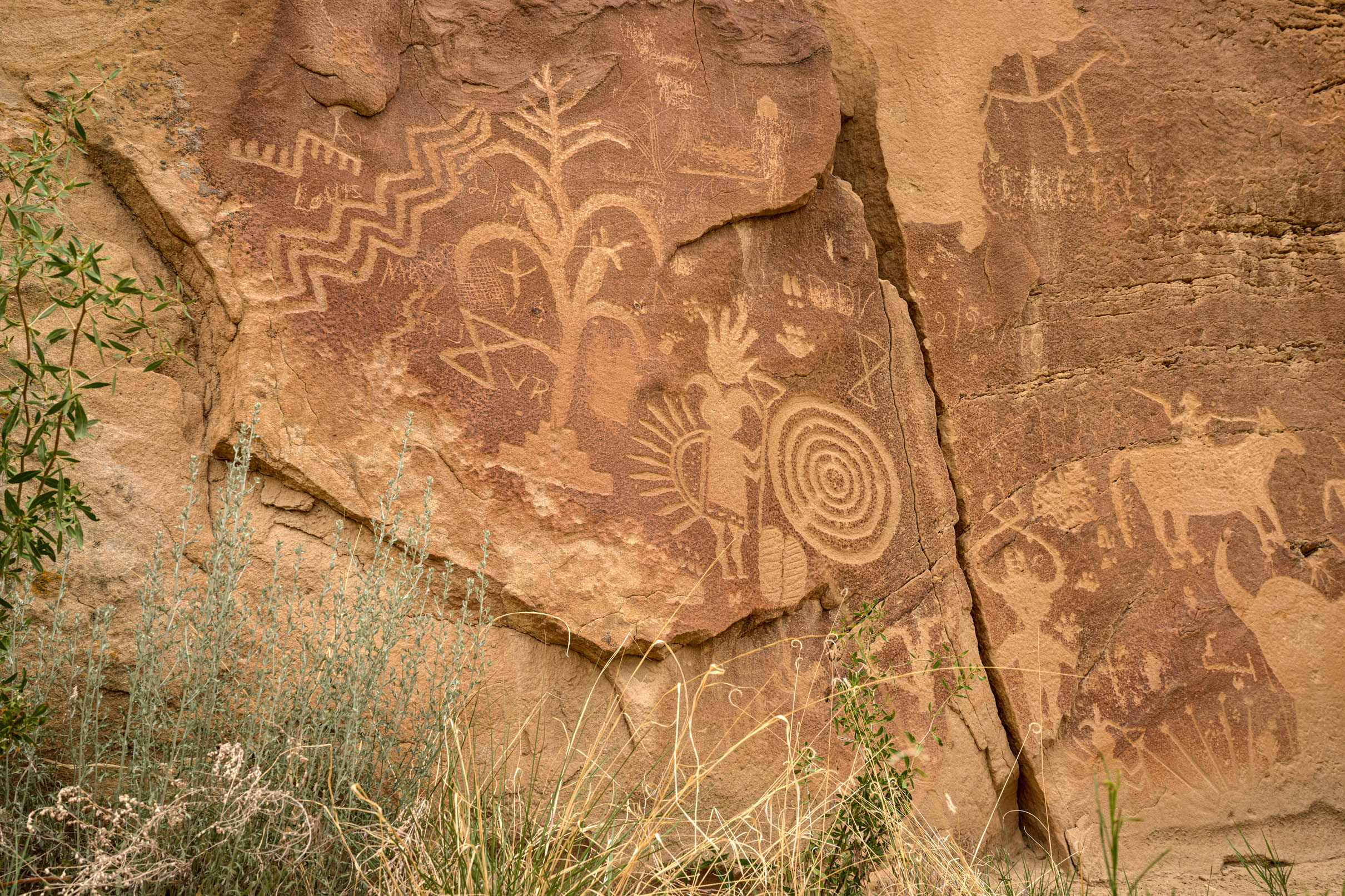
One of the most decorated rock art panels at Crow Canyon, this sandstone panel is covered in detailed images that rise from the ground up the vertical face to about 15 feet. Some of the figures are incredibly detailed and feature large figures on horseback, recognizable natural elements like corn, horned human-like figures, and geometric designs. Can you identify any of the elements from earlier panels? One of the most recognizable figures here is the Hunchback Ye’ii known as Ya'ackidi' in Navajo. This holy figure has horns like a mountain sheep and a backpack full of seeds for planting and is associated with the harvest.
Harry Walters
Rock art, like that, you know can't be read, you know, like a storybook. They were properly done at different times, and I would say that probably on the left side of the crack was probably done earlier, and then on the right side probably much later, you know, probably maybe after European contact. And that each symbol might have been done at different times, and as I said we don't really know why it is done on these rock faces. But it is uh definitely not just doodling or graffiti because they are very precise, very sharp, and the same precision until today that is used in sand paintings. It's in there. So we don't do ceremonial rock art today, and at some point in time, it became a no-no. So today if you start doing these sand painting design on these rock faces and some elders saw you he's going to get after you.
Tim Begay
So when you take a look at the rock art, at Dinétah, what we call Dinétah, you know there's a-it shows a time period from when Navajos emerged into the four corners area, all the way up into contact with the Spaniard people. And how they have the horse depicted on the rocks, so you know, that's how I see Dinétah.
Stop 7. Pueblitos
You have just been whisked from the sandstone panels down the valley towards another important part of Crow Canyon. Built with individual stones held together with mortar, this square structure is built atop a boulder and is called a pueblito. Although hypothesized to have been used for defense, due to its excellent view of the entire valley, according to Navajo oral tradition, this type of structure is known as kin and was used for many purposes not solely associated with conflict.
Harry Walters
Some of the Navajo stories make reference to that kind of structure. We call that "kin", kin is like a square stone house. The major ceremonies, the blessing way, the beginning of that is said to be, we call that "kin nalta" kin, kin is that kind of house "kin nalta", sitting in that kind of house, that's what it is. And a deity known as changing woman, when she became of age and started her menstruation, a ceremony was done for her, that's the beginning of the Blessing Way. And that ceremony, the event is called "kin nalta" "kin seta" sitting in the kind of house. Now, they did not say "Hoogan Nalta" that's Hogan.
Tim Begay
A lot of the the pueblitos that we see in Crow Canyon and other places, you know when you talk to an archaeologist, they say, well you know those were defensive sites, and they might they may be well defensive sites but Navajos lived in rock structures like that before you know there was major warfare.
Stop 8. Homeland of the Navajo
You have just been whisked from the sandstone panels down the valley towards another important part of Crow Canyon. Built with individual stones held together with mortar, this square structure is built atop a boulder and is called a pueblito. Although hypothesized to have been used for defense, due to its excellent view of the entire valley, according to Navajo oral tradition, this type of structure is known as kin and was used for many purposes not solely associated with conflict.
Tim Begay
I think for our youth the problem we have today, is the loss of language. So when I was growing up, I would ask my dad these questions in a ceremony and he would answer me in Navajo. So the language, like I said the language is the glue to the culture and ceremonies. So you need to know the language, I hope that when we bring Navajo youth to sites like this, they are willing to relearn the language. Because if we don't have a language, we don't exist as a people, we don't exist on the landscape, we can't connect ourselves to the landscape, our culture that was put in place for us like by holy people is going to be erased.
Erik Simpson
You know people's behavior when they come here is very important. You know, respect that these places have been here for centuries, and you know if we're not touching them with our hands if we are not defacing them, you know with graffiti and that kind of thing, that they can also be here for centuries later. You know that the experiences people are having now, you know, could be had by, you know multiple generations, you know, down through time. And just being respectful and appreciating these places without you know, causing damages I think is a key takeaway that I would like people to have.