The Great Mosque of Djenné
I ni chè! Welcome to the Great Mosque of Djenné, located in the country of Mali by the Bani River. This building is the largest mud brick building in the world and a powerful representation of Islamic faith in Africa. During your visit to the mosque, you will learn about the spread of Islam to this region, the unique style of the building and how the mosque is a symbol of the community's faith and traditions. You will also hear from mosque Imam Yelfa Djeité, Chief Mason Nouhoum Touré, and female youth Aïssata Djitteye.
Stop 1. Welcome to the Great Mosque
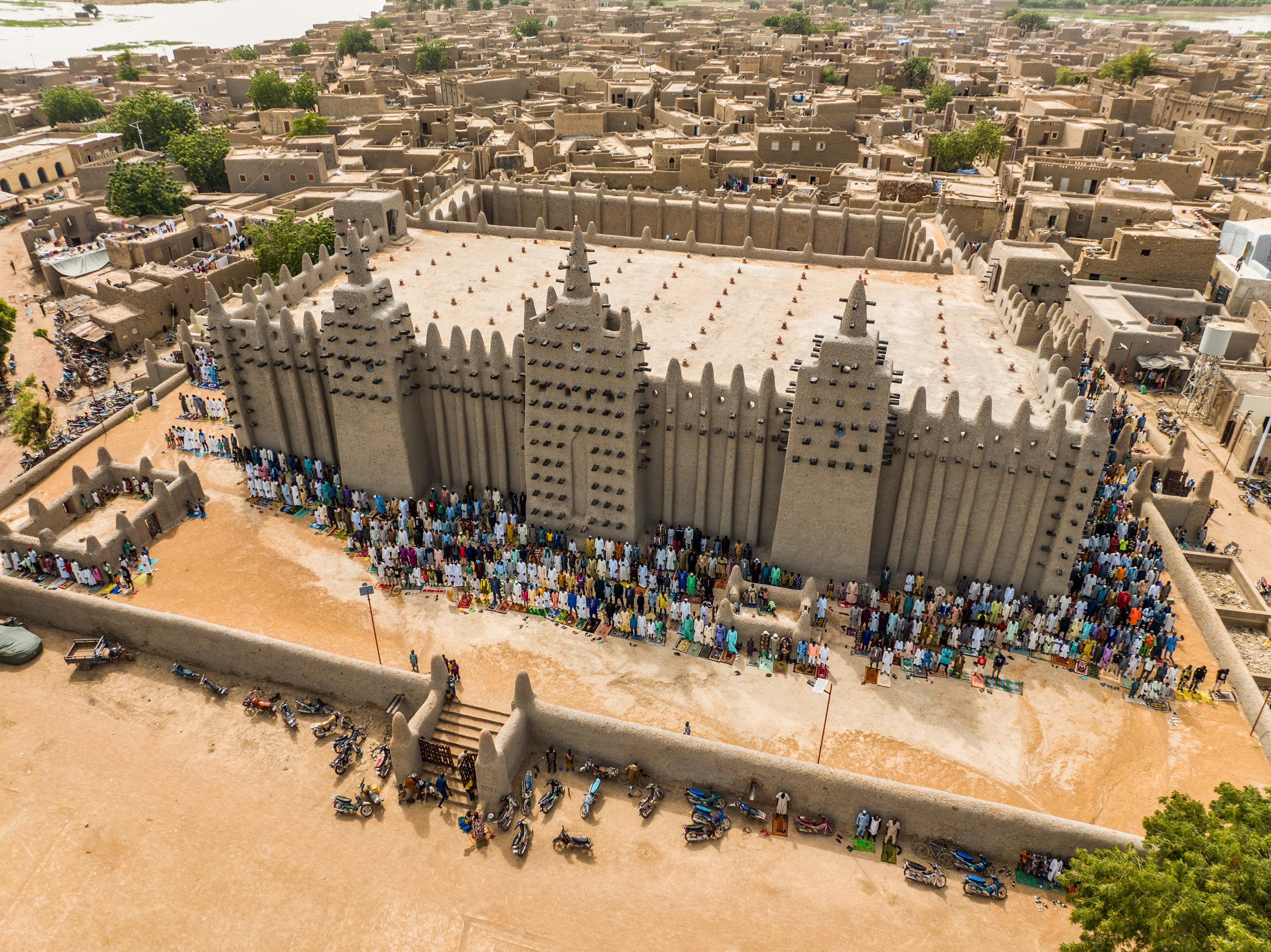
This is the great mosque. At over 50 feet tall it is the largest mud structure in the world. Almost every year, the community gathers to replaster the mosque. A mosque is an Islamic place of worship and the people who practice the Islamic faith are called Muslims. Islam first came to Mali in the 11th century, and Muslims still worship at the Great Mosque today.
Yelfa Djeité
My name is Alphamoye Diakité, commonly called Yelfa Diakité. Son of Djenné, I am the imam of the great mosque of the city. The place of imam that I occupy today emanates from the will of God because I did not declare myself a candidate for this position. As far as I know, the father of the imam I succeeded was an imam, my father, my grandfather and my great-grandfather were all imams. When Imam Koroboro died, the village chief appointed me to this position and it is purely religious.
Nouhoum Touré
My name is Nouhoum Touré known as Bocoum. I am a mason in Djenné and I have not learned anything else in life. and we do our best to perpetuate this tradition bequeathed by our elders I am a native of Djenné and I am from here.
Aïssata Djitteye
My name is Aïssata Djitteye, I come from Djenné, more precisely from the Sankoré district. At 1 or 2 days of the annual plastering, young men and women leaders are designated to supervise the work. I have the great honor to be chosen for this year.
Stop 2. History
You are standing in front of the main gate to the Great Mosque. The mosque was built in the 13th century when King Koi Kunboro, newly converted to Islam, had his own home demolished and the Great Mosque built on its site. By the early 19th century, this structure was in great disrepair. Like the modern Great Mosque, the original structure was also made of adobe bricks covered in plaster, the traditional materials and techniques of architecture in the region. The current mosque was built in 1907.
Yelfa Djeité
When we talk about peace among Muslims, it starts at the mosque. In addition to peace in the family, collective peace begins in the mosque. The mosque creates love and sympathy among Muslims because they all go there for the same common purpose.
Nouhoum Touré
The plan of the mosque was made by our ancestors and white people helped them in the realization. That is the secret, it was built in peace, unity and tolerance.
Stop 3. Unique Architecture
An important feature on the outside of a mosque is a minaret. It is a tower from which Muslims are called to prayer five times each day. There is an ostrich egg on top of each of these minarets. Ostrich eggs are a traditional symbol of creation and resurrection. The great mosques, minarets also face Mecca, the birthplace of the Prophet Muhammad. Muslims face Mecca when they pray.
Yelfa Djeité
The mosque is the place where the believers gather since not everyone can go to each other for the collective prayer. Prophet Mohammed advocated peace with the idea of five collective prayers per day that Muslims do in the mosque. At this rate, if you notice the absence of a muslim during the collective prayers of 2 to 3 days, you will know that there is something unusual in the daily life of the person. So, through this big clue, you will try to find out what motivates his absences from the collective prayer.
Stop 4. The Replastering Festival
The smooth walls of the Great Mosque are made of banco, a type of fermented mud that is the traditional building material in the region. It is a type of adobe with sun dried bricks covered in this mud plaster. The banco covering the Great mosque is prone to damage in the rainy season. To protect it the plaster must be reapplied at regular intervals. The local community comes together in the Crépissage Festival, in which the locals replaster the mosque to protect it for the coming year. Everyone has their own role in the Crépissage. The ‘toron’ bundles of rodier palm that can be seen sticking out of the walls provide a built in scaffolding for people to climb to reapply the new coat of plaster.
Yelfa Djeité
The role of the imam is important in the plastering ceremonies of the mosque even if this activity is not part of the tasks assigned to him. In the run-up to this grandiose event, we have an organization commission in each district of the city. These different organization n commissions plan the annual plastering during the months of March and April and inform the village chief about the date set. The village chief in turn informs the imam of the mosque of the decision taken. Because nothing is done at random here because the choice of the date is fixed according to particular signs. One also needs the blessings of the Imam for things to go well and to benefit from the miracles that occur. The mosque is the house of God and this is a universal truth for all mosques in the world. But what makes the mosque of Djenné special It is the largest mosque in the world built in banco with atypical architecture. Because of its height and its large surface, you will not find anywhere in the world a mosque similar to ours.
Nouhoum Touré
I don't know any other work except masonry So, I have a great mastery of banco. This mosque is built in banco. This quality of banco naturally contains adhesive components which must be associated with certain products so that it does not crumble quickly. There is no other mixture of bricks except banco. But every year it is plastered, this plastering is a very big party. If you are from Djenné, wherever you are, everyone gathers for the occasion. We let the mud rot in a pit for at least 15 days or a month. We add some cereal bran that we mix so that it can be well plasticized. So we organize ourselves to decide the date of the plastering. The plastering takes place in one day until the next year. But the rain plays a lot in it because it is a great mosque made in banco which dates of more than hundred years And that still keeps its initial construction, nothing has changed except the plastering only. It's amazing. And such a mosque does not exist anywhere else, and this is how it is worked and only with banco. When plastering we call all our young masons to a meeting and explain to them how it should be done and we support them. By doing what our fathers passed on to us, everything goes well until the end.
Aïssata Djitteye
On the day of plastering, the girls wake up at dawn. We take buckets to fetch water from the wells and the river that we bring to the mosque. Some go to the roof while others stay inside the mosque. If the girls do not bring water, the mud will not be mixed, so water is needed. The young men are in charge of mixing and bringing mud up, down, inside and outside. We bring water continuously until the plastering is finished. The first day, the men go to take the banco at the edge of the river. And we bring water that we put in so that the mud does not dry. And it is the third day that we organize the evening. We set up tables, we bring chairs Food and drinks are prepared. And everyone sits down like they do at a big party. And on the third day we start plastering After all that, it's time for the food prepared by our old moms and other food, drinks and sweets like pancakes, spaghetti, rice, juice etc.
Stop 5. Keeping Cool
The Great Mosque is located in West Africa, where the climate is very hot and dry. The traditional adobe bricks that were used to build roofs and walls are important to keep the inside of the mosque comfortable. Sometimes the mosque will hold 3000 people. Small terracotta structures on the surface are vents that let in much needed air and light.
Yelfa Djeité
The mosque always keeps a good temperature inside even if it is not equipped with a modern air conditioning system.
Stop 6. A Place for Prayer
From this vantage point, you can see the internal courtyard, which offers an open air gathering place for Muslims to come together to study the Quran and pray. The Quran is the holy book of Islam. Muslims believe that the Quran contains the literal word of Allah or God as dictated to the Prophet Muhammad. Studying the Quran is an important part of practicing Islam.
Yelfa Djeité
From morning until early evening, the Imam's role is to guide the faithful believers on the path to God and salvation. At the end of the first prayer of the day (Fadjr or Sobh)) more precisely after dawn, the teaching of the Koranic school is part of the daily routine of each imam. From 6 am to 8:30 am, we have class with the little ones and after a 30 minute break. That is to say from 9 am to 11:30 am we resume the Koranic classes. After a break of an interval of 40 mm to 1h time, place in the mosque to lead the second prayer of the day (Dhuhr) i.e. when the sun is at its zenith. At the end of this prayer, the Koranic school resumes until 4 pm i.e. at the time of the prayer of "Asr" in the middle of the afternoon. The main role of the iman is to teach the Holy Quran and the hadiths to the believers in order to guide them on the path of salvation.
Stop 7. The People of Djenné
The Great Mosque is an outstanding example of the unique Islamic architectural style of sub-Saharan Africa, blending traditional building methods and materials with Islamic culture. A UNESCO World Heritage site designation has brought the Great Mosque to the attention of the world, but it survives today and will continue to survive, thanks to the dedication of the people of Djenné.