Welcome to El Jem
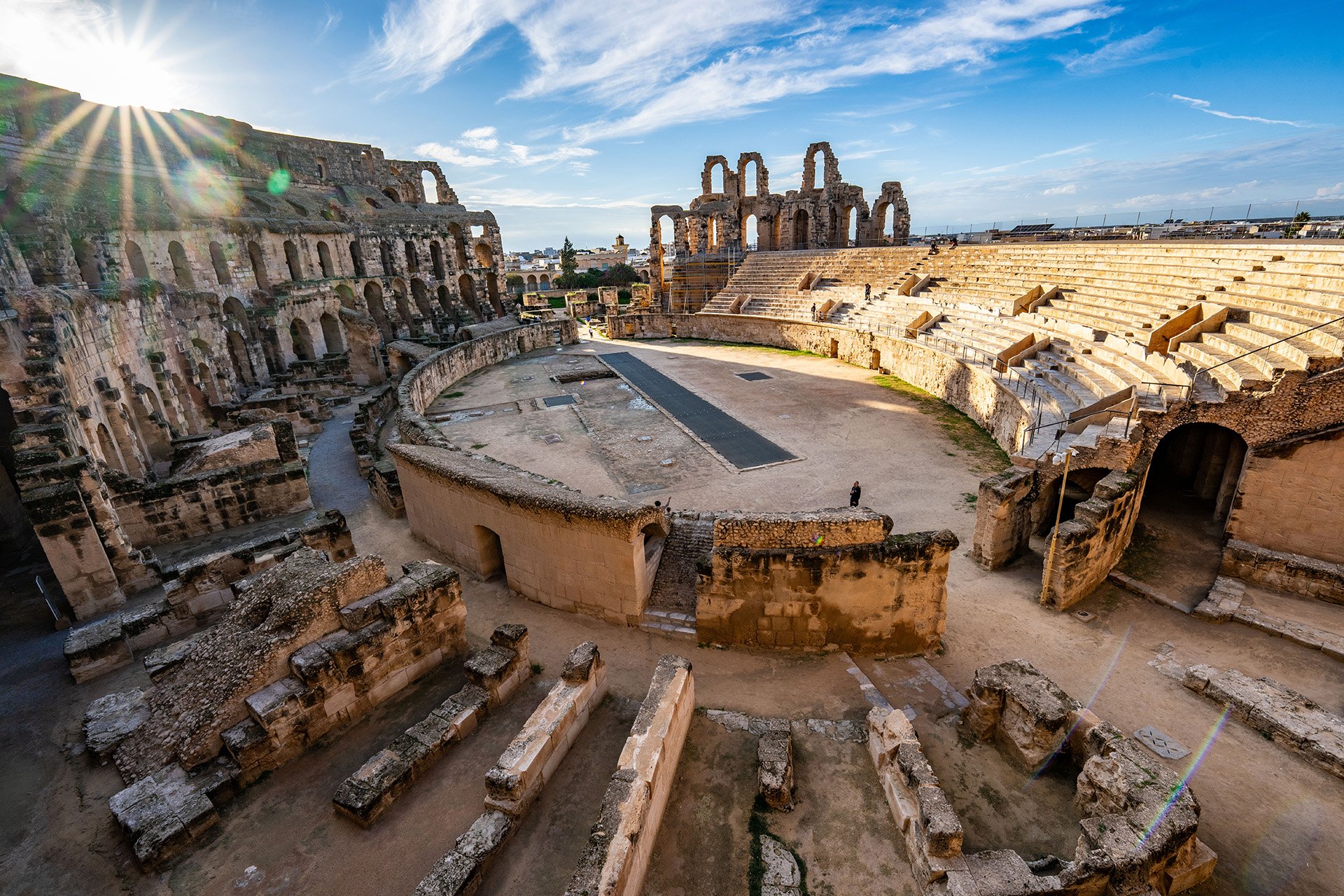
Welcome to the amphitheater of El Jem, also known as the Thysdrus amphitheater, after the original Roman settlement in this location. Located in Tunisia, this amphitheater was constructed in the 3rd century to host gladiatorial games meant to entertain roaring crowds. Able to accommodate upwards of 35,000 spectators, El Jem is the third largest amphitheater in the world by seating capacity and the most well-preserved in Africa. It was designated a UNESCO World Heritage Site in 1979, highlighting the prosperity of the Roman Empire in the region. Throughout this virtual experience, you’ll hear from community members sharing personal stories connected to the amphitheater.
Stop 1. All roads lead to El Jem
This complex sits at the heart of the once prosperous Roman city of Thysdrus, which included many other surrounding structures, such as a circus, villas, and a smaller amphitheater. Completed between 230 and 238 CE by the Roman emperor Gordian, the amphitheater is a visible sign of the Roman Empire’s influence, prosperity, and propaganda in the region. It was a central gathering place that supported community development and the growth of the city. The roads of the region all led to El Jem, connecting locals and visitors from across the empire. In addition to the design of the roads, the area around the amphitheater features water channels and systems for rainwater collection. These water resources likely helped sustain the thriving olive groves in Thysdrus that produced olive products that were exported throughout the Roman Empire.
Shayma Griguiche
For as long as I can remember, I've loved being by the sea. As a little girl, I spent hours in summer splashing in the waves. Our family went to the beach all the time. Visiting historical sites never crossed my mind. Then in 2011, when I was 10, we decided that we should visit El Jem. Since Mahdia, our native city, is close to El Jem We live in the town of Mahdia, so El Jem is not far away from us— it’s about an hour drive. There were four of us: my mom and dad, my sister and me. And we had recently found out that we would soon be five: my mother was pregnant with my brother Shouaieb. She made us dress up for the occasion. I remember watching her put on her favorite black dress decorated with a red pattern. We all sang along to the radio, during the drive. When we got there, I was impressed by the size of the amphitheater, and by the huge difference between Mahdia and El Jem, even though both towns are in the same province. There was neither sand nor water. Right when we got out of the car, we all smelled something delicious. It was coming from the restaurant across from the amphitheater, and I said to my father, "please, let's go there and have lunch.” It smelled so good. My father insisted that we go inside the amphitheatre first. So we entered and took a short walk. Pretty soon my mother and I got tired, so we all sat down to take some family photos. My father told us about the history and the big events held there... We tried to imagine battles between gladiators and animals. I was too happy with my family around to be scared by those scenes. I was equally happy when we finally went to the restaurant. My father asked the waiter, "what is it that you're making that smells so good?" He told us, "You have two options: roasted chicken, or chicken grilled right on top of black coals.” We decided to try the grilled kind. The flavor of that chicken is still on my tongue today, it was so special. Our family has not revisited El Jem, ever since I hope one day I’ll take my own kids there to tell them the same stories we heard from my father. And we will definitely try that chicken again.
Stop 2. An architectural feat
From the outside, the amphitheater is four stories high, with each tier made up of hundreds of arches. The sheer size and scale of the amphitheater, achieved by innovative engineering techniques, showcases the technology and craftsmanship of the time and people who created this monument. The architectural design of the archways and masonry (one of the most accomplished examples of Roman architecture) is the combination of both Roman and North African styles. Local communities adapted the Roman techniques to create this unique structure. The amphitheater was constructed using quarried white sandstone that was cut on-site with advanced masonry techniques, including the use of triangular notches to enable the positioning of the large stone blocks.
Stop 3. A spectator's view
While the amphitheater has sustained damage over the years, inside, you can still see most of the supporting infrastructure for the tiered arena seating. To gain entrance into the arena, spectators used one of four different entrances. The wealthy used coins, while women and enslaved people used terracotta tokens. Social hierarchies also dictated the seating arrangements that reflected class, caste, and gender. Women and enslaved people were seated in the upper rows, while the elite –like governors– occupied the front rows, sometimes accompanied by aristocratic women. Spectators would dress for the occasion in their finest attire, adding to the grandeur of the events.
Stop 4. Where the action unfolds
Looking down on the arena from above, the elliptical shape surrounded by tiered seating resembles modern-day sports arenas. While use of the amphitheater has changed many times over the centuries, it has always remained a central place in the community. Like other Roman amphitheaters, El Jem was built to host public spectacles, including reenactments of historic battles, public executions, and gladiatorial contests where gladiators, often enslaved people, would fight each other or hunt wild animals for entertainment. After the fall of Thysdrus, the amphitheater served as a fortress, withstanding many conflicts over the centuries, including the Tunisian Civil War, WWI, and WWII. These events are in stark contrast to what a modern-day visitor might experience. Today, the amphitheater is a place of gathering for the community and tourists alike. Visitors come not only to explore and learn about the rich history of El Jem, but also to attend festivals and musical performances. The amphitheater has also been a source of inspiration for Hollywood films about gladiatorial games.
Ameni Ben Romdhane & Hamime Bannour
[Instrumental music plays] [Ameni] The first time I went to El Jem palace (amphitheater) was in the summer. My friends and I were sitting in a cafe owned by Bessem. He had tickets for a symphony show at El Jem. He suggested we go... [Bessem suggests they all attend the concert.] [Ameni]...but I didn't think I would like the music. [Ameni voices not want to go at all.] I don’t like violins, and I’m not interested in music without lyrics, either. I listen to it for like three minutes and then I get bored. I know this about myself. My friends said, “It’s so good, you’re going to love it,” but I said, “No, I’m sure I’m going to hate it.” They were determined to change my mind, and I wanted to prove them wrong. [Hamime] I went to the El Jem coliseum for Al-zyara (pilgrimage), a spectacular show drawing inspiration from traditional Sufi music. When we arrived, I was not really focused on the amphitheater because I had heard stories about the site on social media. I sat with my friends way at the top of the amphitheater, so we could see everything. You could see the buildings outside of the amphitheater, the entire audience, and the whole light show. [Ameni] All I knew about it was that it's old and a replica of the coliseum in Rome. It looked like a maze with all the passageways. As we looked for our seats, I could feel the heat coming out of the rocks it was so hot. But the view was beautiful at night. Incense was burning, colored lights had been strung up all around. When the show began people got up to dance. The energy and intensity grew, I was transported. It reminded me of “hizb el-mahdia,” the music that we hear at traditional weddings, I really didn't enjoy the symphony as I knew I wouldn't. I stayed for half an hour just for my friends, because I didn’t want to ruin the mood. When my patience wore thin, I said to my friend Ali, "We're leaving." [Hamime] The rhythm of the music sent me into a trance. The musicians were on the ground in the middle of the amphitheater, and the going got tough. Dancers moved with flags while others moved with candles. [Ameni] Bassem and his fiancé stayed, and my friend and I walked around outside of the amphitheater. You couldn't see the moon from inside the amphitheater because it (the structure) looked so big. But outside it was full and beautiful and sat perfectly behind the amphitheater. [Hamime] That night was a perfect blend of tradition and history. The costumes, music, audience, performers, and incense. combined to create a fiery experience. This blend of tradition and history is important— it brings new life to the amphitheater. [Ameni] One day I hope to go back and see another concert at night to experience the magic of the amphitheater. But next time hopefully with a band I like.
Stop 5. Behind the scenes
Moving under the arena floor, you can see the series of tunnels and alcoves known as the hypogeum. This subterranean space is where animals and gladiators were kept before moving up to the arena floor for entertainment. Today, grates cover the openings between the arena and these underground tunnels, but originally, there was removable flooring that functioned like stage doors. Once these doors opened, an underground pulley system was used to raise animals and gladiators up, allowing them to suddenly appear in the arena from below. The removable flooring also strategically allowed for discreetly removing those who were killed through concealed exits. Additionally, the hypogeum also housed cisterns and water channels to support the amphitheater’s operations.
Bassem Hamouda
When I was 12 years old, I joined Les Scouts Tunisiens. The headquarters were in my neighborhood, and I was always curious about why so many kids hang out there. After a couple years and a lot of volunteer projects, our troop got to go to El Jem. We took the bus from Mahdia, chanting and laughing the whole way. You could barely hear the voices of the two scout leaders trying to explain the history we were about to see. When we first saw the palace (amphitheater) from the windows of the bus, we thought, wow it's so huge. For a while, we had to sit in the plaza out front and wait for our tickets. I wondered, “where will we enter?” I could not tell which archway would let us inside. Finally, a guide joined us and began our tour. He talked about the Roman conquest of Carthage, the fact that the El Jem amphitheater is the largest such ruin in Africa. To tell the truth, we didn't really listen to him. We just wanted to go off on our own. When the talk was over, we ran throughout the entire site. I wondered, "where did they find all the rocks to build this structure?" I learned later that local people who were enslaved brought the building materials all the way from the coastal area. We saw lots of old graffiti carved into the stone by people who visited over the years. Then I went down to the underground area. It was really dark, because back then, we didn't have phones with built-in flashlights. But there were circular holes in the ceiling that let in light from above. I thought of the people suffering there, waiting to be devoured by lions, and to tell you the truth I thanked god that I didn't live in those times, After some minutes, I climbed back up the stairs and rejoined my friends.
Stop 6. Preserving El Jem
Looking around the amphitheater, you can see large portions of the structure are missing, and there is evidence of erosion on the stones. However, it remains a monumental piece of Tunisia’s heritage, in both its cultural and physical presence. Starting in the 1980s, significant restoration efforts were undertaken by the community, the Tunisian government, and multiple international partners. Repairs to the structure include restoration of the stonework damaged in conflict and general erosion over time. In 2019, a grant through the U.S. Department of State Ambassadors Fund for Cultural Preservation (AFCP) was awarded to conserve the structure’s masonry, restore its ancient drainage system, and upgrade the electrical system and accessibility infrastructure. Continued conservation efforts are key to preserving the site for community events and cultural programming, and to ensure the legacy of the El Jem is passed to future generations.
Sihem Ben Mohamed
I don't live far from El Jem. Our home is about 10 minutes away, in the town of Boumerdes. My grandparents were farmers. They sold the olives and vegetables they grew at a local market. Sometimes my grandfather came back from the fields and said, “Today, they found another one.” He meant that someone in the area had unearthed an ancient artifact. They were just plowing and getting ready to put in a new crop, and they found a fragment of a beautiful vase. Back then, it was not illegal to sell ancient artifacts. People took them to the town of El Jem, and tourists paid a lot of money to buy them. Nowadays there are laws forbidding this. When people accidentally unearth artifacts from the soil, they have to declare them to the government. They just hope their land will not be designated an archaeological site— This would mean they could not farm it or build on it. I was 10 when my father took me to the coliseum for the first time. Back then, the road there was just a narrow, unpaved track. When my father and I entered, I looked around and felt soooo tiny. We climbed up as far as we could go. Even though I was afraid I would fall, I felt protected by my father’s presence. I asked, “If we go up to the top, can I see our home?” He said yes, but that we are not able to go all the way up because the restoration work had not begun. Years later, I studied archeology—it felt like my destiny. Now I know the history and how the amphitheater was built. I have not yet taken my own kids there, though. I want them to go as part of a school trip. If they were with me, I would bombard them with facts... They would not enjoy the experience. If they are with their classmates, they can discover it on their own. Today, there are too many building in El Jem to see my town from the top of the amphitheater. but maybe after sunset you can spot the lights of Boumerdes in the distance.
Stop 7. An evolving legacy
From the gladiatorial games and conflicts that once took place at El Jem to markets and festivals hosted there today, the purpose and use of the amphitheater have evolved over the centuries. El Jem is a testament to the region’s historical significance. While it was not built at the peak of the Roman Empire, its presence still played a vital role in shaping the structure and trade commerce of the city. And centuries later, the amphitheater continues to inspire locals and visitors from all over the world.