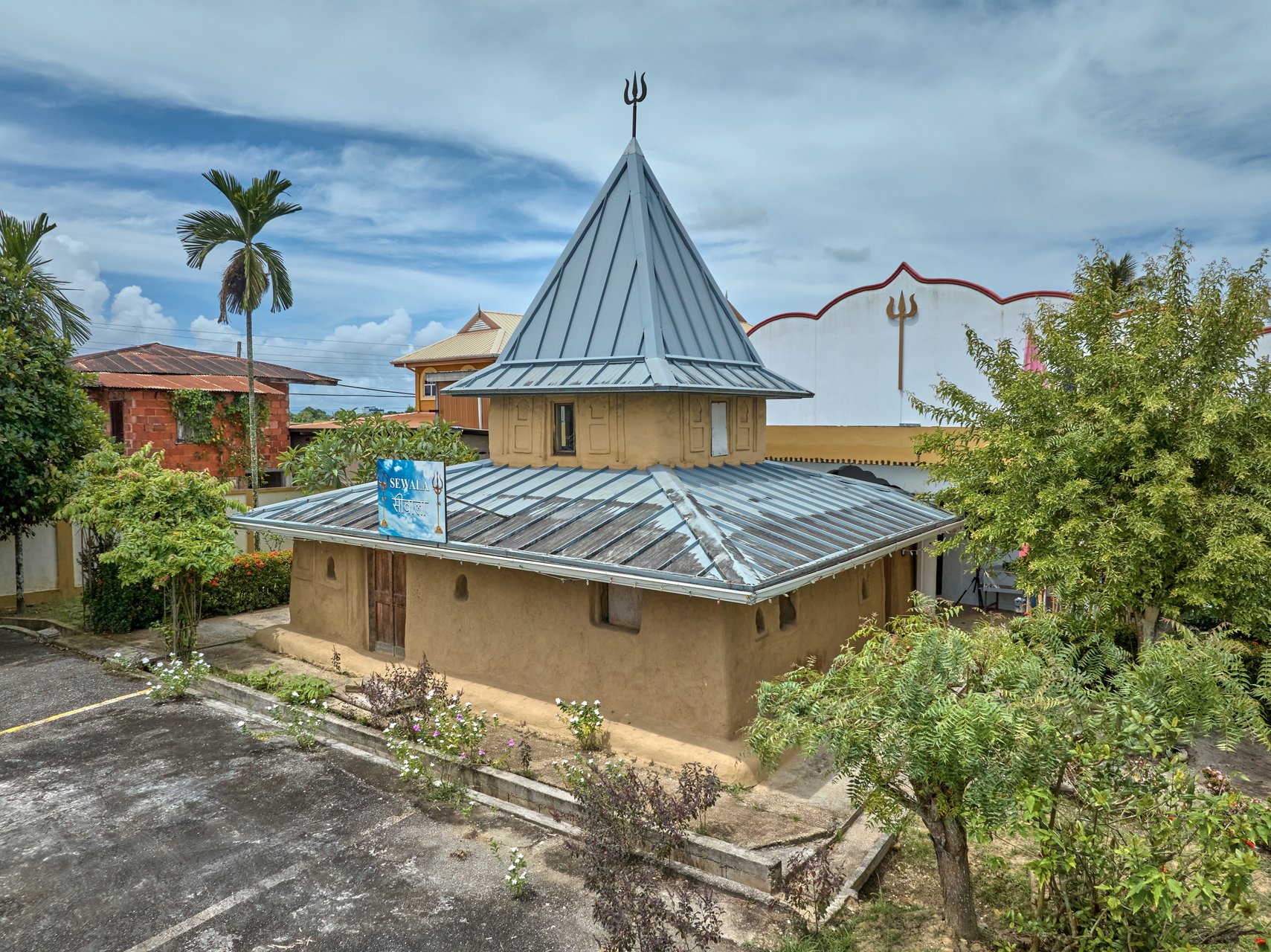
Welcome to the Exchange Sewala and Shiv Mandir
Welcome to the Exchange Sewala and Shiv Mandir, a symbol of religious resilience in the Island Nation of Trinidad and Tobago. In this experience, we will explore the Sewala, a sacred Hindu place of offering and worship. This leepayed structure was created more than 100 years ago and is representative of the country’s Indo-Trinidadian history. Through this experience, we will learn about the history and culture of this unique temple from religious leaders, community members, and a restoration architect.
Stop 1. Indo-Trinidadian History
The land seen here was once part of the expansive Exchange Estate. It consisted of sugarcane fields, barracks for indentured Indians, a plantation house, a factory, an estate hospital, as well as other structures. Between 1845-1917 more than 147,000 Indians were brought to Trinidad, then a British colony, under the indentureship system to develop Trinidad’s sugar industry. This labor scheme lasted until 1920. Today, this part of the former estate has transformed into a vibrant spiritual and community hub. Sitting at the heart of this community is a temple, more aptly known by its Hindu name, Sewala. The Sewala was built by Indian indentured immigrants seeking to preserve their spiritual traditions in a distant land. Far from home and facing the challenges of plantation life, they created the Sewala as a resilient and enduring expression of devotion to their Hindu faith. Later additions to the Sewala include a large Mandir used for communal worship, as well as a classroom and a multipurpose space equipped with a full kitchen. Together, these spaces support community life, learning, culture, and collective worship, carrying forward the legacy of those who first built this sacred place.
Pundit Teka Samnarine
This religious life which my father. Which my father had, and due to his company, with being with other Pundits. And at that time we used to ride, take our bicycle and go to the mandir. Walked to the mandir do little service. is like something that was in us that having the lineage of pundits, in the family and with his companions being Pundits. They kind of let it get into me that you have to be a Pundit too, because when we older Pundits go, who's going to carry on the tradition?
Rudylynn De Four Roberts
Mud structures in Trinidad date all the way back to our Spanish colonial days when the Spaniards first came here, they just built with whatever was available at the time. Most of us people my age and maybe a little older than I am remember these structures that were built by the Indian indentured laborers. We don't have too many of those left this structure behind me is one of a few that we have left. But, so the, the actual technique is dying out... unless we encourage people to continue it, you know.
Jaishari Maharaj
The exact history of the Sewala is pretty much unknown right. So what I'm about to say is based on oral recollections of, well, my grandfather and some other persons who would have lived in the community and their recollection as well. Right. So my grandfather, I remember him saying that this, Sewala or basically the lingam in the Sewala was like built around like the late 1800s. Right, It was built around the same time as the first mosque in Trinidad and Tobago. Right, and far as he is aware, this is the first mandir or place of Hindu worship in the Exchange Estate area, right, where persons who lived in the area or who lived in barracks that way they were able to come and participate in full moon puja, any kind of puja that they wish to do.
Stop 2. Leepay Construction
This Sewala was one of the first leepayed worship structures to be built in Trinidad, and remains one of the few leepayed structures left standing today. Male devotees first selected the spot for the Sewala, choosing an area suitable for a small square structure. Before any leepay work began, the ground was cleared of vegetation, and the four cardinal points were identified to guide the placement of the doors. Next, they placed sturdy tree trunks at the four corners to form the main supports. Devotees then gathered the materials—clay-rich sapate dirt, cow manure, and tough grasses like doob or tapia. They mixed these ingredients by hand, creating the traditional leepay mixture. This mixture was pressed flat to form the floor, and the walls were built by stacking layers of leepay on top of one another. Finally, tree branches and carat leaves were used to craft the roof. What stands today is a testament not just to faith, but to the skill, resourcefulness, and devotion of the early builders.
Pundit Teka Samnarine
Most of the plants that we have here on the premises is used for puja. We have the bael, which is recommended for Shiv Puja. We have the tulsi which is recommended for Vishnu Puja. Then we have the neem tree which is used for Devi (Goddess) worship. The neem leaves. We have to doob grass for Ganesh worship which we do use and all pujas. And we have many flowers that we use We have the peepal tree where we use the peepal tree also for Vishnu Puja. But the peepal tree is a tree stated in the Bhagavad Gita Chapter 15 that signifies reincarnation. Say one of the holiest trees we have on the compound here. This tree worshiping this tree on a Saturday alone walking around tree, touching the tree. You get blessings of all Devis(Goddesses) and Devtas (Gods) on that Saturday because all the Devis and Devtas are present on the tree on a Saturday.
Savita Garib
Right, preparations of leepaying and the process of doing that before before leepaying is that we have first we have to get the dirt and then cow dung, which is also we call in in Hinduism, which is goobar, but we need both mixtures and then we combined them together to form a unified process. My mom, who taught me to leepay because our household was really of dirt. So we also have a fire side, which in Hinduism is called a chulha. Nowadays they call it the stove. So that is what we had to the leepaying, and at that point in time was mostly women who used to do the leepaying now, which is, I'm very grateful for we have a lot of men helping us now to leepay, especially our Sewala.
Rudylynn De Four Roberts
You have to keep a good eye on it all the time because, because it's mud and, and especially on the outside of the building where it's exposed to the elements. In the same way that they leepay the building every three months. When you're doing that, you have to be careful that you you don't obliterate all the detailing on the reliefs. And I think that that has happened in a couple of them, and I know that they have somebody who is supposed to be helping to restore it, so that he will have to start recarving the detailing on it, because every time you leepay, you add another level of earth on the top and you just smooth out some of the detailing that, and some of it will disappear, so you have to be careful about all you're doing it. It just means you have to pay attention to what you're doing.
Jaishari Maharaj
Well, I basically grew up here, right, Myself and my brother. We basically grew up here. So my grandfather, he would have met this Sewala structure as is, right. And over time, he would have built the temple hall to the back. And then he would have built the multipurpose hall to the back of that as well, right. Now, we have lots and lots of memories of being here, but we also have like lots and lots of memories of like, you know, things that he went through in order to, to preserve this area. Right. In terms of an evolution, I mean, this, this Mandir, there will always be a part of who I am and will always be a part of our family. We—I have memories of when the roof would have fallen in. Right, Because this roof was like a thatched roof at that point— I have memories of when the roof would have fallen in, and then he would have to scramble to to get money and to get funds to try to rebuild the roof and try to rebuild this structure inside so that it could remain erect, you know, and at the same time have some kind of airflow, because in here it is very hot, but yeah, like, it's, it's just always been home to me and I think it will always continue to remain home because it's always been a part of my family and our family legacy.
Stop 3. Entering from the East
There are four doors that lead into the Sewala, each one facing a cardinal direction. The original doors were repurposed from barracks of indentured Indians, creating both a physical and spiritual link between the hardships of the past and the enduring faith practiced here. Devotees always enter from the East and move through the temple in a clockwise path. This reverent movement aligned with divine energies keeps the Garbhagriha, an inner sanctum symbolizing the womb of creation, always on the right. When the Sewala was constructed, worshipers had limited means and access to acquire religious images or murtis. Instead, they decorated the walls of the Sewala’s interior with the raised leepayed reliefs depicting the stories of Hindu deities.
Pundit Teka Samnarine
The Sewala has four doors representing the four cardinal points. When you enter, the one on the East represent the Sun. The Sun rise on the East. So you enter from the East. You walk around the Shiv Lingam clockwise, where your right side shoulder is always pointed towards the Lingam. You exit through the West. But if you have to exit through the East, you walk backwards. Never turn your back against the Shiv Lingam.
Savita Garib
How do we prepare the Sewala for worship? Firstly, well, we have to clean the Sewala. A lot the preparation of cleaning, wiping the murtis and washing. We also have the Lingam, the Shiv Lingam, which is our main purpose of having the Sewala. So we have to wash the Lingam, prepare it by, using milk, dahee, water, honey, ghee and offer it unto the Lingam. And after that we pay obeisance to Lord Shiva in his nirgun form. Have a form that called near nirgun and sagun. And that is his form, the nirgun form which is the Lingam.
Rudylynn De Four Roberts
It's always important to preserve your heritage. If you don't know where you came from, you don't know where you're going and your heritage and the actual physical things that we have that guides us and that helps us in understanding our traditions and understanding how we live now, and all the things that came from that mixture of of different heritages, heritage aspects in Trinidad. This temple is extremely important because it allows the villagers, it allows other Trinidadians to learn about this type of structure. It allows us to appreciate how things were built and how people lived in the old days, basically. It has a sociological aspect as well. So you're learning about your people and learning about heritage and the things that matter to them, and so that you then can relate it back to what and how you live now basically.
Jaishari Maharaj
So one significant tradition that I have always learned and I always take it with me, is that when you go into any place of worship, you always bow, right, So I don't know if like when you walk in, you bend down, you touch the floor of the place of worship and then you touch your head and you touch your heart? Essentially what that process does is two things. Number one, it's showing that you are humbling yourself right before you enter into a place of worship. You are humbling yourself before God. And secondly, it's, you know, it's how do I say it... It creates a sense of peace within you because you know that you are coming into space and you're preparing yourself mentally to come into a space that is peaceful and for the purpose of doing worship and for the purpose of being humble. And, you know, so that's one thing that my grandfather always taught me. And it's something that I always do anywhere that I go.
Stop 4. The Sacred Lingam
This is the original Shiv Lingam and it is the center and focus of all worship in the Sewala. The smooth, oval-shaped stone represents Lord Shiva in his nirgun state—formless, infinite, and beyond material descriptions. Devotees offer panchamrit, which is a mixture of milk, ghee, honey, dahee, and cane juice, during rituals to honor and purify the lingam. Above it, a kamandal continuously drips water to keep the lingam cool, symbolizing devotion and reverence. This practice reflects the deep spiritual significance of the lingam, embodying the eternal energy and divine presence of Lord Shiva.
Pundit Teka Samnarine
The use of the Sewala is where we do our Lingam Puja. The significance of the Lingam is this form of Lord Shiva, which we call the nirgun form, which is the formless form, the Shiv Lingam in the Shiv Puran has no beginning and no end. So that is the form of the Shiv Lingham. It has been there for years. Worshipped by many Pundits over 100 years. So before any other, any celebration or any puja which is done in the mandir here, we always do puja to the Lingam there first.
Savita Garib
My favorite part of leepaying is just being there in that Sewala. That alone does bring tears to my eyes. Give me a second. Just being there in that Sewala brings a lot of vibrations and love for me because being there, knowing that my generations before me was there. They came from way beyond and they are here. And they have brought us here. And knowing that we are here today because of that and the structure is still there and we're trying to make sure that other children, who will be after us, will still be able to come and see what we have to provide and give them because a lot of people come there and the vibration they get from the temple, it's really, really extraordinary and I wish other people could be able to get that same vibration that we have gotten and been there. [bell rings]
Jaishari Maharaj
As far as I am aware, worship would take place where, so it can be done. Where persons could come by themselves and do self worship right, to the Lingam. Or you would have like these sadhus or these swamis or various persons who were well-versed in the religious texts and scripts. Right. And they would come and they would conduct puja in conjunction with the persons who lived in the area and stuff. So, yeah, how we would do worship though is in Hinduism is very important for you to cleanse your mind, body and spirit soul, right. So essentially, as far as I'm aware, they used to be like a river, right, Or like a water tributary, so to speak, that would pass through the Camden area. Right. And it would come straight down here. And the water was very, very clean. So there was a step where persons would go down and they would bathe in the river and they would cleanse themselves, and then they would come here and they would participate in worship. So to speak. Yeah, that's pretty much I mean, what I know the worship to be, You pick your flowers, you come and you do your offerings and say your prayers, and that's it.
Stop 5. Sculpted Stories
While not all the original leepayed reliefs around the Sewala remain, the panels we do see show several scenes from a story in the Ramayan, which speaks to the Battle of Lanka. During the battle Lakshman, brother of Lord Rama, was struck down by an arrow imbued with dark magic. To save Lakshman, Lord Hanuman (a devotee of Lord Rama) was tasked with retrieving the Sanjeevani Herb located on the Dronagiri Mountain. Lord Hanuman knew he had no time to search for the herb, so, using his incredible strength, he uprooted the entire mountain and carried it back to Lanka, in time to save Lakshman.
Pundit Teka Samnarine
My favorite place in the Sewala is by the Lingam. Doing puja to that Lingam. When we do puja in the Sewala in that Lingam, you feel the divinity, you feel the Shakti, which is the energy, is like you are in a different atmosphere inside there. Because the dome in Sewala, the roof represents the universe and all the Devis (Goddesses) and Devatas (Gods) live in the universe. So by standing there alone you feel the blessing, The divine energy of all the Devis and Devtas.
Savita Garib
When we are leepying, what we have to do to maintain the integrity of the relief, is that, we do not mix the material that we are going to use, which is the dirt and goobar, or cow dung. We do not mix it in a thick process. We have to do it in a thin process. So then when we leepay it, we would maintain the structure. Plus you need to see all the structure of the reliefs. So if you do it thick then you would not see the image that you want. So this is why we actually do a thin paste. So you will actually see the outcome of it. And it's a beautiful outcome.
Rudylynn De Four Roberts
I love the relief. My favorite aspect is I just love all the carvings because it's what we call folk art, and it's a talent that I don't think we have too many people who even know how to do that anymore. And to think that they need all of these images and carve them out and if you don't preserve it, if you don't learn to appreciate it, you are disrespecting the craft. You're disrespecting craftsmen. You're disrespecting the religious fervor of the people who actually built that structure. And for that alone, it's extremely important. It's important for us to keep it. It's important for us to be able to show our grandchildren and our great grandchildren how this is done.
Jaishari Maharaj
The structure of the Sewala, is very like significant because there are a lot of similar structures, as far as my grandfather is aware, when he went to visit India Of structures just like this, right, And in our time now in 2025, we don't see structures like this anymore. So in terms of community resilience, it takes a community. It takes a village. People who actually want to preserve, you know, look at the structure as well in terms of if you look at the inside of the Sewala, there used to be four doors and then the outer part of the Sewala. It is also four doors as well. Right, In Hinduism, our cardinal points are very significant to us because we pray face in the East. Right. So that's something that that has remained and it's something that I hope will continue to remain. If you look, at the carvings and stuff as well. in the Sewala, we don't have carvings anywhere anymore. We have pictures, we have movies, we have stories. You know, this is something that's resilient as well. And members of the community want to preserve it. If you look at the slippers, right, I can't remember what the Hindu name for it, but basically those slippers are very significant because I remember when my brother was being Janeued. Right, a Janeu ceremony like I know I'm ranting, but it's basically like where you take a string and you put it on the guy and like, it's very, very significant and very sacred. And only certain people can walk in those slippers, right, My brother did it. My grandfather did it. My dad did it. Persons who wish to get Janeued they do it. It's very, very significant. It's very wholesome. It's something that we just don't see anymore. You know, we don't have these. I don't want to call them relics, but we don't have these relics anymore. So it's very significant. It's a testament to our religion. It's a testament to our preservation. My grandfather would have been so proud. Like he really, really was proud because this the Sewala, this Mandir, this area was it was his heartbeat. It was everything. It was literally what he lived for. So I hope to continue it as best as we can in collaboration with the Mandir. And members of the Mandir and members of the community to try to keep this up for as long as possible.
Stop 6. Renovation and Restoration
There are challenges to preserving and maintaining an earthen structure for over 100 years. In the 1980s, sections of the walls collapsed due to rainwater infiltration, the underground chamber, and a lack of adequate foundational support. The roof was replaced in 1984–85, changing from carat leaves to galvanized materials, and emergency renovations introduced concrete support to stabilize the structure. These interventions sought to maintain the balance between structural updates while maintaining tradition and authenticity. The structure also requires regular leepaying maintenance by the community every 2-3 months to ensure it is well-maintained. The process of leepaying requires special care to make sure the necessary repairs are made.
Pundit Teka Samnarine
The value of maintaining the Sewala is because of the tradition that was brought forward from our ancestors built with dirt, because that was available using the cow dung. It was where the indentured laborers came and they lived, and they had this Hindu lifestyle that what that is what inspired them to build this.
Savita Garib
Emergency work was needed at the Sewala because, before the time, of my grandfather and great grandfather, had a hole at the Lingam, right. Which is a hole in the ground, which was a four (feet) by four (feet) hole in the ground. So they used to go down there and meditate. And after a while, you know, the because of, I guess, construction, people passing and vehicles passing on the road. Right. The, the area caved down right, the hole was filled and that's where we had to strengthen it with beams, with concrete, concrete beams. And also we had to redo the roof because the roof was made out of, how you call it, grass, tapia grass. So that's why we had to redo all those reconstructions.
Rudylynn De Four Roberts
The first thing that you have to do is you have to examine the building carefully and establish what was the original intent. And what were the materials that were used originally, because restoration is replacing like with like. So you have to try and be as authentic as possible in whatever you're doing. This particular structure had some issues on the inner walls where the walls were collapsing, and instead of putting it back in the original material, the introduced reinforced concrete. So you have some issues there with if the materials move differently, they are different things that are happening inside with the, the expansion of the reinforcement bars and it doesn't look at all like what the original thing is supposed to look like. So there are two things you could do. You could take that down and build it back to where it was originally, or just repair what is there and try to make it look a little more sympathetic to the building. The original building in color, maybe in the plaster finish or everything, but right now it really is fighting with the historic integrity of the building.
Stop 7. Preserving, Religion, Culture, and Traditions
The Sewala was built by those who were far from their homeland, their culture, and their places of worship. In this Sewala, they created a sanctuary, a place of refuge not only for the founding devotees, but for all Indo-Trinidadian descendants who followed. Over time, these descendants have nurtured and grown this community space beyond worship alone, expanding its purpose to include informal gatherings, educational and cultural classes, and free medical clinics. As a Listed Property of Interest under the National Trust Of Trinidad and Tobago Act, the continued preservation of the Sewala ensures that it is around for present and future generations. The Sewala honors the skills, the sacrifices, and the religious devotion of those who came before, and whose efforts created this special place for all to learn about history, ancestry, faith and, ultimately, about themselves.
Pundit Teka Samnarine
The sanctity, the devotion that have been here over 100 years. And if we break the Sewala, which throw away our tradition. We live in our part of history. We are responsible for a part of history and it is not known in the village here alone it is known worldwide. So being the members here, the villagers and the people involved here is a big responsibility. It a big hat to be wearing. And by God's grace, we should keep it going as long as possible and pass on the tradition. Let's teach people about it and let them keep it going.
Savita Garib
So when my grandfather and my great grandfather used to go down in that hole and meditate, there was also a snake that used to live there with him. Yes. So the story is that, when he'd have to go and do his offerings, the snake would be there also, and he used to have to tell the snake, "Well, you need to go outside and let me do my puja." And the snake used to listen. That is just to tell you the kind of vibrations that we have in this temple. And up to Shivratri night this year, certain certain people will still see. And this is real. So then people will get the darshan of seeing that snake. Yeah they do because two girls, in fact, were fortunate enough to see that this Shivratri and they say, "Auntie, I saw a snake." I said, "This is your blessing." I said, "Don't tell anybody because, remember, people might be scared or anything, but this is your blessing. You see, you keep it to yourself." Because up to today, we could still say that they actually do see a snake. And this is from way back when that is still here today. And this is something that is real because when they say, "Auntie, we see a snake." It's a snake, you know. So this is the blessings of Lord Shiva and Sewala.
Rudylynn De Four Roberts
This structure is unique because you don't have too many of them. As far as I know, we only have really two, that are as well-preserved as this one, you know, and, and because they... they're just disappearing. And pretty soon, you know, if nobody does anything and if we don't, if we don't make an effort, we won't have this anymore. So two or three generations down the line, they won't know what leepay is or what a mud structure looks like. Again, education. We have to you have to make an effort. We have to make an effort to teach the young ones. I think that what we need to do now, because of climate change and all these things, is that we have to just make sure that we keep the water off the outside of the building. It's being it's a, a mud structure. So we have to be careful about rain and drainage on the site, etc. So once we can keep all of those things under control, I think that this could go for another 100 years.
Jaishari Maharaj
So I'll share a personal story, right, So my grandfather died in, on the third of October 2023, which was, Tuesday, right, So the Saturday before, we would have all come here to do a Shradh, right. Basically, a Shradh is a puja where you honor your ancestors. And I remember we didn't do it in the sewala we would always come to the sewala. Of course. Right. Every time we come here, I remember just like speaking to him and stuff and, you know, just normal conversation. And the very last time I saw my grandfather alive was right here. It was literally right here. Like, I saw him that Saturday. And that Sunday he taken in and he went to the hospital. So this place will always be very significant to me. You know, it's the last place that I saw him alive. And I think he would have wanted it that way.