Welcome to the Great Barrier Reef
The Great Barrier Reef is the largest coral reef system in the world. The reef stretches more than 2,300 kilometers, or 1,400 miles, along the northeastern coast of Australia. In 1981, the Great Barrier Reef was designated an UNESCO World Heritage Site. At the northern end of the Great Barrier Reef is Lizard Island. The Island is an important cultural and environmental resource. It is the ancestral land of the Dingaal Traditional Owners and the location of the Australian Museum’s Lizard Island Research Station. The Island’s location provides unique, long-term research about the reef, especially as monitoring the effects of the climate crisis becomes increasingly important. During this experience you will hear from three individuals: a Traditional Owner from the Dingaal community, a former director of Lizard Island, and a marine scientist. Each one offers their own perspective of this unique location.
Stop 1. Cultural Connections
Across this region of northern Queensland, the lands, seas, and skies hold great cultural and spiritual importance for the Aboriginal and Torres Strait Islander peoples. These communities have lived sustainably with this ecosystem for tens of thousands of years. Cape Flattery is the entry point to the country of the Dingaal, the Traditional Owners of the region. Lizard Island, known as Jiigurru in the dialect of the traditional owners, is located just off the eastern coast. The area has a deeply rooted history for the Dingaal people and is a sacred region used for initiation ceremonies and gatherings. Dingaal creation stories describe Lizard Island as being the body of a stingray, with the surrounding islands forming the animal’s tail. Stories from the Dingaal can be found across the Island depicted through stone arrangements. The Island has many other cultural connections as told by its long history of trading. Stories from the Dingaal and archaeological records of pottery indicate that they frequently traded with Pacific Islanders and others that came through the region. Captain James Cook also stopped at Lizard Island and used the high ground to see and plan a safe route through the treacherous outer reefs.
Anne Hoggett
Lizard Island has incredible cultural significance. Three cultures really have used the island in some way. Firstly, of course, the Aboriginal people, and archaeological evidence points to them having been there for at least 6,000 years, where it was an important ceremonial site for them. The Aboriginal people interacted with Melanesian peoples to the north back in ancient times, because pottery was found at Lizard Island very recently, and that was an extraordinary discovery because Australian Aboriginals were thought not to have used pottery. But the pottery was made at Lizard Island from local materials, and so there must have been some communication between the Aboriginal people and the Melanesians to the north, who had a strong history of using pottery. So, that was amazing. Then there's the European history. Captain Cook came to Lizard Island on his journey up the East Australian coast in 1770, and he was boxed in by the Great Barrier Reef as he was traveling up through the reef. He'd traveled 1,000 kilometers through the reefs, and it gets narrower and narrower the further north you get, and he really wanted to get out of this big labyrinth, as he called it. So, he spotted Lizard Island in the distance, which has a high peak, and climbed that peak and found a way out by looking for the channels between the outer barrier reefs. And if he had been unsuccessful in doing that, Australia would have had a very different history to what it had. We would probably have been speaking French rather than English. Then, of course, when colonization happened, there were interactions between the Aboriginal people and the colonizers, and there was one particularly nasty incident at Lizard Island in the 1880s that resulted in massacres of Aboriginal people by the white people all over Cape York, and that still resonates with the Aboriginal people there today.
Vernon Yoren
I'm here to share what's so unique to us, and what's on the Island, and what's beneath the waters. That makes us connected to the sea country and to the Island as well. Goes way back when I was a young boy, and been listening to the Elders, and that makes it so special to me and my clan, the Dingaal people. The dream time story how it began and separated the Island to mainland Dingaal. It was through the three brothers. There was three brothers, Wapuka, the little red man, the little brother, Thurramulli, the lightning man, and Wurrpal, the storm cloud. They were the three brothers. One day, Thurramulli and Wapuka used to go hunting every day along the coast, providing food, collecting food for the families. One day, Thurramulli and Wapuka went early in the morning and left his other brother back at camp asleep. So the big brother got up, Thurramulli, went looking for him, hunting behind. But then he realized there were no food. No fish, nothing. So he thought, "Oh, well, the little brother got them all." There's a place we call Gumulbiko. It's a spring. And when he went there and he found, he heard the ground shaking. And it was Wapuka, the little red man, snoring, shaking the ground, sound asleep, his belly full with all the fish bone and all the bones, what he caught around him. So Thurramulli, the lightning man, the brother, got angry with him. He stood up high, and he started striking him. Thurramulli and Wapuka got a fright. They got a fright, and they started jumping. Every strike that lightning, Thurramulli would hit, he'd dodge, and he made his way back up, back to Jiigurru. And a ceremony ground there, business ground. So he went there, and he jumped in there and came out, he formed himself into a shark. And so Daramali started hitting him again. He was that angry. He started hitting him. Wurrpal, the older brother, got a fright. "What's going on?" But it was the little brother and the big brother arguing over that. So he started striking at him. So he formed himself into a shark, shovelnose shark, and he started breaking the land. And that's how it separated. He formed himself into the shark, stingray, the grouper, dugong, the whale, and there then he split it, and then when he got to mainland Dingal, he formed himself back into a shark and he walked out. Until today, his footprint's still there on the rock where he walked out. And just left the shark as a wall on the point of Keiflati, Dingaal. And today, that's why the old people, my ancestors, created those stone arrangements on Lizard Island, Jiigurru. And that represent all those animals where they done by stone. Stone arrangements they put and where it sit there today. And that's very important to us, and it's good for us to engage with resort and the research center over there, and to create projects for the younger ones to go back on country and maintain and take care of those stone arrangements.
Stop 2. Research on the Reef
Beyond the Traditional Owners, there is limited human presence on this small coastal Island—only the Lizard Island Research Station and a luxury resort. Lizard Island Research Station, established by the Australian Museum in 1973, is one of the leading locations for long-term coral reef monitoring and research. Before the Research Station was built, little was known about the northern Great Barrier Reef and Lizard Island region. Studies conducted when the Research Station first opened are still relevant more than 50 years later. Continuing research provides comprehensive understanding of coral reef health—especially in such a sensitive portion of the Great Barrier Reef. The reefs surrounding Lizard Island are informative indicators of the wider reef’s health. Some of the ongoing research at Lizard Island includes understanding the life cycles of coral reef fish, how fish behaviors impact the reef, and long-term study of climate impacts on reef communities. During this experience, we will explore two of the reefs near Lizard Island. The first is Coral Palace just off the northern edge of the Island, and then MacGillivray Reef which is to the East of the Island.
Anne Hoggett
Lizard Island is at the northern end of the Great Barrier Reef, about 1,300 kilometers from the southern end. That's about the distance from Washington D.C. to Florida. So things change across that distance quite a bit, things like temperature and day length, which affect how ecosystems operate. The Australian Museum had great foresight back in the early 1970s to recognize that things might be different way up in the north because there was no research infrastructure there at all. The closest place was at the southern end of the Great Barrier Reef. So the Australian Museum set up a research station up there, which was a really good thing to do. The studies that were conducted there in the early 1970s are proving themselves to be so valuable now because they're baselines for things that are changing in the environment now, and if that research hadn't been done, we never would've known what was there in the 1970s. So really, really valuable stuff.
Alexandra Skeer
Lizard Island is this incredibly special, very remote area of the reef. It connects the far north with the Ribbon Reefs. So it's in between Cairns and then the farthest reaches of the Great Barrier Reef and Australia in general. What is unique about that is that all over Australia, there is so little access to these remote areas, and having this station there that is built primarily for science is something really unique and really special, and you get to see some of the most incredible encounters that you can have in Australia there.
Vernon Yoren
And it's very special to us, and we're here now today. And work together with the resort and the research center and starting employment for the younger generation that's coming along, and that'll benefit them in the near future. Yeah. And getting out there working with the research, with the reef, and looking after the reef and other species that there. And I think it's really a privilege for them to take on the role and responsibility in caring for Country, and I'd like to see it happen. We've been looking forward to this for too long. We waited, but we had patience. But now I think it's time now for us to move on, move ahead on with working together and sharing our stories. So we're learning together as one. You're learning my Country, you're learning my culture, I'm learning yours. And it's a real good thing. And this is an opportunity for us as TOs (Traditional Owners) working together.
Stop 3. Importance of the Reef
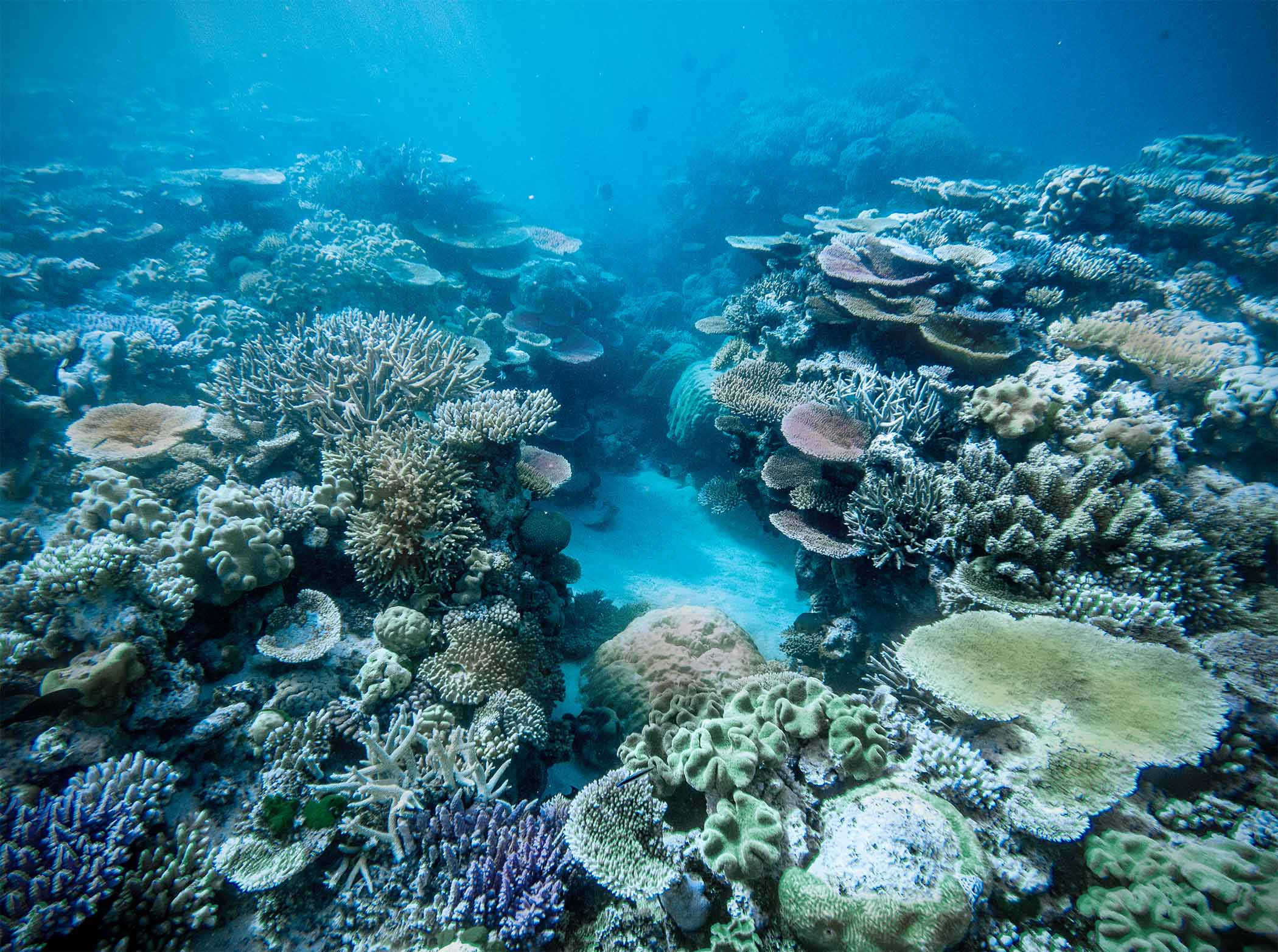
Diving underwater off Lizard Island’s North Point, you can explore the reef known as Coral Palace. Looking around we can see some of the more recognizable coral species such as staghorn coral that resemble antlers, the flat plate coral, and brain coral. Around Lizard Island, more than 150 species of coral can be found—a small subset of the over 600 species found throughout the Great Barrier Reef. Coral reefs make up less than 0.1% of the ocean, but they provide homes for more than 25% of all marine life. Many of these species are still yet to be identified or formally described by researchers. Coral reefs are also crucial to our own health as they create 50 to 80% of the Earth’s oxygen. Scientific research and indigenous knowledge of the land and reefs surrounding Lizard Island allows us to better understand the planet’s overall health. Coral reacts to even subtle changes in ocean temperature, acidification, and other effects of the climate crisis.
Anne Hoggett
Compared to other coral reefs, the Great Barrier Reef is significant for several reasons. Firstly is its size. It's massive. It's 2,400 kilometers long, and it's made up of more than 3,000 separate reefs and islands, so it's huge. And that size gives it some resilience because if one part of the reef is damaged, then another part may not be, and that gives the opportunity for spawn and animals to move in to replenish the area that has been badly affected. Also, Australia is a developed country, and we don't need to use the Great Barrier Reef for subsistence as most coral reefs are around the world. There are coral reef fisheries, of course, on the Great Barrier Reef, but they're managed quite well, as well as a lot of other stresses. Australia is a developed country, and it has the resources and the marine science community to make sure that we look after it.
Alexandra Skeer
Corals provide food, shelter, and environmental stability to a third of marine life. They support one billion people worldwide and have a global asset value of close to 13 trillion dollars. Not only this, but every second breath you take, you can say thank you to the ocean. Half of the oxygen we breathe comes from our oceans. They are the lungs of our planet, and coral reefs represent a critical resource within these systems. Without coral reefs, we don't have those systems, and without the health of those systems, we don't have our own health.
Stop 4. Relationships on the Reef
Across the Great Barrier Reef, there are nearly 3,000 individual reefs similar to what we see here at Coral Palace. These reefs create a diverse range of marine habitats and provide a unique look into the symbiotic relationships where marine animals rely on one another. These relationships are the cornerstone of life on a reef and are vital to creating nutrients to support biodiversity and sustain reef resilience. Coral themselves are excellent examples of symbiotic relationships as they are colonial animals. Each individual coral is actually made up of thousands of smaller organisms that give the coral their color and shape, and provide energy. With over 1,500 species of fish and dozens of other marine species including sharks, rays, and sea turtles, countless other types of relationships can also be observed on the reefs. Even parasitic relationships, where only one species benefits from the interaction, are a necessary part of the ecosystems here.
Anne Hoggett
Relationships between creatures on the reef are key to understanding the ecology of coral reefs. There's so many of them, and the reef wouldn't operate properly without them at all. One set of behaviors that I really love to watch, and it's easy to see, is the cleaner fish going about their business. Cleaner fish are little wrasses about this sort of size, and they eat parasites off the skin, gills, and mouths of larger fishes, relieving them of these parasites, which irritate them. They're annoying. They're like mosquitoes on us, and like mosquitoes, they spread diseases between the fish, so it's a really good service to the whole coral reef community. So the cleaner fish will go up to a client fish who poses, opens its mouth, opens its gills, and allows the cleaner full access. And normally, these bigger fish would eat things like these cleaner fish, but they don't because they're getting this fabulous service in return. The cleaner fish from this interaction get food from eating the little parasites, but they also get access to mucus on the skin of the fishes, which provides them with chemicals that they don't produce in their own body, but which they need to make sunscreens for themselves. So it's a win-win for both parties.
Alexandra Skeer
In nature, nothing exists in isolation. Even the colony of coral that you see is hundreds of individual animals, and it gets even more complex than that. Within their tissue, there is tiny unicellular algae that lives its entire life cycle throughout the body of that coral. So when you see a coral, you're seeing a city of organisms. The algae that lives inside of it, it doesn't just provide the color that you see in coral, it also provides up to 90% of the coral's food. This isolation that we consider ourselves a part of is just not existent in the rest of nature.
Stop 5. Threats to the Reef
Moving farther off the coast of Lizard Island to MacGillivray Reef, affectionately known as Mac’s Reef, we see another ecosystem showing a variety of coral in many shapes and colors. This reef is closer to the ocean shelf, inviting a more diverse mix of marine life. Healthy reefs are vibrant and bustling with activity. By contrast, unhealthy coral lack color and have very little marine life. The coral species found around Lizard Island are some that regrow the fastest after damage. However, they’re also some of the first to disappear during environmental threats. One of the foundational threats facing corals are globally increasing temperatures. Higher temperatures lead to a number of marine threats, including marine heatwaves, ocean acidification, bigger and more frequent storms, and more invasive species. Each of these threats have cascading effects on the health of the reefs and biodiversity when the coral are not able to recover from these events. These losses also have consequences for the Traditional Owners as they lose access to a sacred place vital in keeping cultural practices alive.
Anne Hoggett
There are three major threats, and I've seen them all. Firstly is crown-of-thorns starfish outbreaks. These starfish eat living coral and leave dead coral behind. And I've been there through three major crown-of-thorns starfish outbreaks, and each time I've seen the reef recover really quite quickly from that. The crown-of-thorns don't eat the whole coral. They leave bits behind, and that enables the corals to recover reasonably quickly from a crown-of-thorns starfish outbreak in the Lizard Island area. It's different further south. Another major impact on coral reefs are cyclones, especially big cyclones, category three and category four. And it's those really big cyclones that can strip corals completely back to bare rock from coral reefs, and they can cause enormous damage. We've been through a couple of those at Lizard Island in my time, and they take a while to recover from because they just remove coral from everywhere. And that really requires coral larvae to come in from somewhere else to settle on that bare rock and rebuild the coral. So you need to have reefs nearby to enable those corals to come back. The last major impact on coral reefs is coral bleaching, and that's really a new thing. The first worldwide mass bleaching event was in 1998, and we didn't get that at Lizard Island. The first bleaching that we ever saw was in 2002. In the scheme of things, that was a relatively minor one. Now, coral bleaching is caused by warm water, and that warm water is caused by us putting too much carbon into the atmosphere. So this is a brand-new threat to coral reefs that we have caused, and it's a really terrible one. At Lizard Island, in four consecutive years, we had two major cyclones, followed by two marine heat waves, and by the end of those four years, the corals that hadn't been swept off the edge of the reef by the cyclones had been got by coral bleaching. They were dead. It was total annihilation, and it was utterly heartbreaking to see. That finished in 2017. That was all over. Since 2017, we've had coral bleaching almost every summer, and that was not the case before that. So these bleaching events are becoming more and more frequent. And even though since those four annihilation years, reefs in some places have bounced back, and they've bounced back amazingly in some places, they're still getting hit almost every summer with new events of coral bleaching. It doesn't kill the whole reef. It kills the more susceptible corals. It's kind of shocking.
Alexandra Skeer
Three of the biggest threats our coral reefs are facing are rising sea temperatures, where it's too hot for the corals to handle, ocean acidification, which is weakening the skeleton system of the corals, and ocean deoxygenation, where the oceans don't have enough oxygen in them anymore to support those coral reefs. These are all huge, but it doesn't mean that these corals can't recover from it. They are so resilient. That entire ecosystem is dynamic and it can bounce back, and we've seen this happen time and time again. It just needs the time to be able to do that.
Vernon Yoren
With the climate change, it did affect a lot of the Traditional Owners. And with the reefs all around the islands, and with the water levels and the heat, temperature of the water, it's destroying the reefs.
Stop 6. Reef Resilience and Vulnerabilities
Moving to another section of Mac’s Reef, we see more examples of bright, healthy, and resilient coral. Fossil records show us that coral have existed on Earth for millions of years. However, their existence is reliant on having time to recover from threats or changes to their environment—longer and more frequent damaging events decrease a reef’s ability to rebound. Over time, this creates what is known as “resilience debt.” Coral reef health is also linked to the economic health of the regions where they are found. Preserving coral reefs helps tourism in the area, as well as fisheries and aquaculture. Reefs also provide coastal protection by acting as a natural barrier against large waves that could hit the coastline, reducing flood damage from storm surges, and preventing coastal erosion. Researchers, Traditional Owners, and local communities are working towards rehabilitation of coral reefs after they are damaged. However, political action is key to protecting the reefs and the health of our oceans. Rehabilitation work can only help to a point before greater policy changes are necessary to address the root causes that threaten coral reefs.
Anne Hoggett
Beyond the existential and economic downsides to losing coral reefs, to me, the other downsides are moral and emotional ones. If we lose coral reefs, we're losing a huge chunk of biodiversity that is so important to us, and the reefs are so beautiful. All those species will be gone. The reefs are just so beautiful, it's unbelievable. And even if you never see one in life, just to know that they're there is amazing. We started damaging reefs in ignorance, but now we know what we're doing, and we know how to stop causing that damage. We really should do it to keep these beautiful ecosystems on our planet.
Alexandra Skeer
In 2016 and 2017, the Northern Great Barrier Reef and around the Lizard Island area experienced these huge back-to-back marine heatwaves. Many of the reefs bleached, even some of them dying completely. But what this region shows is that reefs are so resilient and can come back. They are showing us a message of hope. They can be saved, and our future with the reef can be secured by putting in climate action and policy within our governments.
Vernon Yoren
Hoping for a better future for myself and for them. I'd like to see, as an Elder, yeah, and looking after what's there today. Combined it together, and working together, walking together, and listening to each other, and respecting each other. Yeah. And sharing that knowledge together.
Stop 7. Looking to the Future
Lizard Island and the surrounding reefs provide insight to a complex ecosystem. Here you can find extraordinary biodiversity that serves as an important environmental and cultural resource. The Traditional Owners have cultivated a connection with the Island and surrounding waters for thousands of years, witnessing and adapting to the constant changes that occur in marine environments. By understanding the reef and the impact of a changing climate, we can gain more respect for this irreplaceable natural wonder. Coral reefs have shown resilience, but increasing threats from the climate crisis are placing unprecedented pressure on their ability to recover. Protecting the reefs requires not only continued research and conservation, but also meaningful action.
Anne Hoggett
I think people should care about the Great Barrier Reef, even if they've never seen a coral reef or even the ocean, because it's one of the most amazing places on the planet, and it's great to know that it's there, even if you personally don't get to go there. We have the opportunity now to see fantastic stills and videos of these places, and I think people can share vicariously these beautiful environments that we have. But reefs particularly are important for their diversity, the number of things that live there. It's incredible. Reefs occupy a tiny proportion of the Earth's surface, yet 25% of all marine species live or have some part of their life on coral reefs. That's incredible, and that's because of the habitat that coral reefs provide. It's those beautiful corals that make intricate patterns and make little holes and crevices for other things to live in that enables that diversity to exist there, and that's really important on Earth.
Alexandra Skeer
One of my favorite moments on the Great Barrier Reef was just off Lizard Island. There's this dive site that I'd dived so many times before, and every time I would have a slightly different experience there. This one dive, for 40 minutes, I was followed right next to me, maybe two, three meters away, by a white-spotted eagle ray for the entire duration of the dive. He was my dive buddy, and it made me feel so connected to that experience and to that location, and it was just something that I knew not many people get to experience, and I felt so lucky and so much a part of the world.
Vernon Yoren
Well, normally when visitors are ready to go, well, the night before they go, the next day, we share a corroboree with them. Yeah, we do a little celebration there, cultural dancing. Yeah, and that's part of our goodbyes then. Farewell. I'd say... [speaking traditional Dingaal language] I'm telling the friends that just going, maybe next time we'll meet again.