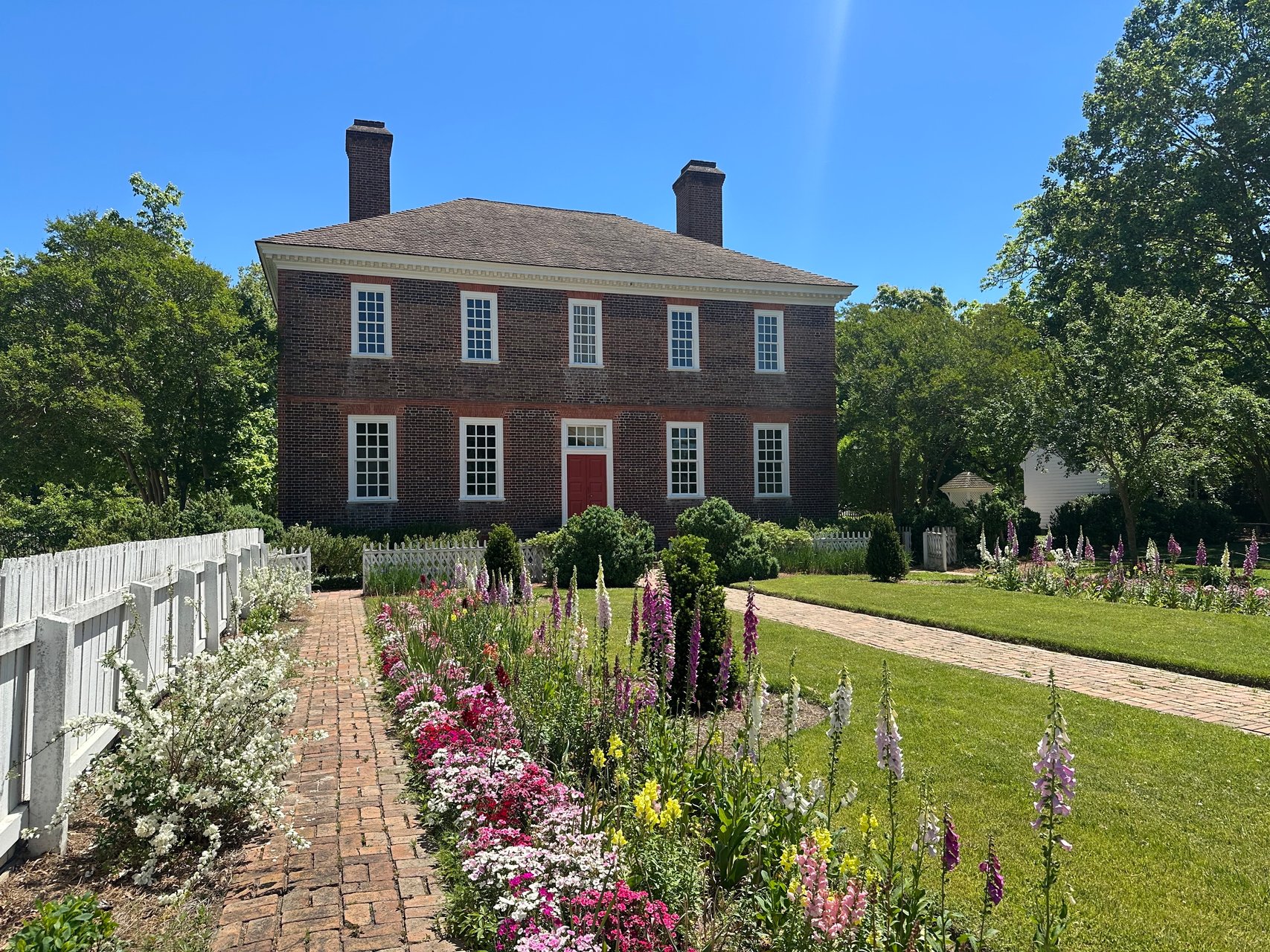
Welcome to The George Wythe House
Welcome to the George Wythe House located in Colonial Williamsburg’s Historic Area. Inside this historic home lived one of revolutionary America’s most influential minds, George Wythe, one of 56 delegates that signed the Declaration of Independence. In the Wythe House, Virginia’s leaders came together for entertainment and education. George Wythe’s longtime student and friend Thomas Jefferson spent many hours here talking about law and politics. During the Revolutionary War, George Washington briefly used the house as a headquarters. Throughout this experience, you will hear from historical experts and historians describing the life of George Wythe, the people around him, and the house itself. Click the images at the bottom of your screen to meet these experts.
Stop 1. Who was George Wythe?
The two-story home was built by Richard Taliaferro around 1755 when his daughter Elizabeth married George Wythe. It is believed that Richard gifted lifetime use of the home and property to the Wythes as a wedding present. Beyond the Wythes, there were a number of people who lived on the property, including many of George Wythe’s law students and long-term guests. By the mid-1780s, as many as 17 enslaved people lived here. The original eighteenth-century structure has survived, and today the house is part of The Colonial Williamsburg Foundation, a nonprofit educational institution that operates the world’s largest U.S. history museum—bringing the stories, people, and ideas of eighteenth‑century America to life to inspire learning about the nation’s past and its relevance today. Surviving evidence does not allow for an exact copy of the interior of the house as the Wythes lived in it. Instead, the furnishings were re-created based on historical evidence about the Wythe household as well as information about other homes of similar social class from the time period.
Robert Weathers
George Wythe is a titan of the pre-revolution revolution. and early Republican periods, not only here in Virginia but throughout the 13 colonies who would become the 13 United States. He is most famed perhaps as the man who was the tutor of Thomas Jefferson in the law, but he also was the first professor of law in all of North America. Only the second in the English-speaking world. He also was the signer of the Declaration of Independence. He's the man who filled Washington's seat at the Continental Congress. And when I tell people about George Wythe, I say, he's the most important man you've never heard of. When he dies in 1806, the President of the United States, the Chief Justice of the Supreme Court, an Associate Justice of the Supreme Court, the Attorney General of the United States, the Attorney General of Virginia, the President of the College of William Mary, two United States Senators and then multiple other members of the Virginia government are all students of George Wythe.
Caitlin Simpson
In the 18th century living here in this property is going to be George Wythe, his wife Elizabeth Taliaferro Wythe, and then normally about 12 enslaved people are going to be occupying this property too. That's going to include individuals like Lydia Broadnax, Fanny and her 3 children, Polly and Charles and Ben and Michael. We know there were a lot of nieces and nephews who were going to be living here as well, too, at various times, and at least 1 or 2 students are actually going to board here with Mr. Wythe while he is tutoring them in the law.
Grahame Long
Colonial Williamsburg is a unique place to say the least. It is an incredible collection of buildings and artifacts and people that all tell an amazing American story. The George Wythe House is part of a larger collection of many many buildings that make up Colonial Williamsburg. It's not any more important or less important than some of the other ones, like the Randolph or the Thomas Everard. And it does represent the key representative, really, of the socio-political, economic movement of the importance of Virginia in the American Revolution, and the years before and the years after.
Stop 2. The Parlor
The parlor was a multipurpose room that changed and adapted to provide the appropriate setting for many different occasions. Here you will find furniture suited for entertainment with music, dancing, and games, including several chairs, a harpsichord, and convertible card table. It is possible that George Wythe also used this room to teach. A large hole can be found in the shutters, which may have been fitted with a solar microscope to project images from slides using light from the sun. In 1781, George Washington also used the Wythe House to strategize and plan the Yorktown Campaign. These gatherings included other notable figures such as General Lafayette.
Robert Weathers
Mr. Wythe's social status is reflected in the people who come to visit his household. By the fact that these men are government men. Mr. Wythe is a member of even what they call the better sort, what we would refer to as the gentry sort. This is the top two percent of all of Virginians. And indeed, because of his station he is expected to serve in government. And he does in various capacities. And so people from the general court or from the House of Burgesses, or eventually the Virginia House of Delegates, the Virginia Senate, the governor himself, whoever that may be at the time, were likely to visit somebody like George Wythe and do come into the household.
Caitlin Simpson
The parlor really is a place for entertainment more than anything else. This room can be set up however it needs to be. You can pull tables from the edges into the center for afternoon tea or a game of cards, maybe. You can also move everything out and have dancing going on in this space as well, too. So a lot of that work being done by the enslaved people to set it up at a moment's notice for any type of guests that might be coming over or any type of event happening. In 1781, when George Washington is using this house as his headquarters before the Battle of Yorktown, we think the parlor is going to be the main place where a lot of the strategic planning might have happened. So you might have seen tables here with maps and strategy being planned plans for where they're moving troops, things like that, but probably going to be more of an official meeting space more than anything else.
Grahame Long
With the George Wythe House, unlike other houses around Colonial Williamsburg. We don't have as much hard period data as we would probably like. In other words, there's no real probate inventory here. There's no estate records. We do have those at other places, but not necessarily here. So we rely heavily on those of other local sites. Inventories and, specifically where they do exist, houses that would be of equal structure, equal size, owned by people of equal place in society. We also have archaeological records, which do come in handy quite a bit. And we also have microscopy and paint analysis and things that will kind of help us decide what is period appropriate for someone like Wythe, like what he probably would have had in his house. What helps us with the Wythe House furnishing plans are that we at the very least know the people who are in them. We know a lot about Elizabeth. We know a lot about George Wythe, certainly. We know about his career and his life and his dealings. So that also, on top of the scientific record, the social record, helps immensely in what furnishings to choose and how those are represented and interpreted.
Stop 3. The Dining Room
Like the parlor, the dining room was a multipurpose space reflecting the Wythes’ gentry status in society. The house saw many kinds of gatherings. The view of the room as you see it here shows what it may have looked like during a meeting for the Society for Promotion of Useful Knowledge—established as part of the Enlightenment-era movement to advance science, industry, and practical learning. The house was a temporary residence for Thomas and Martha Jefferson in 1776, while George was in Philadelphia.
Robert Weathers
The Society for the Promotion of Useful Knowledge is a reflection of other gentlemanly societies across the Western European landscape for the purpose of endeavoring into what they refer to as natural philosophy. What we might refer to as science, but also moral philosophy, what we in our modern day refer to as philosophy. They enter into the business of discussion of varying topics. Oftentimes gentlemen are assigned a topic to make a discussion on, and while they sit and enjoy a bowl of punch or enjoy a meal, they might do things such as use Wythe’s solar microscope. They might entertain a lecture on electricity. They might entertain a lecture on the planets, the great spot on Jupiter, the moons of Jupiter and how they orbit, or any other various topics that were popular in the time.
Caitlin Simpson
A dinner in the 18th century typically could last many hours. Starting early afternoon, going late into the night, with many courses being prepared by enslaved individuals in the outdoor kitchen. Mrs. Wythe is going to be coordinating a lot of those efforts, signaling to enslaved people standing at attention at the edges of the room when it's time to bring in another course or to take something away or bring more of something. So I like to imagine all the conversations that they would have been hearing in this space. The dining room was a place for all sorts of conversations, political and educational, and you've got a lot more than just those sitting at the table that are hearing those conversations, even if they can't respond to them.
Grahame Long
Dining rooms like yours and like mine can have multiple purposes. There's usually a table in them. There's usually chairs, some decorated, not of some kind of high quality. Whether that's British or American. But dining rooms become also, in this day, presentation spaces. So again, like with parlors, you have meetings, you have conversation. You have, it's not necessarily just a place to eat dinner. And in Georgian architecture such as the Wythe House, it's the furniture that really dictates that. Now look at the bigger picture of a dining room. How is it decorated architecturally? Wainscoting, any type of decoration. In this dining room in particular we have a beaufat. So that is a display cabinet for your best and brightest ceramics and glassware and silver and all things that would go into a dining room. So it is a presentation space. But as you'll see in different cases where we do seasonal changes here, it could be a meeting space. It could be a place for political conversation. Could be any number of things depending on what Wythe's going on in that particular week.
Stop 4. The Back Chamber
The back bed chamber has been interpreted as Elizabeth Wythe’s office, where she would have carried out all her responsibilities as the wife in a gentry household. The location of this room is important as the large windows overlook the property’s gardens and outbuildings, including the kitchen and the laundry, where much of the daily work was conducted by the enslaved people that lived and worked on the property. The room also may have served as the summer bed chambers or as Elizabeth’s private bed chambers at the end of her life as she dealt with a long-term illness until her death in 1787.
Robert Weathers
Mr. Wythe appears to go through a conversion of thought in regards to the institution of slavery around the mid 1760s. It's at that time he converts his family property away from tobacco which is heavily labor intensive to cattle and potatoes, which is decidedly not. But the real action comes after the passing of Mrs. Wythe in 1787. After Mrs. Wythe passes Mr. Wythe begins to remit himself of any enslaved people in terms of property. And so by the time he moves to Richmond in 1791, he owns no enslaved people at all.
Caitlin Simpson
Mrs. Wythe would have been essentially acting as the property manager of this entire estate. She was the one overseeing tasks being done in the laundry or in the kitchen by enslaved people in those spaces. She was doing expense accounts and record keeping and supply management, ordering everything that they needed to show off and be one of the most fashionable houses here in town. She has a decent amount of work, even if the labor itself is being done by the 10 to 12 enslaved people here on the property. She was working closely with Lydia Broadnax in the kitchen, maybe preparing the menu, maybe letting Lydia do that but making sure everything gets done. Fanny, having everything she needs to do the extensive amount of laundry happening in here as well. In fact, when she passes away in 1787, a close friend of George Wythe describes that there are a million tasks that vex him constantly that he never knew actually was being done here. Many of the enslaved people actually returned to her family upon her passing, as they're not technically belonging to George Wythe. So he's left with just a few individuals running a very complex household. So things change pretty dramatically for them.
Grahame Long
The chamber in the house which we have interpreted as a space for Elizabeth Wythe is a critically important room. Just the placement of the room within the house is important. As you look out the window you see the outbuildings and the enslaved spaces. So that was a room of observation and supervision for the daily goings on. Mrs. Wythe's management of the house is very likely coming out of a space like that. The desk and bookcase which would have been the business heart of the activity that's going on here George Wythe finds out very quickly how difficult the management of this house is when Elizabeth Wythe died in 1787. He is overwhelmed with the detail of which she carried out the management and the other hidden details that he wasn't necessarily aware of. Like the work of Lydia Broadmax, the work that went into a space like this becomes very visible. That's something that Elizabeth Wythe would have been very aware of. George Wythe becomes aware of later on.
Stop 5. Mr. Wythe's Office
Trained as a lawyer, George Wythe had many interests and was curious about the world. His office, like other rooms in the house, features a variety of scientific objects and instruments in addition to his expansive library of law and philosophy. Beyond his normal business and law interactions, George would have used his office as another space in the house to teach. Until late in the eighteenth century, there was limited access to law education in North America as there were no traditional law schools. The most common way individuals pursued a career in law was to find an existing attorney who would take them on as an apprentice and educate them. In 1779, George Wythe became the first professor of law in the United States at the College of William & Mary.
Robert Weathers
In the 18th century prior to independence there were three passages, by which one may take to become an attorney in Virginia. The first and most common was the way that Mr. Wythe actually became a lawyer, and that is to be apprenticed for generally about four years to a practicing attorney. Mr. Wythe goes through this practice. Of course, all of his students go through this practice. The vast majority of lawyers in Virginia are apprenticed. Another way you come to the bar is perhaps the least likely, and that is to attend and read the Inns of Court in London. This is prohibitively expensive. To give you an idea, a tradesman in Virginia probably has for their own purse, their pockets about 30–35 pounds in a year. The cost of crossing and room and board and tuition, and then just the general expense of living in London, could easily exceed a thousand pounds per annum. So even Mr. Wythe, who is a member of the better sort, could not afford to attend to the ends of court. Now, if you do attend to the Inns of Court, you are not a lawyer per se but rather you are what's called a barrister. Lawyers are confined to particular jurisdictions such as a county or a borough, a city, etc. But barristers are only bound to the jurisdiction that is the British Empire. And then the third way is to simply read on your own, and then approach the bar to be examined. Patrick Henry takes this way, although I dare say Mr. Wythe himself would not recommend this particular method.
Grahame Long
The interpretation that you see in the Wythe house today interprets as best we can tell, as the best records show who Wythe was as a person. He is deeply interested in a number of different things. He's a jurist. He's a politician. He is a professor. He has got a lot of little fingers and a lot of little pies, and this house reflects that. So on top of maybe your expected furnishings you'll see how Wythe was incredibly interested in science. He has a genuine interest in the betterment of society, which leads to his membership in the Society for the Promotion of Useful Knowledge. We know he kept scientific instruments in this house to be used in conversation and be used in demonstration to help just spread to aid in just general knowledge, what they call useful knowledge. How is that useful? Well, they're all going to figure that out.
Stop 6. The Kitchen Outbuilding
Like many homes of the era, the kitchen was located in one of the buildings outside the main house. This two-room building included a space for cooking and meal preparation, as well as an area where enslaved members of the household slept. Lydia Broadnax was one of the most well-documented enslaved individuals in the Wythe House. She likely lived in this space. Historical documents suggest that Lydia played a significant role in the Wythe House, likely working as a cook. George Wythe’s perspective on slavery changed gradually over time. By the 1760s, he began to raise questions about slavery. In the late 1780s, after the death of Elizabeth, he began to take action to emancipate some enslaved people, including Lydia, Ben, Polly, and Charles. By the end of his life, Wythe no longer legally owned any enslaved people. Two formerly enslaved individuals, Lydia and Ben, followed George to Richmond, Virginia, and remained in his service through the end of his life as paid servants. Lydia also witnessed the poisoning that led to George’s death in 1806. However, because she was Black, she was not allowed to offer this crucial testimony in court. As a result, no one was ever convicted of Wythe’s murder.
Robert Weathers
On the morning that George Wythe is poisoned. It is Lydia who sees what happened. Unfortunately, because she is Black, Virginia law does not permit her to testify. Against George Wythe, Sweeney and he is acquitted of the action.
Caitlin Simpson
So there's not a lot we know about Lydia, but there's more than a lot of people expect. We don't know where her surname Broadnax comes from, but we know she takes that by the end of her life. We don't know exactly when she comes to this property. Our first records are from the 1780s, but we're pretty sure she was part of the household much, much earlier than that. We believe that Lydia was responsible for most of the cooking here on property, but probably held a pretty trusted position, pretty high within the site itself, and a lot of what she was trusted with — We know that she was manumitted within just a few short weeks of Mrs. Wythe's passing in 1787, but she does remain here on the property. When George Wythe decides to move to Richmond in 1791, she actually chooses to follow him, and she remains in his service as a paid staff member for the rest of his life. Now we really don't know exactly why. We don't know what life she was leaving behind when she moved to Richmond. We don't know if it's because she truly loved George Wythe or anything, but I like to imagine all of the choices that she was able to make after receiving that her legal freedom from Mr. Wythe.
Grahame Long
Including the kitchen, laundry, whatever outbuildings can survive or be reconstructed. It is vital to telling the entire story of a place like the Wythe's. You can see the main house, it's pretty, it's nice. You can learn all about George Wythe, but how does all this work? Sometimes you have to look beyond the main walls and see how everything comes together. Full circle, and what that work really looks like. And it's not always pretty.
Stop 7. The Lumber Room
Entering the house again and going upstairs, you'll find the Lumber Room. While typically serving as a storage space in houses of similar social status, George Wythe likely used this room to host and teach students. This room is currently staged with teaching objects and scientific instruments. It also features another set of shutters with a large hole that could have also been used as a second location for the solar microscope in the house, to be used according to the sun’s changing location during the day. A straw-stuffed pallet can be found in the corner that may have been used as a bed by enslaved individuals. In addition to Thomas Jefferson, other well-known students of George Wythe included Henry Clay, John Marshall, as well as other future governors, senators, and supreme court justices.
Robert Weathers
I would say, and I think Mr. Wythe would say as well, that the most important thing that came of his students is the friendships that he made with them. Mr. Jefferson refers to George Wythe as his mentor in youth and friend throughout life. And even though it may sound somewhat modern to say, Mr. Wythe refers to Thomas Jefferson as his best friend. His legacy, his progeny, is that. It's his students. And so I sometimes am asked why we don't know Mr. Wythe in the modern day, even though he was such an influential figure in the period. And there are many reasons why. But I think in the mind of George Wythe himself, he might say that it doesn't really matter, because we know who his students were. And that is the legacy.
Grahame Long
The lumber room is by classical definition, sort of a store what you and I would call a storeroom. It's where furniture you're not using may be stored. You've got some crates or boxes of things. It's like kind of like an attic for you and me. The lumber room here because of Wythe's work in the law, and his work in the education of the law and teaching students, it's a fairly safe bet we would think that he is using his lumber room as more of a classroom and a place to educate young minds into how to drive, what he hopes is going to be a new independent nation.
Stop 8. Mr. & Mrs. Wythe’s Bed Chamber
This was the primary bed chamber for George and Elizabeth. The two were married for 32 years and had no children; however, relatively little else is known about their personal lives. After George moved to Richmond in 1791, the house changed hands many times and served many purposes until 1926, when it became rectory for the neighboring Bruton Parish Church. Rector W.A.R. Goodwin used his office in the home when planning the restoration of Colonial Williamsburg. The large shutters in the room were once connected like those in the rest of the house, but Dr. Goodwin cut the shutters in half to be able to manipulate the light throughout the day. Much like it had been in the eighteenth century, the Wythe house remained a place of experimentation and enlightenment.
Robert Weathers
After Mr. Wythe moves to Richmond he is no longer the professor of "Law and Police" at the College of William and Mary. But he does continue to sit on the High Chancery Court of Virginia. It's from the bench where he rules a couple of times in opposition to the institution of slavery, but he also acts in his private life. He takes a described young Negro boy by the name of Michael Brown into his household and he teaches him Greek and Latin. Richmond is the new metropolis; it is what Williamsburg once was, and his ties to Williamsburg are severed. But the lessons that he learns and teaches in Williamsburg influence him in Richmond, especially in regard to the institution of slavery itself.
Caitlin Simpson
Unfortunately, there's not much we know about the relationship between George and Elizabeth Wythe, but it really seems like they do have a very loving relationship from what other people have talked about. They did not have any children, and we don't unfortunately know why. It could be for 100 different reasons. But he writes very lovingly of her in retrospect, and seems to have really been a friend to each other through their lives. I like to imagine him teaching her all about the new scientific discoveries he's making and the fun things that he's working on with his students at the time, and talking to each other just like we would think of today.
Grahame Long
George Wythe moves to Richmond. The house, uh, ultimately goes from different owner to different owner to different owner, which is usually a death sentence for colonial American houses. In this case, we're just incredibly fortunate that most of it survives. Not necessarily in its pristine original form, uh, this house coincidentally has a pretty important role in the restoration movement of Colonial Williamsburg in the early 20th century. This room becomes, uh, an office space for the rector of Bruton Parish Church, Reverend W.A.R. Goodwin. It's Goodwin whose grand idea is to restore Colonial Williamsburg to its original appearance, and begins meeting with John D. Rockefeller Jr. to finance this grand mission, uh, that ultimately produces, uh, by mid-20th century, Colonial Williamsburg, which we to this day are adding to and expanding and researching and improving.
Stop 9. Labor of Many
George Wythe had an extraordinary impact both through his influence on the early political development of the United States, but also through his long legacy of students. While the George Wythe House acts as a museum space today, it was once an active home, where real people lived and worked. It was the labor of many people that enabled George to accomplish what he did—Elizabeth, the enslaved people, and his students—all contributed to creating the opportunities and time for him to make such a profound impact on the world.
Robert Weathers
Make no mistake. George Wythe is one of the most influential figures of the early republican period, both in Virginia and in the United States. He is a man who carries so much clout that one biographer says he elicits more lines in eulogy than Washington or any of the other founders. But he didn't do this alone. Mr. Wythe is supported by a vast network of enslaved people who attend to his needs, who clean his household and organize his office. Mr. Wythe is also supported by Mrs. Wythe, who tended to his household, oversaw the daily business of things so that he could do things like sit and read ancient Greek and ancient Roman and Cervantes in Spanish. And somebody who should also be noted is Mrs. Wythe's mother. Her name was Margaret Walker Wythe, and the period sources conflict on this, but we know that she took the time to teach him to read, either Greek or Latin or both, a skill that he carried through life and imparted onto the most influential men of the next generation of Virginians and United States citizens. All of these people combine to form someone that we sometimes will point at and say, look, one man truly can change the world. But it wasn't just one man. It was the actions of many individuals who happened to focus upon this one man that changed the world.
Caitlin Simpson
I really want people to understand just how important education really was in the 18th century. And even for us today too, how influential small individuals can sometimes be. George Wythe was a very humble man, and he didn't like to talk about himself or leave a lot of writings about himself. But his students wrote so many wonderful things about him that we're still able to have today. And education is so important for allowing people to make all the choices that they did. We have so many people on this property who are making choices every single day about all the small things in their life, whether they were free or enslaved. They used the education that they had access to to make the best choice for themselves in that moment. Everybody had different motivations, but you've got so many individual stories here that we know a decent amount about, enough to have a really fun picture of everybody.
Grahame Long
Colonial Williamsburg's efforts of preservation are critically important. at the Wythe House at the Randolph House at the Capitol at the Palace, all of our collection of hundreds of buildings within this restoration project. ongoing restoration project is a daily task. This is not something that we rest on our laurels. We are constantly researching, we are constantly caring for, we are constantly looking out for ways we can improve. Does the research change? Technology changes, archaeology continues that helps us better interpret and better understand properties. So what we know now very likely won't be what we know tomorrow, and that's the exciting part of it.