Welcome to Great Zimbabwe
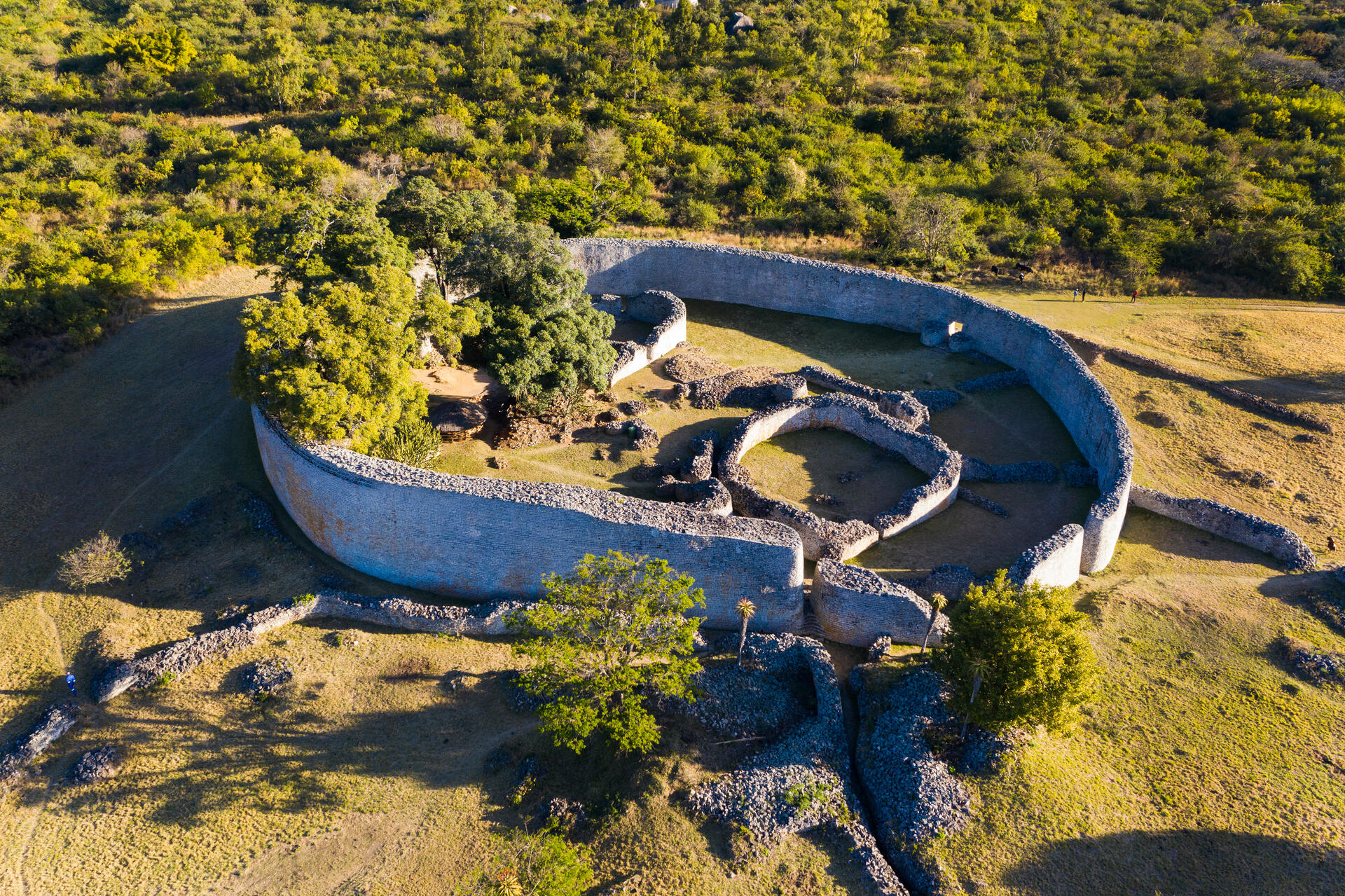
Welcome to Great Zimbabwe National Monument, a cultural heritage landmark for Zimbabwe and a UNESCO World Heritage Site. Nested in the foothills near Masvingo, about a four-hour drive from Harare, this ancient city reveals its grandeur through dry-stone walls and daga (earthen) structures. Built between the 12th and 15th centuries during the African Iron Age, the site consists of the Hill Complex, the Great Enclosure, and the Valley Ruins. As you soar over the Great Enclosure on this tour, you will discover towering walls, narrow passageways, and intricate patterns—testaments to the ingenuity of the Shona people and the kingdoms that flourished here. The name “Zimbabwe,” meaning “houses of stone,” not only shaped the nation’s name and identity, but also symbolizes enduring African creativity and pride. In this virtual experience, you will meet Senior Tour Guide, Lovemore Mwaiyana, Matubede Mhute Mudavanhu or Chief Mugabe, and community members who bring the artistic, historical, and spiritual meanings of Great Zimbabwe to life.
Stop 1. Entering the Great Enclosure
As we pass through the meticulously constructed lintel entrance, we step into the heart of the Great Enclosure, the largest ancient stone structure in Sub-Saharan Africa. This narrow, confined entryway, designed for privacy and defense, controlled access and safeguarded rulers and attendants within. Erected from over a million granite blocks without the use of mortar or cement, the enclosure’s towering walls and interconnected passageways exemplify strategic architectural planning. This site once supported a thriving population with over 10,000 people, making it a center of trade, governance, and worship. For the Shona community, a Bantu-speaking group whose descendants were the original builders of Great Zimbabwe, these stone walls are more than remnants of a past civilization—they are sacred, believed to house the spirits of their ancestors. The site remains active today, with rituals and offerings performed by chiefs from four regions who honor this ancestral significance.
Lovemore Mwaiyana
The Great Enclosure, is a stunning architectural marvel, which was the last major construction, which means over the years population was increasing. ...so there was more labor and their architectural skills were also improving. It stands about 255 meters in circumference, 11 meters high in some of the areas, the walls and the base are about 5 to 6 meters wide. No mortar or any cement was used. So for equilibrium and stability, the base was always made broader. Then it gets progressively thinner toward the top. So it is about 3 to 4 meters, and approximately... ...they used about 18,000 tons of stone. [It is the] second largest single pre-colonial structure after the pyramids of Egypt in Africa.
Matubede Mhute Mudavanhu
It was home to our ancestors. Who performed their rituals in there Which made the earth stable. That was done in Great Zimbabwe by our ancestors Who lived and ruled from there. They were unfortunately removed by the whites. If the whites had not come, even myself I would be ruling from there.
Stop 2. Journey Between Realms
Walking through the narrow passage you experience a profound sense of history. This passage, often interpreted as symbolic, reflects a transition between the earthly and celestial realms. Respecting the spirits was and remains vital to ensuring balance and well-being. During the colonial era, when Zimbabwe was still referred to as Rhodesia, the significance of these structures was contested, with early archeologists misattributing the site to non-African builders and dismissing its connection to the Shona and indigenous people. However, the advanced engineering and craftsmanship of these walls, constructed by multiple generations over nearly two centuries, firmly established Great Zimbabwe as a masterpiece of African innovation. The curved design of the walls, including this passage, reflects a fluid spatial philosophy, contrasting sharply with the rigid and linear architectural traditions popular in the West. Here the interplay of open and enclosed spaces mirrors the Shona worldview, where transitions are part of a deeper connection between the physical and spiritual realms.
Lovemore Mwaiyana
The primary reason for the walls was for prestige, showing the king and his family their elevated status. Secondly, it was for fortification, for defense. And thirdly, it was to shelter some areas from public view for privacy. So the stone structures occupying Great Zimbabwe are divided into three distinctive architectural zones. We have the Hill Complex, which was the earliest... ...construction, and that's where we strongly believed that the king used to stay. Mind you, it took them more than 190 years in construction, which means they could have been 3 or 4 generations involved. Among the Shona in other Bantu-speaking communities, it is commonly said that the high status of chieftainship is comparable to the loneliness and the majesty of hills.
Matubede Mhute Mudavanhu
Great Zimbabwe is where supplications are made I can say it is the umbilical cord of the country. It is where all prayers For the country are made. When people wanted to find Even minerals, they went to ask in Dzimbahwe. After that the miners would go and mine. And come back with gold that was given to the king And those who went hunting, would bring Game Those into farming would get sufficient rain
Stop 3. Ancestral Homes
We now come to the daga structures—mud, clay, and thatch buildings that served as homes for Great Zimbabwe’s residents. Today, only remnants of these dwellings remain, but they serve as reminders of the daily lives of the people who once thrived here. Made from materials that were sustainable, practical, and locally sourced, these homes highlight the intergenerational knowledge and resourcefulness that sustained the Shona communities. The design of the daga structures also reveals a communal approach to living, with shared spaces for work, worship, and social interaction. Throughout these scenes, meet villagers who emphasize the importance of safeguarding traditional practices and vernacular culture, which help to anchor their relevance in an ever-changing world.
Lovemore Mwaiyana
So the the structures were only for the elite, which means commoners were living with other walls. So they actually made pole and dagger structures. So today we can only see innumerable clay buildings. It is evident that it was also a residence outside the walls.
Matubede Mhute Mudavanhu
So this is an important home to the people Because it unites them with their ancestors. It is where most ancestral spirits of the land meet All the ancestral spirit mediums of the land. Know the importance of Dzimbahwe because It is where prayers to Musikavanhu the Creator were made.
Xhotshiwe Maphosa
It is our culture that established Great Zimbabwe. We are trying to have the younger generation get involved in the cultural practices of our forefathers. And also the elders who are losing our culture. We wish for all people to go back to our traditional culture, our ancestral spirits.
Stop 4. Power and Prosperity
The Conical Tower, rising 30 feet within the Great Enclosure, stands as a powerful yet mysterious symbol. Its exact purpose remains debated—possibly ceremonial, perhaps a marker of authority—but its presence commands attention and evokes reverence. The tower demonstrates the engineering vision and skill of Great Zimbabwe’s builders. The structure’s solid, tapered design reflects both strength and sophistication, aligning with the broader architectural techniques of the site, such as the intricate stepping system used for stability. At its height, Great Zimbabwe was a thriving center of commerce that traded with kingdoms across the Maghreb and Asia via vast maritime and land networks; artifacts such as Chinese ceramics, Persian tin-glazed pottery, Arabian glass and beads, and local gold have been found in the complex, revealing the city’s prosperity and role as a hub of transcultural exchange.
Lovemore Mwaiyana
But at the end of the eleventh century, we see gold gained much value in the world market. Hence, we see the rise of Great Zimbabwe, which is strategically located to four major rivers. One from the hilltop can be seen, which has only dammed in 1960, called Mutirikwi. On the eastern side, there is Chiredzi River, Runde and Tugwi in the south. Along these riverbanks there was plenty of alluvial gold, so that within a year they could produce about 25 tons of gold. Unfortunately, these communities never valued gold much. They valued iron instead, so gold to them was just ornamental. It was used as trinkets, for instance. Today, a kilogram of gold is worth more than 75,000 USD. During the time, it was just traded for two blankets.
Matubede Mhute Mudavanhu
Some of the things were done because it's a sacred place. So some of the things were done... ...a person could go with their ritual snuff and say what was troubling him/her. One could go, depending on what instructions had been given by the spirit mediums... ...or one could go with their pot of beer. When they got there, they then said their prayer. [prayer]] So... The question of how the prayers were done, they were done in secret and only known by those in charge of the prayers
Stop 5. Artistry in Stone
The chevron patterns visible at the top of the exterior wall exemplify the artistry of its builders. These “zig-zag” designs were more than decorative. They hold cultural significance, reflecting themes like fertility, renewal, and the beliefs of the Shona people. Similar patterns appear across Shona pottery and ceremonial tools, suggesting their widespread circulation and adoption. Beyond the Great Enclosure, the Zimbabwe Birds—soapstone sculptures of bateleur or fish eagles—symbolize a divine connection between the Shona and their ancestors. Originally placed atop monoliths in the Hill Complex, these carvings are revered as messengers of Mwari, the supreme creator deity in the Shona and Venda peoples’ religions. Today, this bird adorns the national flag, currency, and other emblems.
Lovemore Mwaiyana
“Zimbabwe” simply means “a big house of stone.” “zi” is prefix referring to a big object. “mba” is a root word for the word house. We say “mba” meaning a house. Then “bwe” is a singular noun for a stone. So the name is a “big house of stone.” And the name... ...”Great” distinguishes this site from many others which are spread across the Zimbabwe Highveld. And finally, in 1986, Great Zimbabwe was then proclaimed a World Heritage Site by UNESCO, and it is arguably the fifth largest monument in the world in terms of man-made stone structures. After the Great Wall of China, comes Machu Picchu, South America and Peru. The pyramids of Egypt, Angkor Wat those are series of temples in Cambodia. Then comes Great Zimbabwe.
Lesania Pureni
The artefacts we make for a living here show that If people come visiting they see relics of ancient objects Objects that were crafted by ancient people whom we don't even know But I know that we also make similar objects Which means those coming after us Will continue doing this same work we do So that this place will be remembered And for people to continue visiting, seeing and learning This is a place that we benefit from a lot. Our family livelihoods improve With the coming of tourists who buy our artefacts Some see what we do and will go and try it alone They come back to show us what they will have produced Such people will be creating from tradition This means we should value this place and continue in the ways of our ancestors Those who come visiting Despite that they may see young crafters Because the young crafters are heritage keepers, they are actually elders Their cultural practices are not childish, but are mature
Stop 6. Living Heritage
As we catch a final bird's eye glimpse of Great Zimbabwe, we see more than a medieval monument. This is a living site that remains vital to the identity and heritage of Zimbabwe today. Beyond its historical significance, Great Zimbabwe plays a critical role in cultural and religious practices, drawing visitors and local communities alike. Efforts to preserve this site are not only about protecting its structures, but also ensuring its environment is safeguarded from erosion, climate impacts, and modern encroachments. By honoring and maintaining this legacy, Great Zimbabwe continues to inspire a sense of unity and responsibility for future generations.
Lovemore Mwaiyana
To a traveler, Great Zimbabwe is a creative masterpiece, genius. To a tourist, this exceeds most of their expectations. To a traditionalist, Great Zimbabwe is a shrine. It's one way people will come and connect with their ancestors. It is also a rich source of inspiration to the country. No wonder why it gave its name...in 1980, [the country] gained independence.
Murambiwa Chinoronga
When students move from one learning venue to another Since they will be studying at a university If they start lectures in the morning, and finish in the afternoon You then receive those students After they finish eating their lunch Then you teach them, so that our traditional arts traditional craftsmanship don't die in the country If it were possible I wish that the ideas we have could also inspire others