Jabal Moussa
Welcome to the Byut site, a historic self-sufficient hamlet, or small community part of the Jabal Moussa Biosphere Reserve located roughly 50km northeast of Beirut in Lebanon. French historian Ernest Renan once described this area as “the wildest area in Lebanon.” However, when he saw the mountainside lit up in the evening, he realized people had also made their home on the slopes of Jabal Moussa Mountain With no nearby roads or water sources, why did people choose to live here? In this virtual experience, you will explore the ways that people created a home in this unlikely location and how their traditions of living sustainably with the land continue to be carried on today. Along the way, you will also hear from former residents Semaan Khoueiry and Dib Khoueiry, community members Khalil abi Khalil and Sarkis Atallah, and architect and archeologist Dr. Yasmine Makaroun Bou Assaf.
Stop 1. Cultivating a Sustainable Community
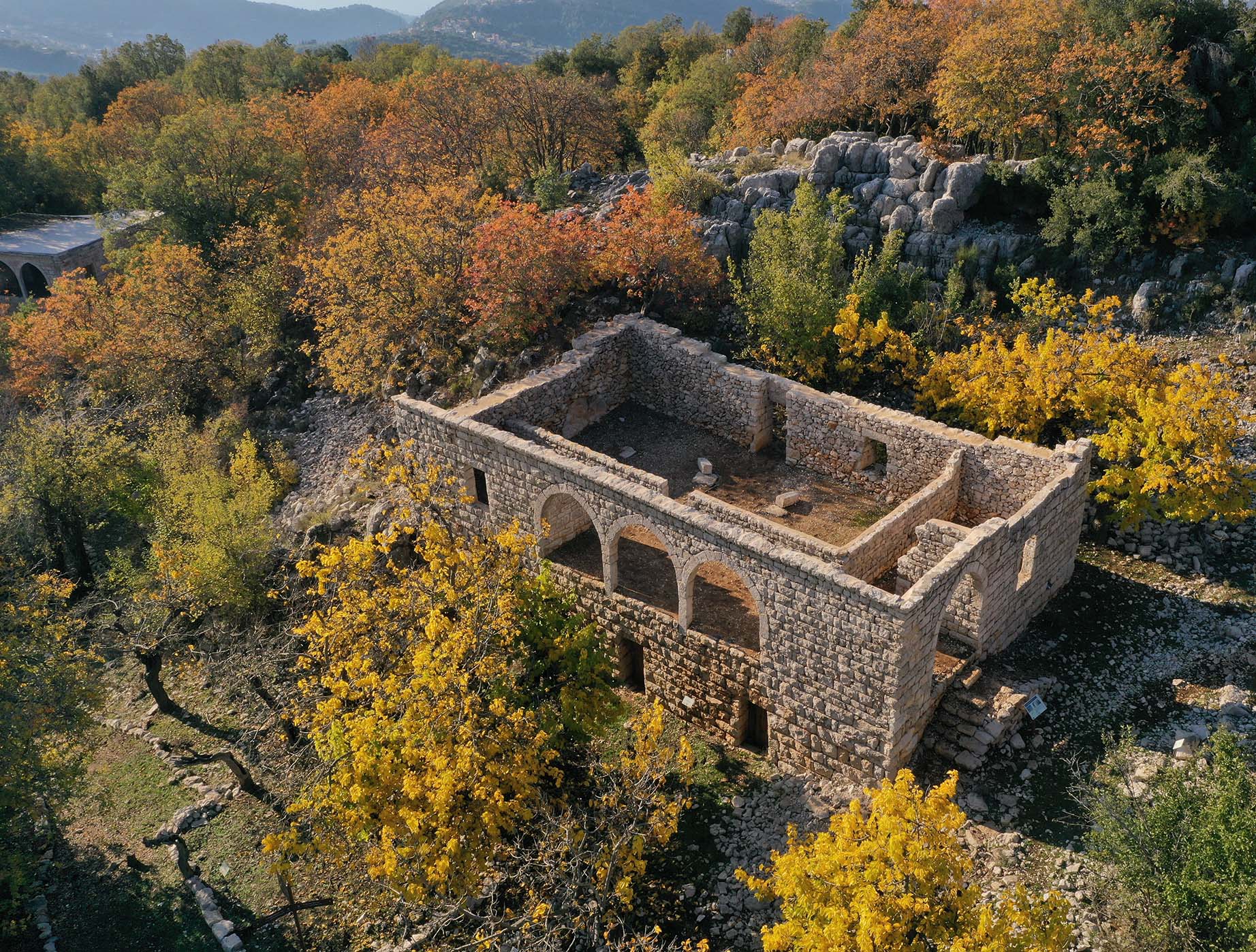
Located more than 1300 meters above sea level, visitors to Jabal Moussa can access the Byut site by foot through a one hour hike up the mountainside. From this view above the Byut site, you can see three vernacular houses meticulously constructed with locally sourced grey-brown stone. What might look like untouched wilderness to some, the surrounding landscape provides clues as to how, for centuries, people cultivated a sustainable relationship with the environment. If you take a closer look at the trees, multiple stems indicate pruning, while the ground below the tallest trees reveals step-like terraces that were used to cultivate moist soil. As you explore the Byut site, keep an eye out for more examples of how people have been able to sustainably use the natural resources of the area.
Joseph Khalil
Oh tourist, when you come to visit us one day For your visit to be sweet and engraved in your memory Visit the houses that aged by the hands of time that left them alone and became abandoned a long time ago There, a story that many people tell About the men who built the houses and installed the beams And there were a girl who harvested wheat and gathered it in bouquets and in the evening She spinned silk, and how joyful she was And the shepherds, in aim to drink, would fill the water in pottery jars From a pure clear well, no turbid water They had no electricity, and they didn't hear news They lived their humble lives, Over the days And now, think carefully, and when you decide to embark on the journey Visit and photograph the site, then frame the photo
Stop 2. The People of Jabal Moussa
As we visit the first home, a two-story stone house built into the mountainside, imagine the echo of people’s voices off the surrounding rocks and the songs of birds through the rustle of wind in the trees. Evidence of people existing in the mountain of Jabal Moussa dates back to prehistoric times. Records show that the first known resident families of these houses we knew about left in 1917. People continued to occupy the homes for decades, with the last resident, Georges el Khoueiry from the village of Qehmez, leaving the 2nd house in 1964. Residents would have continued to maintain the homes year-round. Today, this role has been taken on by site managers who have utilized local materials and new technologies to stabilize the historic structures.
Sarkis Atallah
When we were kids, our families used to tell us, and the neighbors and everyone used to tell us that up in the Jabal Moussa mountain, There are people living there. They have houses and they're up there, happy, farming their land. They have cows and goats. They plant and produce silk, living up there happy and content. They live peacefully, not caring about anything else. They did not care if this one argues with that one, and that one argues with the other. Far away from people troubles, living up there, happy.
Stop 3. Building a Home
A local Lebanese proverb states, “A pile of stones is better than a pile of gold.” As you look at the ashlar masonry visible on the facade of house 1, the care taken in engineering the square stone bricks is clear. Those who built this home would have collected the stone from a nearby rock quarry and utilized other building materials such as mud, lime, water, and wood from the area. The architectural design of the home sheds light on the special relationship these residents had with the natural environment. Built into the mountainside, the second level would have been a living area for the residents, while the space below would have provided shelter for their livestock. The earthen roof, which has since collapsed, would have provided shelter when needed, while the open gallery on the front facade features three arched openings that connect the shelter with the outdoors.
Semaan Khoueiry
Four cows 50 goats And we used to put chickens in that cabin up there And inside that place called “Gallery” at the arches During summer we used to spend best night sleep there During summer During summer, yes what a beautiful sleep!
Dr. Yasmine Makaroun Bou Assaf
The internal walls of these houses have been coated with lime plaster, which is quite typical for the late eighteenth and early nineteenth century. It’s a plaster made of lime, a material extracted locally, on-site, which allows space to be lighted, sanitized and compatible with a sedentary habitat
Stop 4. Work & Livelihood
How did people at the Byut site sustain a livelihood? The people who lived here heavily relied on natural resources, which not only provided them with necessities but also as a source of income. These activities included charcoaling, beekeeping, and raising livestock. The mulberry trees to the left of the front facade provides a clue to another important source of revenue for the residents. According to one of the last residents of the home, the local monastery, owner of the houses and surrounding lands, provided them with silkworms for making silk, in exchange for half of their production. The worms would have relied on mulberry trees as a food source. Utilizing the cocoons of the silkworms and a type of spindle called a “maghzal”, residents would produce silk, a well-known Lebanese craft in the past.
Stop 5. Foodways
An important part of cultivating a community at the Byut site would have been the harvesting, cooking, and eating of food. With the roof no longer intact this overhead view of the home provides a window into the floorplan and areas important for preparing food. Behind the gallery space, the large living room would have served as a space for cooking. A tannour, a type of clay oven, would have been used to make tannour bread, a type of Lebanese flatbread. Making the bread would have started long before the baking process. They likely would have cultivated wheat and barley on nearby agricultural terraces. They would have separated the seeds from the shell on the threshing floor or, “Baydar” above house one by throwing it in the air and letting the wind do the separation. Then they would have created flour by grinding the grain either in grinding stones or a nearby water mill before preparing the dough for baking.
Semaan Khoueiry
This is the entrance to our house. Is it still visible! Was there a door here? No, there's no door. There has never been a door here in the past? Here, there used to be a tanoor (stone oven). A tanoor at this high. We used to bake on it. This is the door to the house here. In this room they used to celebrate mass. It was a chapelle. Yes, but it is located outside the house. Here In this room we used to put beehives in it. We had 100 beehives. We didn't buy honey. Did you sell it? Qehmez people used to come to us and eat honey. We never added sugar. They used to eat honey with its comb. How sad that this house is crumbling. There's nothing better than this. In all Qehmez, no one had houses like ours. The best life is here. We fled from here to Qehmez against our will.
Stop 6. The Importance of Water
Life at the Byut village would not have been possible without water. With no permanent year-round water source near the village, the residents found ways to engineer their landscape that took advantage of intermittent water sources for drinking, cooking, and agricultural use. From this overhead view of the Byut site, you will notice a small square opening in the grass fortified by surrounding grey stone. The residents began to collect rainwater through the construction of two canals and eventually built the stone cistern or reservoir that you see here. This provided a more sustainable water supply that was more suitable for drinking and other domestic purposes.
Dr. Yasmine Makaroun Bou Assaf
A barrel-vaulted cistern of great capacity probably ensured the water autonomy of this community installed in this hamlet This hamlet, which probably housed about fifteen or twenty people, needed to sustain itself by planting, but also by ensuring a minimum amount of water to last through summer, spring and probably fall. To be able to drain rainwater and runoff water is something important, and that is why we see low walls around us that have allowed to delimit agricultural areas, as well as rainwater catchment areas to be able to provide an essential substance, that is water, the main source of life.
Stop 7. Community Life
While this community may seem rather isolated in the mountains, the people who lived here would have been connected through social and economic ties to people in the villages further down in the valley. In 1957, Dib Khoueiry, son of Msih, hosted a wedding ceremony and celebration at this hamlet. All of the people who were invited came by foot from many nearby villages, iincluding Qehmez, Mchati, Hrajel and Yahchouch. Khalil abi Khalil from Qehmez, was a 17-year-old boy when he participated in the ceremony, and he still remembers the events that happened and poems that were recited that night.
Semaan Khoueiry
This house [House 1] we were in up there Where we had our wedding The wedding for my late brother [Dib] we did there. The whole village came They all attended the wedding? They attended the wedding and they were happy They slept, drank Arak, ate meat, and everything
Khalil abi Khalil
I am from Amez (Qehmez). My name is Khalil Georges Abi Khalil. In the year 1957. There was a wedding in the mountain. I was 17 years old. The groom's name was Dib Msih Khoueiry. And the bride was Salimeh Youssef Zgheib from Hrajel. He invited us and invited the village. We walked for two hours until we reached the mountain. At the upper house. Everything by walking, neither roads nor cars, nor anything. We met a group coming from Mchati, Yahshoush and from Hrajel. Jabal Moussa became crowded with people. And we sat drinking, singing, dancing, and performing the “Dabke” [Folkloric dance]. And they played the cane flute. The Dabke circle, formed with around twenty or thirty people. They lift the stone basins. And they challenged themselves in arm wrestling. And there was a heavy stone roller. Who can lift it and put it in the mulberry tree? The mulberry tree was about a meter tall. They launched a challenge. Whoever lifts the stone roller and places it in the mulberry tree? If you lift the stone roller, you have the bride. If you can't lift the stone roller, there's no bride. We stayed awake all night until daybreak. There was a poet in Mchati. From Mchati. His name was Emil Seif. He issued a poetry challenge to the poets. There were poets. He said to them: "I’m coming to Jabal Moussa to hear him [Groom] “Maanna” [Kind of poetry]. "And bring back the covenant of Abraham and the covenant of Moses." "To see who’s the scapegoat and who’s bringing the tablet with him." That’s what I remember.
Dib Khoueiry
In Jabal Moussi (Moussa), we spent a long time there. Perhaps around 30 years living there, I don’t know We came from there 50 years ago. I got married in the mountain, yes. And I invited the whole village. There are beasts here barking.
Sarkis Atallah
In winter, when the weather gets harsh, they come down to the coast. They spend the winter in Ghazir and in Jdeideh. Once, they took their cat with them from up there to Ghazir for the winter. They had it in a bag. The next day, they lost it. Apparently the cat has a strong sense of smell, so it came back, just where they had left. They put the cat in a bag on the donkey's back, and he started sniffing the trail. It came back, the next day it came back up again. They lost it, and one week later they came back home to get some stuff. They found the cat, and they returned to the house up in the mountain. For the man living in the mountain, whose name was Msih, They called him “Msih of the mountain”. His young children used to come and have fun in Yahchouch village here in the valley, at Badran's family neighborhood. They would play and gather together, and they would play "jumping on the goat." Two or three of them would stand against the wall, one behind the other, and two or three of them would jump on them. The last one have to sit, and if he falls down, he would lose. Whoever sits firm wins. The last one that jumped said, "I’m above you Semaan Badran, I’m landing on your back". I’m above you, I’m landing on your back, he jumped and he won. The gathering was over, and they wanted to come back. They came back to the mountain. And he slept. After he fell asleep, he dreamed in his sleep that he’s jumping above Samaan Badran. He sleepwalked and jumped from the gallery. And he says, "I’m above you Semaan Badran, I’m landing on your back". He fell down the house, jumped, and came out from the gallery. He fell down from the gallery till the bottom of the house. He thought he was jumping on Semaan Badran. And he injured himself. He screamed loud Just as he jumped, he came up to his senses and screamed. His father woke up and saw him on the ground saying he was saying, "I’m above you Semaan Badran". Damn you and Semaan Badrane, You caused me a calamity. Is the coffee ready, my wife? They used to gather together up there all night, always looking for something to play. There was no other entertainment, no televisions, no phones, nothing. They amused themselves playing cards, playing "jumping on the goat" and “Rakoub”. They were blowing the goat skin “Rakoub” intended for storing seeds. They would inflate it properly and tie it with a rope. Then they would pull it and place it on the ground in the open field. They would jump on top of the “Rakoub”. Whoever was standing on top won. But no one can win. With this sack, it was shaped like the ball. They would jump on it, and it would push them left and right. And that was their night of fun.
Stop 8. A Sustainable Landscape
Thank you for visiting the Jabal Moussa Biosphere Reserve and the Byut site. For the people who lived here, nature was not just a place to visit but a home. As they did for centuries, these houses remain a testament to living harmoniously with the landscape. This place is an invitation to see nature as our home, to spend more time in the natural world, and to cultivate a respectful relationship with the land that sustains us.