Welcome to Jaigarh Fort: “Cheel Ka Teela”
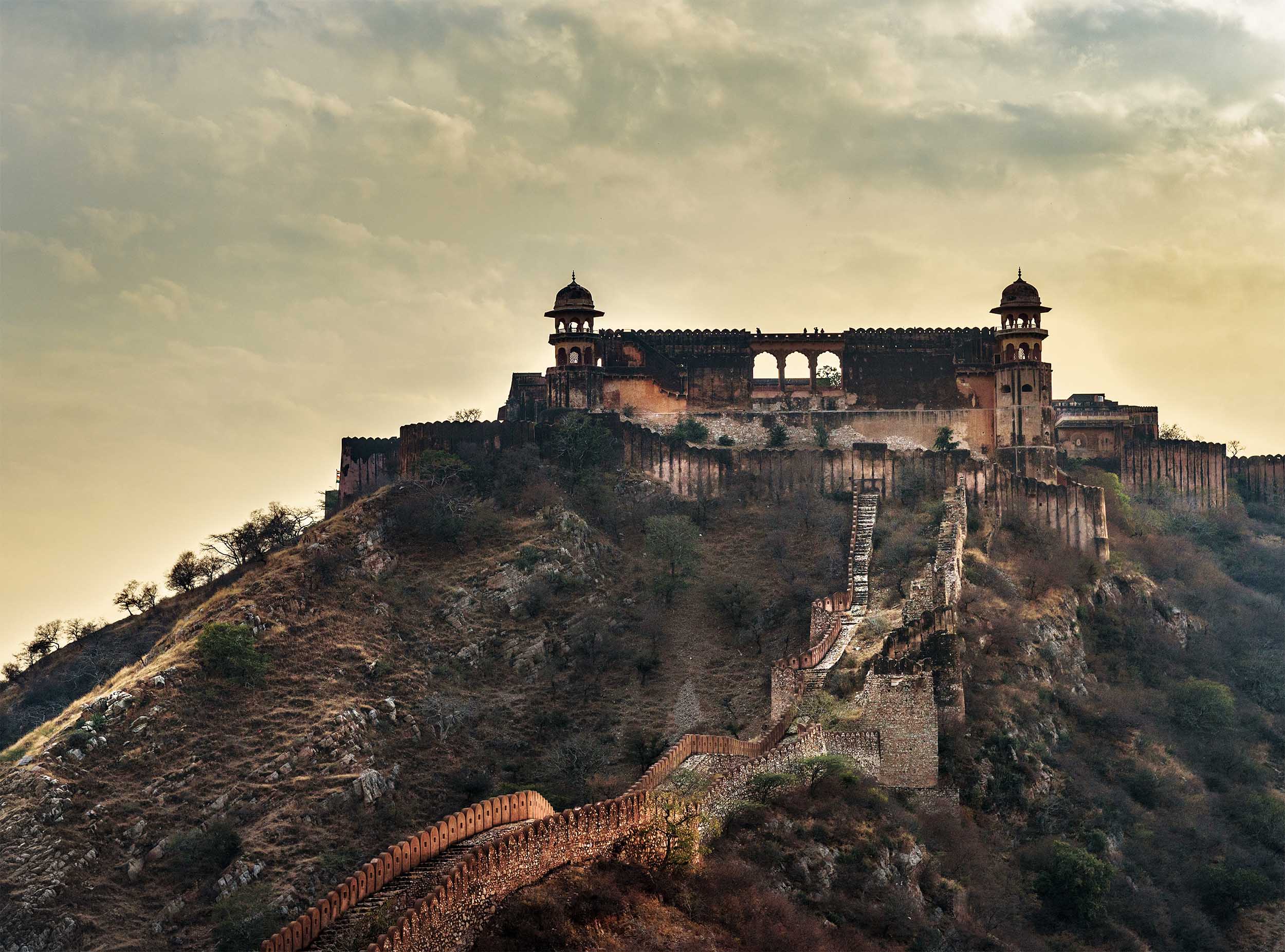
[Music] As we soar above the dense forests of the Aravalli range. the colourful contours of Jaigarh Fort emerge against a mountainous backdrop. Perched atop the Cheel Ka Tira or the Mount of Eagles, the oldest parts of this mighty fortress date back to the 11th century. It was added to substantially by Maharaja Sawai Jai Singh II in the early 18th century. It was designed to protect the settlement of Ambar, the then capital. But it also stands as a masterclass in water-harvesting and conservation, an essential necessity in Rajasthan's arid landscape. On this virtual journey you'll explore how Jaigarh's reservoirs, aqueducts and rainwater-harvesting systems have sustained its residents and visitors. Along the way Experts including Dr. Reema Hoja, Dr. Chandni Choudhury and master stonemason Mahendra will share insights into the fort's engineering and legacy.
Stop 1. Entering the Fort – Harnessing the Monsoon
From above, a narrow pathway snakes up towards the fort. While it may look like a mere entrance, this unassuming channel is actually the start of a sophisticated rainwater harvesting system, one designed to capture and transport monsoon rain into Jaigarh's deep reservoirs. The Rajputs, legendary warriors and master builders, understood that in Rajasthan, water was as precious as gold. By carefully sculpting the aqueducts, slopes and underground storage tanks, they ensured a secure year-round supply. This ingenuity also played a pivotal role in Jaigarh's cannon foundry, one of the largest of its time, where water was vital in metalworking. Here, military strength and sustainability went hand in hand.
Dr. Rima Hooja
Entering the fort, may be a little disappointing to some people because if you're expecting a grand gateway, you don't have it. But that makes a lot of sense because to repeat something that we all know as a garrison fort. You didn't need to have embellished grand entrances. Today when a visitor comes in, they may expect a grand entrance. But what you come in to is one of three ways of getting to a fort. We don't use all of them equally. We use one which brings you straight into near where the water collection center is, which is one of our highlights. It then brings you to some of the galleries and then, as would have happened in the past, the inner quarters of a fort, whether it's the commander in chief sitting there or addressing soldiers, which is one of the sort of chowks (squares) we're in right now or areas we are in right now, or one of the living spaces you came into them, last of all, which also means that if you were protecting a place, you would, you know, the enemy would need to fight their way through.
Dr. Chandni Chowdhary
These are features that we attribute to the reign of Sawai Jai Singh II. So we are definitely talking about, say, 300 years ago and to have constructed the extensive system, the catchment system actually extends up to four kilometers south of the fort. And to have a network that was so diligently planned and engineered with such precision that the slopes don't give way. It is, lime plastered. It is robust and aided, of course, by regular routine maintenance activities. Water continues to be brought into the fort premises by these channels. So it is not just the scale of this entire network and system, but I think the very accuracy and the precision with which it was constructed that, to put in simpler terms, simply blows my mind.
Mahendra
Our generation, from generation to generation, has carried on this tradition. This fort has also provided us with employment. And we have learned many skills here. We have acquired a special skill here. Many traditional techniques are practiced here. How it is done, In what manner it is done, One must have knowledge of all these things. We continue to learn and ensure that everything is done properly. Every single detail must be taken care of. For example, what specific task needs attention.
Stop 2. Storing Water – The Tankas of Jaigarh
Descending into the southern courtyard, we witness Jaigarh's immense covered reservoirs, designed to protect stored water from evaporation and contamination. The largest tank, capable of holding 6 million gallons, ensured a steady supply of fresh water for soldiers and residents, even during times of sieges. Within this area, there are three reservoirs, including one open-air tank that allowed for immediate access to water, while the other two remained sealed for long-term storage. These tanks, which are still functional today, highlight the sustainability of water practises developed centuries ago.
Dr. Rima Hooja
When the original tanka (tank) was visualized, I suspect it might have been redone in Sawai Jai Singh II's time, but some version of it may have been there earlier for the garrison that was living here. Now getting the water from any rainfall behind us is where the Aravalli Hill range is. It now looks very desolate and the trees have gone. But there was, substantially more tree cover at one point. Natural. So if there was a landslide and a tree went, it went. It wouldn't come back in a hurry. But the water would then flow down and be lost. So Jai Singh went out of his way to do what ancestors had done. His ancestors, but the ancestors of other rulers across, Rajasthan and parts of western India, which was channel them through, stone and mortar, like, almost like a slide, you know, and the channels look wonderful even now. And have them, take the slope of the hill all the way down to his collection points. So following the slope also helps, because then you reduce the extra, pebbles and and everything else that accumulates. Part of the whole chain would have been, you also cleaned the space out just before the monsoon rain, which we still do. So we were learning from the past there just to have our own efficiency. Then the water would a) be ready to flow into the fort, into the fortified section of Jaigarh, through the siltation chamber. I think there were three, but I may just be totally off at this point. And then into more settling chambers and finally into that larger tanka that we talk about. But also some of it would get channeled through to other parts of the fort for routine usage. The notion of potable water in the same way is not there. As long as the water looks clean and is clean, and you're downhill of the actual collection area, which is clean, it would work.
Dr. Chandni Chowdhary
Because, the maintenance actions that we have in place are something that are tried, time tested. We have, traditionally trained masons who work on the work with the materials on these structures. They're very respectful of how they handle these, structures. And we are very mindful to ensure that we do it in a manner that is prescribed as a suitable for the structure and for the longevity of it.
Stop 3. Maotha Lake – The Fort’s Lifeline
Looking down from the fort, we see Maotha Lake, a shimmering expanse of water at the base of the hills. This man-made lake served as both a natural defence and a vital water reservoir for the Amber Palace, the royal residence below. As rainwater from the surrounding Aravalli range flowed into Maotha Lake, it was stored and carefully managed. The lake was divided into sections to allow sediment to settle, ensuring cleaner water before it was transported. A relay system then lifted water from the lake to higher elevations. To supply Amber Palace and Jaigarh Fort, workers used Persian wheels, a manual water-lifting mechanism powered by oxen or human labor.
Dr. Rima Hooja
When a dossier was being made on the hill forts of Rajasthan, we considered Jaigarh also, and found that it has unusual enough features to set it aside from the others, and in part it is because it is, at the one level, a pure garrison fort, and another. It's an excellent example, along with a fort like Jalore, which is in the middle of the desert, on how water conservation was done. And we have a great example of that here in the storage tanks. Also, the way it overlooks two very important places. One, the preexisting fort of Amber, which is what this would have originally been part of even before it took on the incarnation. And I use that word, even before it became Jaigarh Fort. The earlier version was part of the old Amber, and sat on top like a crest and overlooked it and protected it. But the other angle that comes in is after 1727, when the city of Jaipur starts being built, and that lies on the plains to the south of where we are. Jaigarh was one of the places that could potentially protect the new city. The capital city of Jaighar, which is the capital of Dhundar, against enemies. So it's got that double purpose which also sets it apart from a lot of other forts.
Dr. Chandni Chowdhary
So, Jaigarh was a garrison fort. That means it, was where the infantry could be and, where the royal family would have perhaps sought refuge if the situation came to that. And the palace underneath in the valley, beneath the ridge upon which Jaighar is situated, was besieged by an attacking army. So in times of those, in desperate times, such as those if the family and important nobles and, even the citizenry of Amber were to seek refuge in Jager, the water that was harvested unduly stored in the fort would have been of prime importance, because they would have been removed from everything that used to, supply or make their daily lives comfortable. This was a safe haven. It would not have afforded the luxuries and basic vagaries of, daily life, but it would have given them the opportunity to recoup, perhaps, travel elsewhere to safer areas. But water is one thing without which you can't exist. It is. You can go by without food, but not water.
Stop 4. Distributing Water – The Flow of Daily Life
Beyond collecting water, Jaigarh Fort relied on a carefully managed distribution system to sustain daily life. Near the living quarters, an overhead tank stored water, which was then channelled through an underground network to supply bathing areas, kitchens and gardens. The Meenas, an indigenous community of Rajasthan, played a key role in constructing and maintaining this intricate system, drawing from generations of knowledge about the land and its resources. Unlike Ambar and Nahargarh, which depended on step wells, Jaigarh's design prioritised underground distribution, ensuring a reliable water supply even in the driest seasons.
Dr. Rima Hooja
When we think about Jaigarh Fort and the people who are here, of course, if there's a garrison and there are people who are cooking for them, there are people who are carrying the water from the local, water sources to whichever area they're going to be used in. They're going to be people who are making sure the swords are sharp. So that whole almost military lifestyle is there. But there is another story that has always been associated with Jaigarh from even before the fort of Amber enclosed it, and that is that it's part of, where a group of Meenas who were indigenous inhabitants have lived for a very long time, and they lived around what is now the fort of Amber, which is open to tourists. They lived around the town of what is now, Amber you know, different parts of, the modern city of Jaipur, including part of Jaigarh. And eventually when by the 17th, so when I say word here, I mean about the 10th century, 11th century, 12th century. By the time that the fort of Jaigarh is built in the early 18th century, that group was encouraged to stay here. And, the legend I grew up with was that even when the Maharaja came, there were places where there was a secret treasure trove that was not open to just anyone to take. That could be, I mean, if there was any truth to the story, because it's it's something we've heard. Not something that's written up about in, authenticated papers with, you know, seals and all of that. But, it would make sense to have a secret, hidden supply to hold the fort in times of absolute emergency. So that's literally the pin money that they would need. And where that was, it's still not known there all kinds of stories about what was beneath the water, in the water tank, and it was somewhere else. But mind you what we are where the fort has been sitting for all this time is on top of an actual hill or part of the Aravalli Range, and it could have been, tunneled for miles beneath where we are sitting, without us knowing where that is. So the Meenas are one part of it. They continue to hold this place even once the state of Jaipur signed to become part of New India in 1947, prior to August 15th, I may add. So most of the, the Maharajas Maharana (Kings and Queens) models, the princely states opted to join the new country that was being formed and signed on the dotted line before 14th and 15th of August. Jaipur stated that also. But they continued to hold Amber. They continued to hold the city of Jaipur. They continued to hold Jaigarh until parts of the whole thing were merged into modern day Rajasthan, which was a process that took place through 1948 down to 1949. The final touches were done on, we celebrate the 30th of March of 1949, as the day that modern day Rajasthan was built. Strictly speaking, some of the treaties was signed on the 9th of April. Also, you know, few days after. But up until that point, the Meenas continued to be the people here, along with whoever was the Rajput, the warrior who was given the formal charge of holding the fort.
Dr. Chandni Chowdhary
There would have been animals. So there are different stages with which by which water is harvested and then subsequently stored in the fort. Different areas would have been demarcated for drawing water for different purposes, whether it was for animals for daily needs. Potable water was in a different tank. Water for ablutions would come in from a different area. And we do also have a cannon foundry within the fort. And water would definitely be needed for the quenching of metals when they were casting guns later on, guns or cannons at the inception of the cannon foundry. So water was used in different forms, whether it was survival or it was technological advancement. They were not just, providing it for people, but also using it to make sure that they had an artillery for defense. So the water formed the most multifaceted, I think gave the most multifaceted contribution to how Jaigarh and its entire fortifications came afterwards.
Stop 5. Aram Bagh – The Pleasure Garden
At Jaigarh, water was more than a necessity. It was a source of beauty, comfort and luxury. The Aram Bagh, or pleasure garden reflects this, with water bubbling through fountains and flowing through shallow channels to nourish lush greenery and cool the air, offering a refreshing escape from Rajasthan's intense heat. Designed in the Chaar Bagh style, a Persian-inspired geometric layout, the garden is divided into four quadrants with flowing water at its heart, symbolising harmony, paradise and controlled nature. While introduced by the Mughals, Rajput rulers adapted this design to suit their own vision. Here, water was not just functional but ceremonial, a symbol of purity and abundance. The garden served as a space for relaxation and gatherings, reinforcing Jaigarh's dual identity as both a military stronghold and a regal retreat.
Dr. Chandni Chowdhary
Water harvesting system and the management system, the supplies, the distribution is all intact. That is a very, that's (that's) something that we are very, very proud of. And we are continuously working towards making sure that it remains for people to witness in the coming years, as well. Currently we don't use the water for potable purposes, but we still use it for landscaping. As I think I'm at the risk of sounding repetitive, this is an extensive premise. And, in recent years, we've undertaken, landscaping projects in different areas of the fort. They have been, of course, done on, historically accurate advice. We had horticulturists and landscape architects, brought in, who advised us what were the best, plants to be planted here to both contribute towards maintenance of microclimate, a comfortable temperature within the fort, as well as to reduce the deforeststation, which is, impending risk when you have such extensive grounds and, while maintaining historical accuracy vis a vis what kind of flowering plants would have been preferred by the rulers back then to ensure that there was a pleasant environment in the bagh (garden), for instance, where we are right now. So most of the water that we harvest now goes to our landscaping needs, and in some cases, perhaps even to, cater to basic washing and, maintenance purposes for our build stock. Whenever we have to clear the floors and we undertake washing even of the terraces, for instance, before the monsoon comes in, we actually wash all our terraces and make sure that there are no leakages anywhere. So at that point of time, whatever water we have harvested, she is still lucky to have it. We use it.
Stop 6. Sagar Lake – The Secondary Reservoir
Beyond the fort's walls to the North, Sagar lake stretches across the valley. Its waters once serving as a lifeline for the fort of Jaigarh. Fed by rainwater and runoff from the surrounding Aravalli hills, its waters were manually lifted to Jaigarh fort. Workers formed human chains using pulley systems to transport them to the fort's higher levels.
Stop 7. Preserving the Legacy – Water Conservation Today
Jaigarh Fort stands as a testament to the ingenuity of Rajput water conservation. A seamless blend of science, sustainability and strategic foresight. Through rainwater harvesting, massive storage tanks and gravity -fed aqueducts, the fort ensured that water scarcity was never a threat. On this journey, we have traced the path of water in the fortress, from the moment raindrops fall across the Aravalli Range, to its careful storage and essential role in daily life. As modern cities grapple with water shortages, Jaigarh's ancient techniques offer valuable lessons for the future.
Dr. Rima Hooja
As President of the International Council of Monuments and Sites for India, a lot of cases across the country where we are pulling down buildings of different ages, you know, a post office of 1950 is as important in my eyes as an archeological site can be, and without giving value judgments, as Jaigarh can be. So why is it important? It tells us the story of the past, not just from the point of view of a mechanical balance sheet of so many square meters covered so much space. The water has this. Its people lived here. There is the human touch. This is what is important for any monument, any site, anything that has had intervention or any natural site that has had birds, animals, reptiles, you know, beetles, what have you live in them, or even the dead dinosaurs or places where where bits of meteorites have fallen. This is part of the history of humankind, but of the history of the Earth, the history, part of the history of the universe. These are non replaceable. They may be forts upon forts and upon forts. They may be, hammams (baths) at Amber and hammams here and somewhere else. Each remains as unique as each human individual, breathing, living, talking on this planet at this point of time is unique and worthy of being, you know, recognized as unique, being protected as unique, and being celebrated for that uniqueness.
Dr. Chandni Chowdhary
There is, of course, photogrammetry. There is LiDAR scanning. We've also gotten some material characterization done as part of the MoU with CEPT University. So, all the restoration actions that were part of the daily roster are Jaigarh. They're now being scientifically backed by evidence that has been checked and double checked in universities and in laboratories of premier educational institutes in the country. So I think we're now not just, being able to take up a variety of restoration processes across the board, but we've been able to do it in a manner that is foolproof. And perhaps I can, I would not be wrong if I call them state of art. So it is basically being able to make, informed decisions and scientifically backed decisions to contribute to whatever exists at Jaigarh right now and to ensure that, the legacy that has been handed on to us can be further handed over to generations to come. And, we very glad that the Jaigarh Public Charitable Trust, the trustees themselves, are personally involved and are constantly on the lookout for, more such technologies. We are also drawing a lot of inspiration from our peers across the state of Rajasthan, as well as the Indian subcontinent and, perhaps aided with the same partnerships that we look forward to, we'd be able to bring in some, fresh perspective with regards to conservation actions.