El Kurru & The Tomb of Tanwetamani
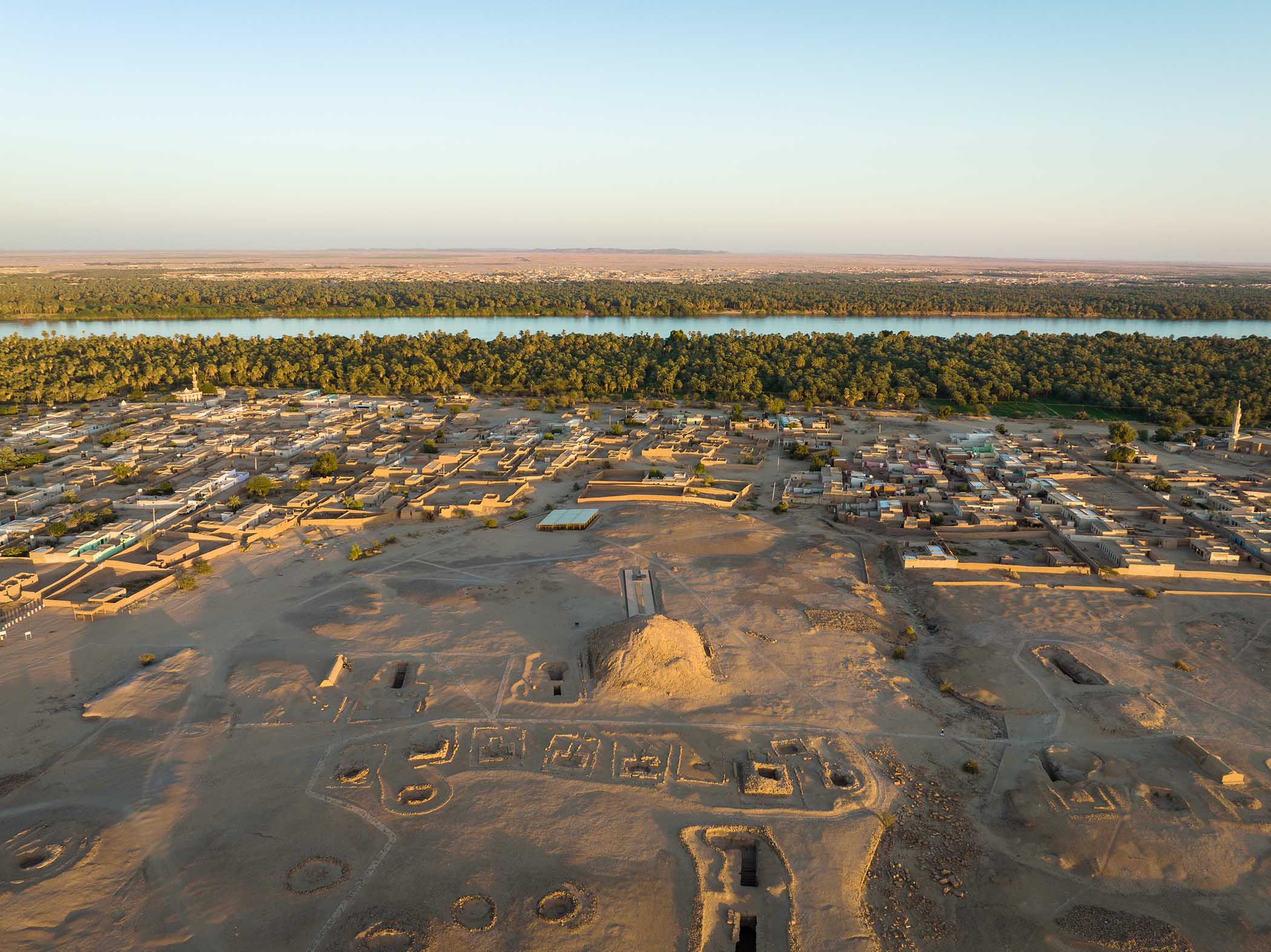
Hello and welcome to El-Kurru, a village in Northern Sudan home to an exceptional archaeological site: a royal cemetery dedicated to the kings and queens of ancient Kush. From this vantage point above El Kurru, the site unfolds before you with the Nile river flowing in the distance. The dry desert landscape is interspersed with numerous sandstone structures that shed light on the beliefs and burial practices of the Kingdom of Kush. On this tour, you'll hear from three local residents, Ibrahim Sidahmed, Jaffar Khidr, and Mansour Elhadari who are involved in the ongoing preservation of this invaluable site. They will guide you through the tomb of King Tanwetamani, a ruler of Ancient Kush who holds the distinction of being the last pharaoh of Egypt's Twenty-fifth Dynasty.
Stop 1. Welcome to El Kurru
As you observe the arid landscape before you, several monumental structures come into view. These include the remnants of a pyramid and the remains of numerous sandstone tombs. On the left is the tomb of Queen Qalhata (not visible in the 3D model), who is believed to have been Tanwetamani's mother. On the right is King Tanwetamani’s tomb, which we will explore further. The El-Kurru cemetery preserves a sequence of elite burials of close to 30 kings and queens of ancient Kush, along with separate burials of teams of horses belonging to four of these kings.
Ibrahim Sidahmed
My name is Ibrahim Sayyed Ahmed. I'm from the North of Sudan, from a village called El Kurru Al-Kurru is an archeological site which contains the royal graves from the Kingdom of Kush I was born here and have spent my whole life in El Kurru I left briefly to study in the Capital, Khartoum and to study abroad in Lebanon. The main language we speak in El Kurru and in Sudan is Arabic. My friends and I will take you on a tour and guide you through the site and inside the sacred Tomb of Tanwetamani. I hope you enjoy this visit and learn new things!
Stop 2. Kingdom of Kush
You now stand before the entrance of King Tanwetamani's tomb. Tanwetamani was the last king of Kush to rule over Egypt (until his defeat in 663 BCE). During this time, Kushite rulers adopted Egyptian gods, burial practices, and hieroglyphic writing as their own. The pyramid that once stood over this tomb is almost entirely gone and this tubular structure is a 20th-century addition. The tomb, along with the entire El Kurru complex and the neighboring site of Jebel Barkal, achieved recognition as a UNESCO World Heritage site in 2003.
Jaffar Khidr
The tomb is covered by a tube-shaped structure which was made locally with simple materials. It was built in the beginning of the 20th century, and is still standing today. And has become a part of the historical cemetery. Anyone who visits this place will notice that, the temperature rises as they descend the stairs. As the tomb is about 7 meters underground, the temperature can be slightly warmer than outside.
Stop 3. Ancient Staircase
As you descend the ancient stairway, notice how workers painstakingly carved each step into the bedrock. Inside the tomb's chambers, you'll find exquisite wall paintings, testifying to the extraordinary skill of artists from over 2500 years ago. These paintings help us understand some of the commonly held beliefs during the reign of Tanwetamani. Recent conservation efforts have added stairs inside the tomb's two underground chambers, allowing visitors to move safely between them.
Jaffar Khidr
When you enter, you are greeted with the stairs, which lead down into the tomb. There are 32 steps total, that are carved from a commonly found stone in the area. We call it 'sone' [sandstone] While it is easy to carve, and easy to cut it also erodes easily. Over time we had to make some changes to these stairs We added additional support to… To prevent additional corrosion And hopefully in the future, we will continue to make similar improvements.
Stop 4. Preserved Paintings
The first illustration in the entrance chamber features King Tanwetamani positioned between two gods who guide him toward burial and a judgment ritual: the weighing of the King's heart. Tanwetamani is recognized as a king by his tight-fitting cap crown ornamented with two protective serpents and amulets depicting the ram-headed god Amun. His name is written in a golden oval known as a cartouche positioned just above and to the right of his head.
Mansour Al Hadari
The reason many of these paintings are no longer visible is that… After the grave's discovery in the early 1900's, During those early years there was no external protection When there was rain, the water went into the rooms and pooled there. As a result, the humidity caused the failing of some drawings of the wall That's how some paintings, have been lost.
Stop 5. Journey to the Afterlife
As we proceed into the main burial chamber, scenes depict the king's burial, and hieroglyphs record magical spells to protect the king in his journey through the underworld. In the center of the wall, a sizeable table-like structure is shown; this is the top of the burial bed (with the tail of a lion at the left) on which the wrapped king’s body would have been placed. On either side of the bed, deities guard the king's body.
Mansour Al Hadari
These drawings on the wall explain to us the details of the arrival to the afterlife. These represent the first moments in the afterlife, after his departure from the world of the living. We can see here the coffin, the coffin in which King Tanwetamani left this world to the afterlife. The characters that are with him in the paintings are the Gods of the afterlife This is at the greeting… Here he is shown being welcomed as he has done good deeds and he will be crowned. And those who greet him here will provide him the status and authority he had in this world. These drawings on top are written in hieroglyphics. It says that the king has arrived to the afterlife with good deeds, and has been crowned as a king. What we see on the wall was a belief. The belief that this is what will happen in the afterlife.
Stop 6. A Pure Heart
On the back wall, the climactic scene shows the king’s heart, which has been judged pure. The king’s soul, known as the ba, is shown as a human-headed bird. The ba-bird is now ready to accompany the sun (shown in its boat just above, where it is being worshipped by baboons).
Mansour Al Hadari
Here at this back wall, which is the furthest one in the tomb, we see a scene of the final interrogation, before the king can move into to after life. Here he is interrogated, and his heart is interrogated too. They think that the heart is interrogated alongside it's owner, the king When the interrogation of the king and the heart is done, they say, he moves from this world to the afterlife One transfers from this world to the next in a boat. They believed that the boat takes the soul from this world to the afterlife. They say if the king has done bad deeds, he can't reach the afterlife, he will be trapped, so he is neither in this world, nor the next. That's how the interrogation works, and their belief in this process of moving from this world to the afterlife. and the process of moving from this world to afterworld
Stop 7. Life's Continuity
After the judgment of his heart, Tanwetamani’s body is awakened by a god who holds an ankh to his face. The scene is only partially preserved in this tomb, but we can reconstruct it from paintings from other tombs. On the north wall of the burial chamber, we can see Tanwetamani lifting his head, having been awakened on his burial bed. Above, the tomb ceiling depicts the night sky. In Egyptian and Kushite mythology, the sun traveled through the sky during the day, and traveled through the underworld at night. Since the burial journey took the king through the underworld, the tomb depicts the night sky. This symbolic representation illustrates the king's daily voyage, as he follows the path of the sun, beginning in the sun-drenched realm of the living, he traverses into the night sky, symbolizing the domain of the deceased. Each day, the king faithfully follows the cyclical journey of the sun, transitioning between the realms of life and death.
Mansour Al Hadari
The roof of the tomb represents the extension of life, the continuity of life. They did not believe that your story ended at death. What we can see on the roof is the night sky with stars, the sunrise, sunset. By including the sky, stars, sunrise and sunset, the artists meant to show that life is continuous, without an end. Thus, the illustrations in the king's tomb are meant, to convey the message of life's continuity, suggesting that his life endures beyond death.
Stop 8. Rebirth
Along with the King, we return to the stairway upward and are met by the final wall portraying the King's triumphant departure from the tomb, once more accompanied by two minor gods known as Sons of Horus. This moment signifies the ritual's completion and symbolizes a metaphorical rebirth into the realm of the living. Although the lower sections of the walls have been eroded by the flooding that once inundated the tomb, the painted walls above are still vibrantly preserved.
Mansour Al Hadari
The bottom of the tomb is dug into the bedrock. which is formed from a stone called ‘sone’ [sandstone]. When tourism started to increase and visitors came more frequently to the site, more dust started being produced. So we put gravel down to protect the floor to get rid of the dust.
Stop 9. Community Stewards
Today, political circumstances in Sudan limit the ability of international visitors to experience El Kurru in person. The local community members' efforts ensure that this place will continue to be preserved and shared with future generations. We hope that this virtual tour has helped you learn more about the Kush empire and the ongoing work the community is taking to share this history with the world.
Ibrahim Sidahmed
[Ibrahim] Thank you so much. I hope you have enjoyed the tour with us, and that you have learned more about this place. We look forward to welcoming you soon, so you can witness everything in person. Thank you.