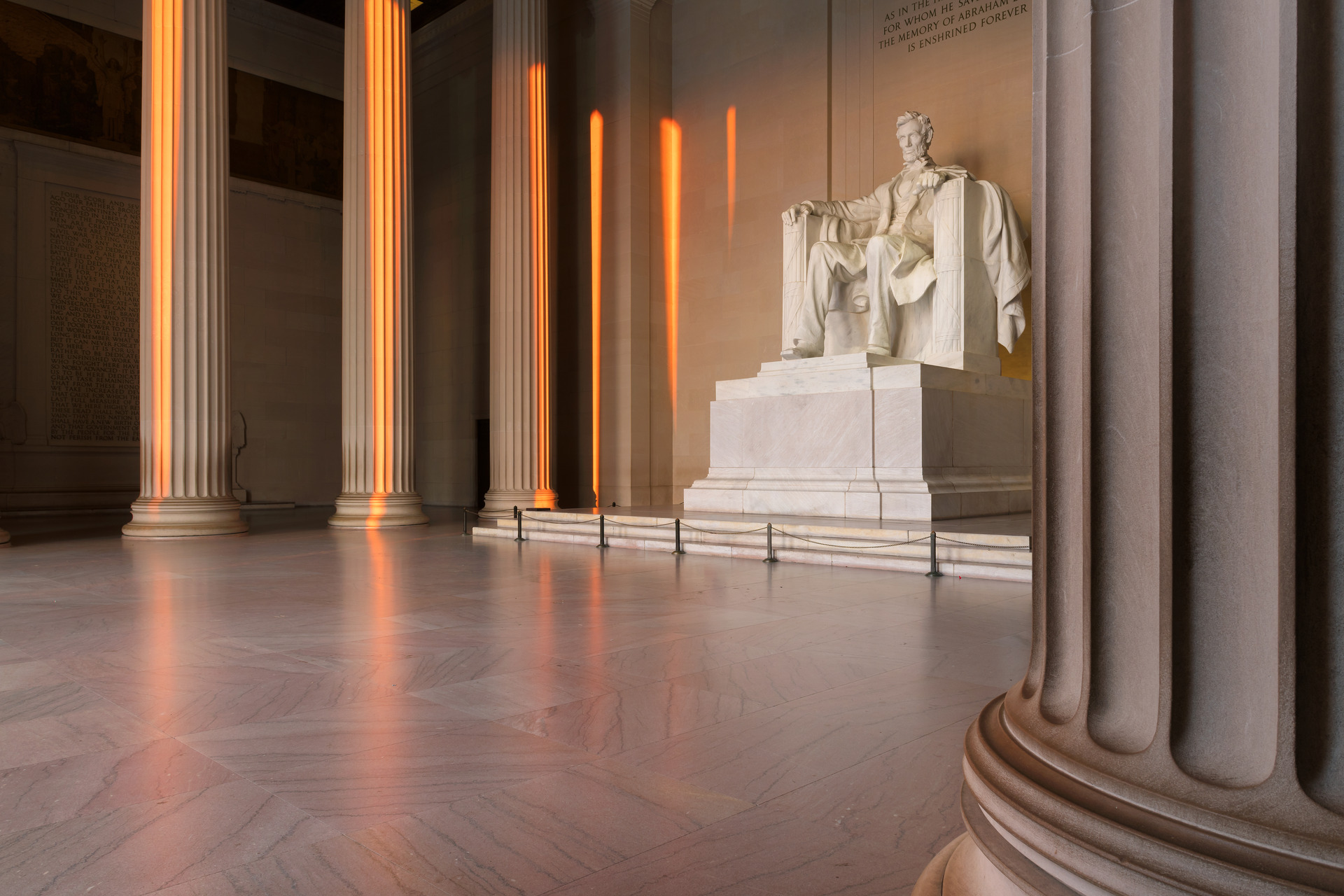
A Temple to Democracy
Welcome to the Lincoln Memorial. A site dedicated to honoring Abraham Lincoln, America's 16th president and the great emancipator. Built in 1922, this memorial sits at the western edge of the National Mall in Washington, D. C., amongst many other landmarks that celebrate and commemorate American history and culture. Designed as a temple to democracy, the Lincoln Memorial emphasizes themes of unity and freedom, defining tenets of Lincoln's presidency. These themes have made the memorial a natural location for key events in the civil rights movement, including Marian Anderson's open-air concert in 1939 and Dr. Martin Luther King Jr.'s "I Have a Dream" speech. The Lincoln Memorial remains the most visited site on the National Mall, hosting more than 12 million visitors from around the world each year. It continues to be a platform for civic discourse and demonstration. Join us to discover how and why this memorial to Abraham Lincoln was built and explore how its meaning has evolved after bearing witness to more than 100 years of history.
Stop 1. Honoring Lincoln
Before us stands a towering statue of President Abraham Lincoln, commanding the center chamber with an awe-inspiring presence. Lincoln's presidency is largely remembered for its unification of states through the Civil War and the passing of the Emancipation Proclamation, abolishing slavery. On a busy day this room is filled with the hustle and bustle of tourists and the clicking of camera shutters, but today it's just us and Lincoln. Atop an immense 11 foot tall base the statue of Lincoln measures 19 feet tall from head to foot while seated. If the great marble Lincoln were to stand he would tower over 28 feet tall. The artist Daniel Chester French skillfully captured Lincoln's strength and compassion through the smallest of details such as his hands, one clenched into a firm fist, the other resting open and relaxed. His hands remind us of America's twin histories, one of slavery and division and one of freedom and unity.
Bethany Bagent
The biggest things that were asked is Lincoln signing his initials in his hands? And at the end of the day, the statue was a work of art, and if that is what you see in Lincoln, and then that's an aspect that you want to remember about him, absolutely. I don't think there's any, documentation that supports that, sort of story. But during Lincoln's administration, Gallaudet University becomes a university. and there's a statue that sits right out in front of Gallaudet and its first student, Alice, who are clearly signing the letter A, and Daniel Chester French happened to be the sculptor of that statue, and Daniel Chester French also does the Lincoln statue. So you can see, you know, in his closed fist you can see where people would make that connection. For me, though, the the hands themselves don't necessarily represent, him signing his initials, but more of strength and compassion. The two qualities that French thought made Lincoln such an exceptional leader. There's also the idea that something is carved in the back of Lincoln's head. perhaps an image of someone. And I've heard everyone from Jeez, you know, John Wilkes Booth to Andrew Johnson. you name it. I've heard it. And again, it's looking at a cloud. If that's something that you can see in the way his hair is parted, then again, it's a piece of art, and, you know, that's definitely up to the viewer. So, there's all kinds of different stories associated with the Lincoln Memorial.
Teresa Taylor
That inscription, the temple reference, leads people to often think, is he buried here? No, it's not that he's buried here, but it's more referring to that, it's supposed to be a special place that we come, we reflect on his work that he did in his, in office, and the work that our nation needed to continue to do. Many in that generation clearly saw that, yes, great things have happened so far, but there's much still left to be done.
Stop 2. Words of Legacy
As we move our gaze from the statue to the surrounding walls. we encounter two sets of murals and inscriptions that honor different aspects of Lincoln's character and legacy. Here on the south wall we can read one of his most famous speeches, the Gettysburg Address. delivered at the site of the Civil War's deadliest battle. The speech highlights Lincoln's resolve and determination during the war. When we look directly above the inscription we see a mural titled Emancipation, symbolizing the freedom and liberty brought by the end of slavery. Turning to the north wall we find Lincoln's second inaugural address which was delivered shortly before the end of the Civil War. This speech, chosen for his message of peaceful reconciliation, urges the nation to heal with malice toward none and charity for all. The mural above the inscription, aptly named Unity, depicts the North and South being joined by the Angel of Truth, reflecting Lincoln's enduring hope for a unified nation.
Bethany Bagent
And one of the things that I think has always been unique about the Lincoln Memorial is the Gettysburg Address, and the second inaugural address are up there in their entirety. If you look at the rest of the memorials that we have in the park, they're inscriptions. They're snippets. and sometimes you can look at it and think, well, this is what the the builders wanted us to, to remember. With these two addresses, It's up to the audience, the reader, to really determine the important pieces within those speeches. and I really like that about the design, but it was this idea of picking perhaps Lincoln's most iconic speech, the one he thought we would never remember in the Gettysburg Address. and then his Second Inaugural Address, which gives us a a very quick glimpse into perhaps what he was thinking when the Civil War came to an end and reconstruction came about. So I think those were the two things that they were really looking at.
Teresa Taylor
There are a lot of fun facts about the Lincoln Memorial, but one that I lean to sharing sometimes based on the fact that I'm a veteran. I served in the Army for four years, many years ago is the fact that the Veterans Administration slogan was developed from Lincoln's speech. And so when you're looking at the Second Inaugural Address on the wall in the lower right hand corner, you'll see the mentioning of taking care of those who served, taking care of the widow and the Veterans Administration motto was pulled from that. Now, recently, it did get more modernized, so it's more inclusive to include female veterans and include family members. But the whole theme of the VA taking Lincoln's ideas, which was one of his agendas, let's start building some type of system to care for these veterans coming home, VA taking that and using it as a model is really neat.
Stop 3. United in Stone
As we ascend to the rooftop of the memorial, a panoramic view of Washington D.C. unfolds before us. The neoclassical design of the Lincoln Memorial, with its Doric-style marble columns, were inspired by the Parthenon, an ancient temple in Athens, Greece, widely considered the birthplace of democracy. Unity is reflected throughout the memorial's design.
Bethany Bagent
The reason that that design was chosen is that the sort of architectural movement at the time, City Beautiful, was all about neoclassical white marble structures. this was something that was brought out in the Chicago World's Fair. It was a popular architectural feature at the time. A lot of the older cities at the time were looking at revamping some of their older spaces and this was a kind of a design that was, you know, sort of became popular. But I think there's also this idea that to use something that, was, inspired by Greek architecture, and a lot of people will say that that's the sort of the the beginning of democracy and bringing that back to Abraham Lincoln. I think that you can make that connection as well.
Teresa Taylor
The Memorial was built with great care in design and selecting things that would have a great deal of symbolism. It was intentionally planned out that the different stones would be from different parts of the United States, some from the North and some from the South. And that was very intentional to represent a togetherness. Another fun fact relating to the Lincoln Memorial and the States is that they're all represented until the last two. The last two that got added to our nation. So to represent Hawaii, and Alaska, if you walk down to the very bottom of the Lincoln Memorial steps, before you get to the Reflecting Pool, you'll see on the ground in the marble something for Hawaii and Alaska.
Johanna McCrehan
L'Enfant plan from 1791. laid out the laid out the way that D.C. looks. So the city planner, he worked with Benjamin Banneker, who was, a freed engineer, who actually did a lot of the mapping for what DC would, you know, topography and how to lay out the street grid. and it established the L'Enfant grid actually doesn't encompass everything that we think about as DC. It's just kind of a central core area. and that influenced, like I said, where, like where the White House goes and its connection to the US Capitol, kind of a general sense of what the National Mall would look like. But it wasn't until 1901. So over a hundred years later, that the McMillan plan McMillan Commission, decided or, was was brought on board to create this grand place that we think about as what the National Mall is. And so it's this lawn lined with civic buildings, again, sort of representing, what we want, what we as Americans aspire to, to have these cultural institutions and our government buildings all lining the Mall. So that really drives what you see on the ground today.
Stop 4. From Marsh to Memorial
When Lincoln was alive. the site where you are now standing was a remote marshland known as Kidwell Flats. The choice of this location for the memorial sparked debate in Congress, delaying construction for years. Many thought the swampland was not a fitting environment for Lincoln's legacy. Moreover, financial setbacks and the onset of World War I postponed the project even further, pushing its completion to 1922. The marshy terrain required innovative engineering to support the monumental structure, including massive concrete pillars buried deep beneath the memorial to provide stability. These pillars, twice the height of the memorial itself, supported the entire structure and are hidden underground, comprising a structure known as the Undercroft. Now it is hard to imagine a National Mall without the Lincoln Memorial, which gazes out towards the Washington Monument and the Capitol Building, surveying this inspiring civic space.
Bethany Bagent
So, I think the, the biggest challenge, for construction of the Lincoln Memorial is the fact that it is built on reclaimed land, land that hadn't been, you know, had only been built up a few years prior to the actual construction. So the foundation part of it needed to be, pretty strong. And they really needed to look into the ground in which they're building this memorial on. And if I recall, there was, there were some engineers who found that there was some settling going on even as they were building the memorial, and that settling needed to be addressed before they could actually dedicate it. and so I think that was probably the biggest challenge. The other, I guess, challenge, if you will, is that because it's sort of built upon this new land, there's not a whole lot out there. So they have to build railroad tracks in order to, to bring the building supplies close to the construction site. and so there's a lot of prep work that has to be done prior to the actual building beginning.
Teresa Taylor
So the memorial was built on marshy land. There was a great deal of planning ahead to make the memorial. They brought in reclaimed dirt, meaning dirt from the river, and built the land out, which was an interesting issue in itself, because there was actually some pushback to even making the memorial because it was too swampy. No one wanted to go down there, but eventually the area was built up and they built these huge seems like pillars. they're like huge pillars. And then on top of that, then the memorial is built.
Johanna McCrehan
In, in 2003, the Commemorative Works Act, which was established in 1986, was amended in part, this was because there were so there were so many new memorials that wanted to be on, that wanted to be on the National Mall and folks that plan for that, the stewards of the National Mall got a little concerned because you you want to protect the integrity of the memorials that are on the Mall. you want to keep them meaningful and you don't want this place to become cluttered. So in 2003, there's a an outline made kind of following the Mall's borders to say there will be no new memorials in this space. They said it's a complete work of civic art. Well, at the time, they had really good intentions. Because you're because you do, like I said, want to preserve the integrity of memorials and the the beauty and planning of the space as intended. What that now mean meant, looking back 20 years is that we're leaving a lot of people out. And we've heard that not everybody feels like the National Mall belongs to them, when in fact it belongs to all Americans. that they don't see themselves in this place or they don't identify with this place. And I think that we can carefully allow for both to happen, to have new stories and have new memorials while also making sure that this place stays, beautiful and, iconic and important and representative of who we are as a country.
Stop 5. Power of Assembly
Standing on the steps of the Lincoln Memorial, we find ourselves on hallowed ground. that has become a symbol of unity and progress for the American people. This very location has hosted some of the most significant demonstrations in American history. from Marian Anderson's 1939 open-air concert to Dr. Martin Luther King Jr.'s I Have a Dream speech during the March on Washington for Jobs and Freedom. The Lincoln Memorial has served as a powerful backdrop for civil rights protests and national assemblies, drawing some of the largest crowds in history. The steps of the Lincoln Memorial are a locus for freedom, presenting a powerful platform to captivate audiences below. Originally built to honor Abraham Lincoln, the Memorial now serves as the nation's premier stage for expressing our First Amendment rights and has inspired countless demonstrations for freedom and equality.
Bethany Bagent
I think one of the things that I find very unique about the Lincoln Memorial, and something that visitors should not miss, is really sort of the evolution of the meaning of the memorial, more so than any other space, I think, in on the National Mall, the memorial has become a forum for people to speak out against injustice, to address grievances, and to finish the unfinished work. And I think that's something that is very, you know, can be attributed and looked back at Abraham Lincoln. You know, we have the inscription of of the spot where Dr. Martin Luther King Jr. stood, you know, when he delivered his very famous, "I Have a Dream" speech and the idea is, well, why did they choose the Lincoln Memorial? And perhaps it can be because they were there to finish some of the unfinished work that began with individuals such as Abraham Lincoln. And I think that's something that, you know, visitors I hope they don't miss when they're taking photographs and, and, you know, just kind of being overwhelmed by just the enormity of the memorial and everything that there is to see there. It's that it's that legacy piece. It's that visitors coming to to see the memorial, you know, to to see an aspect that's not just about Lincoln. Perhaps
Teresa Taylor
The information I like to share about the Marian Anderson concert is that it's my belief, or my interpretation that the meaning of the Lincoln Memorial shifted from being about just Lincoln to so many other things when that concert happened. Never before was the Lincoln Memorial used as a public speaking space or a public event kind of space, but because of the events that led to Marian Anderson getting invited by the Secretary of Interior, Harold Ickes, to sing there, then it became a public and government sanctioned opportunity to present yourself with new ideas and to have big events at the Lincoln Memorial. And it's my interpretation or belief that maybe, Dr. Martin Luther King, speaking on the steps of the Lincoln Memorial, might not have ever happened if Marian Anderson hadn't been invited to sing there first.
Johanna McCrehan
Marian Anderson, who is this renowned, Black contralto opera singer. She was barred from performing at Constitution Hall because she was Black. And, many folks intervened and said, we want to see her perform, and they found a place for her on the Lincoln Memorial steps, and it was one of the first times anybody performed to an integrated crowd. So there are about 75,000 people on the mall witnessing Marian Anderson sing. And she sang, 'My Country Tis of Thee,' among other songs. And so the Lincoln Memorial was the perfect site to host that.
Stop 6. Voices for the Future
As we reflect on the history of the Lincoln Memorial. we also consider its future. The memorial continues to be a lively space for civic discourse, and national reflection. It stands as a focal point for civic engagement where the nation's past and future converge. The National Mall itself continues to evolve and reflect the changing nation, with new memorials, visitors, stories, and events continuing to shape the landscape. However, with this significance comes the responsibility to protect the memorial's delicate materials and structure, which have withstood the test of time but remain vulnerable to the elements. The future of the Lincoln Memorial is one of careful stewardship, ensuring that it remains a beacon of unity and freedom for generations to come.
Bethany Bagent
What do I hope the future holds for the memorial? I hope that it continues to be a space where people can come and, speak out. I hope it's a place that, continues to be on everyone's itinerary. I hope that the memorial itself, is as relevant today, you know, as it was in the past and will continue to be in the future. I think that there are a lot of, amazing experiences that can happen at the Lincoln Memorial. Whether it's something as simple as watching a high school band perform in the shadow of the memorial to something, you know, as important as inaugural concert, you know, I think all of these things just continue to make this, a destination, a place where visitors can come sit on those steps. Look out towards the Washington Monument, and just think about, you know, how far this country has come and perhaps how far we need to go.
Teresa Taylor
What I predict for changes to the memorial or how it's going to be interacted with, would be to make it grow with people, meaning that it's going to maybe get a little bit more modern in interpretation. Maybe the the inclusion of some type of digital format. And I also interpret that facilities will probably be a factor, that maybe there'll be more facilities just because the crowd grows every year more and more. And so as each time a expansion or renovations done, I think those factors are included in how can we can serve visitors even better?
Johanna McCrehan
The Lincoln Memorial has had a really interesting history since 1922. I don't think even the original builders of it had imagined what it would become. and I say that because over time, it's been the memorial that people go visit, but the grand stairs and this grand view and building that exists on the mall with overlooking the Mall, has become a platform for other demonstrations to happen. there protests of the Vietnam War on the Lincoln Memorial. Of course, Martin Luther King Jr. gave his famous "I Have a Dream" speech and Marian Anderson sing there as well. So it's taken on a life where it's symbolic because of what and where it is and what Lincoln represented, which is actually so much more than the memorial itself. So I think that's a really interesting way to treat, what memorials can be, right, they can change over time, they can tell different stories over time. They can carry different types of significance, for people and for individuals, there are still folks that maybe attended the March on Washington. and that's their memory of the Lincoln Memorial. Not necessarily going to revere Lincoln and think about that. So there's a lot of different emotional ties to the place that have, happened because of what's happened there.