César E. Chávez Memorial Garden
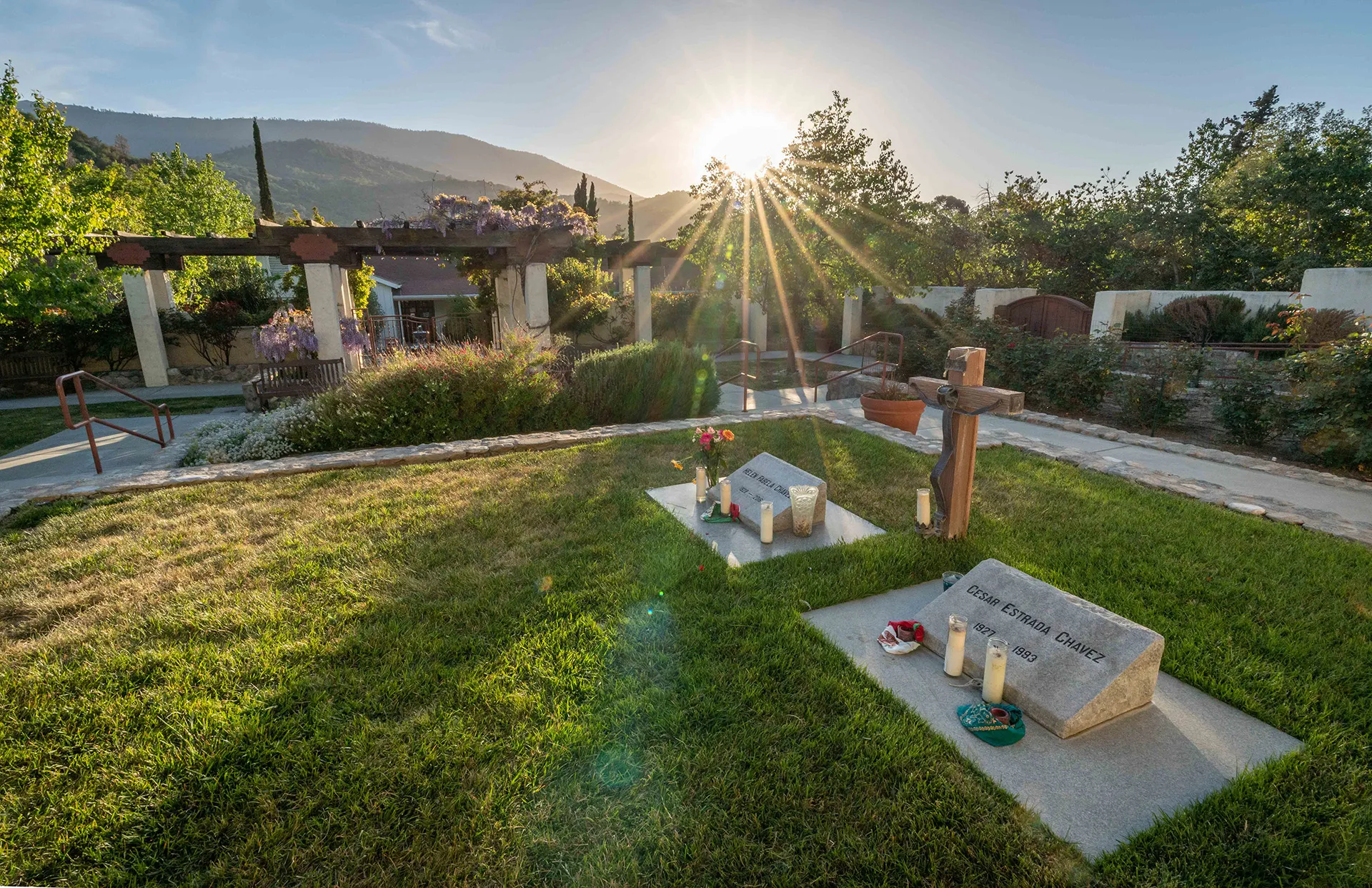
Welcome to the Memorial Garden at César E. Chávez National Monument, located in Keene, California. The Memorial Garden is part of Nuestra Señora Reina de la Paz, which in the 1970s became the home base for the Chavez family and one of the most successful labor movements in U.S. history. Today, the Memorial Garden is the final resting place of Cesar and Helen Chavez, who were instrumental in igniting and sustaining the farmworker movement. As you visit the Memorial Garden, learn from family members and park rangers about Cesar and Helen Chavez and the importance of humility, community, and faith in the fight for justice.
Stop 1. Faith & Service
Entering the Memorial Garden, enclosed by white, thick adobe walls, we pass through a pergola with large wooden beams supporting hanging wisteria plants overhead. These features echo the architectural style found at California Missions. Raised in the Catholic faith, the missions were important to the life and work of Cesar and Helen Chavez. Faith was critical in shaping Cesar and Helen's activism and provided support through difficult times. As part of the farmworker movement, Cesar was inclusive of many faiths, emphasizing the foundation of service and community. As we move through the Memorial Garden, notice statues and architecture that highlight the importance of religion.
Andres Chavez
You know, when I think about my Tata, Cesar, and his faith, it was really what was his driving force. And it's also what introduced him to activism and introduced him to organizing. He actually learned about organizing and issues of social justice through his parish priest when he was living in San Jose, this individual named Father Donald McDonald. And he taught him about the social justice teachings of the Catholic Church. And so as he began doing community organizing, and then with the inception of the farmworkers movement, you saw different elements of faith sprinkled all throughout the work of their work in organizing. I think a big part of that is when you're experiencing something like farmworkers were experiencing, where you're downtrodden, where there isn't a whole lot of hope, where there's lots of oppression. Oftentimes what people lean back to, especially looking at Latino and Filipino communities at that point, was their Catholic faith. It was the thing that gave them hope. It was the reflection that they needed so that they felt like they could continue on another day.
Bernadette Chavez Farinas
I know that, you know, my grandparents were very devout Catholics. So if you take a look in our garden, you will see some statues that were very important to him, that were some of his favorite. But also back in the day with a community, you know, we had a lot of different volunteers, a lot of people that would come for summer breaks or just, you know, would work here. And they weren't all Catholic. They had all, we had all different religions here. And I remember growing up as a kid, we would celebrate everyone's religion. Whether it be on a Sunday, we would celebrate, you know, a Protestant mass or a church, whatever it was. But we made, my Tata made sure that it was important for us to know that we respect others and we respect everyone else's beliefs.
Paul Chavez
One of the themes that runs through the Memorial Garden is the role that faith played in his life and, you know, another component of that was his love of the California missions. You know, when my father and mother got married, their honeymoon was to visit all of the missions in California. And as kids growing up, we, you know, invariably he would take us to the missions and so we knew all of the missions growing up, but here we thought that because it was such a central role in his personal life, but also in his work life, that the architecture should reflect that. And so, you know, if you take a look at the plantings, we have the rose gardens and we have we have the pomegranate trees that were planted. We also have the grapevines. We have the fountains and the architecture used the vigas, the beams that were commonplace in the California missions. But, you know, but part of the inspiration for making sure that there was a strong presence of the mission theme here at the center was that I can remember before La Paz had its own conferencing facilities, every time there was an important decision to make, my father would take his board and leadership and they would go to one of the California missions and they would stay there with the monks and the priests that lived there and they would use their facilities for planning and for reflection and I think a place to kind of gather the strength to go out and do the next campaign. But, you know, another thing that happened is that invariably as kids we would go with him and so my father, you know, didn't didn't like to have people sit around not doing anything and so he'd always make sure that in the back of the of his station wagons that were going with him that there was hoes and rakes, you know, and shovels and so I can remember on more than one occasion that we would get to a mission and my father would introduce us to the to the priest and then he would promptly put us to work. He would tell the priest my sons are here, they can help, they can help hoe weeds and clean gardens and stuff. So while there was a lot of planning going on as kids, we were out there taking care of the California mission. So when I sit here and I take a look at at some of the work that needs to be done, I'm really happy that we have a maintenance staff now.
Stop 2. Life as a Farmworker
As we move to the southeast corner of the Memorial Garden, you will see a statue of Our Lady of Guadalupe. This depiction of the Virgin Mary is particularly important as the patron saint of Mexico and the Americas. Cesar and Helen's upbringing in Mexican American farmworker communities shaped their later activism. At an early age, both Cesar and Helen Chavez dropped out of school to work in the fields to help support their families. They both faced the indignities of performing backbreaking work for long hours in the hot sun with low wages. These experiences led them both to give up a comfortable life for their family and commit to advocating for improved working conditions for farmworkers.
Bernadette Chavez Farinas
I remember, you know, my Tata saying that he'd attend all these different schools, right, as a kid, because his family had to follow the crop. So he went over, he went to over 30 plus schools. And as he grew up, as he grew older, he noticed things weren't changing. Everything was still staying the same. And people didn't believe that they had a voice. And he had mentioned, my Nana saying he had mentioned to her, someone needs to do something about it. And she had said, Well, then you need to do it. And he said, Well, you know what that means? I'm going to have to. They had a decent, you know, lifestyle back then. And she said, Yeah, I know what that means. That means I'm going to have to go back to work in the field, which that was something she had done before. But not with all her children. So she'd get up in the morning and have to go work in the field so that my thought that could go out and do home visits and try to inform people of what their rights were and what they could do. We know he couldn't do it alone. And it took a long time. But my Nana was willing to sacrifice that. They both were, because they knew that this was so important, that people's lives mattered. And they were going to do what it took so that people would listen.
Erin Gates
I think Cesar and Helen's upbringing shaped what their future would look like, even if they didn't know that. And it's similar to how all of our upbringings, in some way, shape, or form, shape who we are going to end up being as adults. And with both Cesar and Helen growing up experiencing the struggles of farmworkers, because they were farmworkers themselves. I mean, Cesar had to stop going to school, you know, at an age when all of us are just starting to make our great friends going into middle school. And Cesar is not even getting to go to school any longer. And Helen had a very similar experience. And I think what that did is it built within them, probably one of the most essential things that we all need, if we want to be of service, is it built in empathy. They understood what other people were walking through, because they had walked through it themselves. And rather than shun or run away from their experience as farmworkers, it was actually while they were at the most, if you will, financially successful place in their life, where Cesar, you know, had a great job, and they had a house, and they had a car, and he wore fancy suits to work. It was at that point in life, when they were as far away from the fields as they could have been, when they collectively made the decision to have Cesar quit his job and start organizing farmworkers full-time. And Helen made the hard choice to have to go back to the fields in order to make enough money to support their family. And she had to raise eight kids. And so I feel like just like their upbringing shaped ultimately their ideals and who they were, all of our upbringings partly shaped that. And it gives us an opportunity to question how we're going to use our upbringing to help us shape how we want to contribute to the world.
Stop 3. Community in the Past & Today
The relief sculpture and fountain on the east wall highlight the diversity of the farmworker movement and those who keep this space alive today. The sculpture depicts a pilgrimage for justice and includes those whose participation in the movement is less well-known. They include men and women of all ages and backgrounds, student activists, and Indigenous workers. The fountain has five spouts dedicated to each of the five martyrs who gave their lives in the movement for justice. The constant flow of water through the fountains serves as a commemoration of their lives and the ongoing significance of their impact. The community that Cesar and Helen cultivated here at La Paz continues today and resonates through those who live here and the visitors who come to celebrate and pay their respects in the Memorial Garden.
Bernadette Chavez Farinas
Over two to three hundred people lived here at one time. Kids running everywhere. I remember we had the hospital we used for dormitory housing. My Nana was, her credit union was based out of there, so we would run in there and help her stuff envelopes. In their yard, you know, we'd have community barbecues, even for holidays, Christmas dinners or Thanksgiving dinners. It wasn't just for our family, it was for the community because we had a lot of folks here that weren't able to go back home, or maybe didn't have a place to go. And it was one thing that my grandparents made sure that everybody was invited to join us. So we thought as kids everybody was related to us, right? But it was, this was a place of community and I think everybody felt very welcomed here. My Nana especially made sure that if people didn't have, you know, their moms or their grandmas or aunts or best friends to talk to, she was always there. She was there to listen. She invited people into her home, into her yard. She was, if you talked to anyone back then, even now, they would talk about how, how welcome she made them feel, even though, you know, she was no, she had no relation to them.
Paul Chavez
But you know, growing up here in La Paz was a different thing. There was people from all walks of life, and there were farmworkers who were working for justice, and there were religious folks, there were protestant ministers and catholic priests, and there were nuns, and there were activists, and Chicano nationalists, and there was just a whole different group of people. And then there were always interesting visitors coming in. So what we grew up in was a community that experienced us to a lot of different types of folks and a lot of different ideas. And so as a teenager growing up, it was a pretty stimulating environment. And I think that it was that setting that gave my father a lot of nurturing and supported him in the work that he had to do.
Erin Gates
There have been several special moments that have happened here in the garden that just have an element of feeling magical. And one specific story was when I was in the garden guiding a field trip with fourth graders. And trying to connect fourth graders to the power and the significance of this story can be difficult sometimes. But as we're in the middle of doing this field trip, a large group of about 50 elder members of the community gathered around Cesar and Helen's gravesite behind me. And then they started singing De Colores, which is a song we actually play inside the visitor center. And I paused the field trip and I went up to the group and I asked them, you know, what, where are they from? What's the significance of this group? And they were all retired farmworkers. And they were all part of a local senior community center that had just come up here on a day trip, but it almost felt like a pilgrimage. And they all started sharing how much Cesar and Helen had changed their lives and how they had, some of them had been on the picket lines with Cesar and Helen, but others had just benefited from having more fair treatment, better wages as farmworkers. And the relationship that we forged that day with that community center has been a relationship that's continued for the last two years. And now this group of seniors come up here at least once a year and they put on a dance performance. And that's just one example of the significance this place holds for so many different groups of people. And you never know what you're going to find when you stop into the garden.
Stop 4. Dedication to Nature
In the northeast corner of the Memorial Garden, a statue of St. Francis highlights Cesar's faith and dedication to underserved communities and the environment. St. Francis is most commonly known as the patron saint of animals. As a pacifist and vegetarian, Cesar believed in non-violence and extended this belief to all living things. Cesar's concern for people and the environment shaped the movement and led to his success in banning pesticides. To reflect the importance of sustainability, the Memorial Garden was created utilizing local and existing materials, such as rocks from the nearby creek. A type of rose named after Cesar are planted on each side of the Memorial Garden.
Andres Chavez
You know, when we look at my Tata Cesar's legacy, we see that so much of it is talked about in the context of his work with the United Farm Workers. But if you look at it more closely, what you'll realize is that he really was an effective organizer, and his activism and his organizing went beyond the fields. And one of those areas was environmentalism. A lot of the work that he did around environmentalism had to do with the very early on, getting pesticides banned. And then later on, when there was use of pesticides in fields in the Central Valley, he fasted for 36 days, drinking water only, because he felt that he had not done enough to talk about the environmental issues and impacts on farmworking communities and poor and low-income communities. And so he was an environmentalist. And so what we tried to do is, in thinking of that, in that aspect of his legacy and his life, we wanted to make sure that we were as mindful as possible of the items that we were using that would construct what is now the Memorial Garden. And so the rocks that I'm sitting on now in this ledge is actually from rocks that come from the creek that just flows right below the property, right on our borderline. If you look at some of the big, beautiful wooden beams here that serve as our portales, these are from 100-plus-year-old redwood that we found on the side of the road up in Oregon. And so instead of creating something new, we did that. The doors that essentially encapsulate the Memorial Garden is actually from recycled lumber from what was the old building that now serves as a visitor center. And so there's all these little elements of us trying to be as mindful of the environment as possible. And again, that's really us being able to lean into this important part of Cesar's legacy and who he was.
Bernadette Chavez Farinas
You know, my Tata, of course, was a vegetarian and my Nana was not. And so my Tata would, I remember, would always say, you know, don't hurt the animals. They have done nothing to you. We were, my Tata was fasting in 1988 in Delano. It was his last fast. And my husband, my boyfriend then, went to go visit him. And we were having a conversation with my Tata, just us three in the room, and there was a spider. And I told my husband, Oh, get it, kill it. And my Tata says no, no, no, no, no. Don't kill it. He has a right to live too. So get that piece of paper. So he tells him, get a piece of paper, pick it up and just let him go outside because he's not hurting anyone. And my husband, my boyfriend looked at me and was like, Oh my gosh, could you imagine if I would have killed that spider? What your Tata would have said? So we talk about it to this day because I'm like, Oh, remember when we had that conversation and you were going to stomp on that spider? And he's like, Oh my gosh, your Tata would have been upset. So I mean, just little things like that, he would make sure that we were, he would remind us how important it was. How every, everything and everybody had a right to be here. If they weren't hurting anyone, then leave them alone. And again, look at where we're at. You know, La Paz is a beautiful place where we have, you know, a lot of little animals around here. We have bunnies, we have squirrels and, you know, my thought Tata would say, leave them alone. This is their land. They deserve to be here too. So he, he was a real animal lover. And he made sure to let us know that we need to protect them as well. And that was something that was really important to him.
Stop 5. Remembering César & Helen
The Memorial Garden you see today has changed over time. When Cesar passed away unexpectedly in 1993, he had told Helen about his wish to be buried with his dogs Boycott and Huelga in the Rose Garden, where the Memorial Garden is today. Helen continued to live at La Paz until she passed away in 2016. While Cesar is often remembered for his outspoken leadership, Helen led with a quieter confidence. Her strength and dedication to the community were critical throughout the highs and lows of the movement. Today, the Memorial Garden is a place where people honor Cesar and Helen's legacy through both celebration and quiet reflection.
Andres Chavez
So growing up here, this garden looked nothing like this. There's been a complete transformation of this portion of the property. When I was growing up, this is actually where I would hang out. And this exact spot is where I'd hang out and wait for the bus to pick me up to take me to school. And we used to bring our skateboards because it was one of the few places on the property that had concrete. And so we would do skating and whatnot before school and then we'd jump on the bus and head to school. In the early 2000s, we began developing the idea of creating a National Chavez Center and a memorial garden for Helen and Cesar. And so what I remember is if you look at the grave site, just imagine a piece of grass that was about maybe three feet wide by six feet long. There was no headstone. All they had was that simple cross that's still there. And there was a couple rose gardens. And really it served as a road divider. Traffic coming in to the property would go one way and coming out would go the opposite way. And you would have never assumed that somebody who made such an incredible impact on this nation's history would have a grave site as kind of plain as what we had here. And so what we've developed here is really a place that's I think a little bit more fitting for Cesar and Helen. But it's also a place for people to come and not only reflect but also celebrate. You can tell by some of the architectural design that we did here. We kind of created informal staging so that we could have celebrations and we could have programs like our naturalization ceremonies, like when we've had celebratory religious observances, like when we've had days of service and we have a jazz band that's playing up right here by Cesar and Helen's grave site because that was some of their favorite music. And so that's what's been really unique about the kind of transformation of this property.
Bernadette Chavez Farinas
The gravesite is the most important to me because, of course, this is my grandparents. It's a place that I can come to if I ever wanted just to talk or just sit. It's a place I come to sometimes just reflect. It's a place that is pretty important to me because I can have these deep conversations with my Nana, Helen, with my Tata, and just ask, you know, am I doing okay? Um, I want to make sure that I make them very proud. Um, but it's important because not only to me, but what I want people to know is that, um, my grandparents sacrificed a lot, but not only them, um, farmworkers. And so to me, the story is, um, never forget, um, how hard they have worked. How much sacrifice people that they have made, not only my grandparents, but farmworkers and farmworker families. So when I see people coming here, um, who have that connection, uh, it brings me great joy because they know that, um, there's a place for them just to come in and reflect.
Paul Chavez
You know, when my father passed away, it was a complete surprise to all of us. You know, his parents, my grandparents, lived to close to 100 years of age, both of each of them, and we figured that, you know, because of my father's diet and his yoga and just how active he was that he would be here forever. So when he passed away, we were all shocked, because he was 66 years of age when he passed away. I remember my mother coming to us and and telling us that his wish was to be buried here in La Paz, and that she, you know, she was fine with that, with the condition that we never leave him. And, you know, what she was saying is that, you know, if we're going to bury him here, then we got to make sure that we stay here. And so of course we agreed and we made the arrangements to bury him here. Well, as it turns out, his specific wish was to be buried in a rose garden where his German shepherds had been buried. He loved those animals. And so I remember after the public ceremonies and the private burial, we sat down and we began to take a look at, you know, what we had on our hands. And the fact is, is that he was buried in probably the worst place here at the National Chavez Center. It was in a skinny rose garden where traffic would come in and it would leave through there, and it just wasn't much privacy. And I remember talking to my mom and saying, you know, do you think that maybe we could maybe bury him on a hilltop and do some kind of inspirational setting? And she laughed and she said, no, that was his wish to be buried there. And then she went on and she says, you know, and I also think that your dad wanted to be buried there because he wanted to see who was coming to work late and leaving early. So those were some of the early considerations on, you know, how we ended up with where we're at today.
Stop 6. A National Legacy
In 2012, Helen Chavez walked President Barack Obama through the Memorial Garden during his visit to officially designate the site as a National Monument. Today, the site commemorates the work of Cesar and Helen as part of the broader farmworker movement. Through organizing, boycotts, marches, and public education, the United Farm Workers Union successfully increased wages and improved working conditions for farmworkers. César E. Chávez National Monument is one of a few National Park Service sites dedicated to people and communities of Latino heritage.
Andres Chavez
The farmworkers movement was really interesting because you would have anti-war Vietnam protesters on the same exact picket line as union hardhat construction workers who may have been a little bit more supportive of the conflict that was happening in Vietnam. But they were coming together around this cause of farmworkers being treated with dignity and respect. I think part of that was the brilliance of the organizing that was taking place by so many of those folks who were doing the work then. But also this idea that the food that we eat impacts everybody. And what was happening and what folks were witnessing and hearing about in the fields, there wasn't a whole lot of gray area. What you had was you had an industry that historically abused the hands that harvested the crops and that fed this nation. And for one of the first times in a major way, them standing up for themselves and taking their message to the American public and shedding light on the truths and sharing their stories and people from all walks of life responding to that. And I think that's a message for us to think about today and it still reigns true. There's something incredible about the shared humanity that we all have. And I think that's what people saw. What people saw was that farmworkers then and now are no different than anybody who maybe works a professional job.
Bernadette Chavez Farinas
I had a visitor one time come in, this was years ago, and he said, you know, I grew up a long time ago, and his father happened to be a grower. And he said, my father didn't like him very much, and the gentleman didn't know who I was. And he said, and so all these years I hated the man. And then he kind of got really emotional, and he said, um, but I'm here to, uh, to tell him that I'm sorry. Because I, as an adult, I now know and see what he's done for these people. And I want to tell him that my beliefs have totally changed. And I want to thank him for what he's done. And he turned around and walked outside and came to the garden, and was here for about 30 minutes, but never walked inside again. And I could see him through the camera, and he was kneeling down at the gravesite, and he was talking to him. And then he went on his merry way. But to see the folks that come to visit us, I get people that are deeply moved when they walk the door. I have people crying before they even enter the door. They're so happy that there's a place for them. They can connect, right? They connect to the story. They remember growing up with their families. On a picket line, they were five years old. They remember boycotting grapes. They remember as a child. But to come as an adult and bring their own kids here is something pretty special. So to hear the stories that, you know, and to see the pictures, people love to share their connection, what brought them here. Some people will come out of their way just to come here, you know. And before, becoming part of the Park Service, we were like a little pit stop for folks. Now we're a destination, and that's something that's pretty important. And I'm pretty proud of.
Erin Gates
Having this special place be designated as a National Monument is incredibly important because it shows that the story of the farmworkers is an American story. It's an American story because we all eat food every day that is picked by people that are still working tirelessly in the fields, no matter how cold or how hot it is. And I think that this place holds significant value for America because it actually helps to kind of speak to the American dream. You know, the American dream, this idea that regardless of where you came from, you can come to this country and you can build a life for yourself that is reflected of your ideals. And that's what Cesar and Helen and the farmworkers, the other leaders of this movement and the farmworkers themselves, it's what they did. They believed in the right to be treated better and they did something about it. But they did it in a very strategic, very intelligent way, in a way that was non-violent, in a way that brought as many people along for the ride as they could. And one of the most powerful tools that they used was actually involving the American public. You know, by giving the American public a chance to show their support and their solidarity to farmworkers through the grape boycott, they were able to help make what appeared to be maybe just an issue only representing or only affecting one small group of people. And they made America see how this issue was something that everybody should care for and care about. And having this National Park Service logo here at this park, it speaks to that national level significance of this story and why we all need to learn about this story. you
Stop 7. Hope, Unity, & Action
Thank you for visiting César E. Chávez National Monument and Memorial Garden. Through the legacy of Cesar and Helen Chavez and the farmworker movement, this place continues to inspire hope, unity, and action. We encourage you to learn more about the history of the farmworker movement and how this history continues to shape communities today.