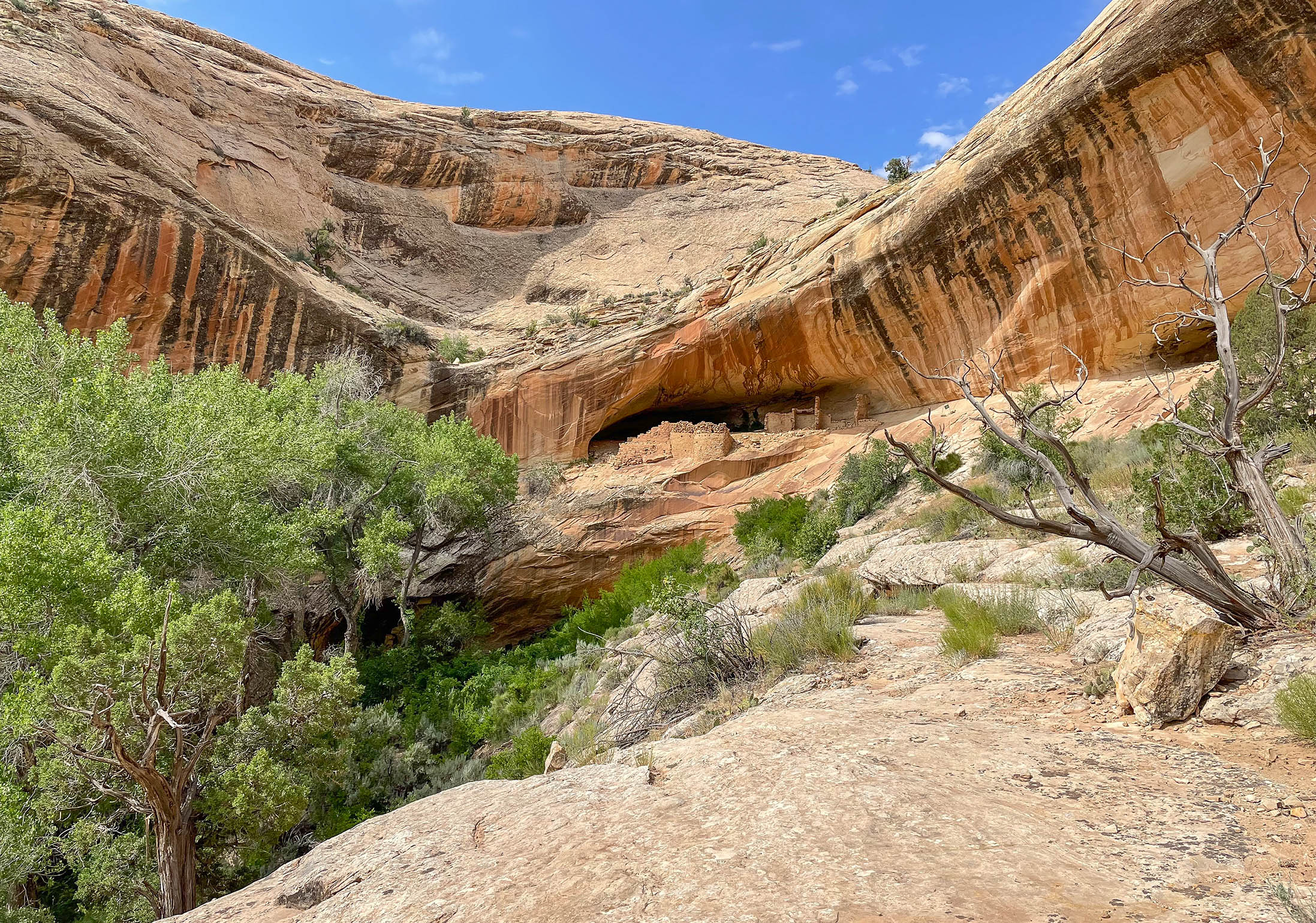
Monarch Cave
[Speaking Keres]. Welcome to Monarch, an ancestral home built into an alcove of Comb Ridge, part of Bears Ears National Monument located in southeast Utah. This place is sacred for Acoma people and other tribal communities. While exploring this place, you will learn about Acoma communities’ deep connection with this land through a long history of migration through the area. This movement has shaped life in Acoma today. Along the way, you will hear from cultural advisors from the Pueblo of Acoma including Steven Concho, Everett Garcia, and Karl Pedro. Today, whether physically or spiritually, pilgrimages to our ancestral homelands such as this are central to Acoma way of life.
Stop 1. Bears Ears & Acoma
This birdseye view of Comb Ridge shows the numerous canyons that have sculpted the sandstone ridge. The tree-filled canyon before you leads to an ancestral village known today as Monarch. For people from the Pueblo of Acoma, this home and the surrounding landscape is the home of their ancestors. The Pueblo of Acoma is a sovereign tribal nation located in New Mexico at a place called Sky City, also known to the Acoma people as Haaku, meaning “a place prepared”. Acoma people are connected to Bears Ears as part of their migration through ancestral lands in the region before arriving at Sky City. Monarch and Bears Ears are part of a broader ancestral landscape central to Acoma way of life. Maintaining connections through movement, both spiritually and physically to these places is part of the process of reaffirming Acoma identity.
Mr. Steven Concho
The Pueblo of Acoma was started to be inhabited about the 1100s and some say even 600 A.D. And it's built on top of a 365-foot sandstone mesa. No running water or electricity even today. And there's about over 500 homes on top. And it's a very, very beautiful place in New Mexico. In our language we call it Haaku. And Haaku means a place prepared or to prepare. And that's what our people were looking for on their migration was this place called Haaku. And that's where I'm from. And it's also known as Sky City. And we do offer tours there as well.
Mr. Everett Garcia
My connection with Bears Ears goes back to the stories, our migration story that was shared with me by community elders. We came from a place up north called Shipapu and in our migration we traveled to many places and Bears Ears is one of the places that we stayed at for a while to replenish our supplies and we continued on our journey, our migration to a place called a place prepared. And so Bears Ears has a very big significance not only to me but to our community because of the migration story that we are told, that it's been shared with us, has been shared with us. And so yes, Bears Ears has a big significance in our lives.
Stop 2. Comb Ridge Communities
Monarch sits towards the top of one of many winding canyons part of Comb Ridge, also known as [speaking Keres]. This prominent landform runs 80 miles long with Butler Wash running parallel to the ridge line. This landform carries a deep significance for Acoma and other Pueblo people evident by the many ancestral homes throughout the area. As we follow the canyon to Monarch, consider what this area may have been like hundreds of years ago. While today, this place may seem remote and isolated, when the people who built Monarch lived here, they would have been part of a much larger community of people living along Comb Ridge. These communities likely would have traded and visited with one another.
Mr. Steven Concho
Up and down this area, Comb Ridge, all these places I think are all connected in one way or another. You know, they just broke off into different sections and, you know, of course if I had my own family and my brother had his own family, after a while we wouldn't want to live next to each other so we would find a different place to live. I think that's what, you know, may have happened and they just settled in different places, close enough to where they could, you know, if they missed each other they could go and meet and do things together and then go back to their homes. But, but all this, you know, all these people in this area, we're all connected.
Mr. Everett Garcia
Comb Ridge has many, many sites, because again, as I stated earlier about the landscape in here, hundreds of years ago, this arroyo was in here. It was good farming. We had water always coming in here, and it was a good farming area, and that's why we have so many sites in here, good sheltered areas in here, where summer from the heat, winter from the cold, we have in here all these things that were needed before they had all these other insulation. They were using built-in insulation, what Mother Earth provided. They were using that, and from the north all the way down to the end, you have these sites, and if you truly look at them, they're almost identical to each other, and again, because there was so many people, that they needed a place where to live close enough that they could share. Maybe in this particular area, the beans did good. A little further up, the corn did good, so I had a good bean crop. Here's some beans for you, because your bean crop didn't do so well. Vice versa, here's corn, because I had a good corn crop, and they lived close to each other. Even pottery, hey, I have some pottery that you might use. They lived close enough and yet far enough away that they were able to trade and share with each other.
Stop 3. Visting Ancestors
From this view, we can see the ancestral home built into an expansive cavernous alcove. For Acoma and other Pueblo people, this place is the living home of their ancestors. For Acoma people, asking permission before entering these places is part of the process of visiting where their ancestors reside. These places are living landscapes that continue to be part of Acoma people’s lives today. These homes are part of the broader living landscape where plants, animals, and all aspects of the environment are part of a critical relationship important for sustaining cultural life for Acoma people. Please be respectful when visiting these places by keeping a distance and leaving everything as you found it. Remember to leave no trace.
Mr. Steven Concho
Over the years, when I first started in this position, all these areas were referred to as ruins. And the story was back then, from the Park Service to the guests, that they don't know where the people went, or there was a huge drought, or they got abducted by aliens. Some stories, things like that, is what they used to tell them back then. But now we're here, and we're telling our own story, and we're telling the story in that our people were in this area, but we moved to different areas. We migrated, basically. And so that, you know, we don't want to use the word ruins, because, as I mentioned, these places are breathing, these places are alive, and we want to relay that to the visitors that visit this area, that you are stepping onto this land that is still breathing, the trees are green, the water is flowing, you know, the earth is speaking to us. And when you get to these homes, our ancestors are often still there, waiting for us. And that's why we never were taught never to go to these homes, these ancestral homes, without announcing yourself first, saying, you know, who you are, where you come from, what your intentions are, and then ask for permission to enter the area if it's safe to do so. So these are some of the things that we're taught, and that's why we regard these places as living, breathing areas.
Mr. Everett Garcia
And we always say these places, non-native term, archaeological sites, are not abandoned. We have spirits there at all times. You heard how we approached Monarch. We ask for permission to enter their home, just as we do when we go visit someone. We just don't walk into a home. We ask for permission to enter. Now we do it with a door knock. And we didn't hear them, but they welcomed us in when we asked for that permission. And to anyone that comes to visit these places should have that respect.
Stop 4. People at Monarch
When entering Monarch, imagine a vibrant community of people living here. Within the canyon and alcove, people's voices carry across the landscape. Many different communities likely lived at this place over generations before moving on in their migration path. People here would have relied on the land for resources to build and maintain their communities, requiring perseverance and hard work. The built structures, cultural objects, and writing on the walls provide insight into people’s daily lives that changed throughout the seasons. Spiritual practices were part of every facet of daily life for those who lived here. Many aspects of this life visible on the landscape continue today for Acoma communities at Sky City.
Mr. Steven Concho
They were a strong civilization, those folks that lived here. They were strong in the sense that they were smart. They knew agriculture. They knew architecture. They were engineers. They were farmers. They were astronomers. Everything that they did was done precisely, and they knew exactly where they were going, exactly where they were going to stay. Here at Monarch, all their necessities are there, and, you know, of course, water's life, and that's the main thing that we all need to survive, and there's water in these areas, especially at Monarch. There's water right where they're living, so it was easy to live there, and it's a good not-too-long hike to get to the valley where they had their crops or they could go hunting, and, of course, where they lived at Monarch, they were well-protected from the elements at that time, and it was just a great place to live, and, you know, being up there earlier today, you know, felt like home.
Mr. Everett Garcia
What was practiced here, as far as religion goes, we still practice that at home every day. We say we have special occasions, just as they did out here, the four seasons of the year. We celebrate them, and I'm sure they celebrated them here. The rains, when they come, we celebrate that at home just as well as they did out here.
Mr. Karl Pedro
Depending on what they were doing. I mean, with everyday life, yeah, I'm sure it's pretty loud with gathering the food and doing whatever you need to do, whether, like I said, if you're grinding corn and with that, I'm sure there were songs and with children climbing all over and I'm sure just like any place else, uh, parents getting after their children not to climb here and not to do that and this and that, but I'm sure it's pretty nice, lovely, lively area, place to be at, to live back, back in this area back then.
Stop 5. Water & Engineering
Looking down the canyon from above the alcove, the green areas indicate a critical part of life at Monarch and Bears Ears: water. Springs near the ancestral home are considered sacred for Acoma and other Pueblo people. They are designated as Traditional Cultural Properties (TCPs) and are given extra protection under the law. The people who lived at Monarch likely utilized the natural formations of this area to mold the landscape for the easier movement and use of water. Those who chose to stay and build at Monarch were likely drawn to the area for the water near the alcove in addition to the wash below the canyon.
Mr. Steven Concho
My ancestors knew how to take care of the water and how to divert the water where it needed to go to for the fields. So in those times of high rain, it wouldn't flood their homelands. And so they built these types of berms and swales all over this landscape to divert the water where they needed it to go. And that's how that's then they were clever in doing so because that's how they flourished. And that's how they got their crops that they needed to survive. And the animals, that's how they got their water. And so, you know, those things, you know, also similar at Acoma.
Mr. Karl Pedro
Yeah, like Everett was saying, water is life and that's what we, you need it, not only to replenish yourself, wash yourself, cook, and again to build your homes, make sure mortar with that and keep up your house to re-plaster, you know. When the rains came, I'm sure they washed off and you had to re-plaster, you know, and then, and there's probably other, and again, if you're making pottery, you need water to, to shape your pottery and work it out and to carry your water, so, you know, and like I said, a few ways down the ways, there's the river and like I said, there's fish in there, so I'm sure if, if you had a pretty dry season where we really didn't have no rain, and if this water source happened to deplete or really go down to where you had to go elsewhere to bring back your water just to, for your daily use, that's what you usually do, which and back home at Acoma, the city on the rock has no running water, so, so we do have to haul our water up there. I mean, we do have cisterns, but nowadays everybody's too lazy to go, go get cisterns and, and bring the water back home. We usually just haul that up in your truck. Other than that, that's what we need, everybody needs water for, I mean, like I said, I mean, not just washing yourself or like I said, cooking and everything else. It's part of life.
Stop 6. Plants & Agriculture
The plants growing in the canyon and wash are resources that would have been critical to the lives of those living at Monarch. The significance of plants that grow in this area is also observed through Acoma pilgrimages to Bears Ears where people collect plants for spiritual and medicinal purposes. The people who lived at Monarch would have harvested plants such as Pinyon, juniper, and cottonwood. In addition to native vegetation, people would have cultivated agricultural crops near the wash. Crops such as corn continue to be important for Acoma people today.
Mr. Steven Concho
Some families will still collect those items, medicinal plants. We have a lot in our area, but there are some that grow in certain areas only, like maybe here in the northern area. And that's why we often advocate to the Forest Service, to Park Service, to take care of the land, because there might be some plants that we use that only grow in a certain area at a certain time. And so we want to protect these areas not only for our future generation, but those that are yet to come.
Mr. Everett Garcia
We must think, three, four, five hundred years ago, this arroyo wasn't here. This was all farmland. And as Stephen had mentioned, they worked that water to irrigate their field. And as he said, we still do that at home now. In fact, in four days, five days, we're going to have our traditional corn planting. So yes, we still practice that. As I said earlier, we still practice at home what they practiced out here thousands of years ago.
Mr. Karl Pedro
Well, just like life now is pretty tough, you know, I'm sure it's pretty rough out there depending on what kind of seasons you had. If you had a pretty good rainy season or if you had a hard winter and if you had a pretty good rainy season, if you planted down below in the flatlands, you have pretty good crops and and I'm sure there was plenty of wildlife you probably had But again, it's just like anybody else. Sometimes you're successful in your hunt and sometimes you're not, you know it it really and I'm sure everybody back then all worked together. So I'm sure They all got along to where they all could help one another both with the farming and gathering of food, plants, whatever was needed.
Stop 7. Pilgrimage & Song
For Acoma people, movement is life. Visiting Monarch and ancestral homes is part of how life is sustained for communities at Sky City. Songs sung in ceremonies directly reference significant places on Acoma’s migration path. Visiting these places both physically and spiritually renew connections to ancestors and the values instilled through these practices. The cultural life observed at Monarch also serves as a map of Acoma and other Pueblo people’s migration paths. Protecting the landscape at Monarch and Bears Ears is critical to maintaining that cultural connection and understanding for future generations of Acoma and Pueblo communities. Songs are still sung at Acoma that touch on these places today.
Mr. Steven Concho
Being in these type of places, like I said, they remind me of home. Because in our way, our ancestors, really we never stopped coming here. Of course, we did leave with the intent to come back and visit, whether it be mentally, spiritually, or physically. Now, Bears Ears to Acoma is a long way. So, a lot of times I'll visit this place mentally and spiritually with my prayers. Back then, our people used to have their pilgrimages and walk this way on foot. But now, as the years have gone by, we have things like the interstates, fences, private property. And so, it's difficult to make such a hike, pilgrimage on foot back up here. But nonetheless, we still find a way to make it back here to our homelands, the places where our footprints are still here.
Mr. Everett Garcia
When songs are sung, not only Bears Ears, but other places that have significance to Acoma are in these songs. And we visit places such as Bears Ears, and I had mentioned earlier about our migration. Every place that we had gone to or traveled to in our migration, we visit these places spiritually. And there is one prayer in particular that takes about two hours that names all these places. And so yes, we continue to have that tie with not only Bears Ears, but other places. This prayer in particular goes from coast to coast. And so we do have a tie with Bears Ears, and it's a very significant tie. And there was a time that we had our religious leaders up until two years ago, I believe, that made pilgrimages to here in particular, Bears Ears in particular, that I was, that I had the honor of joining them when they make these pilgrimages. And so, as I say, spiritually, we visit, physically, whenever possible. And I'm thankful that we're here at this time making this visit again.
Stop 8. A Peaceful Place
[Speaking Keres]. Thank you for visiting Monarch and Bears Ears. Protecting places like Monarch is critical for maintaining this beautiful, peaceful home of Pueblo ancestors. Please share what you have learned with others and continue to learn more about the significance of Bears Ears and its importance for descendant communities.
Mr. Everett Garcia
When we came here this morning, it was like returning to my birthplace, birth home. Many will not understand what I mean by saying birth home, because at home at Acoma, I have one of those. It's called a family home, a place where I was born. And when I go there, I am at peace. I have no worries. I feel good inside. My mind is at rest. And the nap I took earlier was because of that, because I was at peace. I just wanted to rest, because I was with the spirits there, that are there. And I want, I would like to see other community members come and experience that feeling. I want them to be at peace, because we, within our daily lives, get into such a rush that we are not very happy. Today, today I'm very happy, because I am here. I'm here with the ancestors, the spirits.