Mount Rushmore National Memorial
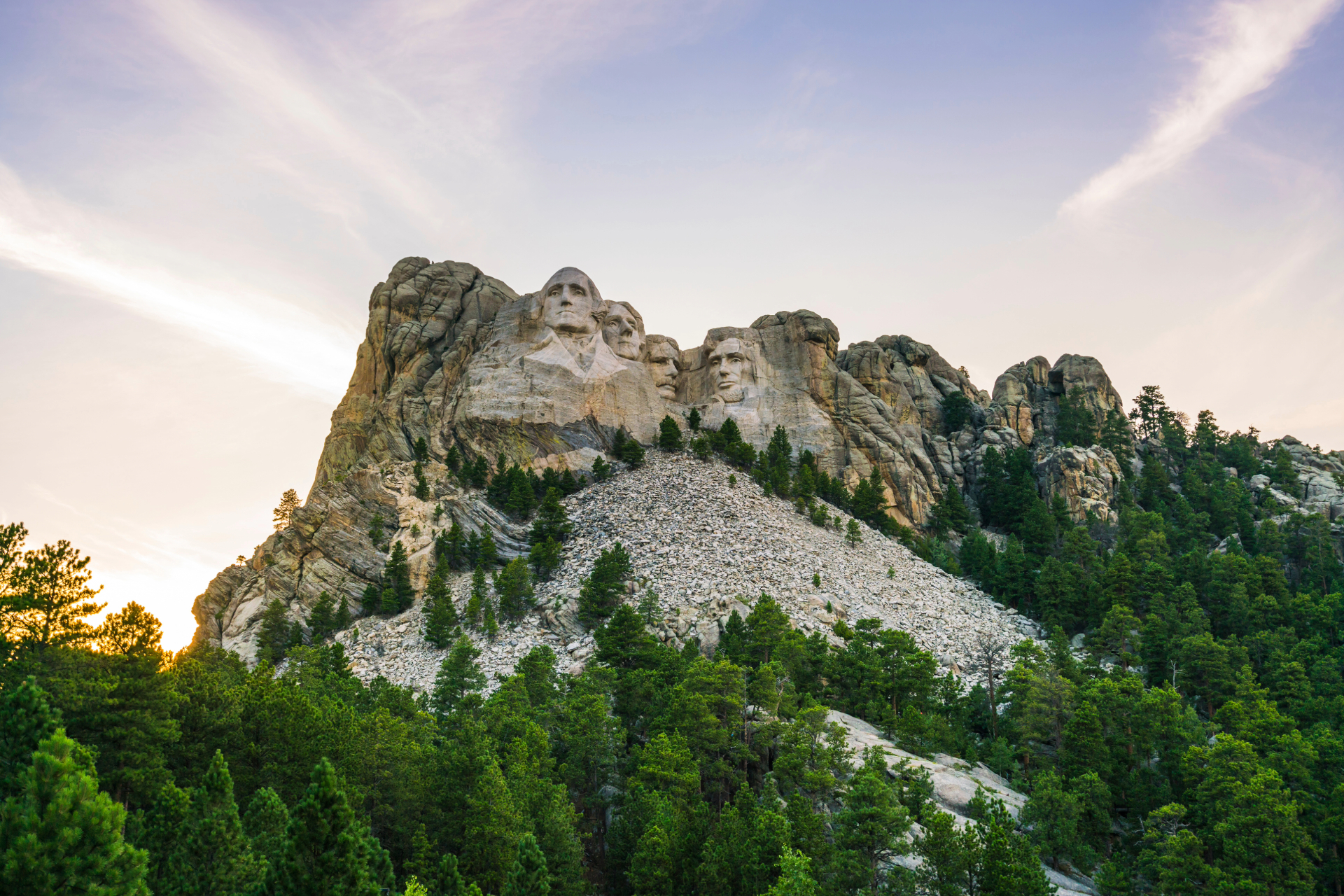
Welcome to Mount Rushmore National Memorial in South Dakota located in the central Black Hills, also known as “Pahá Sápa” in Lakota. The granite rock formations that rise from the dark surrounding forests have played a prominent role in the lives of diverse communities. In this virtual experience, trace the transformation of Mount Rushmore over time and discover the deep connections people have with this sacred place. Along the way, you will hear insights from site experts and interpreters Zane Martin, Sequoia Crosswhite, and Jasmine Pickner-Bell. As you explore the Memorial, consider your connections to this place.
Stop 1. The Six Grandfathers
As you explore Pahá Sápa, the Black Hills, you are surrounded by dense forests of towering ponderosa pines and rugged granite peaks, creating a landscape that many Indigenous communities, including the Lakota, Arapahoe, and Cheyenne, consider sacred. For the Lakota, the rock formation where Mount Rushmore now stands has long been known as the Six Grandfathers. This name comes from a vision experienced by Black Elk, an Oglala Lakota healer and spiritual leader, during the late-nineteenth century. In his vision, he met with a council of the Six Grandfathers, representing the four cardinal directions as well as the earth and sky, who endowed him with the power to heal. As settlers increasingly moved into the region, they sought out the Black Hills as a valuable source of natural resources. Ideas rooted in Manifest Destiny, or the belief that the United States had a unique destiny to expand and spread its values, fueled this expansion, encroaching on territories designated as Lakota. By 1875, the U.S. government began aggressive campaigns to seize the Black Hills. By the end of the 19th century, the US government had forcibly removed Indigenous people from Pahá Sápa and confined them to reservations with boundaries similar to those seen today.
Sequoia Crosswhite
There's four directions, right? Wiyóȟpeyata, Wazíyata, Wiyóhiŋyaŋpata, Itókaǧata. That's north, south, east and west. And then we have [speaking Lakota] the earth below and the sky above. And so that's the name referred to that Black Elk had in his vision. Other names that we had over there is now the mountain is called Black Elk's Peak, But at one point in time it was called Hiŋháŋ Káǧa Pahá which is Makes Owl Mountain. And each one of these peaks had different, significance for different seasons as they came. For instance, you know, in the springtime, that's when really when we celebrate the beginning of the new year. A lot of our people will gather around now to what is Black Elk's Peak, but once was Hiŋháŋ Káǧa Pahá And we welcome the Wakíŋyaŋs to come back. And the Wakíŋyaŋs are the thunder and lightning beings. They're the ones who bring the rain to rejuvenate and to make everything new again. And in the area, specifically below where Mount Rushmore is at, that would be an area that, our people used to take, actually our relatives, before they were making their next step to the journey to the spirit world. And so at one point in time, there would be our relatives that would be up in the trees there.
Jasmine Pickner-Bell
So, prior to the mountain being carved, well, they say desecrated. And, you know, it was for us as Native people, we look at this world, everything has a spirit. Everything from the rock to the trees, you know, has a spirit and a meaning and a purpose in this life. And with the Six Grandfathers, you know, they were already instilled within that mountain. Their spirits were already showing through without having to carve anything. You can feel and see those grandfathers watching over this sacred land. Because this mountain here was part of a beautiful, natural experience that the Creator gave us. To come here and see those Six Grandfathers and connect with them in a way without having to do anything to Mother Earth. You know, we were able to just feel and be connected to one another through this sacred land, through this sacred place.
Stop 2. Tourism in South Dakota
From a bird's eye view looking down below the Memorial, the old road, now part of the Avenue of Flags and the Presidential Trail, sheds light on how roads transformed the area into a hub for tourism. By 1920, aided by the growing use of automobiles, tourism was South Dakota's largest industry after agriculture. State Historian, Doane Robinson, proposed a grand sculpture to boost tourism, initially envisioning figures from the Old West. In 1924, he commissioned sculptor Gutzon Borglum to work on the carving. As construction of the Memorial began, they continued to work on the roads which were essential for promoting and providing access for tourism. At the same time tourism was growing, the Lakota, Cheyenne, and Arapaho filed claims in court, asserting that the U.S. government had illegally taken the Black Hills, an area central to their culture and identity. Indigenous communities had long visited, despite their displacement. Many continued to visit even after their forced removal. The area remains a significant cultural space to this day.
Zane Martin
Gutzon being the visionary because he continually wrote letters to anyone that would listen about the roads and they had to get these roads better to get these people here and to get them here to stop on their way to Yellowstone or whatnot. So he was a huge advocate for that. And one of my favorite stories is, in 1930, when they were getting ready for the Washington unveiling, one of the workers, this is an oral history, was telling this story that, “Oh my goodness, everybody's got to stop. We got to, we're not working on these faces today. We're going down there working on the roads.” So everybody was down there moving these rocks off the road, so the cars and people that did have cars could get up there, you know. And this guy looks around to the people working there, and he looked at the guy next to him and Gutzon was out there picking up rocks himself and moving.
Stop 3. The Sculptor
We have entered Gutzon Borglum’s studio below the Memorial where Borglum iterated on his evolving vision for Mount Rushmore from 1939 to 1941 utilizing a 1/12th scale model. Born in 1867 in Idaho, Borglum's interest in art developed early, shaped by a tumultuous childhood. After studying painting and sculpture in Europe, he returned to the U.S., focusing on American historical subjects and creating a bust of Abraham Lincoln for display in the Capitol Rotunda. Before Mount Rushmore, Borglum was the first carver at Stone Mountain in Georgia. Controversies and disputes during this project led him to abruptly leave the project in 1925, yet also paved the way for his work at Mount Rushmore. His passion and ability to forge connections with U.S. presidents and leaders were critical, helping to secure $850,000 in congressional funding. The Sculptor's Studio here is a testament to his dedication and the massive task of creating this Memorial.
Zane Martin
What Gutzon brought to the project was, I think, just what was needed to get this kind of job done. Particularly when you consider where it was located. And the country for most of the 14 years that they carved was depression era, and so Gutzon was an artist, most definitely, hands down. I mean, he could paint there wasn't he could sculpt to me whatever he wanted to do, he could do artistically. He was get up and give a speech, a very long speech, if he wanted. And he was just interested in so many things, aeronautics, roads, as we've mentioned, pageantry for events and whatnot. And because of that, I think his multi-faceted interests. I don't know if that's the right way to say that, but the numerous things he was quite interested in went to it. I mean, he could kind of zero in on any crowd and kind of knew, you know, what to talk about, what to get done.
Stop 4. Artistic Vision
As you explore the intricate details of the rock face, imagine the vision of Gutzon Borglum, who selected these iconic presidents to embody the first 150 years of American history. Borglum believed that American art should be massive and designed to inspire awe. Initially, he aimed to carve full figures of Lincoln and Washington, but his plan expanded to include Roosevelt and Jefferson. Borglum chose the southeast-facing rock to maximize the exposure of natural light on the sculpture. How does Borglum's vision reflect the artistic and historical significance of each presidential face carved into the granite?
Zane Martin
His thing about Lincoln was his hair and his mustache, or his beard. And, you know, you can see, like I said, in the in these letters and stuff, this is commented upon, you know, he wants it just right. And so I went through, I think there was like 242 different images, photographs, slides, film clips, what have you. And if there's any scaffolding on Lincoln, it was his hair, and his beard. At first and I thought, well, Gutzon kept him where he said that was his focus for Lincoln. And then he, he wasn't as worried, and he wanted that just so, Roosevelt's glasses, you know, because he was the only one with glasses, and he wanted that to So. And, and it's kind of funny, there were his words and instructions written out, you know, to Lincoln and whoever, and then the the image is just backed up. That's what was worked on. Yeah. So you could see he was satisfied with Lincoln's eyes were totally fine. You know, Jefferson had trouble with his lip because they had a strange type of rock there. So, but, yeah, it was all hair and beard.
Stop 5. The Workforce
Gazing up at the Memorial, the viewer can imagine where the winch houses once stood on top of the sculpture near Washington, Jefferson, and Lincoln. These were essential for hoisting and lowering workers and tools during the carving process. A total of 400 workers assisted in the carving of Mount Rushmore. This workforce, composed mostly of locals but also individuals from across the nation, was significantly impacted by the Great Depression, with Borglum often traveling to secure additional funding. They formed a tight-knit community and organized group activities such as baseball. Many workers’ spouses lived on-site, managing payroll, organizing events, operating boarding houses, and cooking. Despite frequent funding interruptions and the tolls of the Depression, the workers persevered. The Civilian Conservation Corps (CCC), a New Deal program providing jobs during the Depression, helped build retaining walls and stairs on the Memorial grounds. Workers were sometimes away from their families for long periods while others, like those part of the Payne family, lived and worked on site together.
Zane Martin
The workers, I mean, it was a job and they were awfully glad to have it. And I think probably extremely relieved that they could walk to work, you know, if they lived in Keystone. Right? And then things around. I want to say like into the 30s, particularly after the, you know, the dedication of Washington and people were getting more the idea what that was going to be. You know, I think more people probably moved there. I know, like, one of the ladies in town, you know, she would let people board there with them and you'd see a lot of families like, oh, hey, my brother working there, and one brother comes, and then, you know, the Payne family is a perfect example. I think at one time, there might have been as many as six people with the Paynes getting paid for various jobs there.
Stop 6. Carving of the Memorial
This close up view of the presidential faces reveals many of the innovative techniques used in the carving process. The project began with skilled workers suspended in specially designed chairs, using heavy, compressed-air jackhammers to bore vertical holes in the mountain's face. Powdermen then filled these holes with dynamite and blast caps to remove precise amounts of rock. This was followed by a process known as honeycombing, where workers drilled holes three-quarters of an inch apart, softening and weakening the granite for easier removal. Finally, workers utilized specially fitted drills to smooth the granite. Harney Peak Granite is a fine-grained igneous rock with quartz, feldspar, and other minerals native to the Black Hills. Borglum preferred this type for its low erosion rate and durability, but with thin veins running through it, the granite was susceptible to cracking. Over fourteen years, with six and a half years of actual carving, the workers had to adapt and improvise their techniques, ensuring the Memorial would endure over time.
Stop 7. Unfinished and Evolving
Just behind the presidential faces, at the top of the mountain, a small rectangular opening leads to the Hall of Records, a section of the Memorial that was never completed. Borglum's dream for this space was to create a vault containing important national historical documents. Although he passed away in March 1941, his son, Lincoln Borglum, who had been involved in the project from the very beginning, managed to finish the main sculpture by October 1941, right before the U.S. entered World War II. In 1998, 16 porcelain panels inside a teakwood box were added to the unfinished Hall of Records representing a symbolic completion of Gutzon’s vision for the space. The Hall of Records remains a symbol of the continually shifting meanings associated with the Memorial. Just as American democracy is an ever-evolving process, so too have people’s relationships with Mount Rushmore changed over time.
Zane Martin
Lincoln to me, documented without realizing he was documenting the progress of the of the phases by all the photographs he took, you know. And so that's one of my favorites is just the whole story. And and also then I think, I think ownership of the project and pride in it was grew every year from the time they started. But it was really that summer of 37, I think, really cemented that with those that core set of workers that were locals, what we call locals. And then after that, Gutzon got the funding where they actually worked year round, you know, and I think in 40 he got, some people that had been there before, to come kind of spend the summer. But basically, you know, it was and no one was there. Also, when Theodore was finished, that was locals, you know., the men he trained. You know, Lincoln's boots on the ground up there every day. He's up there. And of course, at night, the table at his mom's house, they might be hearing about fundraising and planning and meetings and stuff, but Lincoln was up there with the guys every day.
Stop 8. Indigenous Connections
Along the Presidential Trail below the sculpture is the Lakota, Nakota, and Dakota Heritage Village, one place where visitors can learn about Indigenous culture. Throughout Mount Rushmore’s development, Indigenous communities have maintained strong ties with this land From the early 1950s until his death in 1973, Ben Black Elk, son of the famed holy man Black Elk, shared Lakota stories and traditions with visitors. These days, visitors can learn about Indigenous connections to the Black Hills, both past and present, from cultural interpreters. Reflecting ongoing reparations, the Supreme Court ruled in 1980, in favor of the Lakota claim to Pahá Sápa, offering monetary compensation accruing to over one billion dollars today, which Indigenous leaders declined by stating “The Black Hills are not for sale.” This refusal highlights the profound values and connection with the land and the ongoing struggle for recognition of Indigenous sovereignty.
Sequoia Crosswhite
When we think about these concepts of things, when treaties were made and the distinct areas were given off for certain groups of people, that was never in our concept of way of thinking. We never thought that we had territories or we had areas that we necessarily claimed as ours. We just lived in where we lived in at the time, and that thought of land ownership would, would really just go against our faith, because our faith is that the Creator made everything and we're all the part of the creation. Not any of us human beings planted any of these rocks or moved or moved any of these rocks, or planted any of these trees. These are all made from the creator, and we're a part of that creation. And what that has done is, is caused a stigma amongst a lot of us Natives where we wake up every day thinking that somebody owes us something, right. And when you have that laying on your heart all the time, you lose focus on what you want to do in this world and what you want to do in this life. And you're just constantly thinking about that money that's owed to you or those things that are owed to you. And the truth be told, those are the systematic things in, and I try to do my best to walk in both worlds and respect the fact that that's what we live in now. But I also keep my mindset that this is all the Creator's creation.
Jasmine Pickner-Bell
For many years since I was younger, I have started to build this relationship and create this family tradition with Mount Rushmore. And in this beautiful area of the Pahá Sápa, the Black Hills and I am at the point now to where my daughters are getting the opportunity to learn more about taking on that role and responsibility. So it's very important for me to be here in this beautiful area because it's part of a sacred land that my people years ago roamed. And through the years we have evolved and we have adapted to a new way of life, but yet we can still come back here and still feel their sacred presence right here in this beautiful land.
Stop 9. The Memorial Today
Directly below the sculpture is a large amphitheater with a view of the Memorial. Mount Rushmore was envisioned by the artist and patrons as a symbol of American democracy and freedom. Today, the Memorial welcomes visitors from around the world who come to appreciate this artistic marvel and express their own connections to it. Several Indigenous communities maintain connections to this land, with twenty-one Tribal Nations affiliated with the Memorial. Each summer evening, the Memorial hosts a lighting ceremony and the singing of the national anthem, Since 2008, the ceremony has included a program where veterans retreat the flag on the amphitheater stage and are publicly recognized for their service.
Sequoia Crosswhite
I guess if there's one thing I would share with people, if you are up in the area, whether you're at Mount Rushmore or you're around the area and you do see somebody see, a Native person that is there to be a guide or is there to share stories, give them the opportunity to tell their story. In Lakota we say [speaking Lakota] We have two eyes and two ears and only one mouth, and so we should use our eyes and ears a lot more than we should use our mouth. And so within that sense, give them a chance to give them stories. And also think of some questions you might ask those individuals. Think about some curiosities, because the only way we learn in this world is if we ask questions.
Jasmine Pickner-Bell
The one thing I would want each and every one of our visitors to leave with after visiting this place and seeing how we have incorporated the modern day society and our traditional society together, and learn to balance those two things out and help educate people on both walks of life. I would hope that they leave here with a open heart, a open mind, a better understanding and a better outlook on who we are as Indigenous people in hopes that even they may go home and research who they are and where they come from, and be proud of their heritage, their culture. Because each and every one of us come from that rich background of our culture, our people. And so I hope to encourage them to one day maybe have them be able to be thankful for being here, because I was able to show them how to be proud of who you are and where you come from.
Stop 10. Opportunities for the Future
Thank you for visiting Mount Rushmore National Memorial. Mount Rushmore is not only a Memorial, but an ever-changing symbol of history and heritage that ignites discourse from its diverse visitors. As you leave, take with you the stories of the many communities whose cultural traditions have shaped this place and continue to flourish in the Black Hills. We invite you to explore further, engage with the history, and share this experience with others.