Mule Canyon Village
Welcome to Mule Canyon Village, a place where the past continues to resonate today. Part of Bear's Ear's National Monument, this village was once a thriving community, a home to families who lived, worked, and celebrated life here, over a thousand years ago. As you stand here, imagine the laughter of children, the aroma of meals cooked over open fires, and the warmth of gatherings under the vast desert sky. Today, the village and the broader landscape are considered home to the ancestors of many descendant communities who live throughout the region, as you explore tread lightly. Joining us on this experience is Shirley Cloud Lane from the Bureau of Land Management, who will share insights on the past and the ongoing significance of this vibrant landscape today.
Stop 1. Daily Life
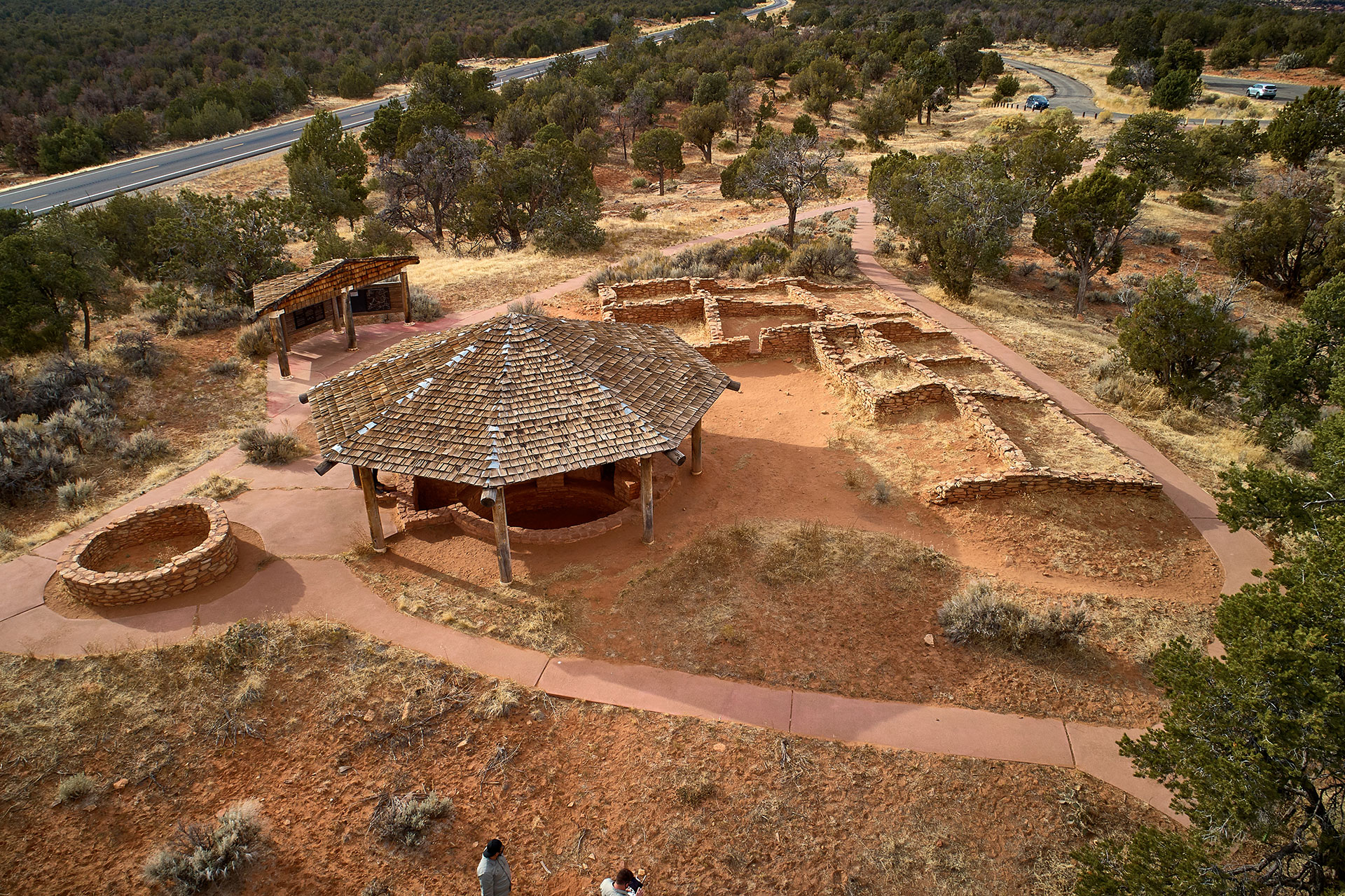
Looking at the village from above, the square footprints of room blocks constructed out of stone bricks show how the people of Mule Canyon were masters of ingenuity and adaptation. The local materials used to construct the village shed light on how essential the landscape was in shaping people's daily lives. They were farmers, artisans, and storytellers deeply connected to the seasonal rhythms of the land. They relied on the landscape for building materials, tools, and clothing, adapting to extreme seasonal changes and resource availability throughout the year. Life here was not easy and hard work and resiliency were important values for community and survival.
Shirley Cloud-Lane
People need to realize that this isn't a site. This is an actual village, a place where people lived and survived and they married, they had children, they did prayer, they performed dances, they had ceremony, they ate food, they had celebrations. And so that's, that's what you know, needs to come out of this, that there were actual human beings that lived here. Most of them were probably farmers, they were stone carvers, they were potters, they were weavers, hunters, artists, storytellers, and clan priests. And these people, when they lived there, their clothes were probably made from hides. Their shoes were probably sandals woven from the yucca plant that's very plentiful in the area. In the winter, your clothes may have been made from animal hides or rabbit fur, or turkey feathers. An interesting thing about these people, their lifespan was 40 years, and that was only if you made it past the age of five. When you look at some of the physical features of these people, we know that they were short in stature and we know that they suffered a lot from arthritis. And so it was not an easy life. It was hard, but these people were highly skilled. And what the Pueblo say is these people survived because of the connectedness they felt to the land and to their deities that they worshiped and that they gave offerings to. So when people come and visit this place they need to be reminded of, it wasn't an easy life and all the skill that it took to build this particular site.
Stop 2. Building a Community
The people who lived in this village relied more on agriculture than their ancestors and settled into more permanent homes. 12 room blocks made out of stone, brick and clay mortar are visible on the landscape. Imagine the effort. Every stone carried on their backs, water hauled in yucca baskets lined with pitch. Design and construction required. Skill and knowledge passed down over generations. Maintenance of the structures would have been an important part of seasonal life at the village. This village is a testament to their hard work and ingenuity. A monument to the power of human collaboration and adaptation.
Shirley Cloud-Lane
This is a village that represents where a group of people who came into the Southwest originally around at the time of Christ. And then because of corn, they moved from being hunters and gatherers to be in a little bit more sedentary. And so here, this is where the people started building. And that's what you see at this particular site is you see room blocks built out of stone. And you need to keep in mind when they were building this, they didn't have the wheel. They had no beasts of burden. And so all of the stone that they use to build these homes were carried on their backs and often carried from long distances. Because if you look around the area there, where did they get the stone from? There aren't any rock quarries in the areas, there’s lots of sandstone around there, but there are no real rock quarries. So they had to carve the stone and then carry it back to where they were building. The other thing that they had to do was to look for water. How did they build them, make the mortar? They had to mix it with clay and mix it with sand. So where's the water. So water had to be carried from a distance, probably in baskets, Yucca baskets that were lined with pitch. They carried them great distance and they probably needed a lot of water. They also could have utilized the pottery, pottery that was made from the clay that was in the area. So there was a lot of, a lot of work involved in building this site.
Stop 3. The Kiva
At the heart of Mule Canyon Village lies the Kiva, a sacred space important to spiritual and community life. The circular Kiva with a keyhole shape is built into the ground, and this reconstructed Kiva is covered by a roofed structure to help protect the site from the elements. Historically, there likely would have been a roof that covered the opening flush with the ground. Here, the community gathered for ceremonies and other community activities. An underground tunnel connects the Kiva to a circular tower, suggesting important religious practices that would have allowed people to move from one structure to the other without being seen. Kivas are sacred places for many descendant communities, and they ask that you refrain from entering these structures and visit them with respect.
Shirley Cloud-Lane
If you look at the Kiva and the tower, you can tell that these folks had a very strong religious system. Kiva, we know, from talking with some of the Pueblos that have shared with us, the Kivas were used by clan society members. And so for this particular site, we know that Kiva represents one clan. The tunnels that are there that go from the tower to the Kiva. Some of the Pueblos have shared that in some of their rituals there are clothing that they wear that's not to be seen by anyone on the outside. And so these dancers and these people who were performing these rituals would dress in a certain place, and then they would enter into the Kiva, where, you know, through the tunnel, so no one on the outside could see what they were wearing. These clan societies were very, very important to the people, part of their way of giving honor to the creator who brought them to this area and helped them survive and gave them ways of life.
Stop 4. Migration
Mule Canyon was likely a home for many communities who migrated throughout the region after being utilized for over a century. People moved on to different areas, leaving behind sandals, pottery, and other material aspects of life. The migration of people can be seen throughout the region and the Bears Ears landscape. Their descendants returned to this place, honoring their ancestors and keeping their stories alive.
Shirley Cloud-Lane
The Ute people respect the lives that they had and we also marvel at the mystery of their departure. And I think that's what needs to stay is the mystery of why they departed. And we know what the archeologists say about drought that came in the air that may or may not have been why they left. We know stories where the Pueblo people say that their creator told them it was time to leave, leave everything behind, move on, it's time for a different place. And so they moved South. And for many years, the archeologists used to say they disappeared. Well they did not disappear. Their descendants are alive and well. Twenty-three Pueblo tribes still carry the songs, still carry the prayers, still come and visit the area, still talk about their people and still carry on some of the skills like the weaving, the pottery making, that's a skill that's been handed down from generation to generation. You can still see it among the people today, among their descendants.
Stop 5. Living Legacy
The people of Mule Canyon did not vanish. Their legacy lives on in the descendant communities and tribal nations throughout the region, who carry forward their traditions, songs, and values. The art of weaving. The skill of pottery making and the connection with the land have been passed down through generations in efforts to protect this cultural landscape. Bears Ears National Monument was established through the efforts of five tribal nations. Bears ears is not just a window into the past. It is a living landscape and home to the ancestors of descendent communities.
Shirley Cloud-Lane
For the Pueblo tribes, is the home of their ancestors. And for other native nations, Bears Ears is a place where tribes can come to sing songs, to do offerings to gather plants for food, for medicine. There's a lot of history that's involved here. For instance, among the Navajo, one of our chiefs, original chiefs, Chief Manuelito, he was born in this area, and so we sing songs and tell stories about this event. One of our other chiefs, K'aayelii, he was one of the chiefs that led a band of Navajo followers up into the forest of Bears Ears to hide when the soldiers were coming to round up our people to take them to, on what we call the long walk to Fort Sumner in New Mexico. So it's a very important place, like I said, to all tribes.
Stop 6. Sacred Ground
As you explore Mule Canyon, remember that this is a sacred place, considered the living home of ancestors. The Kiva, the room blocks, and the artifacts you see are not relics of a forgotten past. They are threads connected to living communities. Please do not climb on the walls or enter the Kiva. Treat this site with the reverence it deserves. By doing so, you honor the people who lived here and their descendants who still hold this land sacred. Respect is not just a gesture. It is a bridge between the past and the present.
Shirley Cloud-Lane
We always say that when you come to a village, you're coming to someone's home. So you want to make sure that you don't climb on the walls, you don't go down into the religious structure, the Kiva. You don't carve your names in any of the stone. The only thing you leave are your footprints and what you can take away are pictures.
Stop 7. Reflections
The story of Mule Canyon is one of survival, ingenuity and connection in this harsh and beautiful landscape. People built a community who were dedicated to the values of hard work. They cultivated crops, crafted tools, and established community networks, adapting to the seasons and sometimes unpredictable environments. As you leave this place, take a moment to reflect on their legacy. What can we learn from their resilience? How can we honor their connection with the landscape? Their story is not just history. It is a reminder of what it means to be human, to adapt and to endure.
Shirley Cloud-Lane
These people, because they were closely tied to their creator that they gave honor to the creator. They gave blessings. They gave offerings. They asked for help and the creator gave it to them. They survived in this area for over a hundred years. And then when it was time for them to leave, they listened, they left everything behind. That's why we find sandals, and that's why we find pot sherds. That's why we find pieces of clothing at these spots. Why didn't the people take it with them? Well, they were told not to. They were told to leave everything behind and just take what you could carry and move on. So these people were magnificent, their culture, and their civilization, and how they survived.