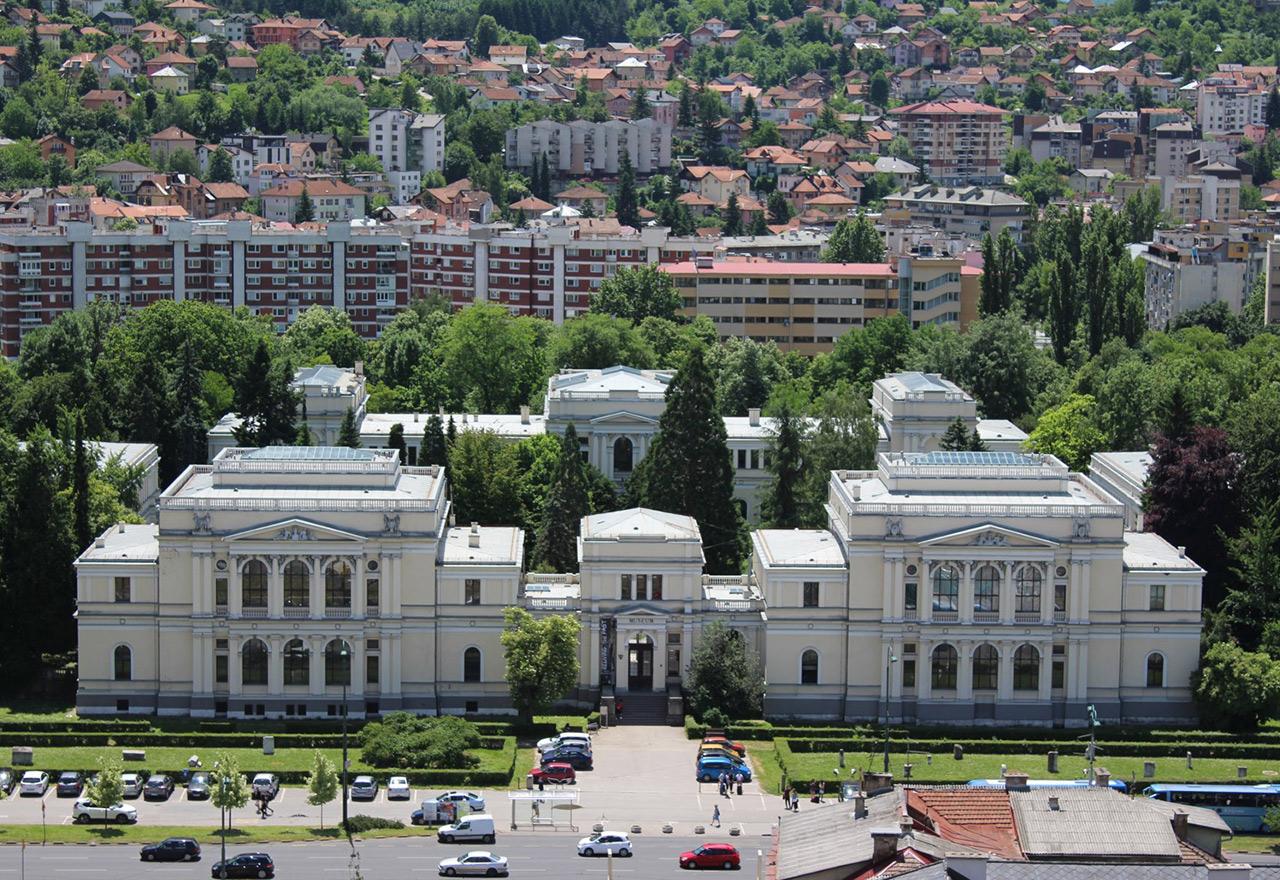
National Museum of Bosnia and Herzegovina
Welcome to the National Museum of Bosnia and Herzegovina, the country's oldest scientific and cultural institution. It was founded in 1888 during the Austro-Hungarian administration, out of a need to safeguard and explore the region's rich heritage. Designed by the acclaimed Czech architect Karel Pařík, the museum complex, completed in 1913, features four distinct buildings connected by terraces and a picturesque central botanical garden. Inside, the museum houses three million objects meticulously curated across its Archeology, Ethnography and Natural History departments. While not all items are on display, they collectively reflect the diverse and vibrant tapestry of Bosnia and Herzegovina's heritage. Sadly, during the 1990s siege of Sarajevo, the National Museum found itself on the front lines, enduring more than 500 shell and projectile strikes. Yet amid the chaos, danger and destruction, the museum staff remained steadfast in their commitment to safeguarding the museum and its collections. Throughout and after the war, various international organizations and foreign governments provided the museum with crucial support and aid for its preservation and restoration efforts. Though some damage, particularly to the eastern wing of the museum's entrance building, remained unrepaired for decades. Thanks to the Ambassadors Fund for Cultural Preservation and other international contributors, the building was reopened to the public, unveiling a new permanent exhibition within the Prehistory Collection. On this virtual tour, you will get a glimpse of this newly restored building and learn about the museum's challenges and efforts to preserve its collections through the stories of its most representative artifacts and insights from the Acting Deputy Director, Ana Marić, archeologist Adnan Kaljanac, art historian Andrea Baotić-Rustanbegović, and conservator Lejla Bajramović.
Stop 1. The Prehistory Section
The Prehistory Section within the Department of Archeology is of great importance for the museum. With its newly renovated interior and restored painting decorations, it is the most representative part of the museum architecturally and artistically. In 2021, a new permanent exhibition, “Bosnia and Herzegovina in Prehistory,” marked the Department's first opening to the public after three decades of closure due to war and war related damage. Featuring approximately 3,000 of the most significant and carefully selected artifacts, including a rare preserved wooden boat, this represents the largest exhibition in the Archeology Department. The items span periods from the Paleolithic and Neolithic to the Chalcolithic, Bronze and Iron Ages, reflecting the rich culture of all regions of Bosnia and Herzegovina.
Ana Marić
In our Department of Archaeology, or rather in the Prehistory Section, we have inventoried over 60,000 items. However, the actual number of objects is at least three times greater, considering that, for example, certain sites have not been inventoried at all.
Andrea Baotić-Rustanbegović
The Prehistory Pavilion is part of the archaeological department of the National Museum of Bosnia and Herzegovina. And what is important to emphasize is that it was built specifically for the collection, that is, the artifacts that were discovered and are related to the prehistoric period. The National Museum of Bosnia and Herzegovina is known as one of the few scientific institutions, or museum institutions that were purpose-built in the southeastern part of Europe, and what is important to highlight is that this pavilion-style construction was planned for the reason that it was anticipated that the collections would expand, so this pavilion system was designed to allow the museum to expand. Another very important point is that each of the pavilions was designed not only thanks to the architect who was engaged in this project, that is, Karel Pařík, but also thanks to the curators of each individual department. So the pavilion was purpose-built for the collection that is now housed here.
Stop 2. A Prehistoric Discovery
As you enter the Prehistory Section, the first thing that catches your eye is a striking boat measuring 40ft in length and suspended from the ceiling so as to float above the ground floor. This vessel has an intriguing history that began in 1904, when it was discovered at the archeological site of Donja Dolina in northern Bosnia and Herzegovina. During the excavation, it was found in two distinct pieces buried in the mud of the Sava River. These fragments were carefully transported to Sarajevo on two separate occasions. Initially showcased on the ground floor, this remarkable boat was later raised to its current location to offer visitors a clearer view of its impressive features and dimensions. Its length, shape and shallow design suggest that it was crafted for a specific purpose to transport goods traded with nearby settlements along the Sava River. Additionally, it appears to have been connected to a sailing vessel used by merchants navigating these waterways.
Adnan Kaljanac
It was discovered during the Austro-Hungarian period. The head of the excavation in Donja Dolina at the site where the boat was found was officially Ćiro Truhelka. However, of course, other staff from the National Museum also participated, primarily Vejsil Čurćić. An interesting detail, when they managed to lift it from the ground, Vejsil mentions in his memoirs that they used similar boats. He describes how the locals of Donja Dolina, during the Austro-Hungarian period, when the boat was excavated, used almost identical vessels on the Sava River. They took two such boats and managed to lift it thanks to that very water level they struggled with, lifting it so that it simply floated and reached these modern boats, modern at that time, and then they proceeded down the Sava River with them.
Andrea Baotić-Rustanbegović
When designing this pavilion, Karel Pařík had to take into account that a boat from Donja Dolina was found, which is over 12 meters long, so it was also considered as one of the more important artifacts during the design process.
Stop 3. Conserving the Boat
As the workers transported the boat to the National Museum, they undertook a significant conservation effort using the techniques available at the time. The boat was treated with carbolineum, a preservative specifically formulated to protect the wood against decay and pests. The boat's fragments were carefully reassembled with joints meticulously sealed to ensure stability. The wooden boat from Donja Dolina represented a major project for the museum's conservators and staff in their preparations for the new permanent exhibition. To ensure the boat was properly preserved for display, the museum organized workshops with experts from the Institute for Conservation and Restoration in Rome (ISCR) who collaborated closely with the museum team.
Lejla Bajramović
The boat when viewed in the display case, looked quite good, and it was indeed in relatively good condition. However, since the curators had a plan to exhibit it in a different way than it was, in the display case on the first floor of the exhibition, it was necessary to remove the display case. When we did that, when we opened the case, we found that there was a strong smell of the material it was conserved with. It was actually a petroleum derivative, so everything around the boat smelled of petroleum.
Stop 4. The Ceiling and Wall Paintings
Have you noticed the richness of ceiling and wall decorations? These carefully designed motifs - decorating the interior space above the pillars and between the arches - emphasize not only the skill and dedication of the painter, but also the connection between the harmonious pictorial work and the architecture of the building. In accordance with historicism- which was popular in the 19th century- these painting decorations reflect not only the architectural style of the edifice, but also the purpose and content of the exhibition space. The decorative painting motifs are typically framed within geometric borders and central rosettes, adding to the overall elegance using techniques that imitate marble and include intricate floral motifs. These artworks are not only eye catching, but also thought provoking in their interplay of color and form. At the same time, they also serve as a reminder of the passage of time and the fragility of cultural heritage. By creating a dialog between the past and the present, the painted motifs invite us to appreciate not only the beauty of the art, but also the stories and lives behind it.
Andrea Baotić-Rustanbegović
The decorative painting in the Prehistory Section is a typical example of historicist painting style. In general, historicism, which gained momentum in the European context at the end of the 19th century, entered Bosnia and Herzegovina with the Austro-Hungarian administration. It is important to emphasize that it does not represent one style, but several parallel trends. So the main characteristic of historicism is the reference to great works from previous eras, starting with antiquity, through the Renaissance, Baroque, Romanesque, and Gothic. Another important characteristic of historicism or historicist painting of buildings is the aspiration to create the so-called Gesamtkunstwerk, that is, a harmonious and integrated whole. So architecture, painting, and the applied arts should all contribute to a harmonious and cohesive relationship within the building. In this case, the synthesis is quite well achieved, meaning the painting that was made following the model of grotesque painting, or Pompeian painting, with the goal on one hand to highlight archaeology – that is, research as such, and on the other hand, grotesques which, in formal terms, symbolize a connection between continuity and discontinuity, as well as ambivalence. So, for the Prehistory pavilion – I would say that in terms of content, it speaks well about its purpose.
Stop 5. Votive Chariot from Glasinac
In the corner of the first floor, a small glass case appears to be floating in the center of the darkened and mysterious space. As you approach the case, the dim lights reveal the object within - the Chariot from Glasinac. This artifact was discovered completely by accident in 1880, when little was known about the prehistory of Bosnia and Herzegovina. It represented a significant discovery that largely determined the development of archeology in the region, as well as the establishment of today's National Museum in Sarajevo. At the time, Bosnia and Herzegovina was part of the Austro-Hungarian Empire and lacked a museum institution. As a result, everything discovered alongside the chariot was sent to Vienna and never returned home. This chariot represents a masterpiece of prehistoric metalworking, both in Bosnia and Herzegovina and beyond the borders of the Balkan Peninsula. Although the chariot from Glasinac is of unquestionable importance for the history of Bosnia and Herzegovina, the chariot displayed in this isolated, mysterious space is a replica. The original chariot is on display in Austria, in the Museum of Natural History in Vienna. The replica on display was ceremonially handed over to the Acting Director of the National Museum of Bosnia and Herzegovina in 2016, by the General Director of the Museum in Vienna.
Ana Marić
What else, in fact, I could highlight as something that connects with everything else is certainly the Chariot from Glasinac, with which, in a way, everything began and everything ended. We took it as the leitmotif of the exhibition. In fact, the exhibition begins with the original archival black-and-white photograph of the Chariot and ends with a replica of the chariot right here.
Adnan Kaljanac
The Austro-Hungarian Empire launched a campaign in which they started building a road toward Eastern Bosnia, and Lieutenant Lexa was involved in the work there. During the construction, they came across a tumulus, supposedly during the construction, because we don't have reliable information. It wouldn’t be unusual to even expect that they saw it nearby and then excavated it on purpose, which was a common practice of Austro-Hungarian officers, and that is where the Chariot from Glasinac was found. By 1880, it was published in Vienna by Hochstetter, a well-known name in Austro-Hungarian geology, anthropology, ethnology... He was involved in all sorts of things, researching in Russia, Turkey, and so on. The publication of the Glasinac Chariot is what brought Bosnia and Herzegovina onto the world stage of archaeology, it became an "El Dorado." From that moment, everyone started taking an interest in the cultural heritage of Bosnia and Herzegovina, primarily with a certain goal, which I can link to what (Ljudevit) Taloczy said in 1894. He asked everyone at the Congress held at the National Museum to help them scientifically occupy Bosnia and Herzegovina. The goal of the Austro-Hungarian Empire was to showcase its successes here, in this region, to demonstrate how it brought the light of the West, Western civilization, and everything else. And archaeology played a significant role in that. In my personal opinion, it's a sociological question of how we as a collective, and as a profession, accept the replica. I know there was a general celebration when they said, "The Glasinac Chariot is coming back." As far as I know, it still hasn't returned. A replica has returned, but a replica can be one of many, depending on the serial number they have, but the Chariot from Glasinac is unique, and in my opinion, they should be right here.
Stop 6. Guardian of Cultural Heritage and Identity
Thank you for joining us on this journey through the Prehistory Section of the National Museum of Bosnia and Herzegovina. From the exquisite wooden boat from the site Donja Dolina, to the diverse array of items spanning centuries, each piece reflects the resilience, creativity and cultural richness of the people who have shaped this region. Preserving our cultural heritage is not just a responsibility, it is a vital connection to our past that informs our present and inspires our future. The museum's dedicated team of conservation experts, curators and staff works tirelessly to protect and celebrate these treasures, ensuring that future generations can learn from and appreciate the rich history of Bosnia and Herzegovina. Their commitment, especially in the face of adversity, underscores the importance of safeguarding our shared heritage. We invite you to return and delve deeper into our past as we remain devoted to illuminating the narratives that unite us all.
Ana Marić
How important it is for us to familiarize ourselves with how people lived on the soil of today's Bosnia and Herzegovina, starting from the oldest period, the Paleolithic, when the first traces were found, when the first traces were confirmed, all the way to the end of the Middle Ages. I think that’s the only way to get to know ourselves. However, what is interesting, in fact, what leads us to the end or perhaps even some new beginning is the issue of the very chariot, which still isn't with us, as the chariot is still located in Vienna.
Adnan Kaljanac
The National Museum is a foundation for both historiography and archaeology. During my history studies and later research, as well as literature, even the museum’s journal “Glasnik Zemaljskog muzeja” which initially seemed off-putting to me as a high school student, later became a foundation. Without these works and research conducted by our predecessors, we cannot engage with the origin of the data for our knowledge or make new interpretations based on that, or know something new if we do not understand what was done before us. So, the National Museum is both materially and in terms of its library a foundation and should still be a foundation for students today.
Andrea Baotić-Rustanbegović
The National Museum, as an institution founded at the end of the 19th century, and the building itself, as we know, was constructed in the first decade of the 20th century, actually preserves the natural and cultural heritage of Bosnia and Herzegovina, which has a thousand-year history. That is its primary value, and it allows every individual, whether they are from the local community or a foreigner, to gain insight into how people have lived here for thousands of years, providing a view of how layered and complex the culture of Bosnia and Herzegovina is, and how dynamic it has been, alongside the fact that, of course, we also possess a rich natural heritage.