Ouro Preto | Mina du Veloso
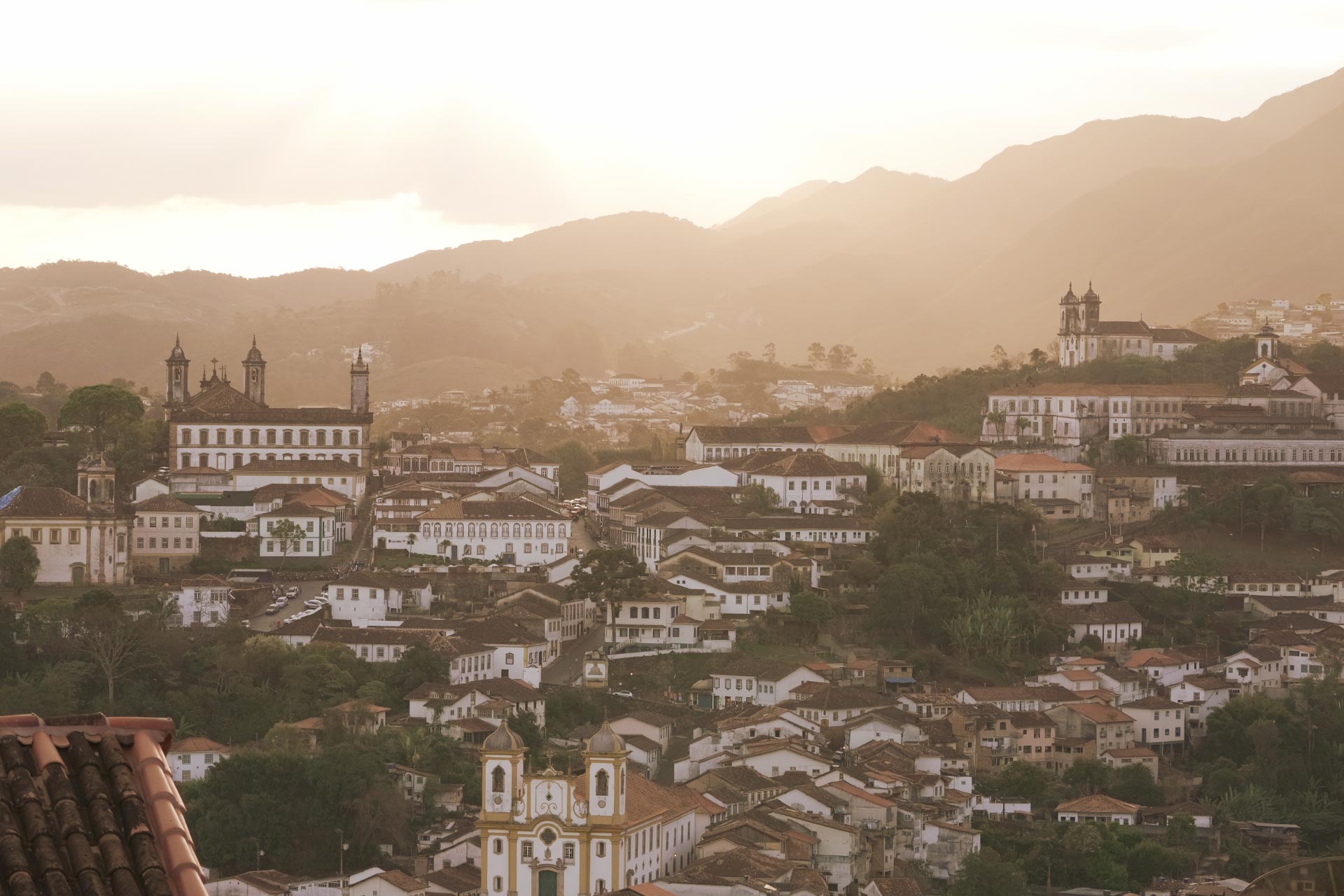
Welcome to the historic town Ouro Preto, a UNESCO World Heritage Site in the heart of Minas Gerais, Brazil. Ouro Preto became a wealthy and thriving center for gold extraction during the Brazilian colonial period in the 18th century. While Ouro Preto is celebrated for its opulent Baroque architecture, a lesser-known narrative is woven into the town's fabric—the story of an Afro-Brazilian community and their indispensable contribution to the city. This tour focuses specifically on Mina du Veloso, an 18th century underground gold mine located at the entrance of the city. On this journey, you'll hear from Eduardo Evangelista, owner of the Mina Du Veloso, historian Sidnéa dos Santos and Cesar Barella from the University of Ouro Preto.
Stop 1. São Cristovão neighborhood
Mina du Veloso is located in São Cristóvão’s hillside neighborhood, where houses are closely packed together. The mine is named after its first owner, Coronel José Veloso do Carmo, who exploited enslaved labor for gold production between 1761 and 1819. The mines fueled the growth of the city, leading to the construction of opulent Baroque architecture and establishing Ouro Preto as a cultural and economic hub. Surrounding the remnants of the mining site, the São Cristovão neighborhood seamlessly integrates both old and new structures. You'll find entrances to historic mines right in people's backyards. Stretching across the mountain rangeare stone containment walls referred to as “mundéus”, used as reservoirs for washing ore, alongside an extensive aqueduct system. Despite its historical significance, this neighborhood sits beyond a protected cultural heritage perimeter.
Eduardo Evangelista
Well, the Veloso mine, it is located right at the entrance of the city of Ouro Preto, in the S�o Crist�v�o neighborhood. And it is important because it was one of the last mines still extracting gold here in the eighteenth century. And here in the neighborhood, we have a large, a large archaeological part linked to the history of mining, of gold. So, the Veloso Mine, it is an underground gallery that is part of a large mining complex that is still completely preserved in the Ouro Preto Range, right at the entrance of the city.
Sidnéa dos Santos
And when the 20th century arrives, there is a rich elite in S�o Paulo thinking about the future of this country. And this wealthy elite from S�o Paulo comes to Minas Gerais to think about the future of this country. And this wealthy elite, after the Modern Art Week in 1922, starts circulating in this territory choosing what will be recorded as heritage, what will be important and creating another version or another box to put what was not so interesting and what was not so interesting was the history of indigenous peoples and blacks, who will be treated as folklore or as exotic and not as culture. But without the African and without the black or without the indigenous arm, there is no Ouro Preto. So where is our history? So, this whole motif is created around the preserved baroque ensemble. But it doesn't tell who built this baroque ensemble. It doesn't tell that to melt a bell it was necessary the wisdom of African blacksmiths. It doesn't tell that to cut quartzite and manage to match stones and create walls on the streets, raise walls, the African and indigenous wisdom was also needed. So, all of this that was built was built from a perspective that was not the perspective of the people who inhabited this place, Including people of color who inhabited the center of Ouro Preto, were gradually being expelled.
Cesar Barella
And it's interesting when we look at the landscape of Ouro Preto, whether with a drone flying over or in the neighborhoods behind each house, not behind every house, but behind many houses, we see the opening of old mines, some being used as storages. There is also a registry made, if I'm not mistaken, by the academy, by a university professor that records more than 170 of these old mines and it's occasionally a sporadic process when compared to landslides, rolling and falling of rock blocks is much more sporadic, but we have the collapse of these mines. So it's a vertical process due to the lack of support of the material above. So, vertically the material falls with great speed and sometimes there might be a house above these mines. And sometimes we are not aware of this.
Stop 2. Mina Du Veloso's Cultural Center
Today, Mina Du Veloso is a cultural center where visitors can explore underground tunnels and learn about the historical and cultural significance of gold mining. The site vividly portrays the harsh realities faced by miners during the colonial era, providing a stark glimpse into oppression, forced labor and demanding extraction conditions. Constructed during the 2010 restoration, the visitor center was built through blending wood and mud inspired by the 18th century African construction methods. This effort captures the essence of African craftsmanship integral to the region's evolution. The reception area, crafted using these traditional techniques, now stands as a testament of the resourcefulness and knowledge of those who contributed to Ouro Preto’s architectural heritage over three centuries ago.
Eduardo Evangelista
So I bought the house and started doing the restructuring of the space, starting with the mine, so I spent about a year doing internal recovery work and during the time we were inside we were thinking about how to do it. We were going to do the reception. So the little house that was there had no way to recover it, restore it. So we took it apart and used techniques from the 1700s and used wood and mud, which is an African construction technique also, because the techniques of construction, the African legacy Here in Minas it goes far beyond just mining and metallurgy, it also goes into construction because the construction techniques, like wood, mud, grass and sometimes even cow dung, and such, is a way that Africans have built for thousands of years in Africa. So they come here 300 years ago, with all the difficulties of the space we have here in Preto, they built that wonder there in the center, which is all made of wood and mud. So here we also decided to build the reception with these same techniques. So we applied wood on the surface so that people could understand how the entire structuring of the house works. So we tried to reproduce here some of the knowledge of African peoples in civil construction as well.
Stop 3. The Courtyard
Step into the visitor center for a warm welcome. Tucked between buildings, the triangular courtyard has cobblestone floors and greenery covered walls. The courtyard, designed for more than tourism, serves as a platform to share and promote Ouro Preto’s lesser known history for both visitors and the community. To the right you'll find maps showcasing the intricate mind layout of Serra do Veloso mountain. Throughout the courtyard, informative panels and various objects, including books, musical instruments, photos and small statuettes provide insights into the captivating cultural significance of this historical site.
Eduardo Evangelista
Well, the mine, since its operation, one of the missions we set was for it to also serve as a place of radiation of this energy we work with here in the mine. This wealth of knowledge, this paradigm shift, this different view of history. We wanted it to be more than just as a place for tourists to visit, but that it should also be a place of empowerment. So, right from the start, we've always done it here awareness-raising and training to provide opportunities for the neighborhood community to get to know the heritage we have here, because ever since I was a child I didn't know about these structures. I was studying in a world and I didn't know what it was, it only talked to me. That's old school, period. So, when I discovered this machine in the neighborhood, this knowledge, this wealth, it empowered me both professionally as an engineer at university, but also, as a descendant of those people who came here.
Stop 4. Cultural Riches Beyond Enslavement
To the left, an open kitchen area has several objects hanging on the walls that are rooted in the rich cultural heritage brought and developed here by the African community. Notice the three berimbaus, unique musical instruments with flexible wooden bow, steel string and a resonator called a cabaça. Berimbaus are integral to Capoeira, a dance fighting form inspired by African traditions. Enslaved individuals ingeniously blended dance with combat training, allowing them to practice discreetly. These objects reflect one of Mina du Veloso’s goals to recover and share both the cultural and the social customs of the black community, moving beyond the common narrative of suffering and oppression usually associate with enslavement history.
Sidnéa dos Santos
Disguisedly, discreetly, and wisely. They left countless messages. And we are now learning to decode these messages. It's not just an iron balcony, it's an iron balcony with various symbols of the Adinkra writing, of the writing of peoples who mastered the mining process and left a message there is not just a set of shells drawn on a retablo. It's talking about an ancestral Africa that existed here and talking about priests and priestesses, kings and queens who, although enslaved, found a way to stay alive and resist and pass on this royalty forward. So, even though the white elite tried to suffocate all of this, this is alive here today.
Stop 5. Step inside the mines
The mines feature more than 400m of linked galleries, supported by robust pillars holding up the ceiling. The main mine channel extends around 192m, branching into additional passages. Some of these passages remain unmapped due to their challenging accessibility. The main passage within the mine begins with a low ceiling gradually rising as miners would venture deeper. On the right side, there's a side tunnel where gold was first discovered. Yet once the miners found no more gold in that tunnel, they chose to close it and continue in the main direction. Water consistently flows across the main gallery floor, originating from various water passages on the mountain range. During periods of heightened rainfall, the interior can be entirely flooded.
Eduardo Evangelista
We have this water flow here that has always passed through here, since the time it was opened for mining. So there is already a flow created exactly to facilitate mining. With water, it is much easier to extract gold. In fact, without water, there is no mining. You can't separate gold from the earth if you don't have water, so they would throw this water into the galleries, not just in the Veloso mine, but throughout the Serra de Ouro Preto. So, this water passing through the galleries, it will cause erosion. Soft water on hard stone beats until it drills or erodes.
Stop 6. A typical day at the mine
Miners endured grueling workdays, engaging in strenuous physical labor under challenging conditions. Their day typically begin before dawn as they descend into the mine to extract valuable resources. Within the mine, tasks were organized hierarchically, with each group assigning specific functions. Beyond their proficiency in mining, enslaved Africans were highly valued for their expertise in metallurgy, a science focused on understanding and engineering metal materials. They demonstrated exceptional skill in crafting their own tools, with some of these artifacts unearthed during the excavation of the mine.
Eduardo Evangelista
So we always mention Eschwege, who is a German who writes, the Pluto Brasiliensis, which is a book where he tells the whole day the day of mining, not only here in Ouro Preto, old Vila Rica, but throughout Brazil, even Goi�s, Jacobina, there in Bahia. So he travels all these regions of gold extraction, but he fixes a lot here. Ouro Preto. So he has reports and then he goes through these reports the importance of the African black here, because it was he who held the mining techniques and ran the entire industry. So all the gold extraction work was in the hands, was in the brains of these African blacks who were here. And they came from regions in Africa and already had great experience in gold extraction. And then, in these books, you see the reports of these Europeans who were here showing the influence of these blacks.
Stop 7. Climate change challenges
Today, Ouro Preto, including its mining galleries like Mina Du Veloso, grapples with the impacts of climate change. The town's hilly topography, coupled with intensified rainfall due to climate change, heightens risks of landslides and erosion, threatening the community as well as the historic buildings and mines. Compounding these challenges is Ouro Preto’s continued role as a mining town, now, focus on iron ore extraction. This mining activity, reminiscent of the 18th century, has substantial environmental impacts, worsened by climate change. Continuous monitoring is essential to address increased rain volume and associated threats. Tackling climate change impacts is vital for preserving the mines heritage and ensuring the safety of local communities.
Eduardo Evangelista
And in the last two years, we see a very substantial increase in the volume of water passing through here. And this is a reflection of this process of climate change, increasing and exacerbating the volume of rain. And it's all here in our region. So, we directly see this global warming, all this process that the planet is going through, of extremes extremes, extreme heat, extreme cold and rain, we feel that here and this is a process that we have to monitor here at the base and change the way we occupy the planet, because it is irremediable. If we don't take action, it will only get worse.
Cesar Barella
Well, Ouro Preto. It has a range of processes that occur in its territory and we have landslides, rock block rolling falls, creep and slow movement which led to a large recent process with homeless people, houses destroyed in the districts. We have flash floods, we have large erosions and very large assets. Linked to climate change, the trigger for all this process is the rain. So, what's going to happen if you have projections with climate changes that increase these rains and this is what is being predicted, we are going to have an intensification of these processes, right? So we have this intensification of the processes that can culminate in disasters, but not necessarily will result in disasters. If we have the occupation of this part of the territory, which is naturally prone to these events.
Stop 8. Ouro Preto's legacy
Ouro Preto’s prosperity was built on the ingenuity of African enslaved communities who, despite immense hardship, played a pioneering role in regional mining. Recognizing their mining heritage offers a new perspective on the city's wealth, visible in the iconic Baroque architecture. Descendants of African enslaved people in Ouro Preto have few remaining built heritage sites reflecting their history. The mines, however, stand this tangible reminders that bear witness to their struggles, contributions and cultural heritage that must be protected from the effects of climate change.