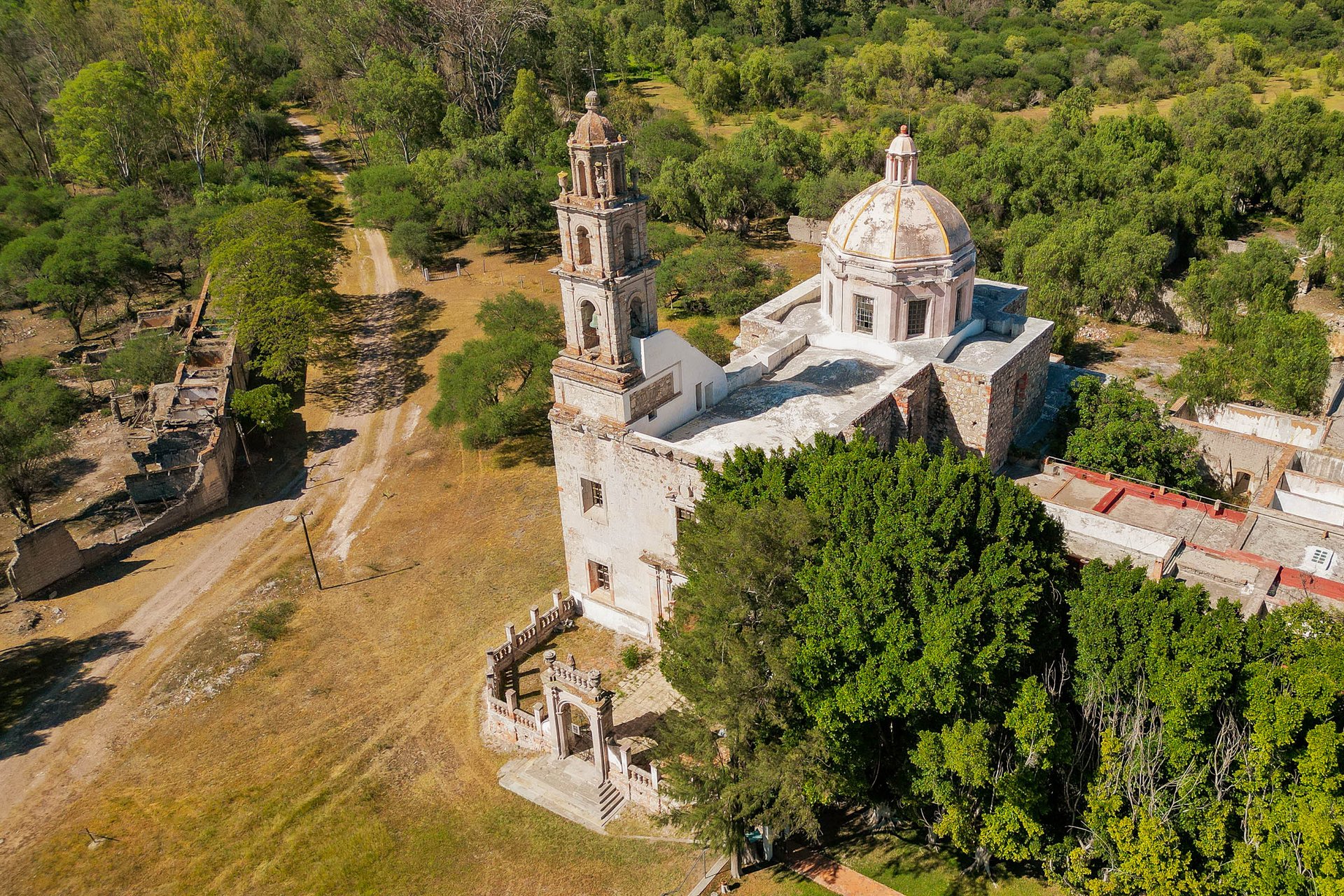
Story outline
-
The Old Hacienda of Peñuelas
The Old Hacienda de Peñuelas in Aguascalientes is a symbol of the economic and cultural dynamism of the El Camino Real de Tierra Adentro, also known as the “Silver Route.” Its architecture, with the wide courtyards of the main house, temple, and living quarters of the workers, exhibits a fusion of Spanish colonial and vernacular styles, illustrating the multicultural interactions that took place along the Camino Real. The restoration efforts of the hacienda have preserved original frescoes and structures, allowing visitors to glimpse the way of life from the colonial era. -
Stop 1. Architectural Design
The Old Hacienda de Peñuelas, located south of the state capital of Aguascalientes, is an architectural complex that was declared an integral part of the Camino Real de Tierra Adentro, which was recognized as a World Heritage site in 2010. Founded in 1575 by Nicolás Ramírez, the complex was originally comprised of three haciendas — San Nicolás de Peñuelas, San Isidro Labrador, and San Antonio — which underwent various mergers and separations over time. -
Stop 2. The Camino Real de Tierra Adentro
The Camino Real de Tierra Adentro encompasses numerous sites along its 2,600 km stretch from northern Mexico to the states of Texas and New Mexico in the USA. It was a critical route from the 16th to the 19th centuries for transporting silver and other important mining resources. Besides its economic role, the Camino Real de Tierra Adentro also fostered social, cultural, and religious connections between Hispanic and Amerindian cultures. -
Stop 3. Workers' houses
Peones, or laborers, in colonial Mexico were the backbone of haciendas like Peñuelas. Often indigenous or mestizo, they worked under challenging conditions, usually bound by debt servitude, contributing significantly to the agricultural and economic output of the colonies through their labor in fields and mines. -
Stop 4. Church
The Temple of the Immaculate Conception was built between 1847 and 1852 and is noted as one of the earliest neoclassical churches in the state of Aguascalientes. Its grand scale and the meticulously chosen stones for its construction reflect its significance. It stood through revolutionary invasions and has witnessed numerous religious events and celebrations. -
Stop 5. Main house
The main house at the Hacienda de Peñuelas stands out for its numerous courtyards, lush vegetation, and mix of architectural styles. It featured decorative elements reflecting the various lifestyles, personalities, and aesthetic tastes of its owners. In the past, the many interconnected rooms hosted priests, bullfighters, friends of the Peñuelas family, and many notable historical figures from the region. -
Stop 6. Conclusion
The Hacienda de Peñuelas complex offers a glimpse into the past and helps us understand the impact of the Camino Real de Tierra Adentro on communities found along this route. This historic site is currently awaiting preservation, restoration, and an opportunity for renewed use, however, we hope this virtual tour helps you connect with this important legacy.
Voices
-

MCPA Arq. Iván Israel Sánchez
Architect
Iván Israel Sánchez Silva has a bachelor's degree in Architecture from the Benemérita Universidad Autónoma de Aguascalientes and a Master's degree in Conservation from the Universitat Politècnica de València. He was born in Mexico City in 1987, however, from a very early age, he lived in the city of Aguascalientes. In 2011, he joined the National Institute of Anthropology and History in the Immovable Historical Monuments Section of the INAH Aguascalientes Center, where he carries out research, conservation, and restoration work on the heritage of that state. -

MRSM Arq. Jorge Guadalupe Villanueva
Architect
Jorge Guadalupe Villanueva Clavel has a degree in Architecture from the Benemérita Universidad Autónoma de Aguascalientes and a Master's in Restoration of Sites and Monuments from the University of Guanajuato. He was born in Mexico City in 1973. He is a professor at the Universidad Autónoma de Aguascalientes and academic coordinator of the Master's Degree in Restoration of Built Heritage at the University of the Arts of the Cultural Institute of the State of Aguascalientes. -

Gabriela López Sigala
Designer and former resident
Gabriela López Sigala, born on December 24, 1981, grew up in a family deeply rooted in the history of Hacienda de Peñuelas, where they resided from 1925 to 1993 (68-years). Her childhood and adolescence were richly woven with countless experiences and anecdotes, all set against the vibrant backdrop of ranch life amidst the close-knit community and her family of ranchers, and these formative years left Gabriela with a treasure trove of memorable stories, each linked to various locations on the ranch and preserved vividly in her memory. In 1996, she moved to the city of Aguascalientes to study high school and, later, a Bachelor's Degree in Interior Design at the Benemérita Universidad Autónoma de Aguascalientes. -
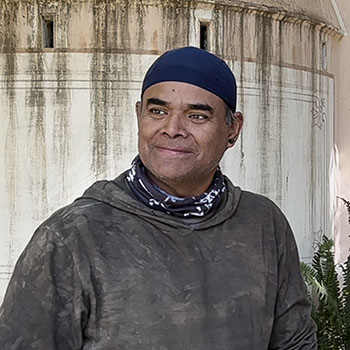
Oscar García Verdín
Site custodian and current resident
Oscar García Verdín was born on November 26, 1975, and is from a family that settled in the Hacienda de Peñuelas at the beginning of the 20th century. His father worked as a carpenter for many years, and Oscar learned that trade and others from his family, who, to this day, still live in the housing area for farm workers. Growing up on the 300 acres that make up this complex, he knows every nook and cranny of this place. He currently works for the Institute of Social Housing and Property Management of the Government of the State of Aguascalientes, assigned to the care and protection of the estate.
Gallery
Partners



About the Project
The Old Hacienda of Peñuelas in Aguascalientes is part of the UNESCO World Heritage of the Camino Real de Tierra Adentro, which stretches over 2600 kilometers from Mexico City to New Mexico. More than a simple trade route, the Camino Real also fostered cultural exchanges. Dating back to the late 16th century, the Hacienda helped supply food for nearby mining complexes and the city of Aguascalientes.
Related Links
Credits
The Tapestry tour was crafted by the Aguascalientes branch of the National Institute of Anthropology and History (INAH) in Mexico, led by Ivan Israel Sanchez Silva and Jorge Guadalupe Villanueva Clavel under the leadership of Director Humberto Carrillo Ruvalcaba. The Connecting Crossroads project was made possible through the generous support of the US Embassy in Mexico City and was implemented by CyArk.