The Old Hacienda of Peñuelas
Welcome to the virtual experience highlighting the old Hacienda de Panela in Aguascalientes. Steeped in history, this stunning architectural marvel dates back to the late 16th century, showcasing the region's rich heritage. The Hacienda was renowned not just for its agriculture and cattle raising, but also for feeding the mining areas of Asientos and Zacatecas, along with the bustling city of Aguascalientes. In 2010, UNESCO recognized the Hacienda as an important site along the Royal Road of the Interior, which stretches over 2600km. Its strategic location underscores the vital significance of this route for trade and as a conduit for cultural exchanges between communities, leaving behind a legacy of tangible and intangible cultural treasures. Join us on this tour as Ivan Sánchez, Jorge Villanueva, Gabriela López Sigala, and Oscar García Verdín guide you through the enchanting spaces of the Hacienda’s architectural complex. Together, they'll illuminate the Royal Road's profound impact on culture and everyday life, offering insights into the enduring legacy of this historical route.
Stop 1. Architectural Design
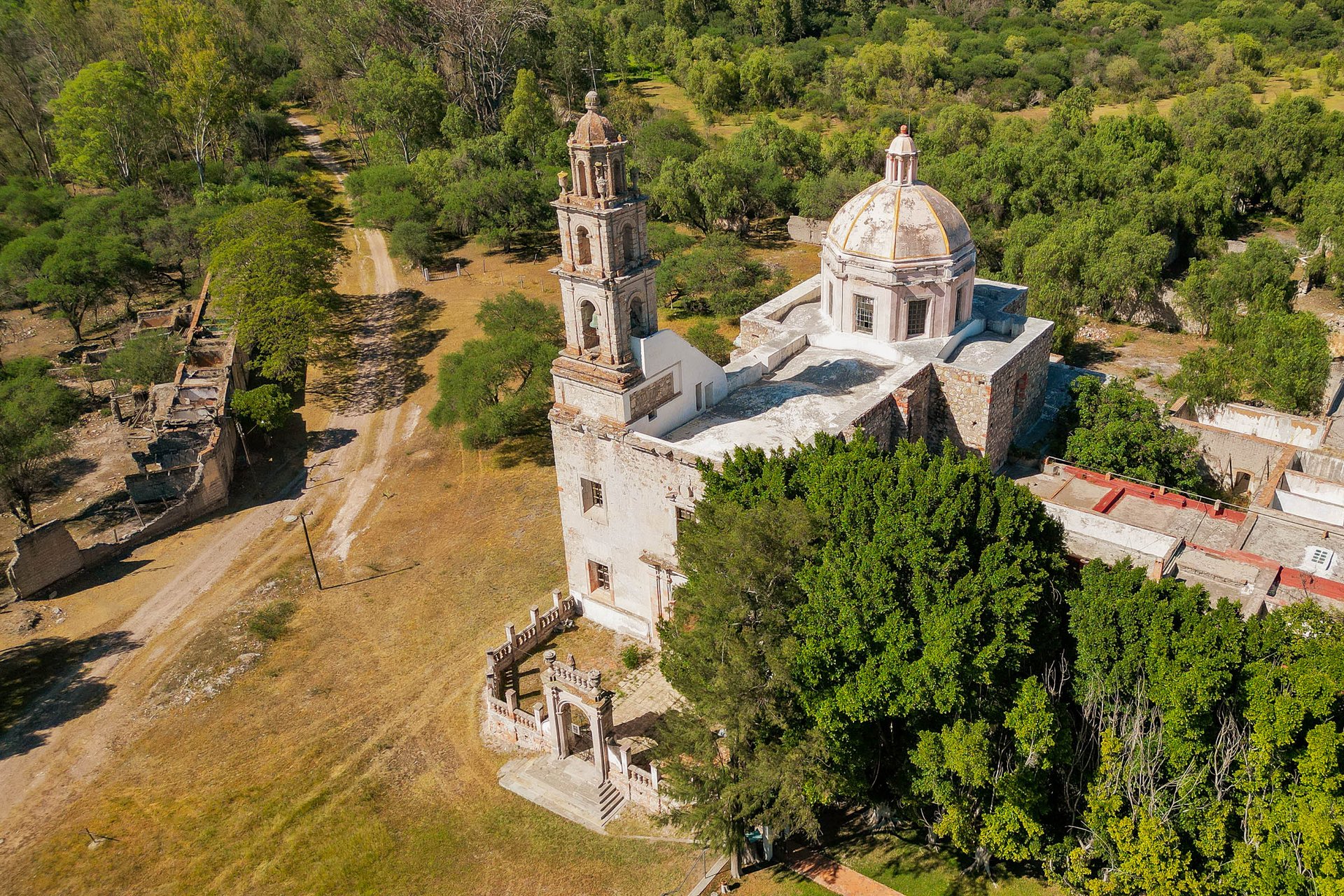
From this elevated vantage point above the Hacienda, the northern section of the complex unfurls before us. To the left, the workers’ quarters shed light on the daily life of the people who were responsible for the running of the Hacienda. In the center, the commanding bell tower and dome of the Church of the Immaculate Conception rise to great heights above the landscape. To the right, the intricate courtyards of the main house invite moments of contemplation and repose. The expansive lands surrounding the buildings stretch out into the distance, highlighting a contrast between the earthen architecture of the buildings and the lush greenery of scattered trees, offering shade and color to this historic setting.
MRSM Arq. Jorge Guadalupe Villanueva
The estate and its architectural complex are composed of two main groups; the first is the old core, meaning what was formed from the 16th century to almost the 18th century. During the middle part of the 18th century to the 20th century, the estate was transformed and new spaces were established that didn't exist before. Let's start with the main house, the large courtyard, the large sunning area, then it became an important area related to the temple. With the formation of the temple since it is one of the most important elements of this architectural group. Subsequent to it are the granaries, the pastures, the dam area. Two dams are built and uh something very important, the commercial part. It was the part of the inns where inns were spaces where all those who traveled along the royal road were received. They stayed at that inn, they were assisted, given food, and shelter for animals and protection. And finally, there is the formation of a group or a collection of residential houses, which is the prototype uh of a peasant house. This is particularly because in the 19th century, for the first time in the central part of our country, well, a peasant prototype of worker housing was established. What does this mean? There will be two elements, some houses that are practically 70 square meters related to the people, the laborers who work in the main house. And then there will be another collection that are about 110 square meters which relates to staff who essentially work in the main house and also with the professions or the regimes in which they are
Stop 2. The Camino Real de Tierra Adentro
The Royal Road of the Interior winds directly through the Old Hacienda complex, leaving an enduring historical legacy. This vital route linked Mexico City to San Juan Pueblo in New Mexico via a stone-paved path, serving as the primary artery for trade, culture, and evangelization for five centuries. In Aguascalientes, the Royal Road not only facilitated the exchange of goods, but also nurtured cultural exchange and communication among diverse regions, underscoring the significance of the Hacienda and its pivotal role in this essential network.
MRSM Arq. Jorge Guadalupe Villanueva
The Royal Road in Aguascalientes, practically since its beginnings in the 16th century, had been established largely along the edge of the rive. This is important because this route heading northward in the country essentially starts and establishes the large estates that make up the state. Essentially, Peñuelas is the first point of contact between Jalisco and Aguascalientes. And it is practically the place where the two paths meet, both the road from Guadalajara and the road from Mexico City. Once they reach the town of Aguascalientes, then there's a change in route. Researchers have considered that the true path is the one that crosses straight north, but actually, it's not. The path essentially turns eastward and reaches the community of Bocas, now known as Santa María de Gallardo. Subsequently, it moves northward and reaches Ciénega Grande. From there, it concludes at Asientos and essentially crosses the border into the state of Zacatecas.
Oscar García Verdín
ind: captions The Todos Bravos livestock farm was established in 1921 when Don Miguel Dos Santos Raúl married the sole heir of the Hacienda de Peñuelas. From there, it is said that the breeding of bulls, of brave cattle, began, which is named Venadero Peñuelas because two families united, and a crest was created with "VP" for the cattle brand.
Stop 3. Workers' houses
To the left we encounter the workers’ houses, examples of earthen architecture that served as prototypes for social housing. Despite their current state of abandonment, these structures were once bustling with vibrant daily life, embodying traditions, aromas, flavors, and narratives that transformed this place into a lively center of communal activity. These homes housed hundreds of people who tirelessly worked on the Hacienda. Every wall and stone tells a story of effort, community and daily life. It's awe inspiring to contemplate the multitude that once inhabited this place, toiling the land and contributing to the legacy of Hacienda de Peñuelas.
MRSM Arq. Jorge Guadalupe Villanueva
Peasant housing, this is a very interesting example nationally because it essentially establishes two types of housing for the workers or peasants according to their profession. In the first type, obviously those of lower skill or rank will inhabit spaces that are practically 70 square meters. Whereas the skilled workers or peasants or people with other roles within the organization of the Estate will live in spaces that are more towards the south, which are about 110 square meters. This is important because it relates to the architectural arrangement of each space and the interaction among families to ensure that the architectural project of the area is obviously maintained and prevails. It will obviously merge with the inn area, which also gives it significant importance as it separates, let's say, class A and class B along with the inns that essentially distribute the flow of the Royal Road in front of the estate.
Oscar García Verdín
Well, regarding the trades, in terms of people, my boss used to say that there were workshops, not just workshops, but ones for cart repairs, rope-making, carpentry. And, what's it called, for providing service to what was essentially the transport, the movement of carts and horses, I think there were even blacksmiths for shoeing the horses.
Stop 4. Church
Constructed between 1847 and 1852, the Temple of the Immaculate Conception stands out as one of the earliest neoclassical churches in the state. Its imposing size and the carefully selected stones used in its construction speak volumes about its significance. It witnessed revolutionary invasions and the regional Cristero War, and served as the final resting place for the mortal remains of its owners and relatives. Just think about all the religious events and celebrations these walls have seen over the years. Standing tall and proud, they prompt us to reflect on the history and cultural significance of the families who married, were baptized were confirmed, and said their final goodbyes to loved ones within these sacred confines.
MCPA Arq. Iván Israel Sánchez
Discussing the temple of the Immaculate Conception at Hacienda de Peñuelas is to discuss one of the great examples of religious architecture in the state of Aguascalientes. Its layout, which is through a Latin cross with a long axis and a short axis, also speaks to the religious beliefs and building traditions of the 19th century. This temple was constructed in the mid-19th century, between 1847 and 1854, indicating a transition between styles, namely neoclassicism and eclecticism. A key aspect of the temple is the involvement of architect Refugio Reyes Rivas, a Zacatecan master builder who later resided in Aguascalientes. He was one of the major architects in the state. His influence is seen in the finishes, the integration of a marble cypress brought from Europe, and other decorative elements we can see in the building. So, when we talk about the temple at Hacienda de Peñuelas, we are referring to one of the great examples of religious architecture in the state.
Gabriela López Sigala
Well, contemporary weddings, all couples, all fiancés, want to get married here in the temple, not just because of the architecture, because it's very beautiful. The wedding would usually take place with the mass on Sundays at 2 pm. The priest only authorized that time and day for it. So the mass was at 2 pm, the couple would arrive, get married, and upon exiting the temple, it was customary in more recent times to have a mariachi band outside welcoming the newlyweds. Some songs were sung and after that, we were allowed to go to the garden to take the official wedding photographs of the couple.
Stop 5. Main house
The main house at the Hacienda de Peñuelas is a majestic example of regional architecture, reflecting various construction periods from the 17th to the 20th century. It housed decorative elements showcasing its owners’ diverse lifestyles, personalities and aesthetic preferences. With over 10 grand rooms, it welcomed friends of the family, priests and prominent figures from bullfighting and politics. Connected to the church, this impressive complex is notable for its lush courtyard vegetation, lofty ceilings and exquisite mesquite wood flooring designs. Despite the passage of time and some degree of wear, its simple furnishings still possess a timeless beauty.
MCPA Arq. Iván Israel Sánchez
Regarding the architecture of the main house, well, it's also of large dimensions and has significant architectural features. We'll find through its three courtyards, different construction periods and stages ranging from the 16th to the 19th century. Well, we'll find this mix of styles, including Baroque, Neoclassicism, even Eclecticism, and the presence of remnants still showing the influence of the railroad. It's important to mention that the main house or Hacienda de Peñuelas donated land for the construction of a railroad station. This speaks to the economic and social importance and productivity, of the entire estate within Aguascaliente, not just locally, but also regionally, through this communication initially via the Royal Road of the Interior, and then later through this new mode of communication, the railroad.
Gabriela López Sigala
Well, when I was a child, a long time ago, we had vacations from elementary school, and I, in particular, would come to visit my grandmother every holiday. During that season, Mrs. Raquel, along with her sisters, would invite us to go on walks, they would walk to the hill and the hill of the roosters, and we would accompany them. We would get up at 7 in the morning and wait outside the main house because we weren't allowed inside the main house. We waited there and then walked to the hill. They would leave us at a point so we wouldn't get too tired because we were children. And they would walk, maybe 1 kilometer, 2 kilometers further up, we would wait there playing, and when they came back, we would return with them. When we came back, they sometimes gave us the opportunity to go into the main house, to play with the rocking chair that is there in the entrance. And it was nice because at the end of the day we would finish the vacation season and they would give us a gift. I remember they gave us, I don't know, chocolates, notebooks, some crayons, I don't know. And that was nice because we had, in some way, uh, this interaction with them, as we, seeing them from the outside, couldn't enter, couldn't be with those people, felt special.
Oscar García Verdín
One would enter the main house from childhood, you know, when one entered accompanied, one's father would take him to do repairs, like since my father was a carpenter, he fixed doors, any furniture that was squeaking, we accompanied him and it was an opportunity to go with him inside to the bedrooms. I'm talking about 85, 86 when I was about 10 years old, and I remember having the access to see how it was inside.
Stop 6. Conclusion
Thank you for joining us on this virtual tour of the historic Hacienda de Peñuelas, illuminating the rich history of the Royal Road of the Interior. The church, the workers’ housing, and the main house transport us to the past, allowing us to glimpse what life was like in another era. Today, this historic site eagerly awaits conservation, restoration and revitalization, longing for a renewed chance to showcase its invaluable legacy and offer new opportunities for appreciation and occupation.
MCPA Arq. Iván Israel Sánchez
At Hacienda de Peñuelas, there's something curious and important to mention: it's one of the estates in the state that still retains all its structural elements, everything that formed this large production unit. Even though they are in ruins, they allow us to read and identify what life was like in the large agricultural and livestock estates that were established in the state. And well, how this way of living, thinking, building, even of moving through these routes that are still preserved in the immediate context of the estate, through the bridges, dams, infrastructure, etc. But it's important to mention that this specific example, Hacienda de Peñuelas, allows us to travel back in time and imagine what customs and life were like in the 16th, 17th, 18th, 19th even in the 20th century when the estate was still operational. So, for us, it's one of the great examples that we need to continue studying, spreading, and visiting.