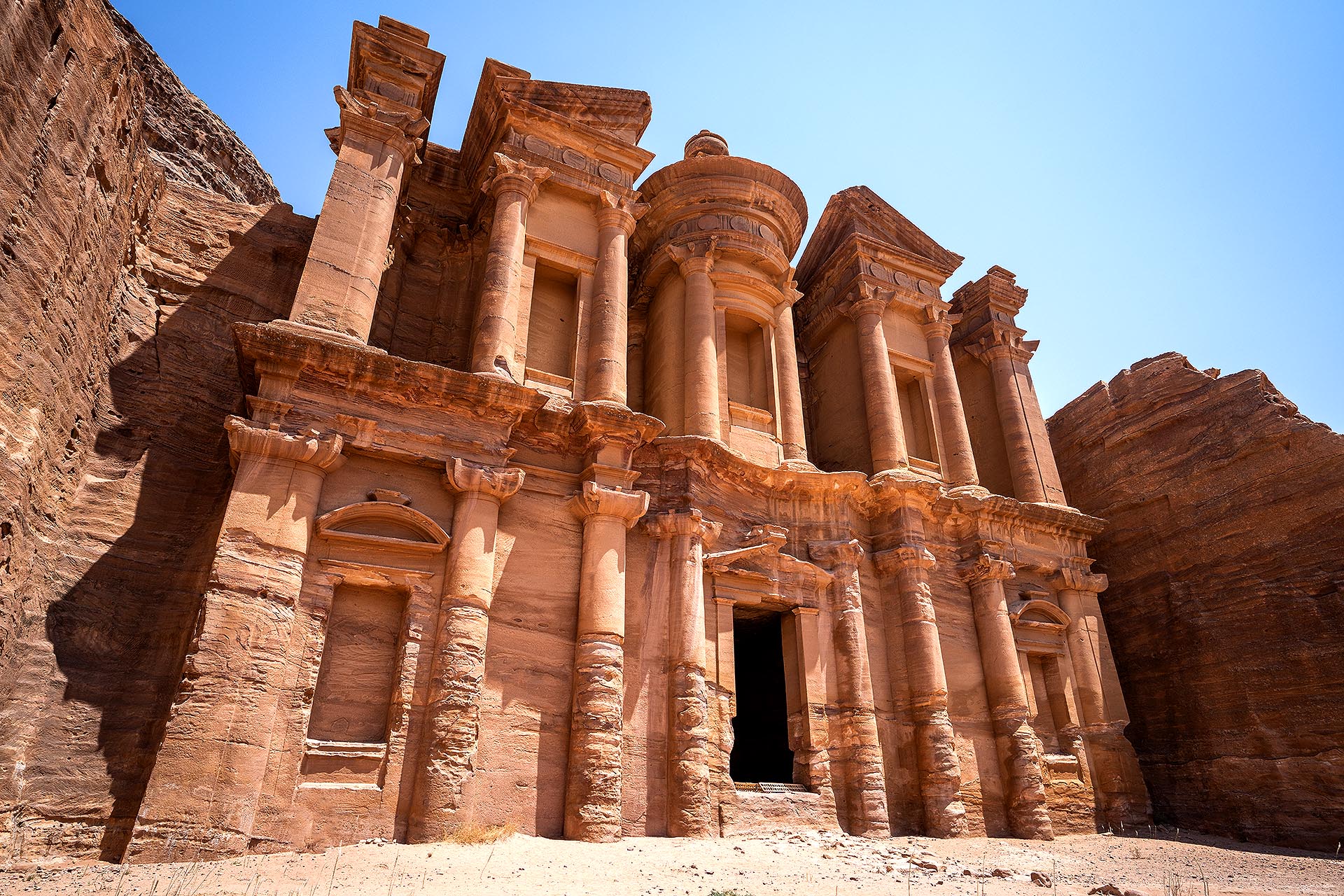
Ad Deir Monastery
Welcome to Petra, a remarkable city carved into the red sandstone cliffs of southern Jordan. From this viewpoint you can look down on Ad Deir, also known as the Monastery, glowing in the warm light of sunset. Carved into a massive sandstone outcrop, its towering facade rises nearly 40 metres. Two levels feature grand columns, carved niches, and a urn-shaped crown at the top. Over centuries, wind and rain have shaped the cliffs into flowing forms that blend with the carved details. Just as they did more than 2,000 years ago, built by the Nabataeans, Petra thrived through mastery of water, trade, and diplomacy. Connecting empires, religions, and cultures across vast distances, today Petra is a UNESCO World Heritage Site. A living record of human achievement, this virtual experience highlights key architectural features and shares voices from the community who continue to protect and draw inspiration from this remarkable place.
Stop 1. Where the Desert Came to Life
Shown at night, lit by torchlight that flickers and casts shadows across the stone, it's easy to imagine how extraordinary Petra must have seemed to traders arriving here after days of crossing the desert. Ad Deir is just one of hundreds of grand structures that make up Petra, the most important city in the vast Nabataean kingdom. By night, the scale of this single structure feels even more impressive when you contemplate its location amongst the wadis and sandstone cliffs. All of this was possible because the Nabataeans mastered water in the desert. They built hidden cisterns, carved channels and shaped the land to grow food. This allowed Petra to become a point of connection in the ancient world. From here, incense, spices and textiles travelled along silk road routes across the desert to the Mediterranean and beyond. Their achievements remain visible today in the carved sandstone around you, proof of a civilisation that turned this dramatic landscape into a thriving city.
Amal Saraheen
Visiting Petra at night feels like pure magic. Walking between the towering mountains in darkness. with stars above you. you feel the magic of this place. As for the Monastery area. or any site inside Petra. I feel the greatness of the Nabataeans. their creativity. their art. and I feel proud that this heritage is part of my country.
Mamoun Nawafleh
Actually. the monastery is. I would say the largest monument in Petra. And it has less details than. other. buildings in Petra because of its holiness. I strongly believe the monastery was used for a funerary purpose. This is what I believe it was. Now it's very well visited. But I remember maybe ten years ago. when you go there, it's silent, like, you know, there's not much people are there. So when you're there. staring at the building. it gives you a very special and very deep feeling. And when you walk to the opposite side of it, the landscapes, they are marvelous.
Dr. Suleiman Al-Farajat
I have visited the site, at night, more than a thousand times. And, every time I have, a different feeling than the one, before. Petra is a unique, site. It is one of the, World Heritage sites in the world and one of the, new seven, wonders.
Stop 2. Climbing to Purpose
Now illuminated by morning light, the colours and carved details of Ad Deir come into sharper view. It is easy to understand why the Nabataeans called the city Rakhmu, meaning colourful. The journey here from the centre of Petra takes over an hour on foot, climbing more than 800 stone steps cut into the mountainside. Built in the first century, its true purpose remains a mystery. It may have been a royal tomb, a ceremonial hall or a temple. The name monastery came much later. Its architecture blends Greek columns with local traditions, revealing how the Nabataeans exchanged ideas with the cultures around them. Not long after Ad Deir was built, Petra became part of the Roman Empire, not through conquest but through diplomacy, a reflection of the Nabataeans' influence and skill.
Amal Saraheen
Yes, I have visited the tombs in Petra. Honestly, I used to feel afraid because our elders told us many scary stories… like the dead rising from their graves, or snakes coming out of the tombs. So when I walked by, I felt fear and dread. But when I grew older, I came to respect them because they show how much our ancestors honored and respected the dead and gave a sense of spirit to this place.
Mamoun Nawafleh
Now a climb up to the monastery, to Ad-Deir. You have to start, from the lower part. climb up 1000 stairs. During that, You will explore monuments on either side of the climb. Which I strongly believe, by the way, that's where the bishops of the temple used to sell their, you know, products So that people can offer them, for the, You know, for the dead people. So 1000 stairs and then suddenly it's on your right side and you don't see it first. Then you walk a bit and on the right side. That's a huge building about 50m by 50m. You know, we are talking about something Built more than 2000 years ago. It's a very interesting walk. The colors you know, Never forget about the color formations. You can see up to 20 different colors Because of the iron oxidization, on your walk. So it's a very interesting crossing, The journey, parts of it goes through woods, You know, there are trees on your walk. The combination of nature and you know antiquities is something very inspiring.
Dr. Majed Hasanat
The most beautiful thing about visiting the Monastery is visiting it from the back road. There, you look out onto a different view, an open space facing Wadi Araba. It feels as if you are preparing to witness something of great importance. From the back road, you see Wadi Araba, then you reach archaeological sites, and then you arrive in front of a massive monument that makes you feel a kind of weakness. These days we feel a similar weakness: with all the tools and knowledge we have, we have not reached that level of precision. And yet, back then, when we think life was harder. they built this civilization that still stands today as testimony to the ability of the Arab human being.
Stop 3. The Stories of Trade
Crossing the large open plaza in front of Ad Deir, take a moment to imagine this space centuries ago. Caravans arriving, markets alive with voices and camels laden with frankincense, silk, myrrh and spices. Petra was built on the strength of the Nabataeans' skill in commerce. They spoke early Arabic, wrote in West Aramaic and traded with many cultures, turning Petra into a vital stopping point for anyone travelling along the caravan route. For them, diplomacy mattered as much as trade. To support this trade, the Nabataeans engineered the landscape to create homes, monumental structures and water management systems. Though few Nabataean writings survive, early accounts describe springs and gardens that once filled these valleys, evidence of the Nabataeans' impact on the land.
Amal Saraheen
My connection to Petra fills me with pride and honor that I belong to this place. Because we. the people of Al-B’doul. are an inseparable part of this heritage. We are also its shield of protection. So being here makes me feel proud. proud to be a daughter of this land.
Mamoun Nawafleh
Petra is in the middle of the ancient trade routes. This is one of the most important reasons why the Nabateans chose the site. And the Nabateans were actually the ones who were controlling the trade routes back then. And they also used a tool which is now called Al Kamal. The original name is Al Kias or Kayas. Just a horn with a string connected with a cord connected. You just put the North Star there on the top of the horn. You take the string toward the next star and make a knot. And that's how they used to navigate. Now. the GPS is based on this knowledge. It's made a hidden pattern. By the way. Al Kamal or Al Kias is the logo of the Nabatean Kingdom. If you look at the Nabatean coin, you'll find the horn of the string.
Dr. Suleiman Al-Farajat
Trade was the main economic, activity in that time, for the Nabataens. The, caravan drivers, and, people of Petra became very rich people, because of the, trade. In the Roman records, frankincense trade and myrrh was the, backbone of the Nabatean trade. Because most of the caravans in that time were loaded with frankincense, myrrh and, spices. Frankincense and myrrh was very expensive in that time. And it is, equivalent to gold or petrol, Now, nowadays. No single ceremony could happen in that time, without using frankincense. and myrrh.
Stop 4. The Silence Inside
Stepping into the chamber at Ad Deir, the atmosphere shifts. The grand façade gives way to a quiet square room. At the back, a carved niche appears, framed by two sets of steps, with long benches lining the walls. Scholars still debate the room's purpose. Was it a place of remembrance, or a site for rituals? Faint crosses suggest Christian visitors during the Byzantine period, while later carvings and inscriptions mark the passage of others. These traces only deepen the mystery of its original use. Though much about the Nabateans remains unknown, their art, coins, and architecture reveal a society rich in ritual, meaning, and enduring presence.
Mamoun Nawafleh
Now from the inside you know, it's just a chamber with an apse. And it has two ways and two stairways, one on the right and one on the left. Not many stairs, just a few. I think three or four on each side. So I think this is where the bishops, when the person was laid down there, the bishops would go from one side and then exit the other side. And in the Nabataean time, I have no doubt it had frescoes and paintings on the sides to represent their afterlife. Later, when it became you know, I would say a church for example in the Byzantine era. And that's why we find the crosses there.
Dr. Suleiman Al-Farajat
There are more than 850 monumental tombs in Petra. Most of them, have, a unique, outstanding universal, value, as we, know, I did many excavations for some of these tombs. I did the excavation in front of the treasury. I, exposed three tombs in front of the treasury.
Stop 5. Engineering the Impossible
Just north of the monastery, carved channels, basins and openings in the rock reveal the remains of a sophisticated water collection system. The Nabateans harvested rain, diverted floods and stored water in hidden mountain cisterns, some so well concealed that only locals knew their locations. This ingenuity made it possible to survive, build, care for animals and even farm in a desert landscape. Today, as Petra faces erosion, flash floods and climate stress, conservators are turning to these same ancient methods, reviving Nabataean engineering to help safeguard the site's future.
Amal Saraheen
For the Nabataeans. water was both a challenge and something they responded to with ingenuity. Their response was building channels. cisterns to store water. and dams. and we still benefit from this genius today. The Nabataeans made sure not a single drop of water went to waste. They used every drop to meet all their needs. delivering water to the temples and to their agriculture. Despite the harshness of this place. that is filled with rocks. rough paths. and desert climate with very little rain. they managed to make use of every drop of water.
Mamoun Nawafleh
What the Nabateans did was building terraces. surrounding the city from everywhere to slow down the speed of rainwater. Making this water settle down to the underground tanks. Then this water was taken down by pipes that were designed with ridges. making the water go spiral and slowly, slowly. And considering the elevation of 3%, which is the needed elevation for water to run smoothly. Plus building water tanks and dams everywhere. When you go to Petra. you will find dams and tanks everywhere to collect every single drop of water back then. So yeah, this is how the Nabateans survived. and this is how they convinced traders from all over the world to come and use Petra as a world trade center.
Dr. Majed Hasanat
From my work as a commissioner. and earlier as Director of Environment at the Petra Authority for many years. a major part of our work was reducing the risk of floods in Petra. This is the greatest threat to the site today and in the future. especially with climate change and the increase of extreme events. In the past. once every five or six years we would face extreme rain events that caused floods. But in the last five years. we have started seeing them every year. sometimes more than once a year and with greater intensity each time.
Dr. Suleiman Al-Farajat
The Nabateans were very smart people, they protected their monuments from water. They made a protection water channel above each monument in Petra and they plastered some of the monuments with a small layer outside the monument to protect it from water. And to protect the city and the people who passed through the Siq, the Nabataeans actually dug a tunnel in front of the Siq.
Stop 6. A Place Still Lived In
Petra is not an empty monument but a living place. For generations Bedouin families have lived in and around its carved spaces. They guided early explorers, shared stories passed down for centuries and cared for the land long before it became a global destination. Their knowledge of the terrain, its weather, secret routes and history remains vital to Petra's future. Yet tourism and change have made that connection harder to sustain. Supporting Petra also means supporting the people who know it best. The site is strongest when both its stories and its stewards are supported.
Amal Saraheen
It’s also important to know about the Bedouin’s connection to Petra because they were the first people to live here before the Emirate of Transjordan was formed. As I said earlier. they are part of this place. their roots are tied to it. They are like trees rooted among the rocks. very hard to remove or plant elsewhere. It’s wonderful to get to know the people who lived through this place and its history.
Mamoun Nawafleh
We found a Nabatean business contract between a lady who owned a palm tree farm and her neighbor. This farm wanted or needed some water. So she rented him an hour of her water turn or share every Sunday,forever. Okay, This is the same technique we use here in Petra now. Spring water are owned by families. Every family has its own turn. And not a long time ago, there was a sundial on a mountain top. When your turn is you know, it's done. They would call and the next one would take his turn the same way. So we inherited a lot from the Nabateans. And when you look at the Nabatean coins, you see their king. Aretus or whoever. you can see the shape of our faces. You know, their food is also the same. I think we inherited a lot. And I think we are. you know, we're all surely Nabateans.
Dr. Majed Hasanat
Some accounts say that the Nabataean Kingdom came to an end when it was attacked by the Romans. But I say no — they didn’t disappear; they’re still here, in one way or another, through their history, and most importantly through the language we speak and write today. We know that the Arabic script was developed early on during the Nabataean period, and I can even show you the beginnings of Arabic writing — how the letter alif started to be written, the letter jeem, and so on. And we know that civilization without the word could not exist — nor could culture. Culture, after all, is the written word, and without letters, without words, there would be no books — and no culture. So the greatest proof of the Nabataeans’ existence to this day is this very language we continue to speak, a language that was spoken before them but wasn’t yet written down.
Stop 7. Petra’s Future Is in Our Hands
Petra is one of the world's great cultural sites, but wonder is not enough to preserve it. It needs careful management, respect and ongoing resources. Ad Deir's survival depends on our choices today. Will we treat it as just a photo opportunity or something more? Every visitor plays a role, learning, listening and leaving the place better than they found it. Petra still stands because people have protected it throughout history. Now, it's our responsibility to do the same.
Amal Saraheen
Visitors can do simple things to help preserve Petra for future generations. They may seem small. but they have a big impact. like walking only on the marked trails. not littering. and not writing on or defacing the rocks. This helps keep Petra as it is for future generations.
Mamoun Nawafleh
When you talk about sustainability & tourism, It's to explore the local culture, and of course, also to help the local communities to survive. You know, this is where they gain their money for living. So when you encourage them to offer what they have for those who need to see it. I think this is actually part of the experience. And I do highly recommend those who come here to experience it. Because it's a different culture, different food, different music, different looking, different dress, different, You know, it's totally different. So I think if you come to the site and do not explore this, you know something is missing.
Dr. Majed Hasanat
Thanks to a sustained tourism boom, we in the Petra community enjoyed a comfortable and prosperous time. This era allowed us to condense and preserve our rich social heritage and value. Now, we have a wealth of culture and experience that we are eager to share with others. Honestly, what visitors miss most is not experiencing the real life of the local community. At one point, while working on the national tourism strategy. I was part of the team that redefined tourism. We said tourism must be an invitation. An invitation for anyone in the world to live as part of the local community during their visit. And this invitation doesn’t start when they arrive in Jordan, it starts when they first think of Jordan as a destination, and continues as they come and live the experience.