Story outline
-
Pigeon Point Light Station State Historic Park
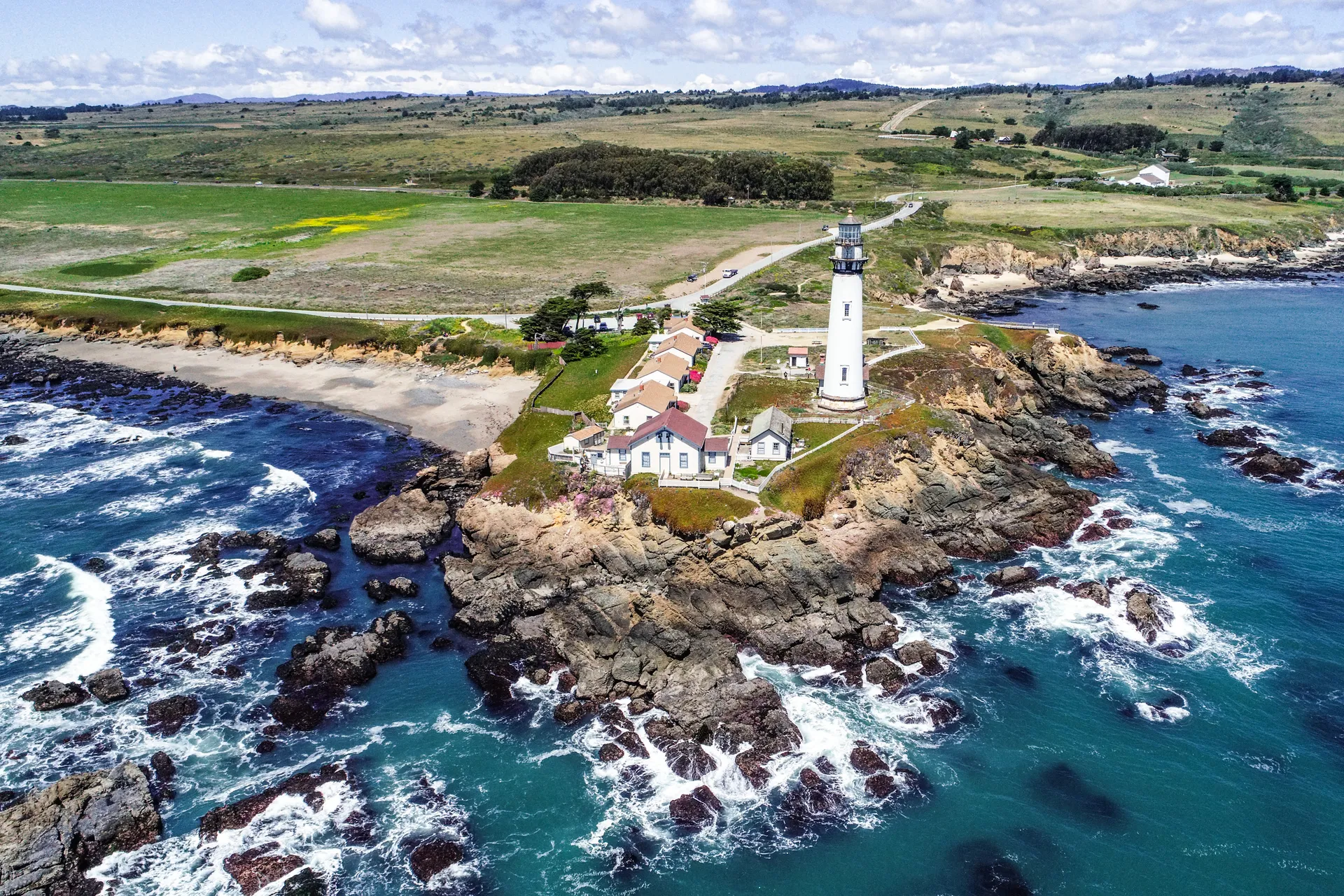
Pigeon Point Light Station State Historic Park celebrates the iconic lighthouse that guides mariners along the California coast for over 150 years with a history that embodies tragedy, innovation, and hope. The lighthouse you will explore in this experience is from 2022, before the restoration of the site. Restoration of this place has carried on its living legacy of navigation, conservation, and cultural memory that shapes California’s coastal identity. -
Stop 1. The Ohlone People
This area is the unceded ancestral land of the Quiroste, a prosperous Ohlone community that thrived here for millennia. As knowledgeable stewards of the landscape , they maintained complex cultural, political, and economic worlds. In 1769 they encountered and aided the Portolá expedition. Missionization in 1791 brought significant impacts to native lifeways, yet Native people remain stewards of this landscape today.
-
Stop 2. Pigeon Point Shipwrecks
The Gold Rush brought a surge of ships past these rugged shores, increasing the risk of shipwreck. In 1853, the Carrier Pigeon founders here, giving the headland its name. Multiple wrecks in the 1860s claimed more than fifty lives, prompting post–Civil War federal investment in coastal lights. The Pigeon Point lighthouse began operation in 1872, yet tragedies persisted.
-
Stop 3. The Keepers Office
The head keeper’s office overlooks the ocean and served as the operational heart of the lighthouse. Here the keeper maintained records, tools, and the daily log that documented life and work on the station. With three assistants and their families living on site, duties ranged from daytime painting and fog‑signal maintenance to evening preparation of the lantern room. -
Stop 4. The Oil Room
In this oil room keepers warmed lard oil—pig fat to fuel the Fresnel lens. A perpetual fire was maintained so the oil could be transferred to a 5-gallon canister to be carried up to the lantern room. The 1880s brought kerosene and the creation of a separate oil bunker for safety; the 1920s brought electrification with a 1,000-watt bulb. Today the lighthouse remains an active aid, automated with an LED strobe.
-
Stop 5. Rotating the Light
Before electrification, the lighthouse’s beacon relied on a clockwork mechanism much like a giant grandfather clock. A a 78-pound weight slowly descended into a well, linked by cable to gears and chariot wheels at the lantern room. That regulated descent turns the Fresnel lens, producing the slow, sweeping flashes seen for miles along the coast. Climbing the tower reveals the cable’s path and the ingenious mechanical solution that once powered maritime safety.
-
Stop 6. The Rocky Reefs
When Pigeon Point Lighthouse first operated without electricity, its windows were the only source of light, framing the jagged reefs that threatened mariners in darkness and fog. From this vantage, visitors also see rich coastal life: gray whales migrating, harbor seals hauling out at low tide, while pigeon guillemots, black oystercatchers, gulls, pelicans and cormorants forage along the rocks. -
Stop 7. Constructing the Lighthouse
Pigeon Point Lighthouse stands as a resilient 19th-century beacon, its unreinforced brick and mortar reinforced by three clever design choices. The tower’s conical form lowers its center of gravity; a double-wall “lighthouse within a lighthouse” creates an insulating air gap that shields ironwork from salty air; and a bedrock foundation anchors the structure. -
Stop 8. Damage and Restoration
Towards the top, visitors encounter visible decay from decades of exposure. In 2001, large sections of the cast-iron belt course — a continuous ring that once bound the masonry — failed and fell, compromising stability and allowing saltwater to erode brick and mortar. Restoration of the lighthouse preserves both the structure’s engineering ingenuity and its maritime heritage for future generations. -
Stop 9. The Watch Room
The watch room houses the mechanisms that illuminate the lighthouse: the gears, and the chariot wheels and cable that lift the weight and slowly rotate the Fresnel lens. At night the keeper would wind the weight, set the switch, and the apparatus would turn, casting one white flash every ten seconds. Mariners use that flash in combination with another light to triangulate their position on charts. -
Stop 10. Lighting the Coast
Each evening the keeper prepared the light. He uncovered and washed the lantern-room windows, polished the Fresnel glass, climbed into the lens to refill the oil reservoir. He would then trim four or five concentric wicks, and clean the lamp chimney to prevent smoke and soot buildup. Once lit, he returned to the watch room to engage the gear that rotates the lens.
-
Stop 11. Pigeon Point Today
Pigeon Point Lighthouse continues to guide mariners with a modern LED strobe, steering sailboats, fishing craft and ocean liners safely past hazardous shores. Its rocky reef sustains rich marine life, linking human navigation to natural systems. The lighthouse invites visitors to connect with maritime history, serving both as an aid to navigation and a cultural bridge between past and present.
-
Stop 12. Preserving the Park
Pigeon Point Light Station stands as an enduring beacon on California’s coast, its restored tower continuing to guide mariners and inspire visitors. The site interprets layered histories. Together these stories reveal the cultural, technological, and natural heritage that defines this rugged shoreline.
Voices
-
Lighthouse Voices
CyArk
Interviews with the following people were recorded during the Lighthouse Luminaries Panel Discussion in November 2022.
Bob Davis is the great-nephew of former lighthouse keeper Jesse Mygrants.
D'Ann Burns is the granddaughter of Mrs. Willie Jasmine Brown, who died when a ship sank near Pigeon Point.
Jerry Jolley is retired from the Coast Guard and was the last official US Coast Guard keeper of the lighthouse.