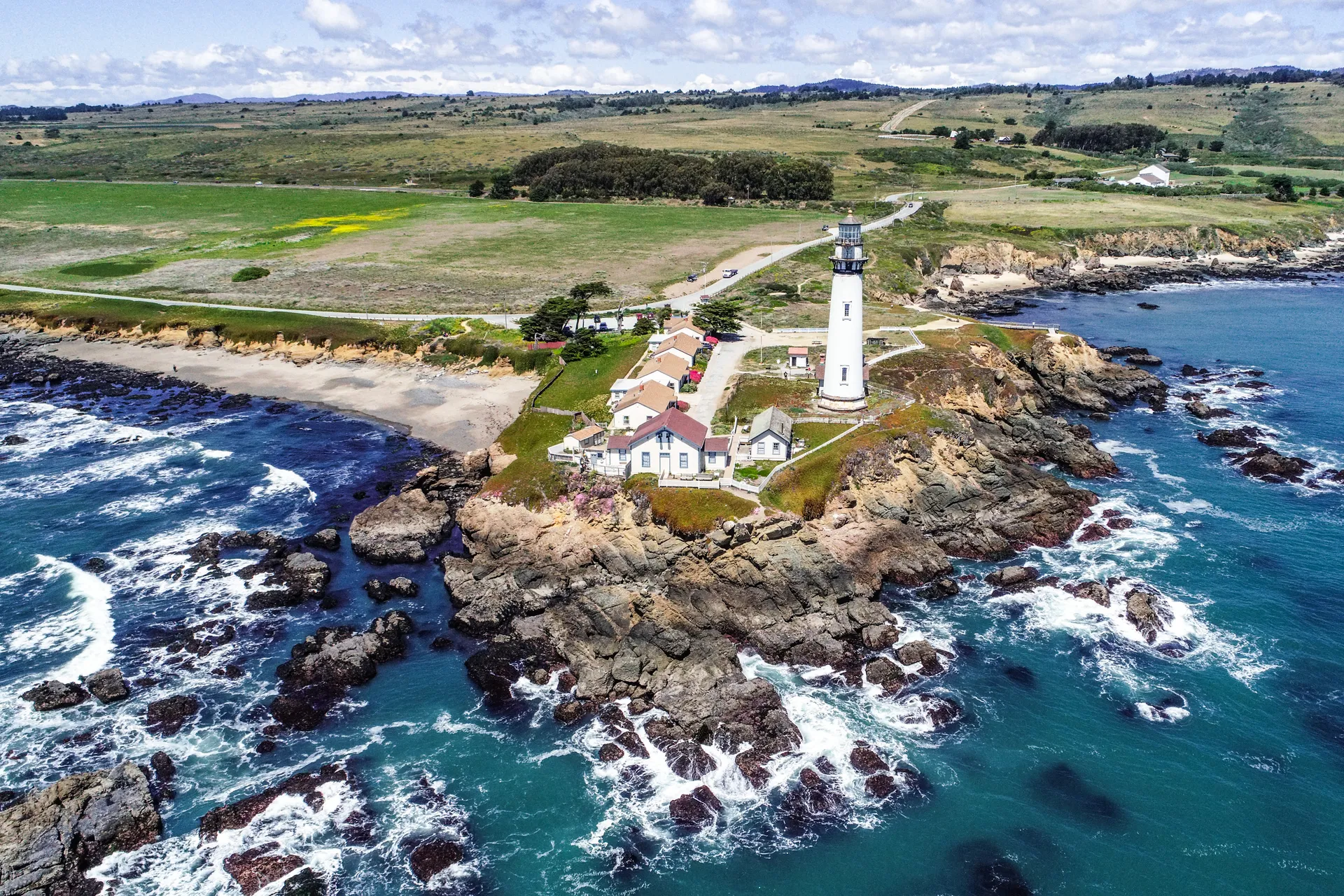
Pigeon Point Light Station State Historic Park
Welcome to Pigeon Point Light Station State Historic Park, home to the iconic Pigeon Point Lighthouse. Located just south of the San Francisco Bay, the story of the lighthouse and the communities connected to this place is one of tragedy, innovation, and hope. During this virtual experience, you’ll explore the rich history of the lighthouse and learn about the restoration of this enduring beacon that has illuminated the California coast for more than 150 years. Along the way, you will hear from former caretakers and descendants who shed light on how this place remains an important part of California’s maritime legacy.
Stop 1. The Ohlone People
Looking beyond the lighthouse toward the hills, we see a landscape shaped by thousands of years of human presence and significant change over time. Represented by several tribal communities in this area today, the first peoples who lived here were a group called the Quiroste (Kee-roh-Stay). They were speakers of the Awaswas language, one of several languages spoken by politically distinct tribes throughout the San Francisco Bay Area. The Quiroste were a politically prominent tribe who stewarded the lands and waters of this region through innovative methods including cultural burning and selective harvest of fish and game. They maintained and negotiated a vast trade network with neighboring tribes across the region. They first encountered Europeans in 1769 when Gaspar de Portola's expedition came up from San Diego, looking for Monterey Bay. Unfortunately, they had missed Monterey Bay, and by the time they got here they were very ill. The Quiroste welcomed them in, nurtured them back to health, and even helped guide them to San Francisco Bay, which was a historically significant colonial event. Years later, in 1791, when the missionary system was established in Santa Cruz, the missionaries attempted to bring the Quiroste into their system. The Quiroste led an active rebellion against the mission system in 1793 before being forced into the missions through various means of coercion and the need to navigate a rapidly changing world. While the Quiroste suffered at the hands of the missionaries, they persisted in multiple ways and today are represented by several tribal communities.
Stop 2. Pigeon Point Shipwrecks
The advent of the Gold Rush here in California meant that many many more ships were coming past these shores on their way to San Francisco Bay. That also brought increased risk of shipwreck. In 1853 the first major shipwreck here along this part of the coast was a ship called the Carrier Pigeon, which actually gave this area its name today, known as Pigeon Point. Now three more shipwrecks after that occurred in the 1860s that brought about the loss of over 50 lives. Unfortunately, it wasn't until after the Civil War that the U.S. government was able to refocus attention to build lighthouses here. So in 1872 this light became operational. Unfortunately, even having the lighthouse here didn't prevent shipwrecks. And the worst shipwreck in Pigeon Point's history was a passenger steamer called the San Juan, which was heading up the coast here. In the middle of the night it was rammed by an oil tanker and within five minutes, 75 men, women and children lost their lives.
Lighthouse Voices
Because my mother was five when my grandmother died. The basic story was that my grandfather— it was depression, so the only place he could find work was in Long Beach, and they hadn't seen each other for a while. So he bought her a ticket and said, you know, just take the train down. And she said, oh, but the children need shoes, and it's cheaper for me to take the boat. So I want to take the boat because she and my uncle needed shoes. So she did go. My mother did tell me this is kind of— she said I was begging her not to go: mommy, don't go. And she said we had French doors between two rooms in our house, and they had panes like this. And she goes, I looked in one of the panes and I saw a ship like this going in the water. So she goes, that was my one—like psychic—thing I ever had. And she said, mommy please don't go. And she said, I'm going. And she said the only thing that really gave her comfort was a period when my grandmother used to just faint at the drop of a hat— fear, shock, anything. So she really hoped that either she wasn't awakened or she just woke up and was so frightened that she just fainted and went— but my mom eventually, when my mom did pass away and my dad, we took their ashes and we got a permit, and we hired a captain to take us out, and she wanted her ashes out with her mom. So they're both out there now.
Stop 3. The Keepers Office
Here we are in the head keeper's office. Beautiful ocean views on the south side of the lighthouse. This room was where the keeper would have a desk, maybe a tool box or tool shed. And it's where he kept his records of what happened in the lighthouse, including his daily log book. Now, in addition to the head keeper, there were three assistant keepers. This was a family station, so they could have their families here as well, because it was on the mainland. Now the duties of the keepers consisted of things during the daytime of scraping and painting the buildings, maintaining the fog signal if the fog was in. In the evenings they would go up and get the lantern room ready. They'd wash the windows, take curtains down, clean the lens, carry up oil to fuel the light. And in fact a room identical to this one on the north side of the building is where they kept the lard oil. This was pig fat, so they had to keep a fire burning 24 hours a day to keep it in liquid form.
Lighthouse Voices
The rumrunner came to the lighthouse one night, and asked Jesse Mygrants to keep her for his car, and he refused. So the rumrunner pulled a gun on him and said, you're going to drive me down the coast and drove about 8 or 10 miles down the coast and let him go. The second incident was my Aunt Jessie and her sister Rosamond, and two boys were coming back from a dance in Santa Cruz, and they got just about to the lighthouse, and the rumrunners pulled the car over and wanted to know where they were going and what they were doing, and the girls said, we live at the lighthouse. So they told them they said, okay, go straight home and go to bed, and they went to bed, and all of a sudden they could hear the winch lifting the booms off the boat
Stop 4. The Oil Room
Here in the oil room right across the hall from the head keeper's office. was where they kept the lard oil or pig fat that was originally used to fuel the flame inside the Fresnel lens. Now lard oil, if you've ever had bacon for breakfast, you know hardens at cooler temperatures. So they had to keep the oil warm by keeping a fire in that room 24 hours a day. They'd fill up an oil can and use 3 to 4 gallons a night depending upon whether it was summer or winter. Now in the 1880s they switched over to kerosene, but kerosene is pretty explosive. So they eventually figured out they needed to build a separate building away from the tower called the oil bunker. In the 1920s the electricity first came to the lighthouse and so they were able to electrify the light and used a 1,000 watt incandescent bulb. Today we're still an active aid to navigation, and we use an automated LED flashing strobe to produce the same one white flash every 10 seconds that the original Fresnel lens did.
Stop 5. Rotating the Light
When the lighthouse was first built, there was no electricity. So, in order to turn the lens up at the top of the lighthouse, and so that the beams of light could flash across the sky, a giant grandfather's clock was built into the lighthouse itself. Here at the base of the light we're standing next to the 78-pound weight that would slowly drop down into a well. It's connected to a cable up at the top of the lighthouse with a set of gears and chariot wheels upon which the Fresnel lens sat. Once the weight started to drop, the Fresnel lens would rotate, causing those flashes of light, and as we climb the tower you'll notice we'll follow the cable on its way to the top.
Stop 6. The Rocky Reefs
Without electricity here at Pigeon Point, when it was first built. The only light inside the tower came from the windows. And when we look outside the windows, we can see the rocky reefs and imagine the dangers presented to passing ships, especially if it was at night or in the fog. You also can get a sense of the abundance of wildlife that calls Pigeon Point home. From the harbor seals that haul out twice a day at low tide on the rocks to allow blood to flow to their extremities to nourish their muscles and build up their bones. We have pigeon guillemots, black oyster-catchers, gulls of different varieties, pelicans, cormorants, and many, many other seabirds that visit here. Best of all, we can see the gray whales migrating north, bringing their calves close to the shoreline as they head north to their feeding grounds in Alaska.
Stop 7. Constructing the Lighthouse
Pigeon Point Lighthouse is constructed of unreinforced brick and mortar. Not exactly great construction materials for California's earthquake country, but there are three design innovations which help provide stability to the building. The first is that it's conical in shape, meaning that it's wider at the bottom and then narrowing to the top, lowering the center of gravity closer to the ground. The second is that it's a lighthouse within a lighthouse, meaning that there's an outer wall, an airspace, and an inner wall. That airspace also provides insulation to all of the ironwork on the inside, protecting it from the salty ocean air. The third reason is that it's built on bedrock, very solid foundation geologically. Now it did survive both the 1906 and 1989 earthquakes, but interestingly enough there was one design feature that caused great consternation during the construction of the building itself, and that's the stairways themselves. Now when the construction was underway they had all of the ironwork laid out on the ground in front of the building, so that they could put it together as they were going up, but when they started to put the stairway together they found that the parts didn't fit. They scratched their heads and decided they needed to send back to the foundry in San Francisco to find out what was wrong. Turned out that all they had to do was look for the numbers that are embossed on each one of the pieces of ironwork. So all of the ones that had a number one on it fit in that first stairway — number two on up, number three, four and five all the way up to number six.
Stop 8. Damage and Restoration
Phew, we're almost to the top. But as we get closer and closer, you begin to see the damage that has occurred over the last 20 years since the building closed to the public. The brick and mortar you see crumbling on the walls show the lighthouse in 2022 before the restoration of the lighthouse began. In 2001, two large pieces of iron and brick on the outside of this wall broke away and fell to the ground. The broken pieces came from what's called the belt course, which is a cast iron, almost rubber band, that held the building together. When the pieces fell and the rubber band broke, the stability was compromised. Over the years, saltwater has impacted the brick and materials. Restoration of the structure has served to secure the belt course and the materials that water has impacted.
Stop 9. The Watch Room
Whew, we're almost there. We're now in the watch room, where the keeper on duty in the night kept his watch. Hence the name. It's also where the gears and the chariot wheels upon which the Fresnel lens sat are located. Now remember, we talked about the gears and the cable and the weight and the fact that the building acts like a grandfather clock back downstairs. So here's where it all happens. The keeper would get everything ready. He'd wind up the weight. He'd get his chores done. When he was ready to rotate, he'd trip a little switch and all of that mechanism above him would start to slowly rotate, producing one white flash every 10 seconds. When the ship's captain spotted that, he'd identify what direction it was coming from and then he'd start looking for a second light so that he could really pinpoint his location. Most likely he was going to be looking for the Farallon Islands light off of San Francisco. Once he had both of those lights identified, he'd draw lines from each one of them on his map, and where those lines intersected, that pinpointed his location. He knew then how close he was to the rocky shores and danger and how far he still had to sail to get to his destination of San Francisco. It's called triangulation, and today your GPS or cell phone does it automatically using satellites.
Stop 10. Lighting the Coast
Each evening the keeper on duty had a series of tasks to perform to get the light ready. First of all he'd come up into the lantern room, remove curtains that were around the windows protecting the lens from the sun during the day. He'd have to wash the windows both on the inside and on the outside. He would then have to dust or wash the glass of the lens itself. After he'd done that he'd climb actually inside the lens to fill up the oil reservoir with that can of lard oil that he'd carried all the way up. He would then clean the chimney of the lamp that surrounded the wicks. He had four or five concentric circular wicks that he had to keep trimmed to prevent flickering or smoke from being created when the flame was lit. That's actually important because that's how they got their nickname of the wickies. Once he had that all set and he was ready to go he had it lit and everything was great. He'd go back down into the watch room and trip that set of gears to allow the lens to start to rotate. Interestingly enough the first order Fresnel lens that we have here at Pigeon Point that arrived in 1872 actually was first used during the Civil War at Cape Hatteras Lighthouse and moved here when they built a taller lighthouse there after the Civil War.
Lighthouse Voices
I was the last official Coast Guard keeper. They had some civilians come in and change a few things. But as far as the military, I didn't really know I was being transferred down for that. But when I got there we spent the next two years focusing on what was going to change and the new lights and sirens. I guess that was the other thing when we came assigned here: the fog signals were just ear-piercing. And they were even with the house that we were assigned down on the end here. I asked them — I said, could we get that changed? And I'd never seen the military work so fast. Interesting. They changed it, and we just enjoyed what was a good life then.
Stop 11. Pigeon Point Today
Today Pigeon Point still serves as an active aid to navigation. using an LED flashing strobe to guide sailboats, fishing vessels, and even ocean going cargo ships and passenger ocean cruise liners past these dangerous shores. The rocky reef below continues to provide habitat for an abundance of seabirds and other marine wildlife. And the lighthouse itself helps visitors to this park connect themselves and each other to the past, and also serves as a bridge connecting us to the world around us and a longer lasting future.
Stop 12. Preserving the Park
Thank you for visiting Pigeon Point Light Station State Historic Park. Restoration of the lighthouse has ensured that it will continue to illuminate the coast and inspire future generations. We encourage you to visit and learn more about the communities who have shaped this place, including Native people of the land, the lighthouse keepers and their families, and the wildlife that calls this place home.