Story outline
-
Welcome to Pompeii
Frozen by Vesuvius in 79 CE, Pompeii preserves an unparalleled snapshot of Roman urban life. The Forum, its civic and commercial core, reveals how residents shopped, worshipped, and gathered—offering intimate insights into daily routines, politics, and public culture. -
Stop 1. Temple of Jupiter
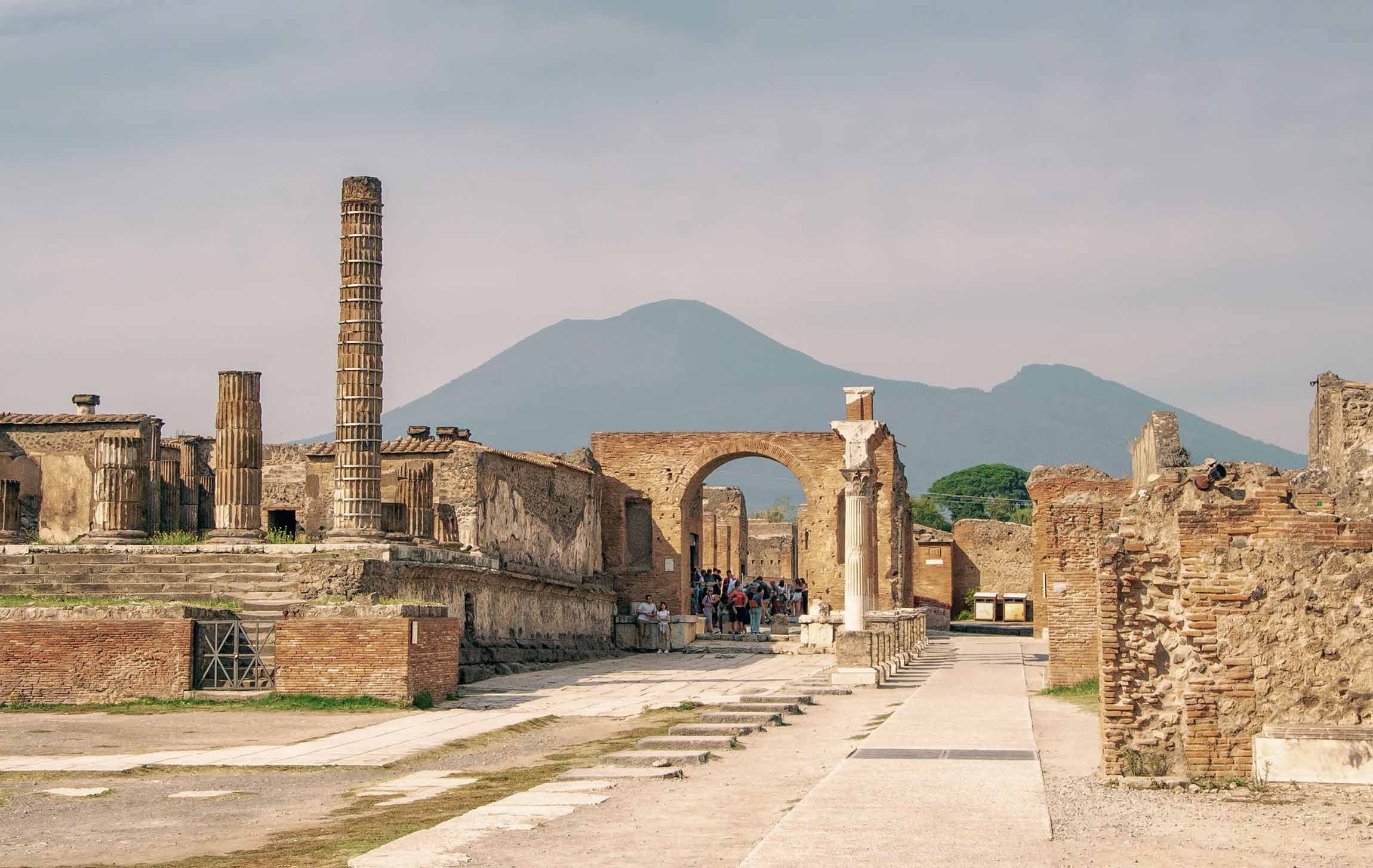
Dominating the Forum, the Temple of Jupiter—remodeled as a Capitolium after 80 BC—held statues of Jupiter, Juno, and Minerva on a high podium. More than a shrine, it proclaimed Pompeii’s Roman identity, power, and civic stature against Vesuvius’s dramatic backdrop
-
Stop 2. The Basilica
Pompeii’s Basilica served as the city’s law court and a bustling hub of commerce. Its dual-level design combined magistrates’ hearings with everyday business, revealing how legal authority and urban life met openly in the Forum’s civic and commercial heart. -
Stop 3. The Human Cost
This cast preserves the final position of a young girl, thought to have been between 13 and 19 years old. Her remains are a powerful reminder that behind Pompeii’s streets and monuments were real people whose lives ended suddenly in the eruption.
-
Stop 4. Temple of Apollo
The Sanctuary of Apollo reveals earlier sacred layers beneath the Forum: an archaic temple—crafted with Cuman influence—stood within a courtyard long before Rome reshaped the square. Later rebuilding and shops redefined boundaries, yet Apollo’s presence continued to anchor Pompeii’s civic heart. -
Stop 5. The Macellum
Facing the Forum, the Macellum served as Pompeii’s meat and fish market but also housed the Augustales after early imperial renovations. Its imposing walls mark a space where commerce, religious ritual, and imperial power converged at the city’s civic heart. -
Stop 6. The Eumachia building
Eumachia’s grand Forum building, financed by a wealthy textile entrepreneur and priestess, embodied family prestige, civic generosity, and imperial loyalty. Dedicated in her and her son’s names, its statues and façade proclaimed status and influence at Pompeii’s civic heart. -
Stop 7. Reading the Forum
Once a bustling civic heart, the Forum organized Pompeii’s religious, commercial, legal, and social life around one long square. Its temples, markets, and public buildings expressed Roman urban values, demonstrating how architecture shaped daily life and communal identity.
Gallery
Partners


About the Project
Project ETERNAL is a global heritage initiative from Antigravity x Insta360, created in partnership with CyArk and international heritage institutions. Using 360° imaging and 3D Gaussian Splatting, the project aims to preserve the memories of these places through immersive digital experiences. Using Antigravity’s A1 drone, CyArk documented the iconic Italian heritage sites of Pompeii and Civita di Bagnoregio. 3D Gaussian Splatting was then used to create immersive 3D digital environments of these locations to safeguard their shared legacy. CyArk’s Tapestry platform was used to create interactive narrative experiences for each location, allowing anyone to explore this iconic heritage up close.
Related Links
Credits
This project was made possible through the generous support of Antigravity. Special thanks to the Parco Archeologico di Pompei for their partnership and support.